AP Physics - Core Concept Cheat Sheet 
09: Gravitation and Circular Motion 
Key Physics Terms 
• Vector: A quantity that represents magnitude (size) and 
direction. It is usually represented with an arrow to indicate 
the direction; arrow may be drawn to scale. 
• Vector Component: The perpendicular parts into which a 
vector can be separated and that act in different directions 
from the vector. 
• Resultant: The result of adding two or more vectors; 
vector sum. 
• Vector Addition: The process of combining vectors; 
added tip to tail. 
• Force: A vector quantity that tends to accelerate an 
object; a push or a pull. 
• Centripetal Force: A center seeking force for an object 
moving in a circular path. 
• Centrifugal Force: An apparent, outward pointing force 
for an object moving in a circular path. A rotating object 
may seem to be pushed outward, but actually must be 
pulled inward in order to maintain any circular path. 
• Inverse Square Law: A relationship relating the strength 
of an effect to the inverse square of the distance away 
from the source. 
• Gravitational Field: The map of influence that a massive 
body extends into space around itself. 
• Linear Speed: Straight path distance moved per unit of 
time, also referred to as tangential speed. 
• Velocity: The distance an object travels per unit of time 
including its direction of motion. 
• Rotational Speed: Number of rotations or revolutions per 
unit of time, often revolutions per minute, rpm. 
• Normal Force: Support force that acts perpendicular to a 
surface. If the surface is horizontal, this force balances the 
weight of the object. If the surface is banked, the normal 
force is a reaction force, still perpendicular to the surface, 
to a component of the weight. 
• Universal Gravitational Constant: A proportionality 
constant that relates the strength of gravitational attraction 
in Newton’s law of universal gravitation. 
Variables Used 
• v = velocity (usually average velocity or constant velocity) 
• ac = centripetal acceleration 
• Fg = force from gravity 
• Fc = centripetal force 
• Δ = change in 
• θ = angle 
• m = mass 
• d = distance 
Key Formulas 
• Pythagorean Theorem: c2 = a2 + b2 
• Sin θ = opp / hyp 
• Cos θ = adj / hyp 
• Tan θ = opp / adj 
• Fnet = ma 
• Fg = Gm1m2 / d2 
• G=6.67 x 10⁻¹¹ Nm2/ kg2 
• ac = v2 / r 
• Fc = mv2 / r 
Key Metric Units 
• Velocity: m/s 
• Linear speed: m/s 
• Rotational speed: revolutions per unit of time 
• Distance: meters, m 
• Time: seconds, s 
• Acceleration (linear or centripetal): m/s2 
• Force (gravitational, centripetal, etc): Newton, N 
• Mass: kilograms, kg 
Weightlessness 
• Weightlessness: Astronauts “floating” in space may appear 
to be weightless. However, the pull from gravity definitely 
still acts on them. If it didn’t, their inertia would carry them 
off in a straight line never to return to the earth. Instead, 
the pull from gravity acts as a centripetal force to maintain 
their orbit about the earth. 
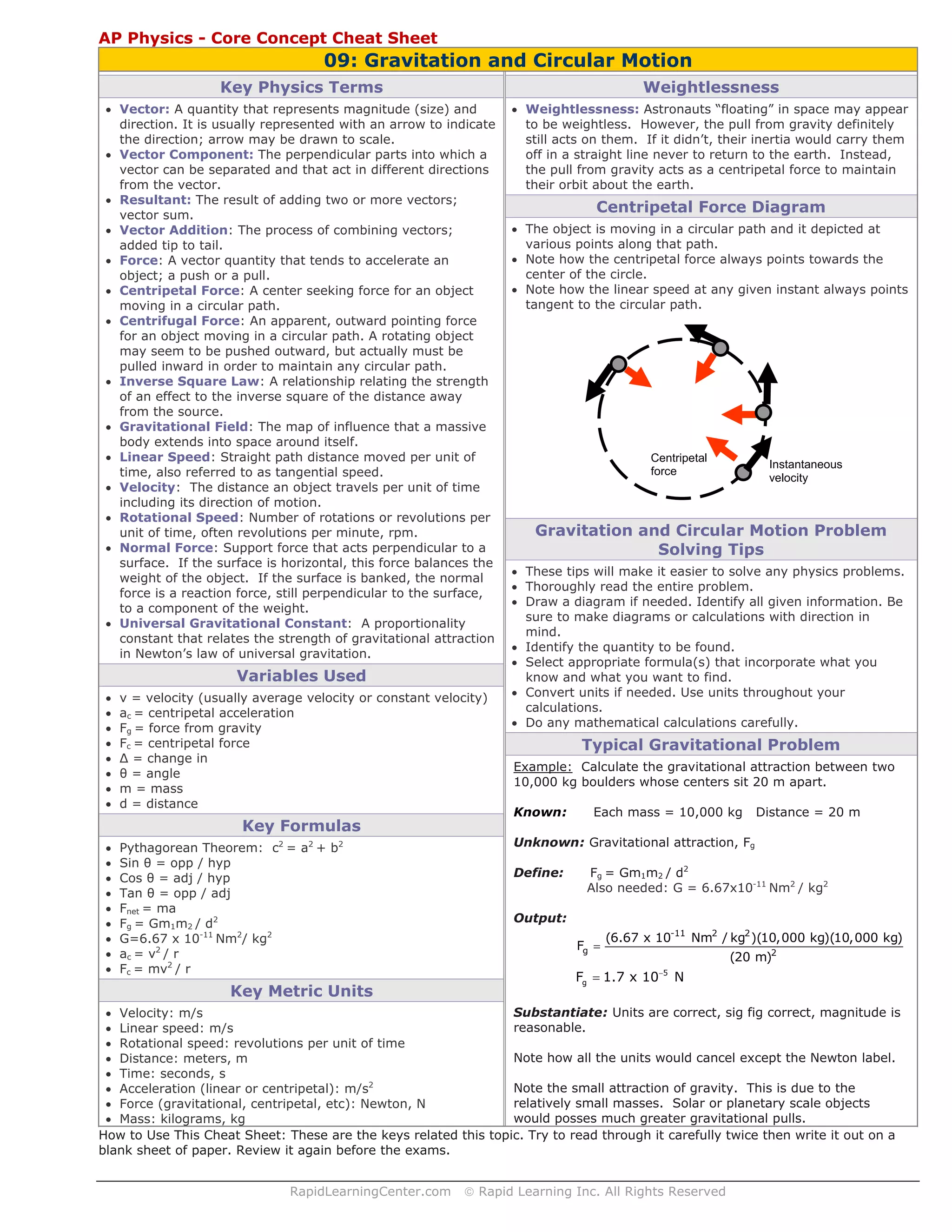
Centripetal Force Diagram 
• The object is moving in a circular path and it depicted at 
various points along that path. 
• Note how the centripetal force always points towards the 
center of the circle. 
• Note how the linear speed at any given instant always points 
tangent to the circular path. 
Instantaneous 
velocity 
Centripetal 
force 
Gravitation and Circular Motion Problem 
Solving Tips 
• These tips will make it easier to solve any physics problems. 
• Thoroughly read the entire problem. 
• Draw a diagram if needed. Identify all given information. Be 
sure to make diagrams or calculations with direction in 
mind. 
• Identify the quantity to be found. 
• Select appropriate formula(s) that incorporate what you 
know and what you want to find. 
• Convert units if needed. Use units throughout your 
calculations. 
• Do any mathematical calculations carefully. 
Typical Gravitational Problem 
Example: Calculate the gravitational attraction between two 
10,000 kg boulders whose centers sit 20 m apart. 
Known: Each mass = 10,000 kg Distance = 20 m 
Unknown: Gravitational attraction, Fg 
Define: Fg = Gm1m2 / d2 
Also needed: G = 6.67x10⁻¹¹ Nm2 / kg2 
Output: 
-11 2 2 
(6.67 x 10 Nm F / kg )(10,000 kg)(10,000 kg) 
g 2 
gF = 1.7 x 10− N 
RapidLearningCenter.com © Rapid Learning Inc. All Rights Reserved 
(20 m) 
= 
5 
Substantiate: Units are correct, sig fig correct, magnitude is 
reasonable. 
Note how all the units would cancel except the Newton label. 
Note the small attraction of gravity. This is due to the 
relatively small masses. Solar or planetary scale objects 
would posses much greater gravitational pulls. 
How to Use This Cheat Sheet: These are the keys related this topic. Try to read through it carefully twice then write it out on a 
blank sheet of paper. Review it again before the exams.

Circular Motion & Gravitation Cheat sheet

  • 1.
    AP Physics -Core Concept Cheat Sheet 09: Gravitation and Circular Motion Key Physics Terms • Vector: A quantity that represents magnitude (size) and direction. It is usually represented with an arrow to indicate the direction; arrow may be drawn to scale. • Vector Component: The perpendicular parts into which a vector can be separated and that act in different directions from the vector. • Resultant: The result of adding two or more vectors; vector sum. • Vector Addition: The process of combining vectors; added tip to tail. • Force: A vector quantity that tends to accelerate an object; a push or a pull. • Centripetal Force: A center seeking force for an object moving in a circular path. • Centrifugal Force: An apparent, outward pointing force for an object moving in a circular path. A rotating object may seem to be pushed outward, but actually must be pulled inward in order to maintain any circular path. • Inverse Square Law: A relationship relating the strength of an effect to the inverse square of the distance away from the source. • Gravitational Field: The map of influence that a massive body extends into space around itself. • Linear Speed: Straight path distance moved per unit of time, also referred to as tangential speed. • Velocity: The distance an object travels per unit of time including its direction of motion. • Rotational Speed: Number of rotations or revolutions per unit of time, often revolutions per minute, rpm. • Normal Force: Support force that acts perpendicular to a surface. If the surface is horizontal, this force balances the weight of the object. If the surface is banked, the normal force is a reaction force, still perpendicular to the surface, to a component of the weight. • Universal Gravitational Constant: A proportionality constant that relates the strength of gravitational attraction in Newton’s law of universal gravitation. Variables Used • v = velocity (usually average velocity or constant velocity) • ac = centripetal acceleration • Fg = force from gravity • Fc = centripetal force • Δ = change in • θ = angle • m = mass • d = distance Key Formulas • Pythagorean Theorem: c2 = a2 + b2 • Sin θ = opp / hyp • Cos θ = adj / hyp • Tan θ = opp / adj • Fnet = ma • Fg = Gm1m2 / d2 • G=6.67 x 10⁻¹¹ Nm2/ kg2 • ac = v2 / r • Fc = mv2 / r Key Metric Units • Velocity: m/s • Linear speed: m/s • Rotational speed: revolutions per unit of time • Distance: meters, m • Time: seconds, s • Acceleration (linear or centripetal): m/s2 • Force (gravitational, centripetal, etc): Newton, N • Mass: kilograms, kg Weightlessness • Weightlessness: Astronauts “floating” in space may appear to be weightless. However, the pull from gravity definitely still acts on them. If it didn’t, their inertia would carry them off in a straight line never to return to the earth. Instead, the pull from gravity acts as a centripetal force to maintain their orbit about the earth. Centripetal Force Diagram • The object is moving in a circular path and it depicted at various points along that path. • Note how the centripetal force always points towards the center of the circle. • Note how the linear speed at any given instant always points tangent to the circular path. Instantaneous velocity Centripetal force Gravitation and Circular Motion Problem Solving Tips • These tips will make it easier to solve any physics problems. • Thoroughly read the entire problem. • Draw a diagram if needed. Identify all given information. Be sure to make diagrams or calculations with direction in mind. • Identify the quantity to be found. • Select appropriate formula(s) that incorporate what you know and what you want to find. • Convert units if needed. Use units throughout your calculations. • Do any mathematical calculations carefully. Typical Gravitational Problem Example: Calculate the gravitational attraction between two 10,000 kg boulders whose centers sit 20 m apart. Known: Each mass = 10,000 kg Distance = 20 m Unknown: Gravitational attraction, Fg Define: Fg = Gm1m2 / d2 Also needed: G = 6.67x10⁻¹¹ Nm2 / kg2 Output: -11 2 2 (6.67 x 10 Nm F / kg )(10,000 kg)(10,000 kg) g 2 gF = 1.7 x 10− N RapidLearningCenter.com © Rapid Learning Inc. All Rights Reserved (20 m) = 5 Substantiate: Units are correct, sig fig correct, magnitude is reasonable. Note how all the units would cancel except the Newton label. Note the small attraction of gravity. This is due to the relatively small masses. Solar or planetary scale objects would posses much greater gravitational pulls. How to Use This Cheat Sheet: These are the keys related this topic. Try to read through it carefully twice then write it out on a blank sheet of paper. Review it again before the exams.