Presented By -
Debolina Choudhury
Neha Rusia
Nidhi Kompal
Rachit Prasad
Saptarshi Ray
Shriprada C
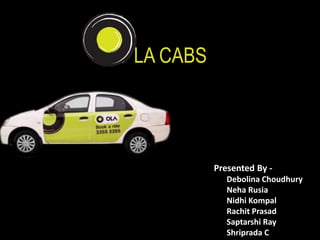
LA CABS
It was founded on 3 December 2010 by Anshul Gupta
(currently CEO) and Ankit Bhati
Ola started as an online cab aggregator in Mumbai, now
based out of Bangalore and is among the fastest
growing businesses in India
Ola cabs has expanded to a network of more than
200,000 cars across 85 cities. In November 2014
Ola expanded to incorporate autos in Bengaluru. Ola
Auto expanded to other cities
like Delhi, Pune and Chennai.
Meru Cabs was one of the first companies to launch metered
"Radio cabs" in India under its brand "Meru."
Meru Cabs has grown exponentially of fleet size and geographical
presence. Customers benefit from a relaxed commute in a well
equipped, air-conditioned cab.
Meru Cabs launched in Mumbai with 45 cabs in 2007; started
operations in 2008 at Delhi, Hyderabad & Bengaluru. It extended
its services Jaipur & Ahmedabad in 2013 and Chennai by March
2014.
Serves more than 1.8 million passengers its also 3rd largest "Radio
Taxi" company in the world
SWOT ANALYSIS
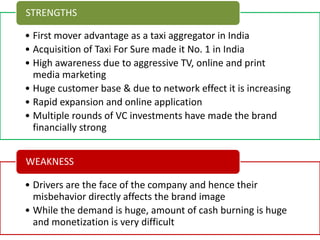
• First mover advantage as a taxi aggregator in India
• Acquisition of Taxi For Sure made it No. 1 in India
• High awareness due to aggressive TV, online and print
media marketing
• Huge customer base & due to network effect it is increasing
• Rapid expansion and online application
• Multiple rounds of VC investments have made the brand
financially strong
STRENGTHS
• Drivers are the face of the company and hence their
misbehavior directly affects the brand image
• While the demand is huge, amount of cash burning is huge
and monetization is very difficult
WEAKNESS
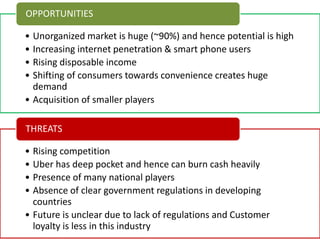
• Unorganized market is huge (~90%) and hence potential is high
• Increasing internet penetration & smart phone users
• Rising disposable income
• Shifting of consumers towards convenience creates huge
demand
• Acquisition of smaller players
OPPORTUNITIES
• Rising competition
• Uber has deep pocket and hence can burn cash heavily
• Presence of many national players
• Absence of clear government regulations in developing
countries
• Future is unclear due to lack of regulations and Customer
loyalty is less in this industry
THREATS
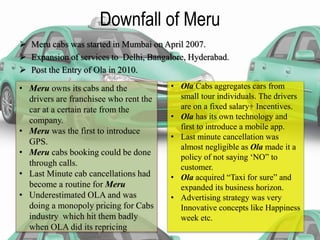
Downfall of Meru
 Meru cabs was started in Mumbai on April 2007.
 Expansion of services to Delhi, Bangalore, Hyderabad.
 Post the Entry of Ola in 2010.
• Meru owns its cabs and the
drivers are franchisee who rent the
car at a certain rate from the
company.
• Meru was the first to introduce
GPS.
• Meru cabs booking could be done
through calls.
• Last Minute cab cancellations had
become a routine for Meru
• Underestimated OLA and was
doing a monopoly pricing for Cabs
industry which hit them badly
when OLA did its repricing
• Ola Cabs aggregates cars from
small tour individuals. The drivers
are on a fixed salary+ Incentives.
• Ola has its own technology and
first to introduce a mobile app.
• Last minute cancellation was
almost negligible as Ola made it a
policy of not saying ‘NO” to
customer.
• Ola acquired “Taxi for sure” and
expanded its business horizon.
• Advertising strategy was very
Innovative concepts like Happiness
week etc.
Strategies used by OLA
Only App service.
Partnership with private taxi owners, hence low
investment.
Variable benefits for drivers of OLA.
Works with leading financial institutions that provide
loans to help prospective drivers buy their cars outright.
Offers training to ensure drivers are equipped to deliver a
quality and safe experience for passengers.
Offers three different tiers of car service to suit different
budgets: luxury sedan models, mid-range, and its Ola
Mini range.
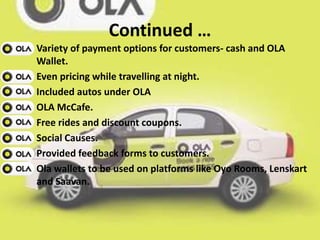
Continued …
Variety of payment options for customers- cash and OLA
Wallet.
Even pricing while travelling at night.
Included autos under OLA
OLA McCafe.
Free rides and discount coupons.
Social Causes.
Provided feedback forms to customers.
Ola wallets to be used on platforms like Oyo Rooms, Lenskart
and Saavan.
FUTURE PROSPECTS OF OLA
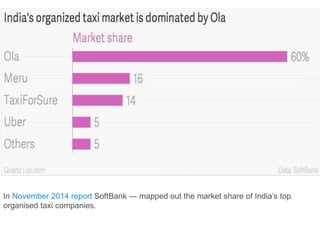
In November 2014 report SoftBank — mapped out the market share of India’s top
organised taxi companies.
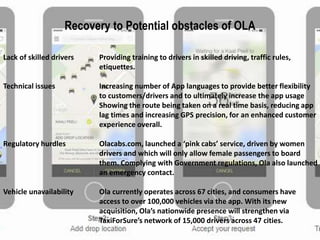
Providing training to drivers in skilled driving, traffic rules,
etiquettes.
Increasing number of App languages to provide better flexibility
to customers/drivers and to ultimately increase the app usage
Showing the route being taken on a real time basis, reducing app
lag times and increasing GPS precision, for an enhanced customer
experience overall.
Olacabs.com, launched a ‘pink cabs’ service, driven by women
drivers and which will only allow female passengers to board
them. Complying with Government regulations, Ola also launched
an emergency contact.
Ola currently operates across 67 cities, and consumers have
access to over 100,000 vehicles via the app. With its new
acquisition, Ola’s nationwide presence will strengthen via
TaxiForSure’s network of 15,000 drivers across 47 cities.
Lack of skilled drivers
Technical issues
Regulatory hurdles
Vehicle unavailability
Recovery to Potential obstacles of OLA
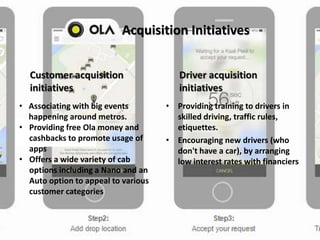
• Associating with big events
happening around metros.
• Providing free Ola money and
cashbacks to promote usage of
apps
• Offers a wide variety of cab
options including a Nano and an
Auto option to appeal to various
customer categories
Acquisition Initiatives
• Providing training to drivers in
skilled driving, traffic rules,
etiquettes.
• Encouraging new drivers (who
don't have a car), by arranging
low interest rates with financiers
Customer acquisition
initiatives
Driver acquisition
initiatives
OLA Cabs
OLA Cabs

OLA Cabs

  • 1.
    Presented By - DebolinaChoudhury Neha Rusia Nidhi Kompal Rachit Prasad Saptarshi Ray Shriprada C LA CABS
  • 3.
    It was foundedon 3 December 2010 by Anshul Gupta (currently CEO) and Ankit Bhati Ola started as an online cab aggregator in Mumbai, now based out of Bangalore and is among the fastest growing businesses in India Ola cabs has expanded to a network of more than 200,000 cars across 85 cities. In November 2014 Ola expanded to incorporate autos in Bengaluru. Ola Auto expanded to other cities like Delhi, Pune and Chennai.
  • 4.
    Meru Cabs wasone of the first companies to launch metered "Radio cabs" in India under its brand "Meru." Meru Cabs has grown exponentially of fleet size and geographical presence. Customers benefit from a relaxed commute in a well equipped, air-conditioned cab. Meru Cabs launched in Mumbai with 45 cabs in 2007; started operations in 2008 at Delhi, Hyderabad & Bengaluru. It extended its services Jaipur & Ahmedabad in 2013 and Chennai by March 2014. Serves more than 1.8 million passengers its also 3rd largest "Radio Taxi" company in the world
  • 5.
  • 6.
    • First moveradvantage as a taxi aggregator in India • Acquisition of Taxi For Sure made it No. 1 in India • High awareness due to aggressive TV, online and print media marketing • Huge customer base & due to network effect it is increasing • Rapid expansion and online application • Multiple rounds of VC investments have made the brand financially strong STRENGTHS • Drivers are the face of the company and hence their misbehavior directly affects the brand image • While the demand is huge, amount of cash burning is huge and monetization is very difficult WEAKNESS
  • 7.
    • Unorganized marketis huge (~90%) and hence potential is high • Increasing internet penetration & smart phone users • Rising disposable income • Shifting of consumers towards convenience creates huge demand • Acquisition of smaller players OPPORTUNITIES • Rising competition • Uber has deep pocket and hence can burn cash heavily • Presence of many national players • Absence of clear government regulations in developing countries • Future is unclear due to lack of regulations and Customer loyalty is less in this industry THREATS
  • 8.
    Downfall of Meru Meru cabs was started in Mumbai on April 2007.  Expansion of services to Delhi, Bangalore, Hyderabad.  Post the Entry of Ola in 2010. • Meru owns its cabs and the drivers are franchisee who rent the car at a certain rate from the company. • Meru was the first to introduce GPS. • Meru cabs booking could be done through calls. • Last Minute cab cancellations had become a routine for Meru • Underestimated OLA and was doing a monopoly pricing for Cabs industry which hit them badly when OLA did its repricing • Ola Cabs aggregates cars from small tour individuals. The drivers are on a fixed salary+ Incentives. • Ola has its own technology and first to introduce a mobile app. • Last minute cancellation was almost negligible as Ola made it a policy of not saying ‘NO” to customer. • Ola acquired “Taxi for sure” and expanded its business horizon. • Advertising strategy was very Innovative concepts like Happiness week etc.
  • 13.
    Strategies used byOLA Only App service. Partnership with private taxi owners, hence low investment. Variable benefits for drivers of OLA. Works with leading financial institutions that provide loans to help prospective drivers buy their cars outright. Offers training to ensure drivers are equipped to deliver a quality and safe experience for passengers. Offers three different tiers of car service to suit different budgets: luxury sedan models, mid-range, and its Ola Mini range.
  • 14.
    Continued … Variety ofpayment options for customers- cash and OLA Wallet. Even pricing while travelling at night. Included autos under OLA OLA McCafe. Free rides and discount coupons. Social Causes. Provided feedback forms to customers. Ola wallets to be used on platforms like Oyo Rooms, Lenskart and Saavan.
  • 15.
  • 16.
    In November 2014report SoftBank — mapped out the market share of India’s top organised taxi companies.
  • 17.
    Providing training todrivers in skilled driving, traffic rules, etiquettes. Increasing number of App languages to provide better flexibility to customers/drivers and to ultimately increase the app usage Showing the route being taken on a real time basis, reducing app lag times and increasing GPS precision, for an enhanced customer experience overall. Olacabs.com, launched a ‘pink cabs’ service, driven by women drivers and which will only allow female passengers to board them. Complying with Government regulations, Ola also launched an emergency contact. Ola currently operates across 67 cities, and consumers have access to over 100,000 vehicles via the app. With its new acquisition, Ola’s nationwide presence will strengthen via TaxiForSure’s network of 15,000 drivers across 47 cities. Lack of skilled drivers Technical issues Regulatory hurdles Vehicle unavailability Recovery to Potential obstacles of OLA
  • 18.
    • Associating withbig events happening around metros. • Providing free Ola money and cashbacks to promote usage of apps • Offers a wide variety of cab options including a Nano and an Auto option to appeal to various customer categories Acquisition Initiatives • Providing training to drivers in skilled driving, traffic rules, etiquettes. • Encouraging new drivers (who don't have a car), by arranging low interest rates with financiers Customer acquisition initiatives Driver acquisition initiatives