BUSINESS MODEL CANVAS
OF UBER CAB
INTRODUCTION:
 UBER Technologies Inc. is the name of the company which uber operated.
It’s headquarter in San Francisco. Uber is essentially an “On-Demand”
Taxi Hailing Service using which people with smart phones to book a trip
in 3rd party private owned vehicle driven by owners helps of owners of
cars. As of last valuation the company operating in 58 Countries and 30
cities.
 Founder- Founded in 2009 by Travis Kalanick & Garrett Camp.
Value proposition
Minimum waiting time
Rating system
Easy transaction etc
Customer relationship
Social media
Customer support ,etc
Key
partners
Drivers
Investors
Key activities
Product
Driver
network
Channels
Websites
Mobile app
Key resources
Uber platform
Skilled driver
Customer segment
For user and driver
Revenue stream
Surge pricing
Km Basis, UberX,
Uber SUV, Uber
rideshare etc
Cost structure
Technological
infrastructure
salary
Business canvas model
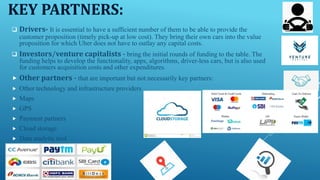
 Drivers- It is essential to have a sufficient number of them to be able to provide the
customer proposition (timely pick-up at low cost). They bring their own cars into the value
proposition for which Uber does not have to outlay any capital costs.
 Investors/venture capitalists - bring the initial rounds of funding to the table. The
funding helps to develop the functionality, apps, algorithms, driver-less cars, but is also used
for customers acquisition costs and other expenditures.
 Other partners - that are important but not necessarily key partners:
 Other technology and infrastructure providers
 Maps
 GPS
 Payment partners
 Cloud storage
 Data analytic tool

KEY PARTNERS:
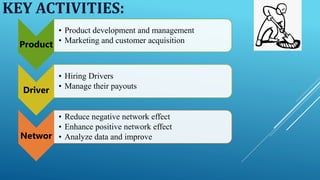
KEY ACTIVITIES:
Product
• Product development and management
• Marketing and customer acquisition
Driver
• Hiring Drivers
• Manage their payouts
Networ
• Reduce negative network effect
• Enhance positive network effect
• Analyze data and improve
KEY RESOURCES:
APP
Brand
CUSTOMER RELATIONSHIP:
CHANNELS:
Events
Website
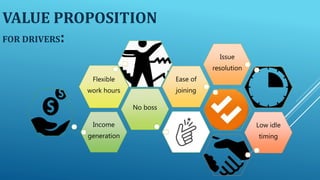
VALUE PROPOSITION
FOR DRIVERS:
Income
generation
No boss
Flexible
work hours
Ease of
joining
Issue
resolution
Low idle
timing
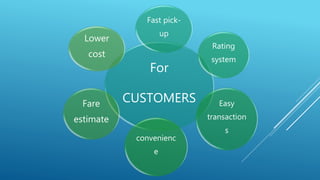
For
CUSTOMERS
Fast pick-
up
Rating
system
Easy
transaction
s
convenienc
e
Fare
estimate
Lower
cost
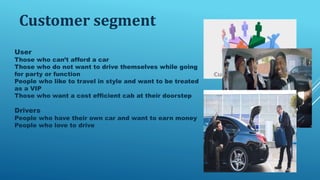
Customer segment
User
Those who can’t afford a car
Those who do not want to drive themselves while going
for party or function
People who like to travel in style and want to be treated
as a VIP
Those who want a cost efficient cab at their doorstep
Drivers
People who have their own car and want to earn money
People who love to drive
Cost structure
Uber’s cost element are:
Legal cases and settlement
costs
Transaction fees (Card
Payment charges)
Salaries for office staff
Expansion to more cities
and countries
Infrastructure costs
Customer support
Insurance cost
Revenue model
Surge Pricing
Uber X
Uber Taxi
Uber Black
Uber Cargo
Uber SUV
Uber pool
Thank you