
Introduction to the Definite Integral Unit 6 Lesson 2 E. Alexander Burt Potomac School
Riemann Sums We can approximate the area under a curve with rectangles.  Each rectangle has a base of  D x and a height of f(x)
The area under the curve is approximately the sum of the area of those rectangles
The more rectangles we sum (and the smaller  D x gets) the closer our approximation will get to the actual area.
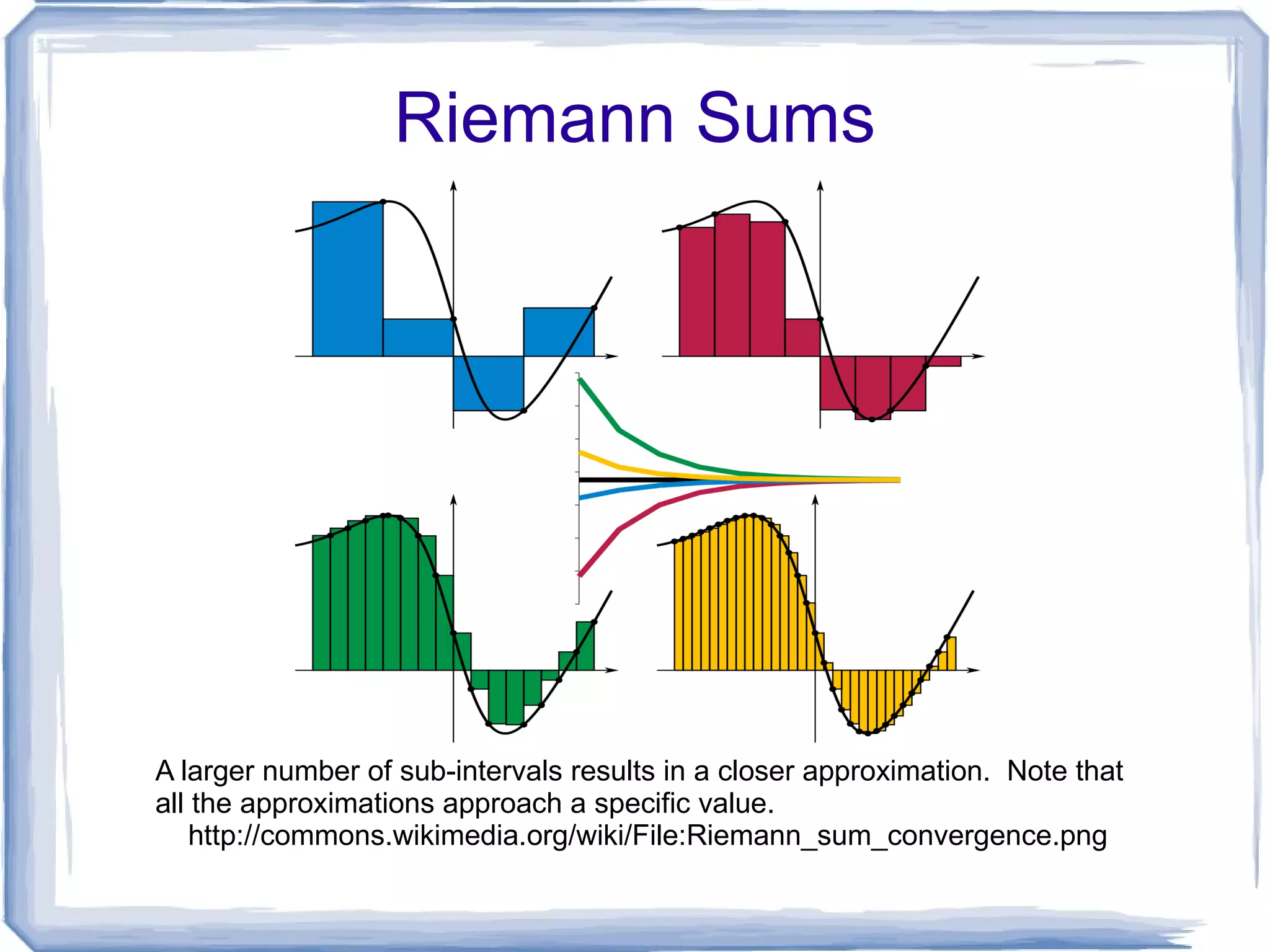
Riemann Sums A larger number of sub-intervals results in a closer approximation.  Note that all the approximations approach a specific value. http://commons.wikimedia.org/wiki/File:Riemann_sum_convergence.png
The Definite Integral If we had an infinite number of rectangles of width dx, the Riemann sum would “converge” to a specific value – the “definite integral” of f(x) for the interval a to b
Calculus Lawyer Talk:  if the function is continuous from a to b, the definite integral over the interval a to b exists.
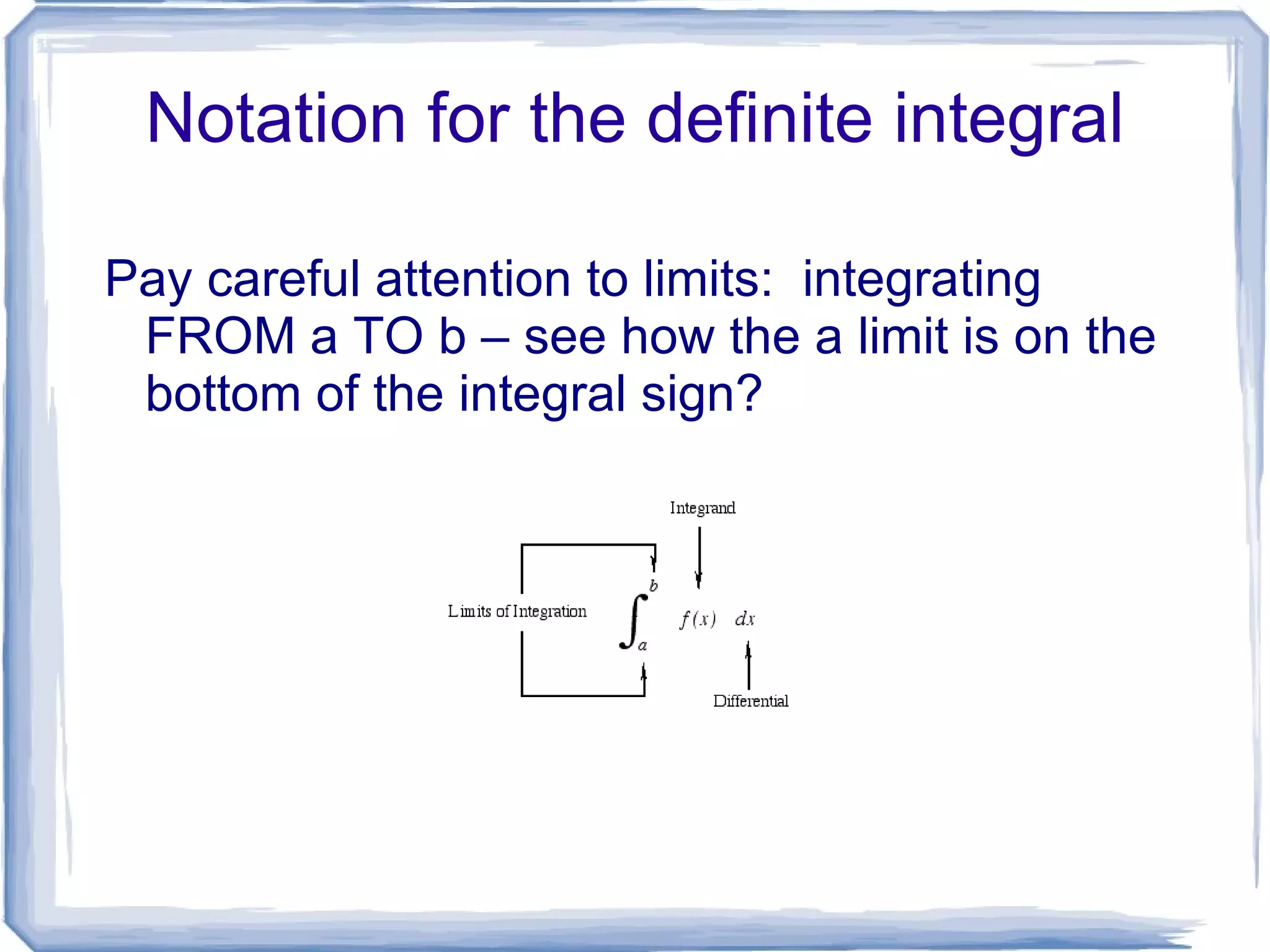
Notation for the definite integral Pay careful attention to limits:  integrating FROM a TO b – see how the a limit is on the bottom of the integral sign?
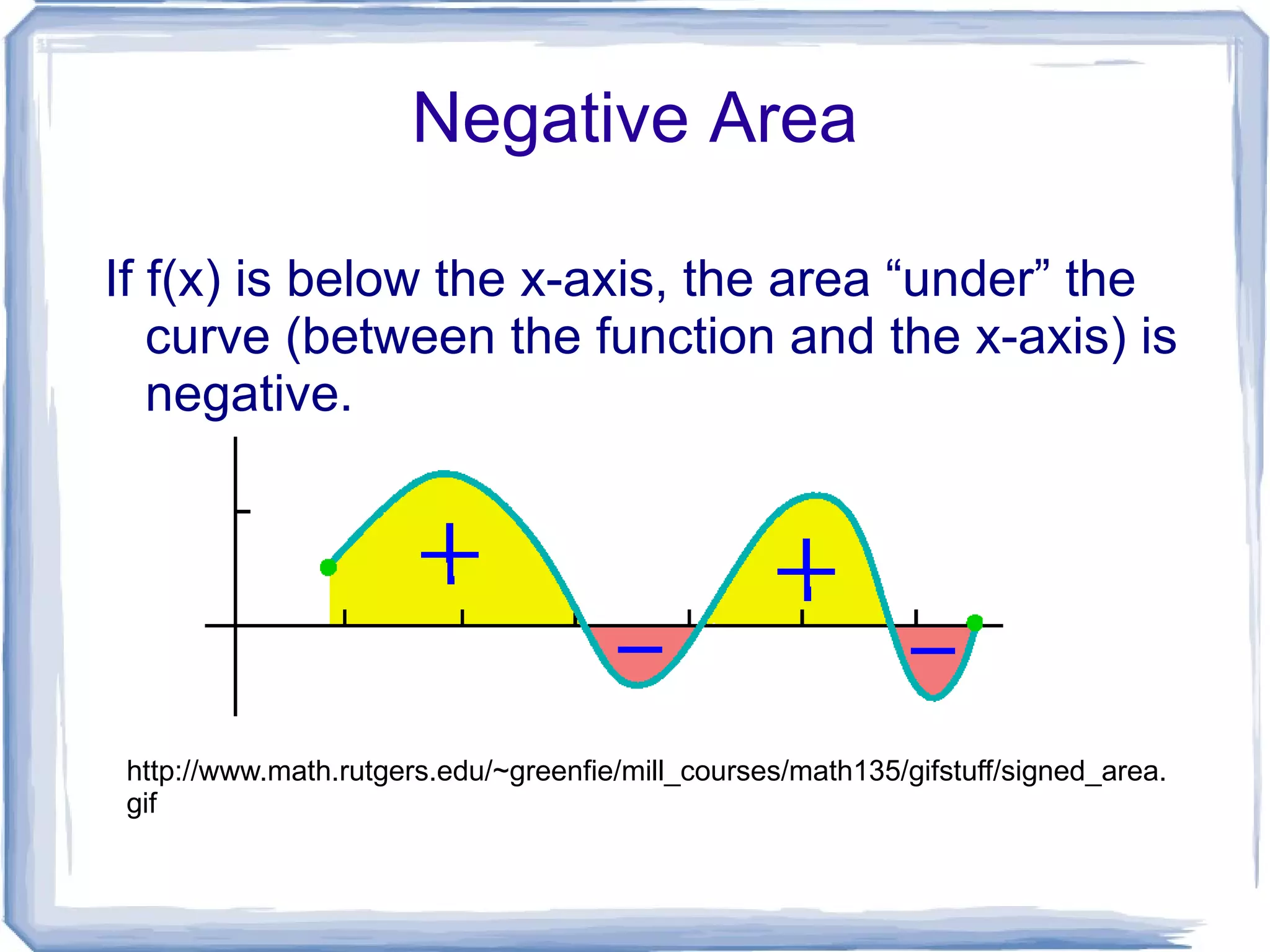
Negative Area If f(x) is below the x-axis, the area “under” the curve (between the function and the x-axis) is negative. http://www.math.rutgers.edu/~greenfie/mill_courses/math135/gifstuff/signed_area.gif

U6 Cn2 Definite Integrals Intro

  • 1.
    Introduction to theDefinite Integral Unit 6 Lesson 2 E. Alexander Burt Potomac School
  • 2.
    Riemann Sums Wecan approximate the area under a curve with rectangles. Each rectangle has a base of D x and a height of f(x)
  • 3.
    The area underthe curve is approximately the sum of the area of those rectangles
  • 4.
    The more rectangleswe sum (and the smaller D x gets) the closer our approximation will get to the actual area.
  • 5.
    Riemann Sums Alarger number of sub-intervals results in a closer approximation. Note that all the approximations approach a specific value. http://commons.wikimedia.org/wiki/File:Riemann_sum_convergence.png
  • 6.
    The Definite IntegralIf we had an infinite number of rectangles of width dx, the Riemann sum would “converge” to a specific value – the “definite integral” of f(x) for the interval a to b
  • 7.
    Calculus Lawyer Talk: if the function is continuous from a to b, the definite integral over the interval a to b exists.
  • 8.
    Notation for thedefinite integral Pay careful attention to limits: integrating FROM a TO b – see how the a limit is on the bottom of the integral sign?
  • 9.
    Negative Area Iff(x) is below the x-axis, the area “under” the curve (between the function and the x-axis) is negative. http://www.math.rutgers.edu/~greenfie/mill_courses/math135/gifstuff/signed_area.gif
  • 10.
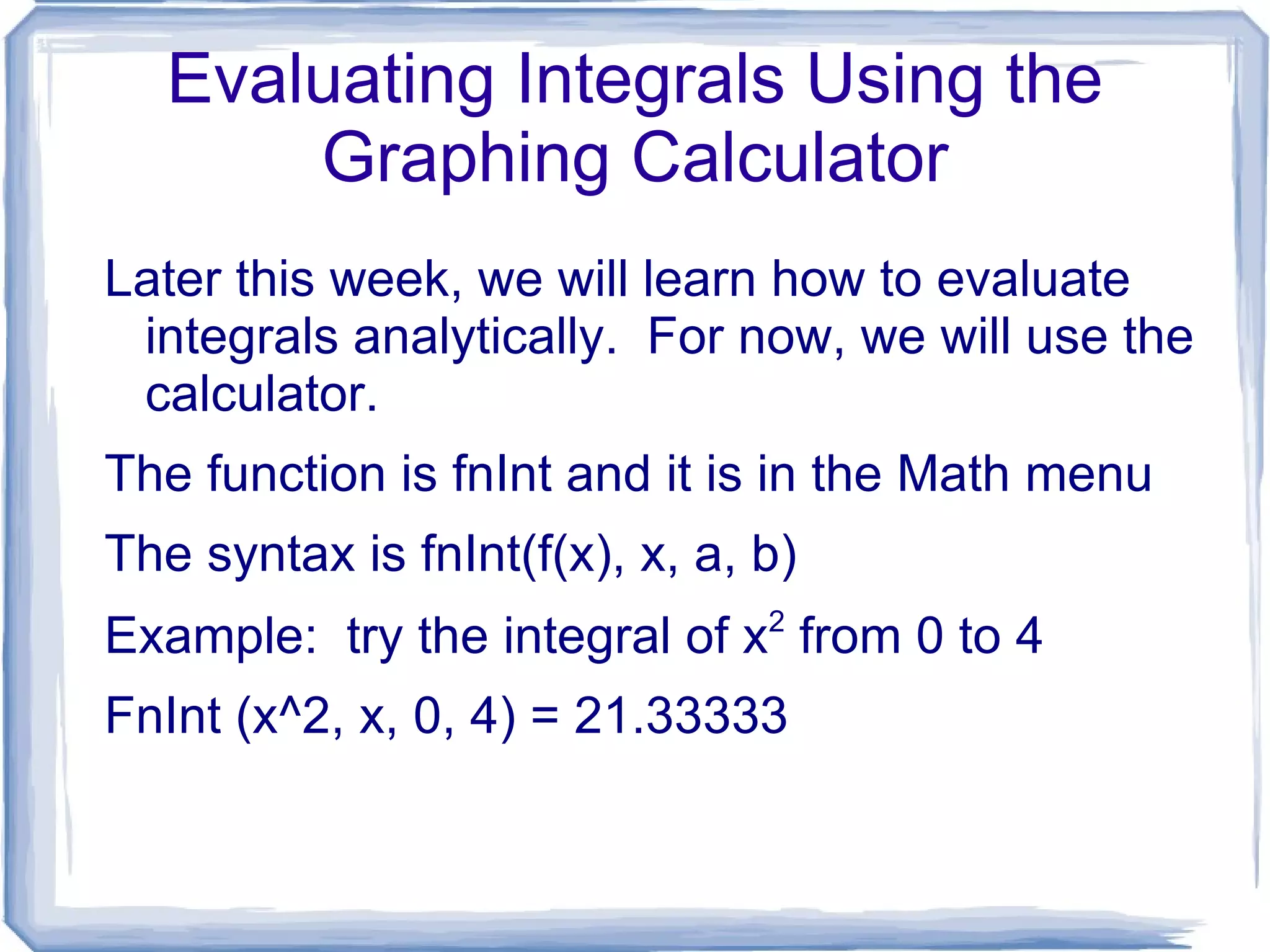
    Evaluating Integrals Usingthe Graphing Calculator Later this week, we will learn how to evaluate integrals analytically. For now, we will use the calculator.
  • 11.
    The function isfnInt and it is in the Math menu
  • 12.
    The syntax isfnInt(f(x), x, a, b)
  • 13.
    Example: trythe integral of x 2 from 0 to 4
  • 14.
    FnInt (x^2, x,0, 4) = 21.33333
  • 15.
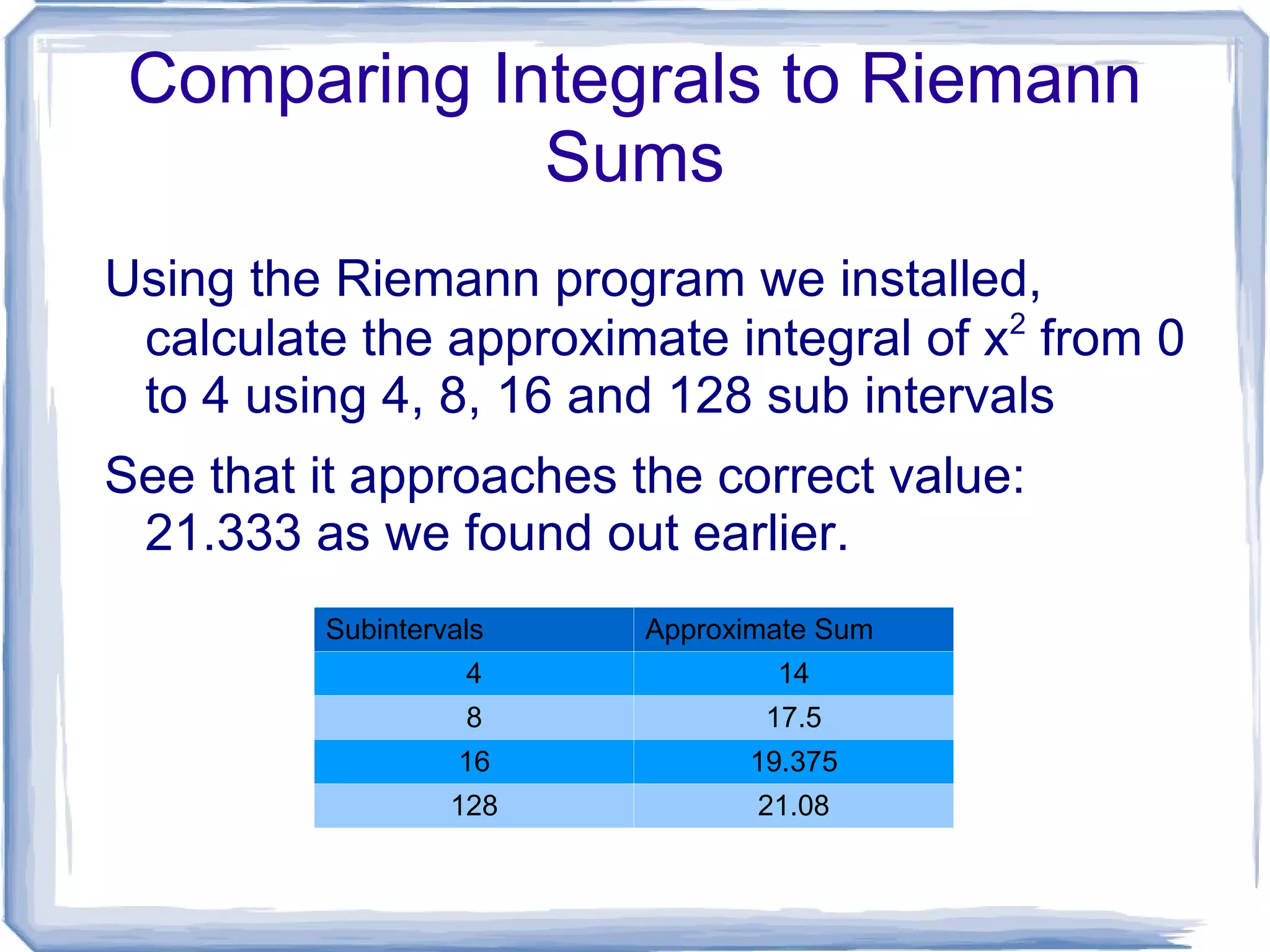
    Comparing Integrals toRiemann Sums Using the Riemann program we installed, calculate the approximate integral of x 2 from 0 to 4 using 4, 8, 16 and 128 sub intervals
  • 16.
    See that itapproaches the correct value: 21.333 as we found out earlier. Subintervals Approximate Sum 4 14 8 17.5 16 19.375 128 21.08
  • 17.
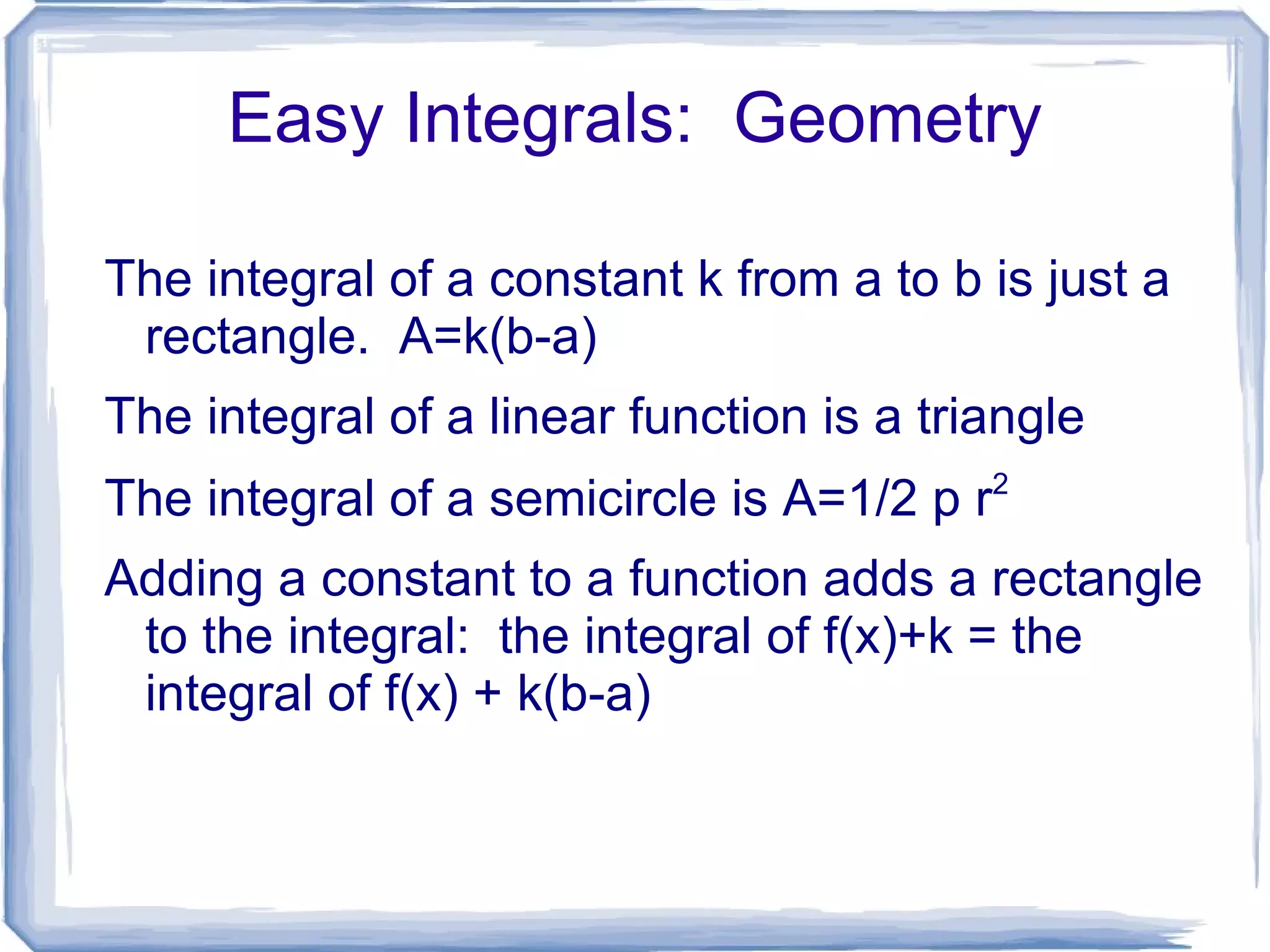
    Easy Integrals: Geometry The integral of a constant k from a to b is just a rectangle. A=k(b-a)
  • 18.
    The integral ofa linear function is a triangle
  • 19.
    The integral ofa semicircle is A=1/2 p r 2
  • 20.
    Adding a constantto a function adds a rectangle to the integral: the integral of f(x)+k = the integral of f(x) + k(b-a)