Introduction to Definite Integrals and Antiderivatives Unit 6 Lesson 3 E. Alexander Burt Potomac School
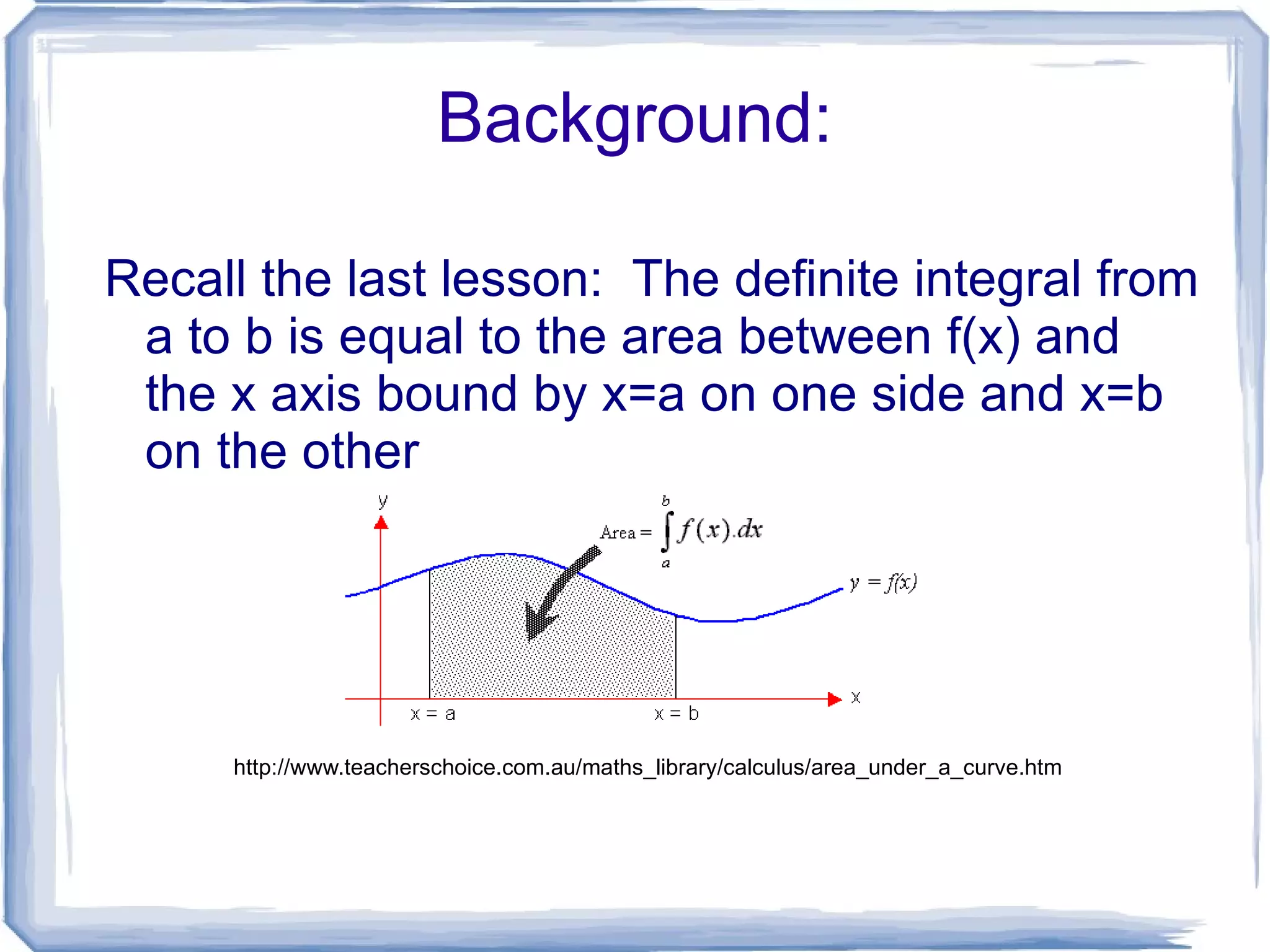
Background: Recall the last lesson:  The definite integral from a to b is equal to the area between f(x) and the x axis bound by x=a on one side and x=b on the other http://www.teacherschoice.com.au/maths_library/calculus/area_under_a_curve.htm
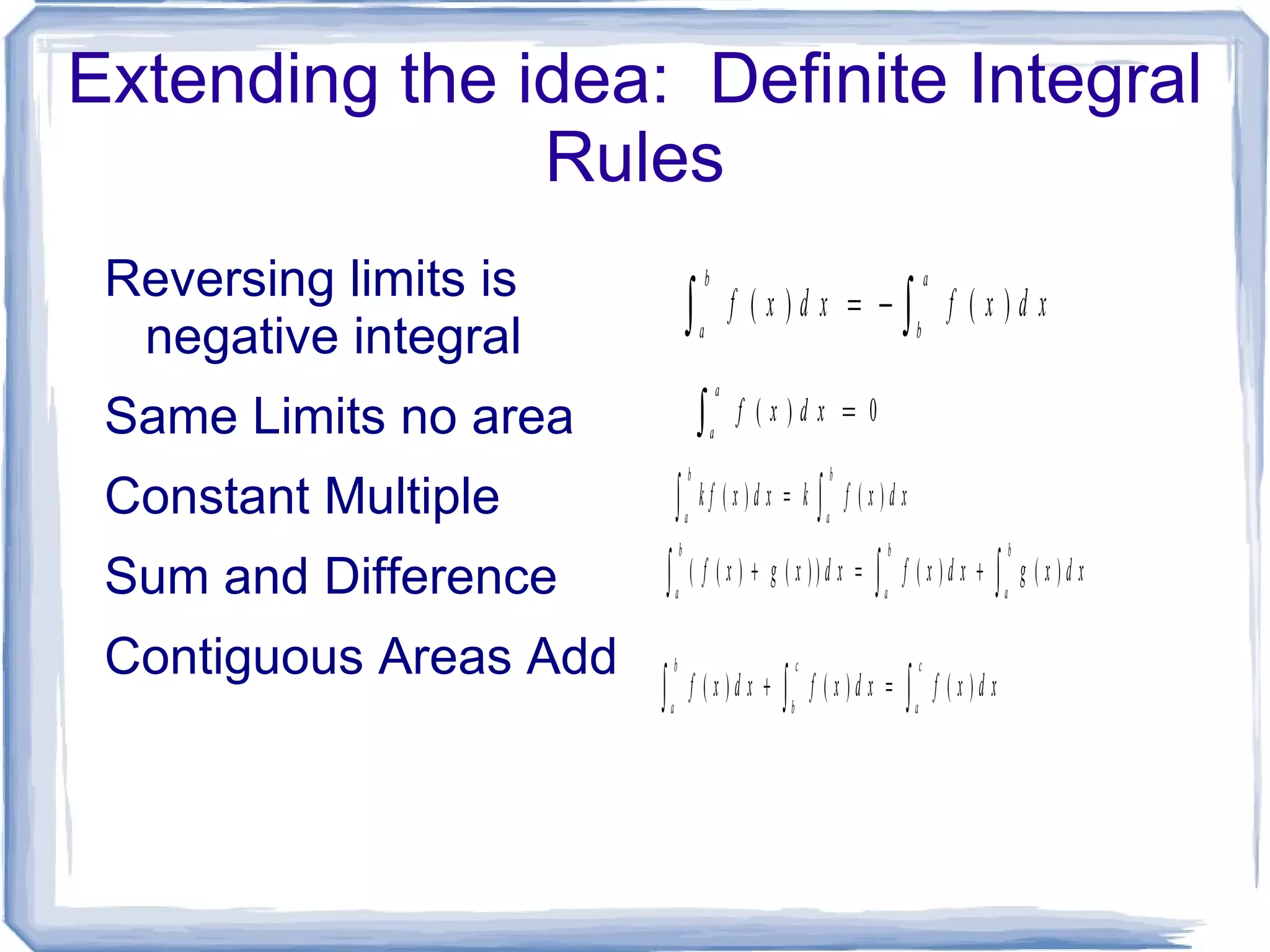
Extending the idea:  Definite Integral Rules Reversing limits is negative integral
Same Limits no area
Constant Multiple
Sum and Difference
Contiguous Areas Add

U6 Cn3 Def Int And Anti Der

  • 1.
    Introduction to DefiniteIntegrals and Antiderivatives Unit 6 Lesson 3 E. Alexander Burt Potomac School
  • 2.
    Background: Recall thelast lesson: The definite integral from a to b is equal to the area between f(x) and the x axis bound by x=a on one side and x=b on the other http://www.teacherschoice.com.au/maths_library/calculus/area_under_a_curve.htm
  • 3.
    Extending the idea: Definite Integral Rules Reversing limits is negative integral
  • 4.
  • 5.
  • 6.
  • 7.
  • 8.
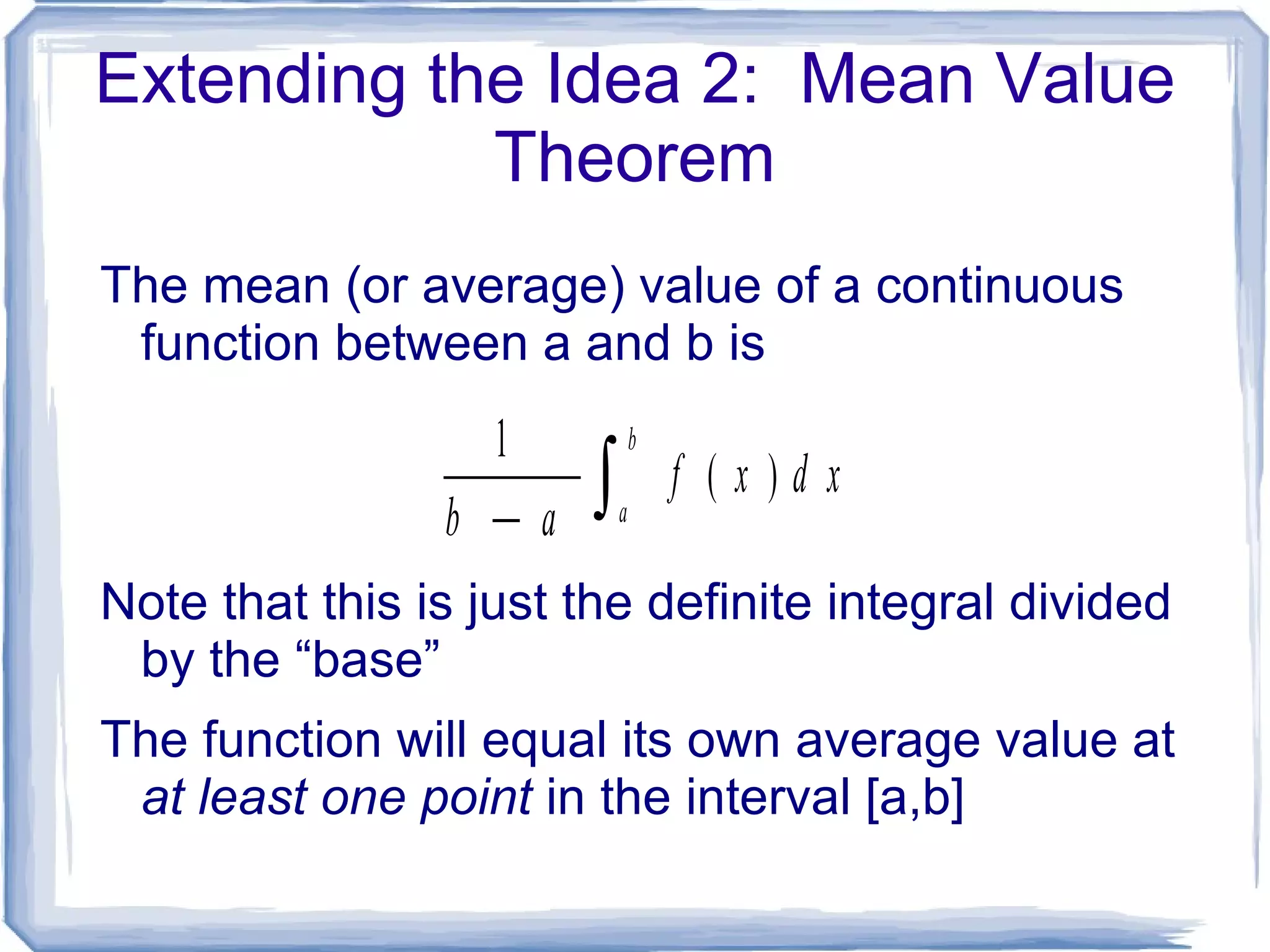
    Extending the Idea2: Mean Value Theorem The mean (or average) value of a continuous function between a and b is Note that this is just the definite integral divided by the “base”
  • 9.
    The function willequal its own average value at at least one point in the interval [a,b]
  • 10.
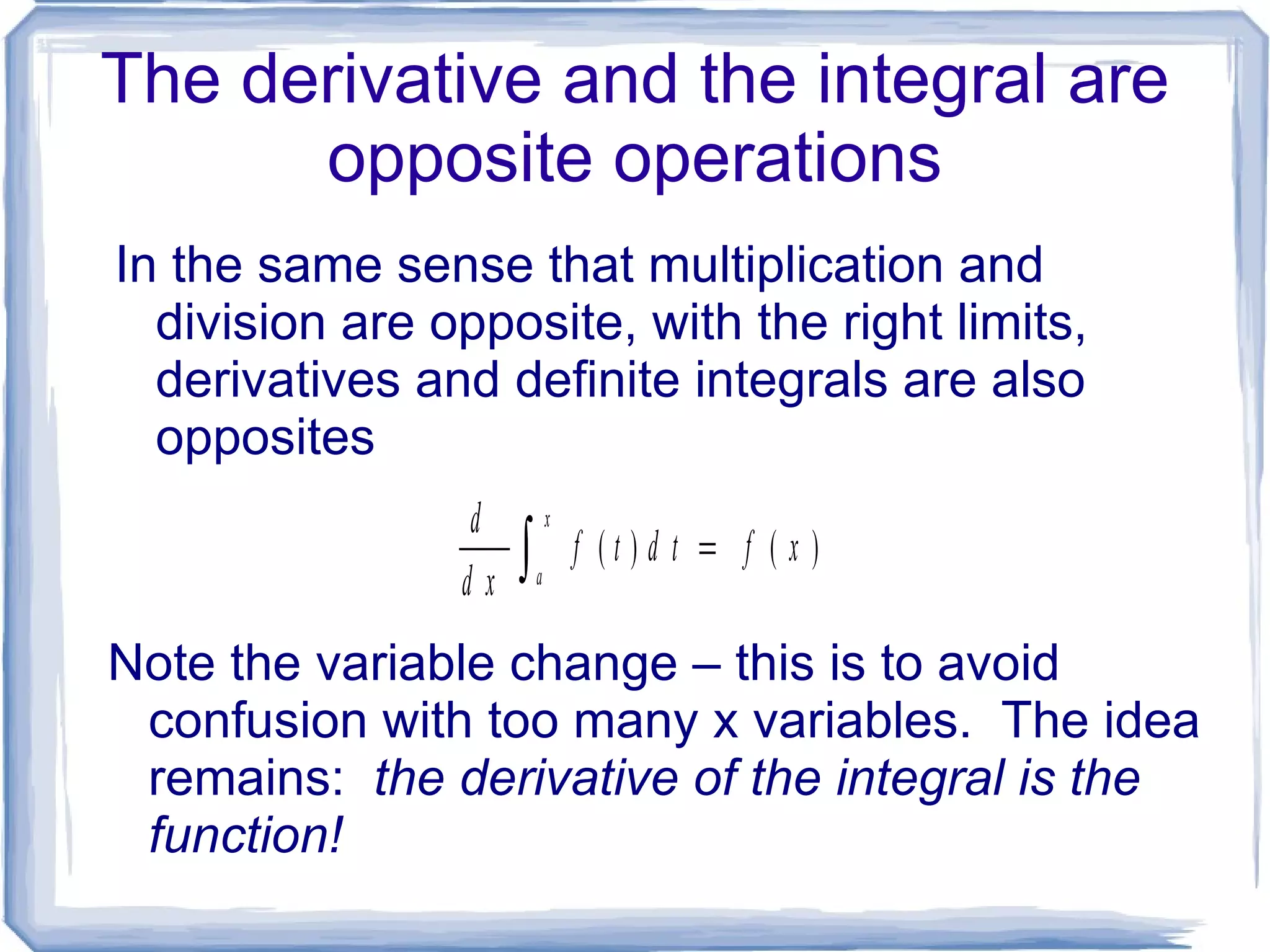
    The derivative andthe integral are opposite operations In the same sense that multiplication and division are opposite, with the right limits, derivatives and definite integrals are also opposites Note the variable change – this is to avoid confusion with too many x variables. The idea remains: the derivative of the integral is the function!
  • 11.
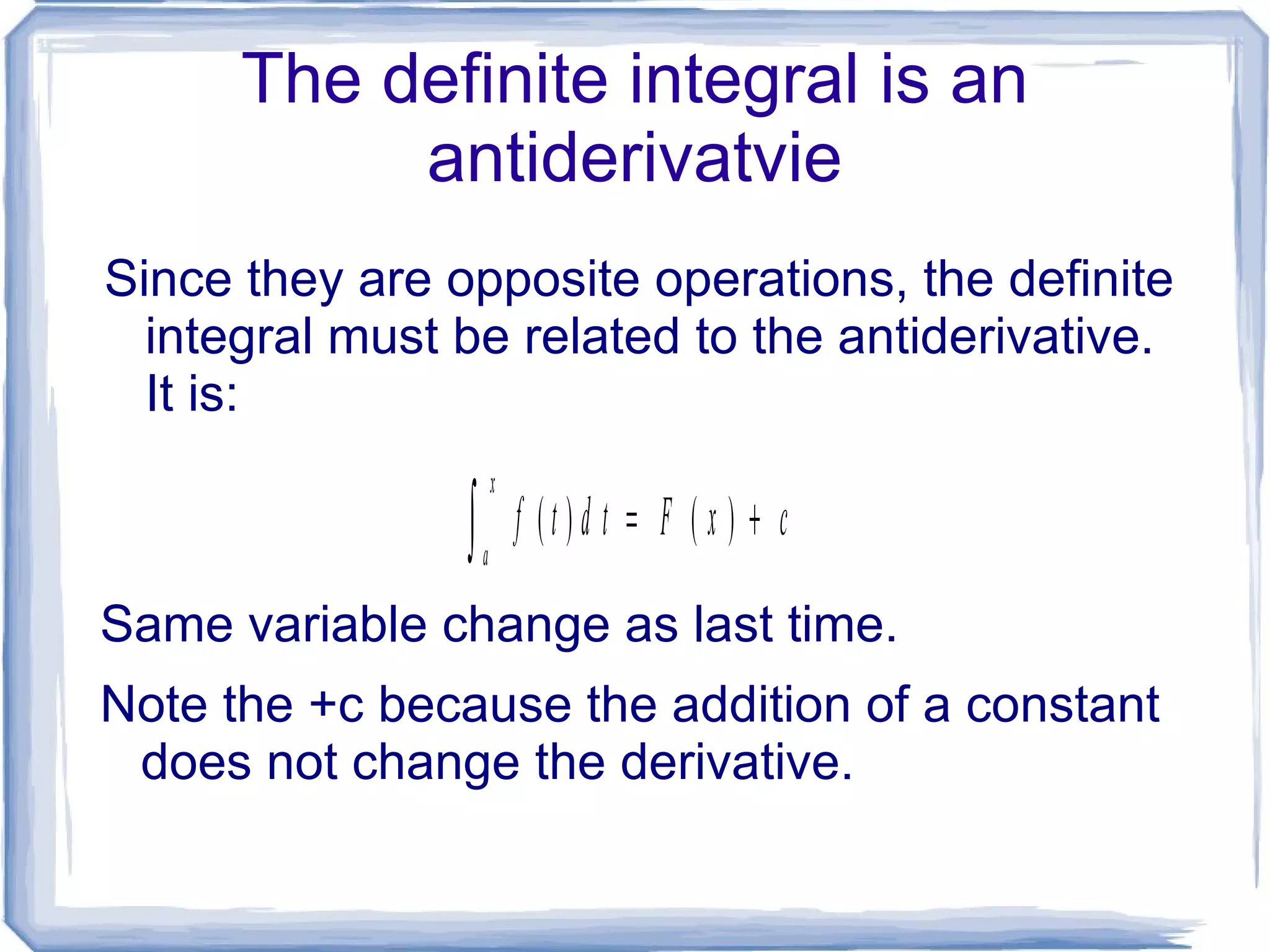
    The definite integralis an antiderivatvie Since they are opposite operations, the definite integral must be related to the antiderivative. It is: Same variable change as last time.
  • 12.
    Note the +cbecause the addition of a constant does not change the derivative.
  • 13.
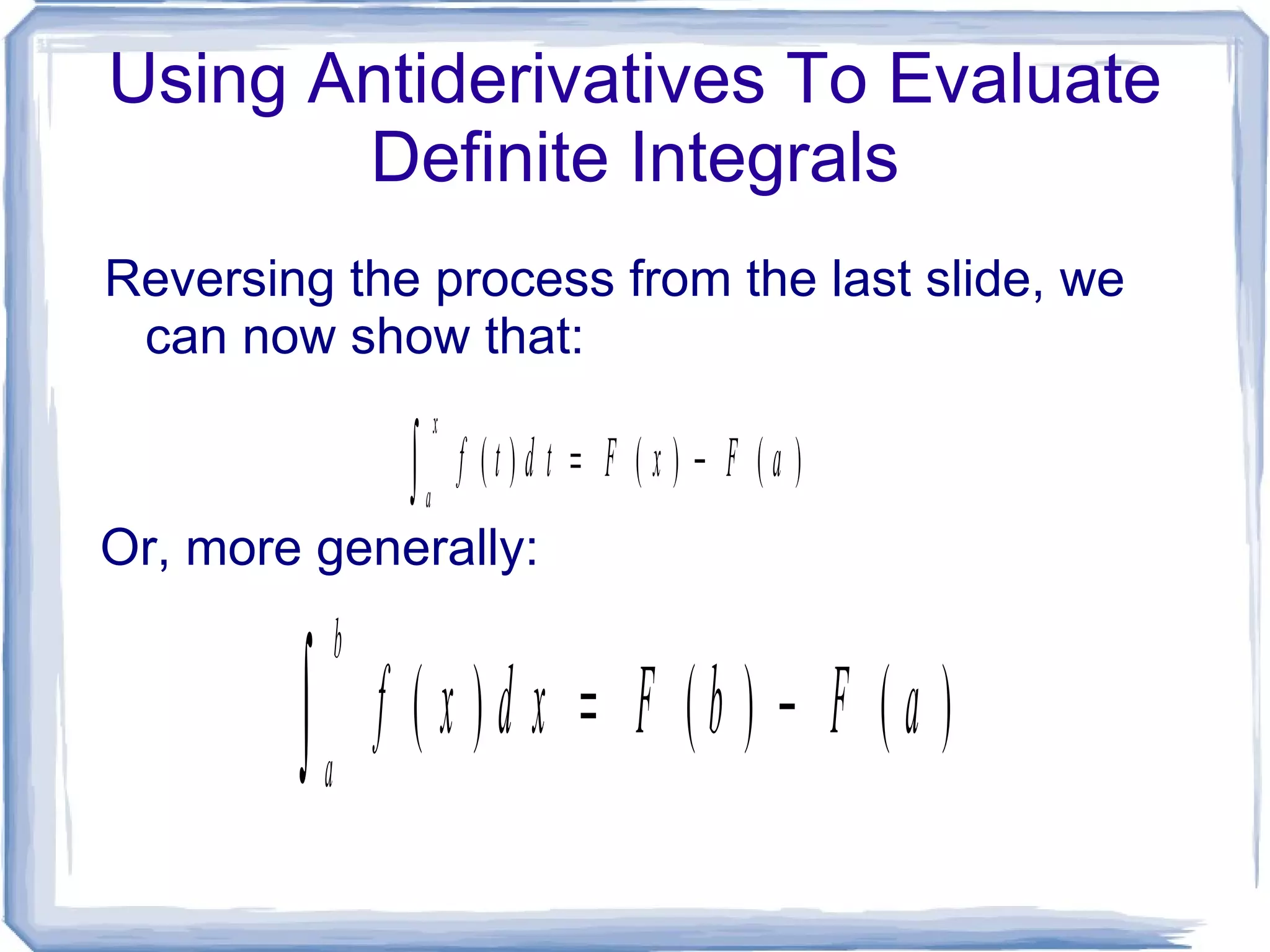
    Using Antiderivatives ToEvaluate Definite Integrals Reversing the process from the last slide, we can now show that: Or, more generally: