1
DEFINITE INTEGRAL
A SHORT NOTES
Arun Umrao
https://sites.google.com/view/arunumrao
DRAFT COPY - GPL LICENSING
2 Definite Integration
Contents
1 Definite Integration 3
1.1 Definite Integration . . . . . . . . . . . . . . . . . . . . . . . . 3
1.2 Properties . . . . . . . . . . . . . . . . . . . . . . . . . . . . . 6
1.2.1 In-dependent of Variable . . . . . . . . . . . . . . . . . 6
1.2.2 Flipping of Limits . . . . . . . . . . . . . . . . . . . . . 7
1.2.3 Splitting of Limits . . . . . . . . . . . . . . . . . . . . 8
1.2.4 Shifting of Variable . . . . . . . . . . . . . . . . . . . . 12
1.2.5 Shifting of Periodic Function . . . . . . . . . . . . . . . 14
1.2.6 Even & Odd Function . . . . . . . . . . . . . . . . . . 16
1.2.7 Periodic Even & Odd Function . . . . . . . . . . . . . 23
1.2.8 Splitting of Limit in n Parts . . . . . . . . . . . . . . . 25
1.2.9 Definite Integration & Limits . . . . . . . . . . . . . . 32
1.3 Average Value . . . . . . . . . . . . . . . . . . . . . . . . . . . 34
1.4 Piece-wise Functions . . . . . . . . . . . . . . . . . . . . . . . 37
1.5 Integral Identities . . . . . . . . . . . . . . . . . . . . . . . . . 47
1.6 Special Integral . . . . . . . . . . . . . . . . . . . . . . . . . . 50
1.6.1 Definite Integral of Laplace Type . . . . . . . . . . . . 50
1.6.2 Definite Integral of Fourier Type . . . . . . . . . . . . 54
1.6.3 Specific Workout . . . . . . . . . . . . . . . . . . . . . 57
1.6.4 Repetitive Integrals . . . . . . . . . . . . . . . . . . . . 60
1.6.5 Derivative of Integrals . . . . . . . . . . . . . . . . . . 62
1.6.6 Vector Integration . . . . . . . . . . . . . . . . . . . . 64
1.6.7 Principal & General Value . . . . . . . . . . . . . . . . 65
1.6.8 Integral of Graphs . . . . . . . . . . . . . . . . . . . . 66
1.6.9 Vertically symmetric Function . . . . . . . . . . . . . . 72
1.7 Exponential Trigonometric Functions . . . . . . . . . . . . . . 77
1.1. DEFINITE INTEGRATION 3
1Definite Integration
In this chapter, the integration of infinite continuous function is bounded
between two limits.
1.1 Definite Integration
When integration of a function is limited between two fixed points where
function is continuous and limit exists everywhere between these two limits,
then The integral is called definite integration. If f(x) is a continuous func-
tion in [a, b] and limit exists everywhere in [a, b] then definite integration of
the function is given by
I =
b
Z
a
f(x) dx (1.1)
Definite integral depends on lower limit and upper limit only. It is indepen-
dent of any intermediate values between [a, b]. If F(x) is integral of f(x) and
there are intermediate points j, k and l such that [a, j], [j, k], [k, l], [l, b] then
I =
j
Z
a
f(x) dx +
k
Z
j
f(x) dx +
l
Z
k
f(x) dx +
b
Z
l
f(x) dx
and
I = F(j) − F(a) + F(k) − F(j) + F(l) − F(k) + F(b) − F(l) = F(b) − F(a)
It shows that only limits a and b are useful. Rest intermediate points are
cancelled by each other. Consider a function f(x) = x that is undergoing
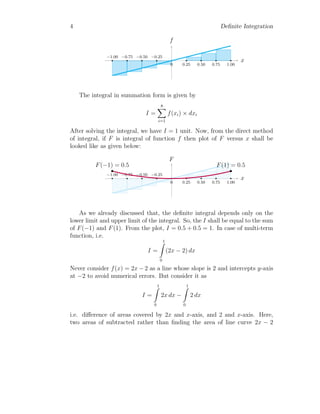
integration (bar summation) in [−1, 1]. Take the width dx = 0.25, and
corresponding integral steps n = 8. The bar diagram for integral of f(x) is
given below:
4 Definite Integration
x
f
b
−1.00
b
−0.75
b
−0.50
b
−0.25
b
0
b
0.25
b
0.50
b
0.75
b
1.00
The integral in summation form is given by
I =
8
X
i=1
f(xi) × dxi
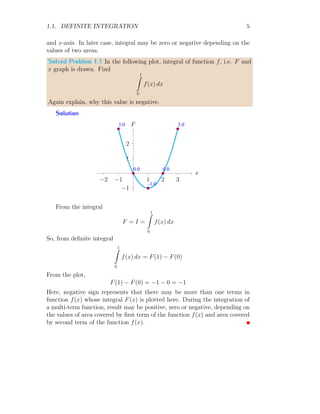
After solving the integral, we have I = 1 unit. Now, from the direct method
of integral, if F is integral of function f then plot of F versus x shall be
looked like as given below:
x
F
b
−1.00
b
−0.75
b
−0.50
b
−0.25
b
0
b
0.25
b
0.50
b
0.75
b
1.00
b
F(−1) = 0.5
b
F(1) = 0.5
As we already discussed that, the definite integral depends only on the
lower limit and upper limit of the integral. So, the I shall be equal to the sum
of F(−1) and F(1). From the plot, I = 0.5 + 0.5 = 1. In case of multi-term
function, i.e.
I =
1
Z
0
(2x − 2) dx
Never consider f(x) = 2x − 2 as a line whose slope is 2 and intercepts y-axis
at −2 to avoid numerical errors. But consider it as
I =
1
Z
0
2x dx −
1
Z
0
2 dx
i.e. difference of areas covered by 2x and x-axis, and 2 and x-axis. Here,
two areas of subtracted rather than finding the area of line curve 2x − 2
1.1. DEFINITE INTEGRATION 5
and x-axis. In later case, integral may be zero or negative depending on the
values of two areas.
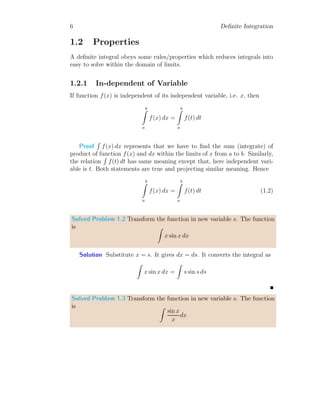
Solved Problem 1.1 In the following plot, integral of function f, i.e. F and
x graph is drawn. Find
1
Z
0
f(x) dx
Again explain, why this value is negative.
Solution
1
2
−1
1 2 3
−1
−2
x
F
b
b
b
b
b
3.0
0.0
-1.0
0.0
3.0
From the integral
F = I =
1
Z
0
f(x) dx
So, from definite integral
1
Z
0
f(x) dx = F(1) − F(0)
From the plot,
F(1) − F(0) = −1 − 0 = −1
Here, negative sign represents that there may be more than one terms in
function f(x) whose integral F(x) is plotted here. During the integration of
a multi-term function, result may be positive, zero or negative, depending on
the values of area covered by first term of the function f(x) and area covered
by second term of the function f(x).
6 Definite Integration
1.2 Properties
A definite integral obeys some rules/properties which reduces integrals into
easy to solve within the domain of limits.
1.2.1 In-dependent of Variable
If function f(x) is independent of its independent variable, i.e. x, then
b
Z
a
f(x) dx =
b
Z
a
f(t) dt
Proof
R
f(x) dx represents that we have to find the sum (integrate) of
product of function f(x) and dx within the limits of x from a to b. Similarly,
the relation
R
f(t) dt has same meaning except that, here independent vari-
able is t. Both statements are true and projecting similar meaning. Hence
b
Z
a
f(x) dx =
b
Z
a
f(t) dt (1.2)
Solved Problem 1.2 Transform the function in new variable s. The function
is Z
x sin x dx
Solution Substitute x = s. It gives dx = ds. It converts the integral as
Z
x sin x dx =
Z
s sin s ds
Solved Problem 1.3 Transform the function in new variable s. The function
is Z
sin x
x
dx
1.2. PROPERTIES 7
Solution Substitute x = s. It gives dx = ds. It converts the integral as
Z
sin x
x
dx =
Z
sin s
s
ds
1.2.2 Flipping of Limits
If a and b > a are lower limit and upper limit respectively for a function f(x),
where it is being integrated then function integration takes place from a to
b. If the direction of integration is change then the integration of function
becomes negative, i.e.
b
Z
a
f(x) dx = −
a
Z
b
f(t) dt
Proof Definite integration of
b
R
a
f(x) dx is
b
Z
a
f(x) dx = F(b) − F(a)
The right hand side of above relation shows that the value of integrated func-
tion F(x) at lower limit a, i.e. F(a) is subtracted in the value of integrated
function F(x) at upper limit b, i.e. F(b). Now take common in right hand
side of above relation
b
Z
a
f(x) dx = −[−F(b) + F(a)]
and it shows that from above description stated, upper limit is a and lower
limit is b. Hence
b
Z
a
f(x) dx = −
a
Z
b
f(x) dx (1.3)
8 Definite Integration
1.2.3 Splitting of Limits
Take, a and b as lower and upper limits for the integral of a function f(x).
If F(x) is integral of f(x) as
Z
f(x) dx = F(x)
and function f(x) is continuous through the region between [a, b]. We can
add a third limit point between boundary limits, a → b, such as a → c → b,
where a < c < b. In this case, integral of the function becomes
b
Z
a
f(x) dx =
c
Z
a
f(x) dx +
b
Z
c
f(x) dx (1.4)
Proof Definite integration of
b
R
a
f(x) dx is
b
Z
a
f(x) dx = F(b) − F(a)
Adding and subtracting function value, F(c), at a point c in above relation
at right side.
b
Z
a
f(x) dx = F(b) − F(a) + F(c) − F(c)
1
1 2
x
y
a b
1
1 2
x
y
a b
c
Figure 1.1: This function is integrated in the closed limit of [a, b]. It rep-
resents area of region enclosed between function and x-axis. Function is
partitioned by splitting limit [a, b] in [a, c] and [c, b]. Area of the region in
limit [a, b] is sum of area of these two regions.
1.2. PROPERTIES 9
Rearranging right hand side of above relation
b
Z
a
f(x) dx = [F(b) − F(c)] + [F(c) − F(a)]
Rewriting right side in integral form:
b
Z
a
f(x) dx =
b
Z
c
f(x) dx +
c
Z
a
f(x) dx
b
Z
a
f(x) dx =
c
Z
a
f(x) dx +
b
Z
c
f(x) dx (1.5)
Solved Problem 1.4 Find definite integral of each function as plotted in
following figure.
Solution
1
1 2
t
y
1
1 2 3
t
y
In the first figure, curve has two line segments, (i) the line segment be-
tween x = 0 to x = 1 and (ii) line segment between x = 1 to x = 2. The
equation of lines are
y1 = x; y2 = −x + 2
Here, slope of first line segment is +1 and second line segment is −1 and the
y-axis intercepts are c = 0 and c = 2. Now the definite integral of the given
curve is
I =
Z 2
0
y dx =
Z 1
0
y1 dx +
Z 2
1
y2 dx
Substituting the values, we have
I =
Z 1
0
x dx +
Z 2
1
(−x + 2) dx
10 Definite Integration
Now, solving it, we get the definite result as
I =
1
2
+
1
2
= 1
This is first result. In the second figure, the equations of line segments can
be found by using principle of equation of line passes from two coordinate
points. Thus the line segments between definite limits x = 0 to x = 1, x = 1
to x = 2 and x = 2 to x = 3 are respectively
y1 = x; y2 = 1; y3 =
−x
2
+ 2
The integral is
I =
Z 1
0
y1 dx +
Z 2
1
y2 dx +
Z 3
2
y3 dx
Substituting the values, we have
I =
Z 1
0
x dx +
Z 2
1
1 dx +
Z 3
2
(−x/2 + 2) dx
Now, solving it, we get the definite result as
I =
1
2
+ 1 +
3
4
= 2.25
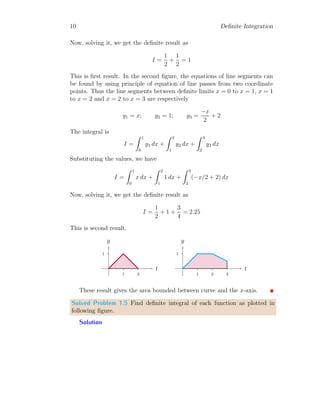
This is second result.
1
1 2
t
y
1
1 2 3
t
y
These result gives the area bounded between curve and the x-axis.
Solved Problem 1.5 Find definite integral of each function as plotted in
following figure.
Solution
1.2. PROPERTIES 11
1
1 2
t
y
1
1 2 3
t
y
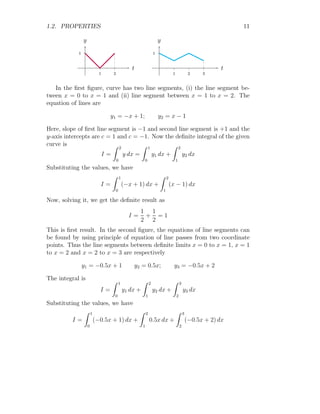
In the first figure, curve has two line segments, (i) the line segment be-
tween x = 0 to x = 1 and (ii) line segment between x = 1 to x = 2. The
equation of lines are
y1 = −x + 1; y2 = x − 1
Here, slope of first line segment is −1 and second line segment is +1 and the
y-axis intercepts are c = 1 and c = −1. Now the definite integral of the given
curve is
I =
Z 2
0
y dx =
Z 1
0
y1 dx +
Z 2
1
y2 dx
Substituting the values, we have
I =
Z 1
0
(−x + 1) dx +
Z 2
1
(x − 1) dx
Now, solving it, we get the definite result as
I =
1
2
+
1
2
= 1
This is first result. In the second figure, the equations of line segments can
be found by using principle of equation of line passes from two coordinate
points. Thus the line segments between definite limits x = 0 to x = 1, x = 1
to x = 2 and x = 2 to x = 3 are respectively
y1 = −0.5x + 1 y2 = 0.5x; y3 = −0.5x + 2
The integral is
I =
Z 1
0
y1 dx +
Z 2
1
y2 dx +
Z 3
2
y3 dx
Substituting the values, we have
I =
Z 1
0
(−0.5x + 1) dx +
Z 2
1
0.5x dx +
Z 3
2
(−0.5x + 2) dx
12 Definite Integration
Now, solving it, we get the definite result as
I =
3
4
+
3
4
+
3
4
=
9
4
= 2.25
This is second result.
1
1 2
t
y
1
1 2 3
t
y
These result gives the area bounded between curve and the x-axis.
1.2.4 Shifting of Variable
If f(x) is a continuous function in [a, b] and limit exists everywhere in [a, b]
then definite integration of the function is given by
I =
b
Z
a
f(x) dx
Now shift the function by sum of limits, i.e.
x = a + b − t; dx = −dt
The corresponding limits becomes, when x = a, t = b and when x = b, t = a.
So,
I =
a
Z
b
f(a + b − t) × −dt
From the property of flipping of limits, we have
I =
b
Z
a
f(a + b − t) dt
1.2. PROPERTIES 13
From the property of changing of independent variable t → x, we have
I =
b
Z
a
f(a + b − x) dx
Here, both relation represents to the same integral and have same meaning.
This property is useful in finding of integral of relation type
R =
f(x)
f(x) + f(k − x)
Solved Problem 1.6 Evaluate
2
R
1
f(x)
f(x)+f(3−x)
dx.
Solution Let
I =
2
Z
1
f(x)
f(x) + f(3 − x)
dx (1.6)
Put x = 1 + 2 − t, it gives dx = −dt. When x = 1, t = 2 and when x = 2,
t = 1. Now, the integral relation becomes
I =
1
Z
2
f(3 − t)
f(3 − t) + f(t)
× −dt
Or
I =
2
Z
1
f(3 − t)
f(3 − t) + f(t)
dt
Transform t → x, we have
I =
2
Z
1
f(3 − x)
f(3 − x) + f(x)
dt (1.7)
Adding equations 1.6 and 1.7, we have
2I =
2
Z
1
f(3 − x) + f(x)
f(3 − x) + f(x)
dx
14 Definite Integration
Or
2I = 1 ⇒ I =
1
2
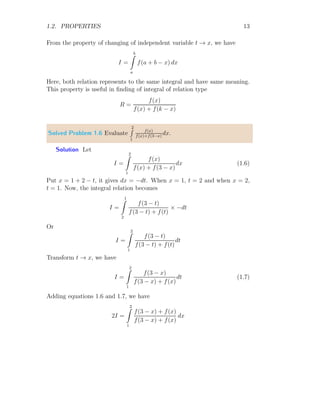
This is desired result. Note that the answer of these types of relations is
always half of the difference of upper and lower limits.
1 2 3
x
y
f(x) = sin x
sin x+sin(3.14−x)
1
−1
x
y
f(x) = cos x
cos x+cos(−x)
The function f(x) should neither change its sign (from positive y-axis to
negative y-axis or vice-versa) or nature (from sine to cosine or vice-versa)
within the limits of integration. For example, this rule is applicable for
f(x) =
sin x
sin x + sin(3.14 − x)
but it is not applicable for
f(x) =
sin x
sin x + sin(4 − x)
as sin(4 − x) is negative till 4 − x > π.
1.2.5 Shifting of Periodic Function
If f(x) is a periodic function in a range from 0 to a then the function f(x)
can be written as a
Z
0
f(x) dx =
a
Z
0
f(a − x) dx
Proof sin(x) is a periodic function of 2π. After each interval of 2π, its
phase is same to the phase, that was just before 2π value. Take a periodic
function f(x) of period a. So,
x = a − t; dx = −dt
The corresponding limits becomes, t = a when x = 0 and t = 0 when x = a.
Put the value of x, dx and corresponding limits in left side of relation
1.2. PROPERTIES 15
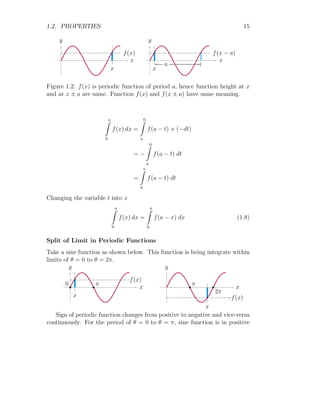
x
y
x
f(x)
x
y
x
f(x − a)
a
Figure 1.2: f(x) is periodic function of period a, hence function height at x
and at x ± a are same. Function f(x) and f(x ± a) have same meaning.
a
Z
0
f(x) dx =
0
Z
a
f(a − t) × (−dt)
= −
0
Z
a
f(a − t) dt
=
a
Z
0
f(a − t) dt
Changing the variable t into x
a
Z
0
f(x) dx =
a
Z
0
f(a − x) dx (1.8)
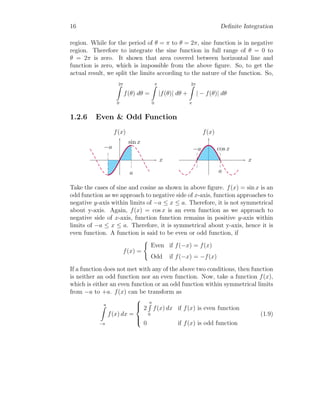
Split of Limit in Periodic Functions
Take a sine function as shown below. This function is being integrate within
limits of θ = 0 to θ = 2π.
x
y
x
f(x)
b
0 b
π
x
y
x
−f(x)
b
π b
2π
Sign of periodic function changes from positive to negative and vice-versa
continuously. For the period of θ = 0 to θ = π, sine function is in positive
16 Definite Integration
region. While for the period of θ = π to θ = 2π, sine function is in negative
region. Therefore to integrate the sine function in full range of θ = 0 to
θ = 2π is zero. It shown that area covered between horizontal line and
function is zero, which is impossible from the above figure. So, to get the
actual result, we split the limits according to the nature of the function. So,
2π
Z
0
f(θ) dθ =
π
Z
0
|f(θ)| dθ +
2π
Z
π
| − f(θ)| dθ
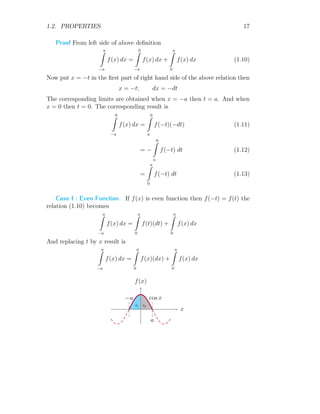
1.2.6 Even & Odd Function
x
f(x)
−a
a
sin x
x
f(x)
−a
a
cos x
Take the cases of sine and cosine as shown in above figure. f(x) = sin x is an
odd function as we approach to negative side of x-axis, function approaches to
negative y-axis within limits of −a ≤ x ≤ a. Therefore, it is not symmetrical
about y-axis. Again, f(x) = cos x is an even function as we approach to
negative side of x-axis, function function remains in positive y-axis within
limits of −a ≤ x ≤ a. Therefore, it is symmetrical about y-axis, hence it is
even function. A function is said to be even or odd function, if
f(x) =
(
Even if f(−x) = f(x)
Odd if f(−x) = −f(x)
If a function does not met with any of the above two conditions, then function
is neither an odd function nor an even function. Now, take a function f(x),
which is either an even function or an odd function within symmetrical limits
from −a to +a. f(x) can be transform as
a
Z
−a
f(x) dx =





2
a
R
0
f(x) dx if f(x) is even function
0 if f(x) is odd function
(1.9)
1.2. PROPERTIES 17
Proof From left side of above definition
a
Z
−a
f(x) dx =
0
Z
−a
f(x) dx +
a
Z
0
f(x) dx (1.10)
Now put x = −t in the first part of right hand side of the above relation then
x = −t; dx = −dt
The corresponding limits are obtained when x = −a then t = a. And when
x = 0 then t = 0. The corresponding result is
0
Z
−a
f(x) dx =
0
Z
a
f(−t)(−dt) (1.11)
= −
0
Z
a
f(−t) dt (1.12)
=
a
Z
0
f(−t) dt (1.13)
Case I : Even Function If f(x) is even function then f(−t) = f(t) the
relation (1.10) becomes
a
Z
−a
f(x) dx =
a
Z
0
f(t)(dt) +
a
Z
0
f(x) dx
And replacing t by x result is
a
Z
−a
f(x) dx =
a
Z
0
f(x)(dx) +
a
Z
0
f(x) dx
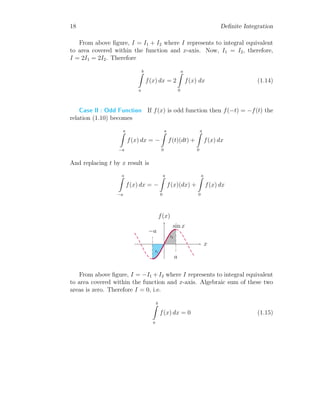
x
f(x)
I1 I2
−a
a
cos x
18 Definite Integration
From above figure, I = I1 + I2 where I represents to integral equivalent
to area covered within the function and x-axis. Now, I1 = I2, therefore,
I = 2I1 = 2I2. Therefore
b
Z
a
f(x) dx = 2
a
Z
0
f(x) dx (1.14)
Case II : Odd Function If f(x) is odd function then f(−t) = −f(t) the
relation (1.10) becomes
a
Z
−a
f(x) dx = −
a
Z
0
f(t)(dt) +
a
Z
0
f(x) dx
And replacing t by x result is
a
Z
−a
f(x) dx = −
a
Z
0
f(x)(dx) +
a
Z
0
f(x) dx
x
f(x)
I1
I2
−a
a
sin x
From above figure, I = −I1 + I2 where I represents to integral equivalent
to area covered within the function and x-axis. Algebraic sum of these two
areas is zero. Therefore I = 0, i.e.
b
Z
a
f(x) dx = 0 (1.15)
1.2. PROPERTIES 19
Integration of Even & Odd Functions
Simply, take a function f(x) = xn
which is defined as
f(x) =
(
Even if n is even
Odd if n is odd
On, its integration, we get
I =
Z
f(x) dx =
Z
xn
dx =
xn+1
n + 1
Now,
f(x) =
(
Even if n is odd
Odd if n is even
It means, an odd function converts into an even function and vice-versa.
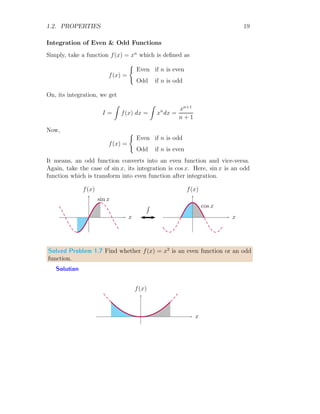
Again, take the case of sin x, its integration is cos x. Here, sin x is an odd
function which is transform into even function after integration.
x
f(x)
sin x
R
x
f(x)
cos x
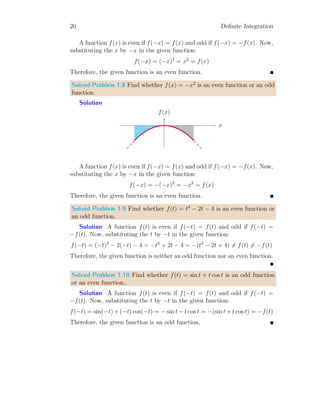
Solved Problem 1.7 Find whether f(x) = x2
is an even function or an odd
function.
Solution
x
f(x)
20 Definite Integration
A function f(x) is even if f(−x) = f(x) and odd if f(−x) = −f(x). Now,
substituting the x by −x in the given function:
f(−x) = (−x)2
= x2
= f(x)
Therefore, the given function is an even function.
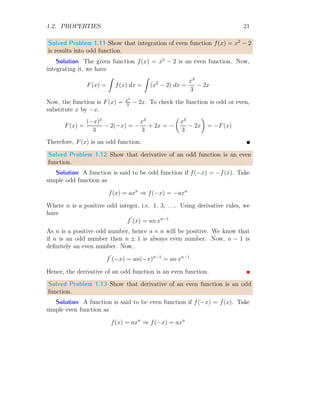
Solved Problem 1.8 Find whether f(x) = −x2
is an even function or an odd
function.
Solution
x
f(x)
A function f(x) is even if f(−x) = f(x) and odd if f(−x) = −f(x). Now,
substituting the x by −x in the given function:
f(−x) = −(−x)2
= −x2
= f(x)
Therefore, the given function is an even function.
Solved Problem 1.9 Find whether f(t) = t3
− 2t − 4 is an even function or
an odd function.
Solution A function f(t) is even if f(−t) = f(t) and odd if f(−t) =
−f(t). Now, substituting the t by −t in the given function:
f(−t) = (−t)3
− 2(−t) − 4 = −t3
+ 2t − 4 = −(t3
− 2t + 4) 6= f(t) 6= −f(t)
Therefore, the given function is neither an odd function nor an even function.
Solved Problem 1.10 Find whether f(t) = sin t + t cos t is an odd function
or an even function..
Solution A function f(t) is even if f(−t) = f(t) and odd if f(−t) =
−f(t). Now, substituting the t by −t in the given function:
f(−t) = sin(−t) + (−t) cos(−t) = − sin t − t cos t = −(sin t + t cos t) = −f(t)
Therefore, the given function is an odd function.
1.2. PROPERTIES 21
Solved Problem 1.11 Show that integration of even function f(x) = x2
− 2
is results into odd function.
Solution The given function f(x) = x2
− 2 is an even function. Now,
integrating it, we have
F(x) =
Z
f(x) dx =
Z
(x2
− 2) dx =
x3
3
− 2x
Now, the function is F(x) = x3
3
− 2x. To check the function is odd or even,
substitute x by −x.
F(x) =
(−x)3
3
− 2(−x) = −
x3
3
+ 2x = −

x3
3
− 2x

= −F(x)
Therefore, F(x) is an odd function.
Solved Problem 1.12 Show that derivative of an odd function is an even
function.
Solution A function is said to be odd function if f(−x) = −f(x). Take
simple odd function as
f(x) = axn
⇒ f(−x) = −axn
Where n is a positive odd integer, i.e. 1, 3, . . .. Using derivative rules, we
have
f
′
(x) = an xn−1
As n is a positive odd number, hence a × n will be positive. We know that
if n is an odd number then n ± 1 is always even number. Now, n − 1 is
definitely an even number. Now,
f
′
(−x) = an(−x)n−1
= an xn−1
Hence, the derivative of an odd function is an even function.
Solved Problem 1.13 Show that derivative of an even function is an odd
function.
Solution A function is said to be even function if f(−x) = f(x). Take
simple even function as
f(x) = axn
⇒ f(−x) = axn
22 Definite Integration
Where n is a positive odd integer, i.e. 0, 2, 4, . . .. Using derivative rules, we
have
f
′
(x) = an xn−1
As n is a positive even number, hence a × n will be positive. We know that
if n is an even number then n ± 1 is always odd number. Now, n − 1 is
definitely an odd number. Now,
f
′
(−x) = an(−x)n−1
= −an xn−1
Hence, the derivative of an even function is an odd function.
Solved Problem 1.14 Show that integration of function f(x) = sin x is an
even function.
Solution The given function f(x) = sin x is an odd function. Now,
integrating it, we have
F(x) =
Z
f(x) dx =
Z
sin x dx = cos x
Now, the function is F(x) = cos x. To check the function is odd or even,
substitute x by −x.
F(x) = cos(−x) = cos x = F(x)
Therefore, F(x) is an even function.
Solved Problem 1.15 Show that definite integral of odd function f(x) = sin x
is zero in the domain of −π/2 ≤ x ≤ π/2.
Solution The given function f(x) = sin x is an odd function. Now,
integrating it, we have
F(x) =
Z
f(x) dx =
Z
sin x dx = cos x
Now the definite integral is
F(x)|
π/2
−π/2 = cos x|
π/2
−π/2 = 0
Hence definite integral of odd function f(x) = sin x is zero in the given
domain.
1.2. PROPERTIES 23
Solved Problem 1.16 Show that definite integral of even function f(x) =
cos x in the domain of −π/2 ≤ x ≤ π/2 is twice to the definite integral of
the function within the domain of −π/2 ≤ x ≤ 0 or 0 ≤ x ≤ π/2.
Solution The definite integral of the given function in the domain of
−π/2 ≤ x ≤ π/2 is
I =
π/2
Z
−π/2
cos x dx = sin x|
π/2
−π/2 = 2
Now, the definite integral of the same function in the domain of −π/2 ≤ x ≤
0 or 0 ≤ x ≤ π/2 is
I1 =
0
Z
−π/2
cos x dx = sin x|0
−π/2 = 1
and
I2 =
π/2
Z
0
cos x dx = sin x|π/2
0 = 1
This shows that I is twice to the either I1 or I2.
1.2.7 Periodic Even  Odd Function
If f(x) is either an even periodic function or an odd periodic function of
range from 0 to 2a then
2a
Z
0
f(x) dx =





2
a
R
0
f(x) dx if f(2a − x) = f(x)
0 if f(2a − x) = −f(x)
(1.16)
Proof From left side of above definition
2a
Z
0
f(x) dx =
a
Z
0
f(x) dx +
2a
Z
a
f(x) dx (1.17)
24 Definite Integration
Now put x = (2a − t) and dx = −dt in the second term of the right hand
side of the above relation alongwith corresponding limits are; when x = a,
t = a and when x = 2a, t = 0. Now, the corresponding relation becomes
2a
Z
0
f(x) dx =
0
Z
a
f(2a − t) (−dt) (1.18)
= −
0
Z
a
f(2a − t) dt (1.19)
=
a
Z
0
f(2a − t) dt (1.20)
I If f(2a − x) is even periodic function then f(2a − t) = f(t) the relation
(1.17) becomes
2a
Z
0
f(x) dx =
a
Z
0
f(t) dt +
a
Z
0
f(x) dx
And replacing t by x result is
2a
Z
0
f(x) dx =
a
Z
0
f(x) dx +
a
Z
0
f(x) dx
2a
Z
0
f(x) dx = 2
a
Z
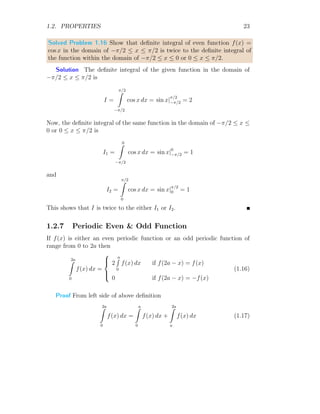
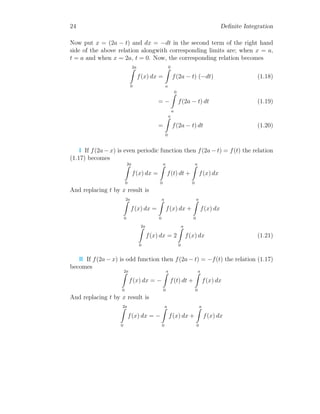
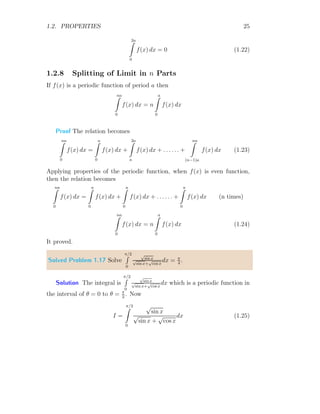
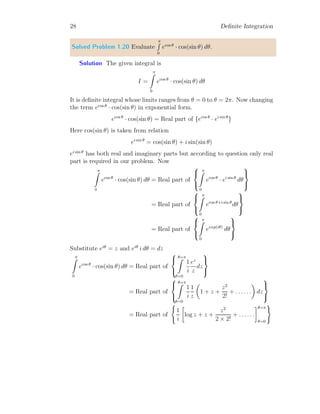
0
f(x) dx (1.21)
II If f(2a − x) is odd function then f(2a − t) = −f(t) the relation (1.17)
becomes
2a
Z
0
f(x) dx = −
a
Z
0
f(t) dt +
a
Z
0
f(x) dx
And replacing t by x result is
2a
Z
0
f(x) dx = −
a
Z
0
f(x) dx +
a
Z
0
f(x) dx
1.2. PROPERTIES 25
2a
Z
0
f(x) dx = 0 (1.22)
1.2.8 Splitting of Limit in n Parts
If f(x) is a periodic function of period a then
na
Z
0
f(x) dx = n
a
Z
0
f(x) dx
Proof The relation becomes
na
Z
0
f(x) dx =
a
Z
0
f(x) dx +
2a
Z
a
f(x) dx + . . . . . . +
na
Z
(n−1)a
f(x) dx (1.23)
Applying properties of the periodic function, when f(x) is even function,
then the relation becomes
na
Z
0
f(x) dx =
a
Z
0
f(x) dx +
a
Z
0
f(x) dx + . . . . . . +
a
Z
0
f(x) dx (n times)
na
Z
0
f(x) dx = n
a
Z
0
f(x) dx (1.24)
It proved.
Solved Problem 1.17 Solve
π/2
R
0
√
sin x
√
sin x+
√
cos x
dx = π
4
.
Solution The integral is
π/2
R
0
√
sin x
√
sin x+
√
cos x
dx which is a periodic function in
the interval of θ = 0 to θ = π
2
. Now
I =
π/2
Z
0
√
sin x
√
sin x +
√
cos x
dx (1.25)
26 Definite Integration
And its periodic derivation is
I =
π/2
Z
0
p
sin(π/2 − x)
p
sin(π/2 − x) +
p
cos(π/2 − x)
dx
I =
π/2
Z
0
√
cos x
√
cos x +
√
sin x
dx (1.26)
Now adding above two equations
2I =
π/2
Z
0
√
cos x +
√
sin x
√
cos x +
√
sin x
dx
=
π/2
Z
0
1dx
Taking integration and substituting the limits of integration
2I = [x]π/2
0 = π/2
Now solving it we will get the result as
I =
π
4
(1.27)
Solved Problem 1.18 Solve
π/2
R
0
sin2 x
sin x+cos x
dx = 1
√
2
loge(
√
2 + 1).
Solution
Solved Problem 1.19 Solve
π
R
0
x tan x
sec x+tan x
dx = π(π
2
− 1).
Solution The integral is
π
R
0
x tan x
sec x+tan x
dx which is a periodic function in the
interval of θ = 0 to θ = π. Now
I =
π
Z
0
x tan x
sec x + tan x
dx (1.28)
1.2. PROPERTIES 27
And its periodic derivation is
I =
π
Z
0
(π − x) tan(π − x)
sec(π − x) + tan(π − x)
dx
I =
π
Z
0
(π − x) (− tan x)
− sec x − tan x
dx (1.29)
Now adding above two equations
2I =
π
Z
0
π tan x
sec x + tan x
dx
Rationalizing right hand side by multiplying and diving it by sec x − tan x.
2I =
π
Z
0
π tan x(sec x − tan x)
sec2 x − tan2
x
dx
=
π
Z
0
π tan x(sec x − tan x)
1
dx
Opening the bracket to make two parts in right hand side.
2I =
π
Z
0
π tan x · sec x dx −
π
Z
0
tan2
x dx
=
π
Z
0
π tan x · sec x dx −
π
Z
0
(sec2
x − 1) dx
Taking integration and substituting the limits of integration
2I = π [sec x]π
0 − π [tan x − x]π
0
= π [sec π − sec 0] − π [tan π − π − tan 0 + 0]
= π [−1 − 1 − 0 + π + 0 + 0]
= π [π − 2]
Now solving it, we will get the result as
I = π
π
2
− 1

(1.30)
28 Definite Integration
Solved Problem 1.20 Evaluate
π
R
0
ecos θ
· cos(sin θ) dθ.
Solution The given integral is
I =
π
Z
0
ecos θ
· cos(sin θ) dθ
It is definite integral whose limits ranges from θ = 0 to θ = 2π. Now changing
the term ecos θ
· cos(sin θ) in exponential form.
ecos θ
· cos(sin θ) = Real part of {ecos θ
· ei sin θ
}
Here cos(sin θ) is taken from relation
ei sin θ
= cos(sin θ) + i sin(sin θ)
ei sin θ
has both real and imaginary parts but according to question only real
part is required in our problem. Now
π
Z
0
ecos θ
· cos(sin θ) dθ = Real part of



π
Z
0
ecos θ
· ei sin θ
dθ



= Real part of



π
Z
0
ecos θ+i sin θ
dθ



= Real part of



π
Z
0
eexp(iθ)
dθ



Substitute eiθ
= z and eiθ
i dθ = dz
π
Z
0
ecos θ
· cos(sin θ) dθ = Real part of



θ=π
Z
θ=0
1
i
ez
z
dz



= Real part of



θ=π
Z
θ=0
1
i
1
z

1 + z +
z2
2!
+ . . . . . .

dz



= Real part of
(
1
i

log z + z +
z2
2 × 2!
+ . . . . . .
θ=π
θ=0
)
1.2. PROPERTIES 29
Substituting the value of z
π
Z
0
ecos θ
· cos(sin θ) dθ = Real part of

1
i

iθ + eiθ
z +
e2iθ
2 × 2!
+ . . . . . .
π
0

= Real part of

θ +
eiθ
i
+
e2iθ
2 × 2! × i
+ . . . . . .
π
0

Taking only real terms in right hand side
π
Z
0
ecos θ
· cos(sin θ) dθ =

θ + sin θ +
sin 2θ
2 × 2!
+ . . . . . .
π
0
= π
It is the required answer.
Addition of Constant Term in Integral Result
In indefinite integration, after each integration we add a constant value
for proper result. But the question is why do we do so. The answer is
that, in indefinite integration we take reference point “zero” for a variable.
Hence range of integration lies between zero to variable itself. If we want
to change the reference point other than zero, we need two values. (i) new
reference point, ‘c’ and (ii) function value, f(c) at this new reference point.
The function value at this new reference point, ‘c’, can be found by just
putting the new reference point value in function f(x). This constant value
is work as new reference function. In definite integration the reference point
other than zero is represented by lower limit and reference function value
is represented by the lower limit integral value. Mathematically
I =
Z
f(x) dx
is infinite integral. Its lower limit is zero and upper limit is variable of
integral itself. Hence in definite integral form, indefinite integral can be
written as
I =
x
Z
0
f(x) dx
If we want to change the reference point other than zero, we have to add
a constant term in right hand side. Let the reference point is c in x-line
30 Definite Integration
where 0  c  x then above integral becomes
I =
c
Z
0
f(x) dx +
x
Z
c
f(x) dx
here
c
R
0
f(x) dx is definite integral for x-limits ranging from zero to constant
‘c’. If it is a constant value then
I =
x
Z
c
f(x) dx + C
There is another reason that can interpret it. Suppose a function is like
f(x) = g(x) + C
After differentiation it gives
F(x) = G(x)
Where F(x) = d
dx
f(x) and G(x) = d
dx
g(x). If we again integrate above
differentiated result then we get the actual function f(x)
f(x) =
Z
F(x) dx =
Z
G(x) dx
But after integration, the result will be
f(x) = g(x)
It differs from the actual function as there is no constant term. To make it
actual function value, we add a constant term in right hand side. So
f(x) = g(x) + C
This is reason for out question. In case of definite integration, lower limit
is act as reference point, hence there is no need to add a constant term in
1.2. PROPERTIES 31
right hand side of the answer. For example
I =
x
Z
c
f(x) dx
Solved Problem 1.21 If f(x) = x6
− x3
+ 15, then find
1
R
0
f
′′
(x) dx.
Solution The second derivative of the given function is
f
′′
(x) = 30x4
− 6x
Now,
I =
1
Z
0

30x4
− 6x

dx =

6x5
− 3x2
1
0
This gives I = 3.
Solved Problem 1.22 If f(x) = tx3
− t2
x2
+ 5, then find
1
R
0
f
′′
(x) dt.
Solution The second derivative of the given function is
f
′′
(x) = 6tx − 2t2
Now,
I =
1
Z
0

6tx − 2t2

dt =

3xt2
−
2
3
t3
1
0
This gives
I = 3x −
2
3
This is desired answer.
32 Definite Integration
Solved Problem 1.23 A resonance term f(t) = sin(ωt) is derivated twice
with respect to t and then integrated with respect to ω. Find the result.
Solution The given function is
f(t) = sin(ωt)
Its twice derivative about t is given by
f
′′
(t) = −ω2
sin(ωt)
Now, integral is
I =
Z
−ω2
sin(ωt) dω
On integration it with respect to ω, we have
I = −
2tω sin(ωt) + (2 − t2
w2
) cos(ωt)
t3
This is desired result.
1.2.9 Definite Integration  Limits
A definite integration of a function f(x) withing bounded region [a, b] is given
by
I =
b
Z
a
f(x) dx
Here, a is lower bound of the function and b is upper bound of the function.
If function f(x) is integrated within symmetric boundaries as
I =
a
Z
−a
f(x) dx
then it can be represented at with limits as
I = lim
ε→a
ε
Z
−ε
f(x) dx
1.2. PROPERTIES 33
This notation is helpful, when function is defined at a point but integration is
being done in a range of limits. Integration of function at points 0 is written
as
I = lim
ε→0
ε
Z
−ε
f(x) dx
and at point ∞ is written as
I = lim
ε→0
1/ε
Z
−1/ε
f(x) dx
Solved Problem 1.24 Evaluate limε→0
ε
R
−ε
e−x
dx.
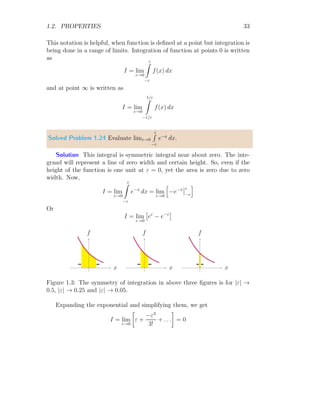
Solution This integral is symmetric integral near about zero. The inte-
grand will represent a line of zero width and certain height. So, even if the
height of the function is one unit at ε = 0, yet the area is zero due to zero
width. Now,
I = lim
ε→0
ε
Z
−ε
e−x
dx = lim
ε→0
h
−e−x
ε
−ε
i
Or
I = lim
ε→0

eε
− e−ε

x
f
x
f
x
f
Figure 1.3: The symmetry of integration in above three figures is for |ε| →
0.5, |ε| → 0.25 and |ε| → 0.05.
Expanding the exponential and simplifying them, we get
I = lim
ε→0

ε +
−ε3
3!
+ . . .

= 0
34 Definite Integration
This is desired answer.
1.3 Average Value
We know that
R
f(x) dx represents the Area between function f(x) and two
points of width dx in base line. If
b
Z
a
f(x) dx
is area between f(x) and x-limits (x = a and x = b). The average value for
this limit is given by
Iavg =
b
R
a
f(x) dx
b
R
a
dx
(1.31)
Above relation is similar to the mathematical average, i.e. average area is
the ratio of total area to the difference of limit.
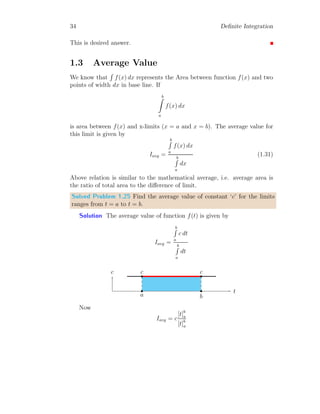
Solved Problem 1.25 Find the average value of constant ‘c’ for the limits
ranges from t = a to t = b.
Solution The average value of function f(t) is given by
Iavg =
b
R
a
c dt
b
R
a
dt
t
c b b
c c
b b
a b
Now
Iavg = c
[t]b
a
[t]b
a
1.3. AVERAGE VALUE 35
Solving the relation
Iavg = c
This shows that the average value of constant remains constant.
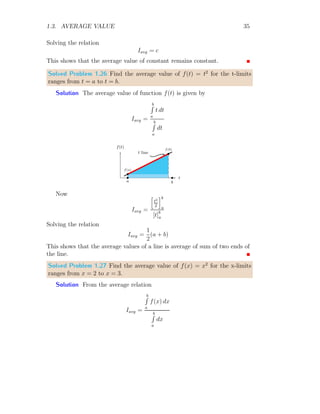
Solved Problem 1.26 Find the average value of f(t) = t2
for the t-limits
ranges from t = a to t = b.
Solution The average value of function f(t) is given by
Iavg =
b
R
a
t dt
b
R
a
dt
t
f(t)
b
b
f(a)
f(b)
b b
a b
t line
Now
Iavg =
h
t2
2
ib
a
[t]b
a
Solving the relation
Iavg =
1
2
(a + b)
This shows that the average values of a line is average of sum of two ends of
the line.
Solved Problem 1.27 Find the average value of f(x) = x2
for the x-limits
ranges from x = 2 to x = 3.
Solution From the average relation
Iavg =
b
R
a
f(x) dx
b
R
a
dx
36 Definite Integration
x
f(x)
b
b
f(a)
f(b)
b b
a b
f(x) = x2
Substituting the values and integrating for the limits
Iavg =
3
R
2
x2
dx
3
R
2
dx
Or
Iavg =
h
x3
3
i3
2
[x]3
2
Or
Iavg =
19
3
This is the required average value.
Solved Problem 1.28 Find the average value of f(x) = sin(x) within the
angle limits in radian values from x = π/3 to 2π/3.
Solution The average of function within the limits is
Iavg =
2π
3
R
π
6
sin(x)dx
2π
3
R
π
6
dx
On integration and solving it
Iavg =
[− cos(x)]
2π
3
π
6
[x]
2π
3
π
6
1.4. PIECE-WISE FUNCTIONS 37
x
f(x)
b
b
f(π/6)
f(2π/3)
b b
π/6 2π/3
f(x) = sin(x)
Iavg =
− cos(2π
3
) + cos(π
6
)
2π
3
− π
6
Or
Iavg =
0.5 + 0.866)
2.093 − 0.523
=
1.366
1.57
= 0.87
This is required result.
1.4 Piece-wise Functions
A function F(x) is said to be a piece-wise function if it follows different
functions at different conditions. See the following function F(x), that is
defined for two conditions of independent variable x, i.e. (i) when x  0 and
(ii) x ≥ 0.
F(x) =
(
f(x) if x  0
g(x) if x ≥ 0
(1.32)
The integration of the piece-wise functions is performed within the domain
of the functions. Integration of above function F(x) is given by
Z
f(x) dx =
0
Z
−∞
f(x) dx +
∞
Z
0
g(x) dx (1.33)
Solved Problem 1.29 Find the integral of the given function.
f(x) =
(
2 if − 4 ≤ x  0
x if 0 ≤ x ≤ 2
38 Definite Integration
Solution Integration of given function is
I =
2
Z
−4
f(x) dx
Replacing the function f(x) for its domain of ‘x’
I =
0
Z
−4
2 dx +
2
Z
0
x dx
On solving it
I = [2x]0
−4 +

x2
2
2
0
Or
I = 10
Solved Problem 1.30 Find the integral of the given function in −∞  x 
∞.
f(x) =
(
x − 1 if − 1 ≤ x ≤ 0
0 otherwise
Solution
1
−1
−2
1
−1
−2
x
f(x)
1
−1
−2
1
−1
−2
x
F(x)
1.4. PIECE-WISE FUNCTIONS 39
The integral of the piecewise function is
F(x) =
∞
Z
−∞
f(x) dx
Substituting the function in above integral relation for as it is defined piece-
wise.
F(x) =
−1
Z
−∞
0 dx +
0
Z
−1
(x − 1) dx +
∞
Z
0
0 dx
On solving it
F(x) =

x2
2
− x
0
−1
= 0 −

(−1)2
2
− (−1)

=
3
2
It is integral of given piecewise function in domain −∞  x  ∞.
Solved Problem 1.31 Find the integral of the given unit step function within
the domain of 0 ≤ t ≤ ∞.
u(t − 2) =
(
0 if t  2
1 if t ≥ 2
What will be integration of e−at
u(t − 2) within the same domain of ‘t’?
Solution A unit step function is that function whose value is zero if
variable is less than the transition point. And its value is ‘1’ if the variable is
equal or larger than the transition point. In the given function, u(t − 2) tells
that the transition point for the variable t is t − 2 = 0 ⇒ t = 2. Therefore,
the unit step function value is 0 for t  2 and 1 for t ≥ 2.
1. Integration of given function is
I =
∞
Z
0
u(t − 2) dt
Replacing the unit step function u(t − 2) for its domain of ‘t’
I =
2
Z
0
0 dt +
∞
Z
2
1 dt
40 Definite Integration
On solving it
I = 0 + [x]∞
2
Or
I = ∞
Ans-1.
2. Integration of e−at
u(t − 2) is
I =
∞
Z
0
e−at
u(t − 2) dt
Replacing the unit step function u(t − 2) for its domain of ‘t’
I =
2
Z
0
e−at
× 0 dt +
∞
Z
2
e−at
× 1 dt
On solving it
I = 0 +

e−at
−a
∞
2
Or
I =
e−2a
a
Ans-2.
By this way, we can obtain the Laplace Transformations of unit step
function also. Second derivative is very important in engineering.
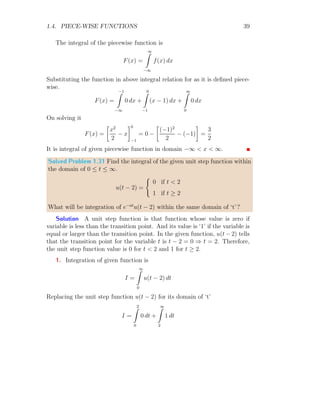
Solved Problem 1.32 Check whether the given piece-wise function exists or
not.
f(t) =
(
2t if 0 ≤ t ≤ 1
t + 1 if 1 ≤ t ≤ 2
Also find the
∞
R
−∞
f(t) dt.
Solution Function is critical for both piece-wise parts at t = 1. Therefore,
at this point, function should be continuous for its existence. So
f(t)−
= 2 × 1 = 2
1.4. PIECE-WISE FUNCTIONS 41
and
f(t)+
= 1 + 1 = 2
Here, f(t)+
= f(t)−
, hence function exists. It is also necessary condition for
the existence of the piece-wise function.
1
2
3
1 2
t
f(t)
(1)
1
2
3
1 2
t
f(t)
(2)
1
2
3
1 2
t
f(t)
(3)
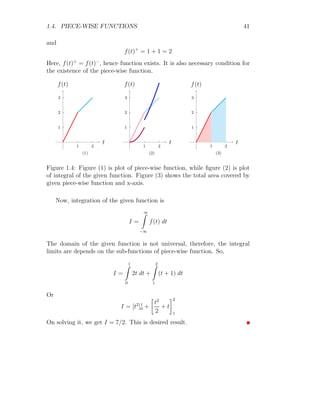
Figure 1.4: Figure (1) is plot of piece-wise function, while figure (2) is plot
of integral of the given function. Figure (3) shows the total area covered by
given piece-wise function and x-axis.
Now, integration of the given function is
I =
∞
Z
−∞
f(t) dt
The domain of the given function is not universal, therefore, the integral
limits are depends on the sub-functions of piece-wise function. So,
I =
1
Z
0
2t dt +
2
Z
1
(t + 1) dt
Or
I = [t2
]1
0 +

t2
2
+ t
2
1
On solving it, we get I = 7/2. This is desired result.
42 Definite Integration
Solved Problem 1.33 Find the integration of function as shown below:
Solution
1
1 2 3
x
y
This piecewise function is a constant function as f(x) = 1 within the
limits of integration 1 ≤ x ≤ 3. Now, its integration is
I =
3
Z
1
1 dx = x|3
1 = 3 − 1 = 2
This is result.
Solved Problem 1.34 Find the integration of function as shown below:
Solution
x
y
a a + k
This piecewise function is a constant function as f(x) = c within the
limits of integration a ≤ x ≤ a + k. Now, its integration is
I =
a+k
Z
a
c dx = c
h
x|a+k
a
i
= ck
This is result.
1.4. PIECE-WISE FUNCTIONS 43
Solved Problem 1.35 Find the integration of function as shown below:
Solution
1
−1
1 2 3 4 5
x
y
This piecewise function is a square wave function as |f(x)| = 1. f(x) = 1
within the limits of integration 1 ≤ x ≤ 2, f(x) = −1 within the limits of
integration 2 ≤ x ≤ 3, f(x) = 1 within the limits of integration 3 ≤ x ≤ 4
and so on. Assuming that the integral is area integral, then
I = 4
2
Z
1
1 dx = 4

x|2
1

= 4
This is result.
Solved Problem 1.36 Sketch the graph of function
u(t − 1) =

0 if t  1
1 if 1 ≤ t ≤ 3
and find the integral of it.
Solution The sketch of the graph of above piecewise function is as given
below:
1
1 2 3
t
u
This piecewise function is a unit step function which makes step at t = 1.
44 Definite Integration
Now, its integration is
I =
1
Z
−∞
0 dt +
3
Z
1
1 dt = t|3
1 = 3 − 1 = 2
This is result.
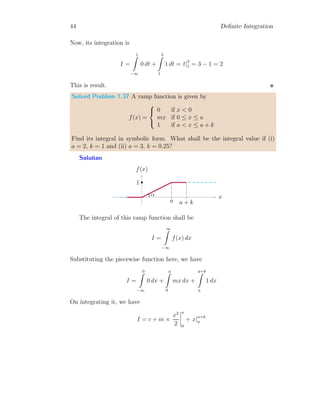
Solved Problem 1.37 A ramp function is given by
f(x) =



0 if x  0
mx if 0 ≤ x ≤ a
1 if a  x ≤ a + k
Find its integral in symbolic form. What shall be the integral value if (i)
a = 2, k = 1 and (ii) a = 3, k = 0.25?
Solution
x
f(x)
a a + k
b
1
α
The integral of this ramp function shall be
I =
∞
Z
−∞
f(x) dx
Substituting the piecewise function here, we have
I =
0
Z
−∞
0 dx +
a
Z
0
mx dx +
a+k
Z
a
1 dx
On integrating it, we have
I = c + m ×
x2
2
a
0
+ x|a+k
a
1.4. PIECE-WISE FUNCTIONS 45
As the function is zero for x  0, so c = 0. So,
I =
ma2
2
+ k
This is symbolic form of result of the given integral. Now
1: a = 2 and k = 1
I1 =
m × 22
2
+ 1 = 2m + 1
2: a = 3 and k = 0.25
I1 =
m × 32
2
+ 0.25 = 4.5m + 0.25
These are desire results.
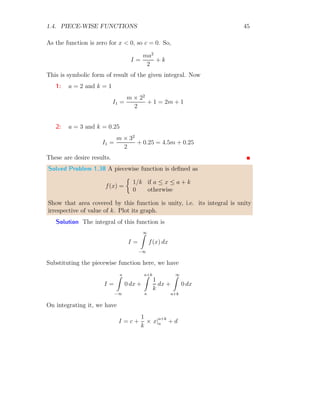
Solved Problem 1.38 A piecewise function is defined as
f(x) =

1/k if a ≤ x ≤ a + k
0 otherwise
Show that area covered by this function is unity, i.e. its integral is unity
irrespective of value of k. Plot its graph.
Solution The integral of this function is
I =
∞
Z
−∞
f(x) dx
Substituting the piecewise function here, we have
I =
a
Z
−∞
0 dx +
a+k
Z
a
1
k
dx +
∞
Z
a+k
0 dx
On integrating it, we have
I = c +
1
k
× x|a+k
a + d
46 Definite Integration
Here, c and d are arbitrary constants. As the function is zero for x  a and
x  a + k, so c = 0 and d = 0. So,
I =
1
k
× k = 1
This result is independent of k, so integration of the given function is always
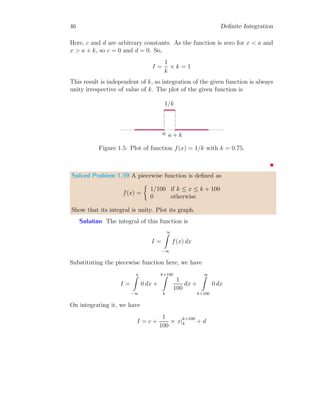
unity irrespective of value of k. The plot of the given function is
1/k
a a + k
Figure 1.5: Plot of function f(x) = 1/k with k = 0.75.
Solved Problem 1.39 A piecewise function is defined as
f(x) =

1/100 if k ≤ x ≤ k + 100
0 otherwise
Show that its integral is unity. Plot its graph.
Solution The integral of this function is
I =
∞
Z
−∞
f(x) dx
Substituting the piecewise function here, we have
I =
a
Z
−∞
0 dx +
k+100
Z
k
1
100
dx +
∞
Z
k+100
0 dx
On integrating it, we have
I = c +
1
100
× x|k+100
k + d
1.5. INTEGRAL IDENTITIES 47
Here, c and d are arbitrary constants. As the function is zero for x  k and
x  k + 100, so c = 0 and d = 0. So,
I =
1
100
× 100 = 1
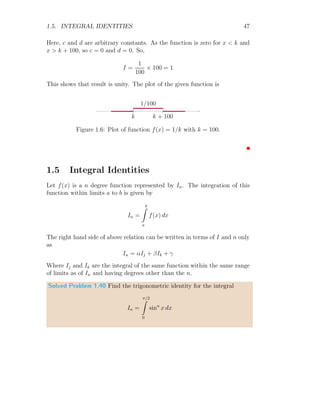
This shows that result is unity. The plot of the given function is
1/100
k k + 100
Figure 1.6: Plot of function f(x) = 1/k with k = 100.
1.5 Integral Identities
Let f(x) is a n degree function represented by In. The integration of this
function within limits a to b is given by
In =
b
Z
a
f(x) dx
The right hand side of above relation can be written in terms of I and n only
as
In = αIj + βIk + γ
Where Ij and Ik are the integral of the same function within the same range
of limits as of In and having degrees other than the n.
Solved Problem 1.40 Find the trigonometric identity for the integral
In =
π/2
Z
0
sinn
x dx
48 Definite Integration
Solution Let the given function is
In =
π/2
Z
0
sinn
x dx
Resolute right hand side for integral of sine function and obtaining the inte-
gral similar to given in problem but have lesser degree.
In =
π/2
Z
0
sinn−2
x sin2
x dx
Converting the sin2
x into 1 − cos2
x and
In =
π/2
Z
0
sinn−2
x 1 − cos2
x

dx
Or
In =
π/2
Z
0
sinn−2
x dx −
π/2
Z
0
sinn−2
x cos2
x dx
First term in right hand side of above relation is similar to the given integral
except that it has degree of (n − 2), now
In = In−2 −
π/2
Z
0
sinn−2
x cos2
x dx
Second term in right hand side of above integration is a beta function if n−2
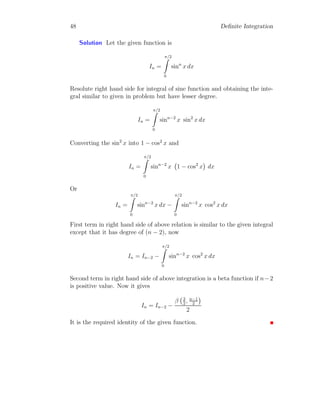
is positive value. Now it gives
In = In−2 −
β 3
2
, n−1
2

2
It is the required identity of the given function.
1.5. INTEGRAL IDENTITIES 49
Solved Problem 1.41 Find the trigonometric identity for the integral
In =
π/2
Z
π/4
cotn
x dx
Solution Let the given function is
In =
π/2
Z
π/4
cotn
x dx
Resolute right hand side for integral of cotangent function and obtaining the
integral similar to given in problem but have lesser degree.
π/2
Z
π/4
cotn−2
x cot2
x dx
Converting the cot2
x into csc2
x − 1 and
In =
π/2
Z
π/4
cotn−2
x csc2
x − 1

dx
Or
In =
π/2
Z
π/4
cotn−2
x csc2
x dx −
π/2
Z
π/4
cotn−2
x dx
Second term in right hand side of above relation is similar to the given integral
except that it has degree of (n − 2), now
In = −In−2 +
π/2
Z
π/4
cotn−2
x csc2
x dx
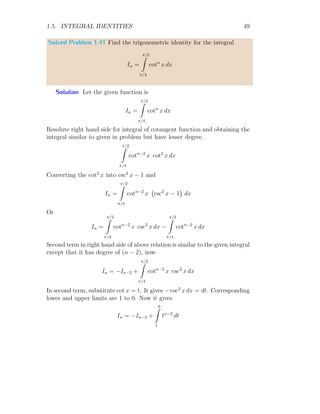
In second term, substitute cot x = t. It gives − csc2
x dx = dt. Corresponding
lower and upper limits are 1 to 0. Now it gives
In = −In−2 +
0
Z
1
tn−2
dt
50 Definite Integration
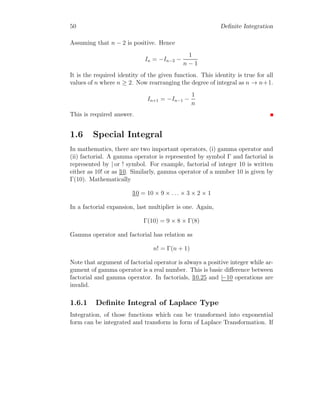
Assuming that n − 2 is positive. Hence
In = −In−2 −
1
n − 1
It is the required identity of the given function. This identity is true for all
values of n where n ≥ 2. Now rearranging the degree of integral as n → n+1.
In+1 = −In−1 −
1
n
This is required answer.
1.6 Special Integral
In mathematics, there are two important operators, (i) gamma operator and
(ii) factorial. A gamma operator is represented by symbol Γ and factorial is
represented by | or ! symbol. For example, factorial of integer 10 is written
either as 10! or as |10. Similarly, gamma operator of a number 10 is given by
Γ(10). Mathematically
|10 = 10 × 9 × . . . × 3 × 2 × 1
In a factorial expansion, last multiplier is one. Again,
Γ(10) = 9 × 8 × Γ(8)
Gamma operator and factorial has relation as
n! = Γ(n + 1)
Note that argument of factorial operator is always a positive integer while ar-
gument of gamma operator is a real number. This is basic difference between
factorial and gamma operator. In factorials, |10.25 and |−10 operations are
invalid.
1.6.1 Definite Integral of Laplace Type
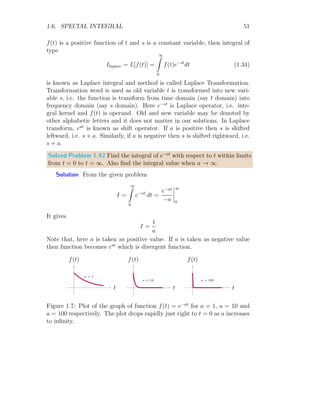
Integration, of those functions which can be transformed into exponential
form can be integrated and transform in form of Laplace Transformation. If
1.6. SPECIAL INTEGRAL 51
f(t) is a positive function of t and s is a constant variable, then integral of
type
Ilapace = L[f(t)] =
∞
Z
0
f(t)e−st
dt (1.34)
is known as Laplace integral and method is called Laplace Transformation.
Transformation word is used as old variable t is transformed into new vari-
able s, i.e. the function is transform from time domain (say t domain) into
frequency domain (say s domain). Here e−st
is Laplace operator, i.e. inte-
gral kernel and f(t) is operand. Old and new variable may be denoted by
other alphabetic letters and it does not matter in our solutions. In Laplace
transform, eat
is known as shift operator. If a is positive then s is shifted
leftward, i.e. s + a. Similarly, if a is negative then s is shifted rightward, i.e.
s + a.
Solved Problem 1.42 Find the integral of e−at
with respect to t within limits
from t = 0 to t = ∞. Also find the integral value when a → ∞.
Solution From the given problem
I =
∞
Z
0
e−at
dt =
e−at
−a
∞
0
It gives
I =
1
a
Note that, here a is taken as positive value. If a is taken as negative value
then function becomes eat
which is divergent function.
t
f(t)
a = 1
t
f(t)
a = 10
t
f(t)
a = 100
Figure 1.7: Plot of the graph of function f(t) = e−at
for a = 1, a = 10 and
a = 100 respectively. The plot drops rapidly just right to t = 0 as a increases
to infinity.
52 Definite Integration
The integral value at a → ∞ is given by
Ia→∞ =
1
∞
= 0
Solved Problem 1.43 Find the integral of t e−at
with respect to t within
limits from t = 0 to t = ∞.
Solution From the given problem
I =
∞
Z
0
te−at
dt =

−
(at + 1)e−at
a2
∞
0
It gives
I =
1
a2
Note that, here a is taken as positive value. If a is taken as negative value
then function becomes eat
which is divergent function.
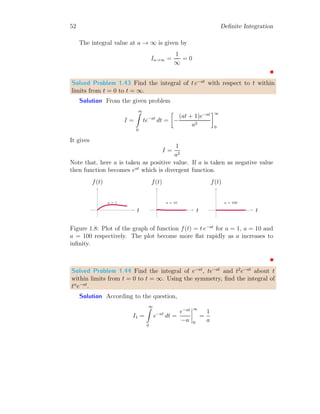
t
f(t)
a = 1
t
f(t)
a = 10
t
f(t)
a = 100
Figure 1.8: Plot of the graph of function f(t) = t e−at
for a = 1, a = 10 and
a = 100 respectively. The plot become more flat rapidly as a increases to
infinity.
Solved Problem 1.44 Find the integral of e−at
, te−at
and t2
e−at
about t
within limits from t = 0 to t = ∞. Using the symmetry, find the integral of
tn
e−at
.
Solution According to the question,
I1 =
∞
Z
0
e−at
dt =
e−at
−a
∞
0
=
1
a
1.6. SPECIAL INTEGRAL 53
I2 =
∞
Z
0
te−at
dt =

−
(at + 1)e−at
a2
∞
0
=
1
a2
I3 =
∞
Z
0
t2
e−at
dt =

−
(a2
t2
+ 2at + 2)e−at
a3
∞
0
=
2
a3
From these three results, we find that the integral values are in order of
In =
n!
an+1
Where, n is power of t and is an integer. So, the
∞
Z
0
tn
e−at
dt =
n!
an+1
This is desire result.
Solved Problem 1.45 Let κ is an operator which means
κ[f(x)] =
t
Z
0
f(x) dx
Now, find the value of κ sin x and κ2
sin x.
Solution The given relation is
κ[f(x)] =
t
Z
0
f(x) dx
Now, substituting the value of f(x) = sin x, we have
κ[sin x] =
t
Z
0
sin x dx = [− cos x]t
0
It gives κ[sin x] = 1 − cos t. Now, κ2
[sin x] can be written as κ [κ[sin x]].
Therefore, f(x) becomes κ[sin x] and its value is 1 − cos x, (t is replaced by
54 Definite Integration
x). Now
κ2
[sin x] =
t
Z
0
(1 − cos x) dx = [x − sin x]t
0
It gives κ2
[sin x] = t − sin t.
Solved Problem 1.46 Find the value of
R ∞
0
e−x2
dx.
Solution To find the integral of this problem, substitute x2
= t. The
corresponding 2x dx = dt. Now, when x = 0, t = 0 and when x = ∞, t = ∞.
The integral becomes
I =
Z ∞
0
t−1/2
e−t
dt
2
Or
I =
1
2
Z ∞
0
t
1
2
−1
e−t
dt =
1
2
× Γ

1
2

This gives I =
√
π/2.
1.6.2 Definite Integral of Fourier Type
We know that Laplace type integral of a function is given by
IL =
∞
Z
0
f(x)e−sx
dx
in s-domain or time domain. If s is replaced iω or jω (where i2
= −1 or
j2
= −1) then integral becomes Fourier type.
IF =
∞
Z
0
f(x)e−iωx
dx (1.35)
Where ω = 2πf in frequency domain. Laplace type integral is related with
Fourier type integral by s ←→ iω. For complete Fourier transform
IF =
∞
Z
−∞
f(x)e−iωx
dx (1.36)
1.6. SPECIAL INTEGRAL 55
A discrete function can also be represented into continuous function by apply-
ing Fourier Series method, i.e. converting Fourier type integral into discrete
series. A function f(x) is equivalent to
f(x) = a0 +
∞
X
n=1
an cos(nx) +
∞
X
n=1
bn sin(nx) (1.37)
Where a0, an and bn are three Fourier constants which can be evaluated for
definite limit range x = a to x = b by using following three relations.
a0 =
1
b − a
b
Z
a
f(x) dx (1.38)
an =
2
b − a
b
Z
a
f(x) cos(nx)dx (1.39)
bn =
2
b − a
b
Z
a
f(x) sin(nx)dx (1.40)
Solved Problem 1.47 Find the constant value of Fourier series integration of
the given function f(x) = x within limits from 0 to π.
Solution Constant term a0 in the Fourier series integration is given by
a0 =
1
b − a
b
Z
a
f(x) dx
Taking limits from 0 to π and function f(x) = x, the Fourier series constant
integral term becomes to
a0 =
1
π − 0
π
Z
0
x dx
Or
a0 =
1
π

x2
2
π
0
It gives a0 = π/2.
56 Definite Integration
Solved Problem 1.48 Find the constant value of Fourier series integration of
the given function f(x) = sin x within limits from 0 to π.
Solution Constant term a0 in the Fourier series integration is given by
a0 =
1
b − a
b
Z
a
f(x) dx
Taking limits from 0 to π and function f(x) = sin x, the Fourier series con-
stant integral term becomes to
a0 =
1
π − 0
π
Z
0
sin x dx
Or
a0 =
1
π
[− cos x]π
0
It gives a0 = 2/π.
Solved Problem 1.49 Find the constant value of Fourier series integration of
the given function f(x) = x sin x within limits from 0 to π.
Solution Constant term a0 in the Fourier series integration is given by
a0 =
1
b − a
b
Z
a
f(x) dx
Taking limits from 0 to π and function f(x) = x sin x, the Fourier series
constant integral term becomes to
a0 =
1
π − 0
π
Z
0
x sin x dx
Or
a0 =
1
π
[sin x − x cos x]π
0
It gives a0 = 1.
1.6. SPECIAL INTEGRAL 57
Solved Problem 1.50 Find the constant value of Fourier series integration of
the given function f(x) = x2
within limits from 0 to π.
Solution Constant term a0 in the Fourier series integration is given by
a0 =
1
b − a
b
Z
a
f(x) dx
Taking limits from 0 to π and function f(x) = x2
, the Fourier series constant
integral term becomes to
a0 =
1
π − 0
π
Z
0
x2
dx
Or
a0 =
1
π

x3
3
π
0
It gives a0 = π2
/3.
1.6.3 Specific Workout
In the following section, we do and find the definite integral by applying
conditions and will analysis our answers.
Solved Problem 1.51 Find the definite integration of f(x) = sin x within
limits from 0 to π/2. What would the answer if function is multiplied by x?
Solution The definite integral as per given problem is
I =
π/2
Z
0
sin x dx = [− cos x]π/2
0 = [− cos(π/2)] − [− cos 0]
This gives I = 1. Now, function is multiplied by x. So, new integral be
I′
=
π/2
Z
0
x × sin x dx = [x × − cos x]π/2
0 −
π/2
Z
0

d
dx
x
 Z
sin x dx

dx
58 Definite Integration
On simplification
I′
=
hπ
2
× − cos(π/2)
i
− [0 × − cos 0] −
π/2
Z
0
[− cos x] dx
Or
I′
= [sin x]π/2
0
It gives, I′
= 1. Thus both results are same.
Solved Problem 1.52 Find the definite integration of f(x) = cos x within
limits from 0 to π/2. What would the answer if function is multiplied by x?
Solution The definite integral as per given problem is
I =
π/2
Z
0
cos x dx = [sin x]π/2
0 = [sin(π/2)] − [sin 0]
This gives I = 1. Now, function is multiplied by x. So, new integral be
I′
=
π/2
Z
0
x × cos x dx = [x × sin x]π/2
0 −
π/2
Z
0

d
dx
x
 Z
cos x dx

dx
On simplification
I′
=
hπ
2
× sin(π/2)
i
− [0 × sin 0] −
π/2
Z
0
[sin x] dx
Or
I′
=
π
2
− 0 − [− cos x]π/2
0 =
π
2
+ cos(π/2) − cos 0
It gives, I′
= π
2
− 1. Thus both results are not same.
Solved Problem 1.53 Find the definite integration of f(x) = 1
1+x2 within
limits from 0 to ∞. What would the answer if function is multiplied by x?
Solution The definite integral as per given problem is
I =
∞
Z
0
1
1 + x2
dx =

tan−1
x
∞
0
=

tan−1
∞

−

tan−1
0
1.6. SPECIAL INTEGRAL 59
This gives I = π/2. Now, function is multiplied by x. So, new integral be
I′
=
∞
Z
0
x
1 + x2
dx
Put 1 + x2
= t. On differentiation, it gives, 2x dx = dt. Or it gives x dx =
dt/2. The corresponding limits are t = 1 to t = ∞ respectively when x = 0
and x = ∞. On simplification
I′
=
1
2
×
∞
Z
1
1
t
dt
Or
I′
=
1
2
× [ln t]∞
1
It gives that I′
is divergent in the given region of x. So, indefinite integral will
be found by substituting the value of t and neglecting the limits of integration
and adding a constant.
I′
=
ln(1 + x2
)
2
+ C
Solved Problem 1.54 Find the definite integration of f(k) = e−sk
within
limits from 0 to ∞. Here s is a constant. What would the answer if function
is multiplied by k?
Solution The definite integral as per given problem is
I =
∞
Z
0
e−sk
dk =
1
−s
×

e−sk
x
∞
0
=
1
−s
×

e−s×∞
− e−s×0

If s  0 then e−s×∞
will be equal to zero. If s  0 say s = −ǫ then e−s×∞
will be equal to eǫ×∞
and it will be equal to ∞. Second case is not acceptable
as integral in divergent, so taking first case (s  0) only, we have I = 1/s.
Now, function is multiplied by k. So, new integral be
I′
=
∞
Z
0
ke−sk
dk
60 Definite Integration
Or
I′
=

−
(sk + 1) e−sk
s2
∞
0
It gives I′
= 1/s2
.
1.6.4 Repetitive Integrals
Some function are periodic function in which their original value can be found
after two or more times integration. These types of functions can be solved
by assuming integral as I. f(x) and g(x) are two functions which returns
to itself on twice derivative or twice integral. Here, two functions, f(x) and
g(x) are taken. Derivating twice to the functions f(x) and g(x), they gave
d
dx
f(x) = f
′
(x);
d
dx
f
′
(x) = f(x)
d
dx
g(x) = g′
(x);
d
dx
g′
(x) = g(x)
Integrating twice to the same functions f(x) and g(x), we got
Z
f(x) dx = F(x);
Z
F(x) dx = f(x)
Z
g(x) dx = G(x);
Z
G(x) dx = g(x)
Now, let I is integral solution of integral of product of these two functions,
i.e. f(x) and g(x) about x. Now
I =
Z
f(x) × g(x) dx (1.41)
Now applying product rule of integration, we get
I = f(x)
Z
g(x) dx ±
Z 
d
dx
f(x)
Z
g(x) dx

dx (1.42)
On solving
I = f(x) G(x) ±
Z h
f
′
(x) G(x)
i
dx (1.43)
1.6. SPECIAL INTEGRAL 61
Again integrating second part of above relation
I = f(x) G(x)±

f
′
(x)
Z
G(x) dx ±
Z 
d
dx
f
′
(x) ×
Z
G(x) dx

dx

(1.44)
on solving
I = f(x) G(x) ±

f
′
(x) g(x) ±
Z
f(x) × g(x) dx

(1.45)
R
f(x) × g(x) dx is equal to I, hence above equation can be written as
I = f(x) G(x) ± f
′
(x) g(x) ± I (1.46)
Here, sign of I in right hand side is determinant. It may cancel to I in left
side or may added to it. Let the coefficient of I is k. So,
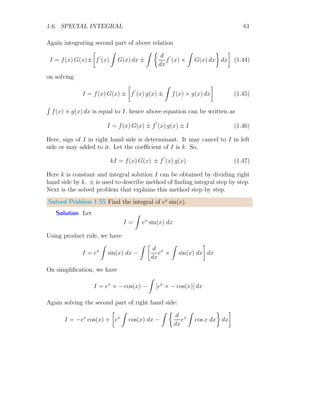
kI = f(x) G(x) ± f
′
(x) g(x) (1.47)
Here k is constant and integral solution I can be obtained by dividing right
hand side by k. ± is used to describe method of finding integral step by step.
Next is the solved problem that explains this method step by step.
Solved Problem 1.55 Find the integral of ex
sin(x).
Solution Let
I =
Z
ex
sin(x) dx
Using product rule, we have
I = ex
Z
sin(x) dx −
Z 
d
dx
ex
×
Z
sin(x) dx

dx
On simplification, we have
I = ex
× − cos(x) −
Z
[ex
× − cos(x)] dx
Again solving the second part of right hand side:
I = −ex
cos(x) +

ex
Z
cos(x) dx −
Z 
d
dx
ex
Z
cos x dx

dx
62 Definite Integration
On simplification
I = −ex
cos(x) + ex
sin(x) −
Z
ex
sin x dx
Or
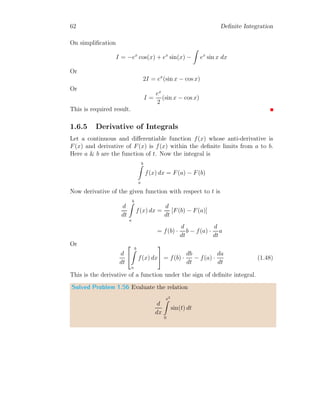
2I = ex
(sin x − cos x)
Or
I =
ex
2
(sin x − cos x)
This is required result.
1.6.5 Derivative of Integrals
Let a continuous and differentiable function f(x) whose anti-derivative is
F(x) and derivative of F(x) is f(x) within the definite limits from a to b.
Here a  b are the function of t. Now the integral is
b
Z
a
f(x) dx = F(a) − F(b)
Now derivative of the given function with respect to t is
d
dt
b
Z
a
f(x) dx =
d
dt
[F(b) − F(a)]
= f(b) ·
d
dt
b − f(a) ·
d
dt
a
Or
d
dt


b
Z
a
f(x) dx

 = f(b) ·
db
dt
− f(a) ·
da
dt
(1.48)
This is the derivative of a function under the sign of definite integral.
Solved Problem 1.56 Evaluate the relation
d
dx
x2
Z
0
sin(t) dt
1.6. SPECIAL INTEGRAL 63
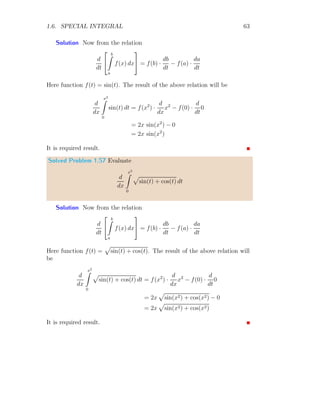
Solution Now from the relation
d
dt


b
Z
a
f(x) dx

 = f(b) ·
db
dt
− f(a) ·
da
dt
Here function f(t) = sin(t). The result of the above relation will be
d
dx
x2
Z
0
sin(t) dt = f(x2
) ·
d
dx
x2
− f(0) ·
d
dt
0
= 2x sin(x2
) − 0
= 2x sin(x2
)
It is required result.
Solved Problem 1.57 Evaluate
d
dx
x2
Z
0
p
sin(t) + cos(t) dt
Solution Now from the relation
d
dt


b
Z
a
f(x) dx

 = f(b) ·
db
dt
− f(a) ·
da
dt
Here function f(t) =
p
sin(t) + cos(t). The result of the above relation will
be
d
dx
x2
Z
0
p
sin(t) + cos(t) dt = f(x2
) ·
d
dx
x2
− f(0) ·
d
dt
0
= 2x
p
sin(x2) + cos(x2) − 0
= 2x
p
sin(x2) + cos(x2)
It is required result.

Definite Integral

  • 1.
    1 DEFINITE INTEGRAL A SHORTNOTES Arun Umrao https://sites.google.com/view/arunumrao DRAFT COPY - GPL LICENSING
  • 2.
    2 Definite Integration Contents 1Definite Integration 3 1.1 Definite Integration . . . . . . . . . . . . . . . . . . . . . . . . 3 1.2 Properties . . . . . . . . . . . . . . . . . . . . . . . . . . . . . 6 1.2.1 In-dependent of Variable . . . . . . . . . . . . . . . . . 6 1.2.2 Flipping of Limits . . . . . . . . . . . . . . . . . . . . . 7 1.2.3 Splitting of Limits . . . . . . . . . . . . . . . . . . . . 8 1.2.4 Shifting of Variable . . . . . . . . . . . . . . . . . . . . 12 1.2.5 Shifting of Periodic Function . . . . . . . . . . . . . . . 14 1.2.6 Even & Odd Function . . . . . . . . . . . . . . . . . . 16 1.2.7 Periodic Even & Odd Function . . . . . . . . . . . . . 23 1.2.8 Splitting of Limit in n Parts . . . . . . . . . . . . . . . 25 1.2.9 Definite Integration & Limits . . . . . . . . . . . . . . 32 1.3 Average Value . . . . . . . . . . . . . . . . . . . . . . . . . . . 34 1.4 Piece-wise Functions . . . . . . . . . . . . . . . . . . . . . . . 37 1.5 Integral Identities . . . . . . . . . . . . . . . . . . . . . . . . . 47 1.6 Special Integral . . . . . . . . . . . . . . . . . . . . . . . . . . 50 1.6.1 Definite Integral of Laplace Type . . . . . . . . . . . . 50 1.6.2 Definite Integral of Fourier Type . . . . . . . . . . . . 54 1.6.3 Specific Workout . . . . . . . . . . . . . . . . . . . . . 57 1.6.4 Repetitive Integrals . . . . . . . . . . . . . . . . . . . . 60 1.6.5 Derivative of Integrals . . . . . . . . . . . . . . . . . . 62 1.6.6 Vector Integration . . . . . . . . . . . . . . . . . . . . 64 1.6.7 Principal & General Value . . . . . . . . . . . . . . . . 65 1.6.8 Integral of Graphs . . . . . . . . . . . . . . . . . . . . 66 1.6.9 Vertically symmetric Function . . . . . . . . . . . . . . 72 1.7 Exponential Trigonometric Functions . . . . . . . . . . . . . . 77
  • 3.
    1.1. DEFINITE INTEGRATION3 1Definite Integration In this chapter, the integration of infinite continuous function is bounded between two limits. 1.1 Definite Integration When integration of a function is limited between two fixed points where function is continuous and limit exists everywhere between these two limits, then The integral is called definite integration. If f(x) is a continuous func- tion in [a, b] and limit exists everywhere in [a, b] then definite integration of the function is given by I = b Z a f(x) dx (1.1) Definite integral depends on lower limit and upper limit only. It is indepen- dent of any intermediate values between [a, b]. If F(x) is integral of f(x) and there are intermediate points j, k and l such that [a, j], [j, k], [k, l], [l, b] then I = j Z a f(x) dx + k Z j f(x) dx + l Z k f(x) dx + b Z l f(x) dx and I = F(j) − F(a) + F(k) − F(j) + F(l) − F(k) + F(b) − F(l) = F(b) − F(a) It shows that only limits a and b are useful. Rest intermediate points are cancelled by each other. Consider a function f(x) = x that is undergoing integration (bar summation) in [−1, 1]. Take the width dx = 0.25, and corresponding integral steps n = 8. The bar diagram for integral of f(x) is given below:
  • 4.
    4 Definite Integration x f b −1.00 b −0.75 b −0.50 b −0.25 b 0 b 0.25 b 0.50 b 0.75 b 1.00 Theintegral in summation form is given by I = 8 X i=1 f(xi) × dxi After solving the integral, we have I = 1 unit. Now, from the direct method of integral, if F is integral of function f then plot of F versus x shall be looked like as given below: x F b −1.00 b −0.75 b −0.50 b −0.25 b 0 b 0.25 b 0.50 b 0.75 b 1.00 b F(−1) = 0.5 b F(1) = 0.5 As we already discussed that, the definite integral depends only on the lower limit and upper limit of the integral. So, the I shall be equal to the sum of F(−1) and F(1). From the plot, I = 0.5 + 0.5 = 1. In case of multi-term function, i.e. I = 1 Z 0 (2x − 2) dx Never consider f(x) = 2x − 2 as a line whose slope is 2 and intercepts y-axis at −2 to avoid numerical errors. But consider it as I = 1 Z 0 2x dx − 1 Z 0 2 dx i.e. difference of areas covered by 2x and x-axis, and 2 and x-axis. Here, two areas of subtracted rather than finding the area of line curve 2x − 2
  • 5.
    1.1. DEFINITE INTEGRATION5 and x-axis. In later case, integral may be zero or negative depending on the values of two areas. Solved Problem 1.1 In the following plot, integral of function f, i.e. F and x graph is drawn. Find 1 Z 0 f(x) dx Again explain, why this value is negative. Solution 1 2 −1 1 2 3 −1 −2 x F b b b b b 3.0 0.0 -1.0 0.0 3.0 From the integral F = I = 1 Z 0 f(x) dx So, from definite integral 1 Z 0 f(x) dx = F(1) − F(0) From the plot, F(1) − F(0) = −1 − 0 = −1 Here, negative sign represents that there may be more than one terms in function f(x) whose integral F(x) is plotted here. During the integration of a multi-term function, result may be positive, zero or negative, depending on the values of area covered by first term of the function f(x) and area covered by second term of the function f(x).
  • 6.
    6 Definite Integration 1.2Properties A definite integral obeys some rules/properties which reduces integrals into easy to solve within the domain of limits. 1.2.1 In-dependent of Variable If function f(x) is independent of its independent variable, i.e. x, then b Z a f(x) dx = b Z a f(t) dt Proof R f(x) dx represents that we have to find the sum (integrate) of product of function f(x) and dx within the limits of x from a to b. Similarly, the relation R f(t) dt has same meaning except that, here independent vari- able is t. Both statements are true and projecting similar meaning. Hence b Z a f(x) dx = b Z a f(t) dt (1.2) Solved Problem 1.2 Transform the function in new variable s. The function is Z x sin x dx Solution Substitute x = s. It gives dx = ds. It converts the integral as Z x sin x dx = Z s sin s ds Solved Problem 1.3 Transform the function in new variable s. The function is Z sin x x dx
  • 7.
    1.2. PROPERTIES 7 SolutionSubstitute x = s. It gives dx = ds. It converts the integral as Z sin x x dx = Z sin s s ds 1.2.2 Flipping of Limits If a and b > a are lower limit and upper limit respectively for a function f(x), where it is being integrated then function integration takes place from a to b. If the direction of integration is change then the integration of function becomes negative, i.e. b Z a f(x) dx = − a Z b f(t) dt Proof Definite integration of b R a f(x) dx is b Z a f(x) dx = F(b) − F(a) The right hand side of above relation shows that the value of integrated func- tion F(x) at lower limit a, i.e. F(a) is subtracted in the value of integrated function F(x) at upper limit b, i.e. F(b). Now take common in right hand side of above relation b Z a f(x) dx = −[−F(b) + F(a)] and it shows that from above description stated, upper limit is a and lower limit is b. Hence b Z a f(x) dx = − a Z b f(x) dx (1.3)
  • 8.
    8 Definite Integration 1.2.3Splitting of Limits Take, a and b as lower and upper limits for the integral of a function f(x). If F(x) is integral of f(x) as Z f(x) dx = F(x) and function f(x) is continuous through the region between [a, b]. We can add a third limit point between boundary limits, a → b, such as a → c → b, where a < c < b. In this case, integral of the function becomes b Z a f(x) dx = c Z a f(x) dx + b Z c f(x) dx (1.4) Proof Definite integration of b R a f(x) dx is b Z a f(x) dx = F(b) − F(a) Adding and subtracting function value, F(c), at a point c in above relation at right side. b Z a f(x) dx = F(b) − F(a) + F(c) − F(c) 1 1 2 x y a b 1 1 2 x y a b c Figure 1.1: This function is integrated in the closed limit of [a, b]. It rep- resents area of region enclosed between function and x-axis. Function is partitioned by splitting limit [a, b] in [a, c] and [c, b]. Area of the region in limit [a, b] is sum of area of these two regions.
  • 9.
    1.2. PROPERTIES 9 Rearrangingright hand side of above relation b Z a f(x) dx = [F(b) − F(c)] + [F(c) − F(a)] Rewriting right side in integral form: b Z a f(x) dx = b Z c f(x) dx + c Z a f(x) dx b Z a f(x) dx = c Z a f(x) dx + b Z c f(x) dx (1.5) Solved Problem 1.4 Find definite integral of each function as plotted in following figure. Solution 1 1 2 t y 1 1 2 3 t y In the first figure, curve has two line segments, (i) the line segment be- tween x = 0 to x = 1 and (ii) line segment between x = 1 to x = 2. The equation of lines are y1 = x; y2 = −x + 2 Here, slope of first line segment is +1 and second line segment is −1 and the y-axis intercepts are c = 0 and c = 2. Now the definite integral of the given curve is I = Z 2 0 y dx = Z 1 0 y1 dx + Z 2 1 y2 dx Substituting the values, we have I = Z 1 0 x dx + Z 2 1 (−x + 2) dx
  • 10.
    10 Definite Integration Now,solving it, we get the definite result as I = 1 2 + 1 2 = 1 This is first result. In the second figure, the equations of line segments can be found by using principle of equation of line passes from two coordinate points. Thus the line segments between definite limits x = 0 to x = 1, x = 1 to x = 2 and x = 2 to x = 3 are respectively y1 = x; y2 = 1; y3 = −x 2 + 2 The integral is I = Z 1 0 y1 dx + Z 2 1 y2 dx + Z 3 2 y3 dx Substituting the values, we have I = Z 1 0 x dx + Z 2 1 1 dx + Z 3 2 (−x/2 + 2) dx Now, solving it, we get the definite result as I = 1 2 + 1 + 3 4 = 2.25 This is second result. 1 1 2 t y 1 1 2 3 t y These result gives the area bounded between curve and the x-axis. Solved Problem 1.5 Find definite integral of each function as plotted in following figure. Solution
  • 11.
    1.2. PROPERTIES 11 1 12 t y 1 1 2 3 t y In the first figure, curve has two line segments, (i) the line segment be- tween x = 0 to x = 1 and (ii) line segment between x = 1 to x = 2. The equation of lines are y1 = −x + 1; y2 = x − 1 Here, slope of first line segment is −1 and second line segment is +1 and the y-axis intercepts are c = 1 and c = −1. Now the definite integral of the given curve is I = Z 2 0 y dx = Z 1 0 y1 dx + Z 2 1 y2 dx Substituting the values, we have I = Z 1 0 (−x + 1) dx + Z 2 1 (x − 1) dx Now, solving it, we get the definite result as I = 1 2 + 1 2 = 1 This is first result. In the second figure, the equations of line segments can be found by using principle of equation of line passes from two coordinate points. Thus the line segments between definite limits x = 0 to x = 1, x = 1 to x = 2 and x = 2 to x = 3 are respectively y1 = −0.5x + 1 y2 = 0.5x; y3 = −0.5x + 2 The integral is I = Z 1 0 y1 dx + Z 2 1 y2 dx + Z 3 2 y3 dx Substituting the values, we have I = Z 1 0 (−0.5x + 1) dx + Z 2 1 0.5x dx + Z 3 2 (−0.5x + 2) dx
  • 12.
    12 Definite Integration Now,solving it, we get the definite result as I = 3 4 + 3 4 + 3 4 = 9 4 = 2.25 This is second result. 1 1 2 t y 1 1 2 3 t y These result gives the area bounded between curve and the x-axis. 1.2.4 Shifting of Variable If f(x) is a continuous function in [a, b] and limit exists everywhere in [a, b] then definite integration of the function is given by I = b Z a f(x) dx Now shift the function by sum of limits, i.e. x = a + b − t; dx = −dt The corresponding limits becomes, when x = a, t = b and when x = b, t = a. So, I = a Z b f(a + b − t) × −dt From the property of flipping of limits, we have I = b Z a f(a + b − t) dt
  • 13.
    1.2. PROPERTIES 13 Fromthe property of changing of independent variable t → x, we have I = b Z a f(a + b − x) dx Here, both relation represents to the same integral and have same meaning. This property is useful in finding of integral of relation type R = f(x) f(x) + f(k − x) Solved Problem 1.6 Evaluate 2 R 1 f(x) f(x)+f(3−x) dx. Solution Let I = 2 Z 1 f(x) f(x) + f(3 − x) dx (1.6) Put x = 1 + 2 − t, it gives dx = −dt. When x = 1, t = 2 and when x = 2, t = 1. Now, the integral relation becomes I = 1 Z 2 f(3 − t) f(3 − t) + f(t) × −dt Or I = 2 Z 1 f(3 − t) f(3 − t) + f(t) dt Transform t → x, we have I = 2 Z 1 f(3 − x) f(3 − x) + f(x) dt (1.7) Adding equations 1.6 and 1.7, we have 2I = 2 Z 1 f(3 − x) + f(x) f(3 − x) + f(x) dx
  • 14.
    14 Definite Integration Or 2I= 1 ⇒ I = 1 2 This is desired result. Note that the answer of these types of relations is always half of the difference of upper and lower limits. 1 2 3 x y f(x) = sin x sin x+sin(3.14−x) 1 −1 x y f(x) = cos x cos x+cos(−x) The function f(x) should neither change its sign (from positive y-axis to negative y-axis or vice-versa) or nature (from sine to cosine or vice-versa) within the limits of integration. For example, this rule is applicable for f(x) = sin x sin x + sin(3.14 − x) but it is not applicable for f(x) = sin x sin x + sin(4 − x) as sin(4 − x) is negative till 4 − x > π. 1.2.5 Shifting of Periodic Function If f(x) is a periodic function in a range from 0 to a then the function f(x) can be written as a Z 0 f(x) dx = a Z 0 f(a − x) dx Proof sin(x) is a periodic function of 2π. After each interval of 2π, its phase is same to the phase, that was just before 2π value. Take a periodic function f(x) of period a. So, x = a − t; dx = −dt The corresponding limits becomes, t = a when x = 0 and t = 0 when x = a. Put the value of x, dx and corresponding limits in left side of relation
  • 15.
    1.2. PROPERTIES 15 x y x f(x) x y x f(x− a) a Figure 1.2: f(x) is periodic function of period a, hence function height at x and at x ± a are same. Function f(x) and f(x ± a) have same meaning. a Z 0 f(x) dx = 0 Z a f(a − t) × (−dt) = − 0 Z a f(a − t) dt = a Z 0 f(a − t) dt Changing the variable t into x a Z 0 f(x) dx = a Z 0 f(a − x) dx (1.8) Split of Limit in Periodic Functions Take a sine function as shown below. This function is being integrate within limits of θ = 0 to θ = 2π. x y x f(x) b 0 b π x y x −f(x) b π b 2π Sign of periodic function changes from positive to negative and vice-versa continuously. For the period of θ = 0 to θ = π, sine function is in positive
  • 16.
    16 Definite Integration region.While for the period of θ = π to θ = 2π, sine function is in negative region. Therefore to integrate the sine function in full range of θ = 0 to θ = 2π is zero. It shown that area covered between horizontal line and function is zero, which is impossible from the above figure. So, to get the actual result, we split the limits according to the nature of the function. So, 2π Z 0 f(θ) dθ = π Z 0 |f(θ)| dθ + 2π Z π | − f(θ)| dθ 1.2.6 Even & Odd Function x f(x) −a a sin x x f(x) −a a cos x Take the cases of sine and cosine as shown in above figure. f(x) = sin x is an odd function as we approach to negative side of x-axis, function approaches to negative y-axis within limits of −a ≤ x ≤ a. Therefore, it is not symmetrical about y-axis. Again, f(x) = cos x is an even function as we approach to negative side of x-axis, function function remains in positive y-axis within limits of −a ≤ x ≤ a. Therefore, it is symmetrical about y-axis, hence it is even function. A function is said to be even or odd function, if f(x) = ( Even if f(−x) = f(x) Odd if f(−x) = −f(x) If a function does not met with any of the above two conditions, then function is neither an odd function nor an even function. Now, take a function f(x), which is either an even function or an odd function within symmetrical limits from −a to +a. f(x) can be transform as a Z −a f(x) dx =      2 a R 0 f(x) dx if f(x) is even function 0 if f(x) is odd function (1.9)
  • 17.
    1.2. PROPERTIES 17 ProofFrom left side of above definition a Z −a f(x) dx = 0 Z −a f(x) dx + a Z 0 f(x) dx (1.10) Now put x = −t in the first part of right hand side of the above relation then x = −t; dx = −dt The corresponding limits are obtained when x = −a then t = a. And when x = 0 then t = 0. The corresponding result is 0 Z −a f(x) dx = 0 Z a f(−t)(−dt) (1.11) = − 0 Z a f(−t) dt (1.12) = a Z 0 f(−t) dt (1.13) Case I : Even Function If f(x) is even function then f(−t) = f(t) the relation (1.10) becomes a Z −a f(x) dx = a Z 0 f(t)(dt) + a Z 0 f(x) dx And replacing t by x result is a Z −a f(x) dx = a Z 0 f(x)(dx) + a Z 0 f(x) dx x f(x) I1 I2 −a a cos x
  • 18.
    18 Definite Integration Fromabove figure, I = I1 + I2 where I represents to integral equivalent to area covered within the function and x-axis. Now, I1 = I2, therefore, I = 2I1 = 2I2. Therefore b Z a f(x) dx = 2 a Z 0 f(x) dx (1.14) Case II : Odd Function If f(x) is odd function then f(−t) = −f(t) the relation (1.10) becomes a Z −a f(x) dx = − a Z 0 f(t)(dt) + a Z 0 f(x) dx And replacing t by x result is a Z −a f(x) dx = − a Z 0 f(x)(dx) + a Z 0 f(x) dx x f(x) I1 I2 −a a sin x From above figure, I = −I1 + I2 where I represents to integral equivalent to area covered within the function and x-axis. Algebraic sum of these two areas is zero. Therefore I = 0, i.e. b Z a f(x) dx = 0 (1.15)
  • 19.
    1.2. PROPERTIES 19 Integrationof Even & Odd Functions Simply, take a function f(x) = xn which is defined as f(x) = ( Even if n is even Odd if n is odd On, its integration, we get I = Z f(x) dx = Z xn dx = xn+1 n + 1 Now, f(x) = ( Even if n is odd Odd if n is even It means, an odd function converts into an even function and vice-versa. Again, take the case of sin x, its integration is cos x. Here, sin x is an odd function which is transform into even function after integration. x f(x) sin x R x f(x) cos x Solved Problem 1.7 Find whether f(x) = x2 is an even function or an odd function. Solution x f(x)
  • 20.
    20 Definite Integration Afunction f(x) is even if f(−x) = f(x) and odd if f(−x) = −f(x). Now, substituting the x by −x in the given function: f(−x) = (−x)2 = x2 = f(x) Therefore, the given function is an even function. Solved Problem 1.8 Find whether f(x) = −x2 is an even function or an odd function. Solution x f(x) A function f(x) is even if f(−x) = f(x) and odd if f(−x) = −f(x). Now, substituting the x by −x in the given function: f(−x) = −(−x)2 = −x2 = f(x) Therefore, the given function is an even function. Solved Problem 1.9 Find whether f(t) = t3 − 2t − 4 is an even function or an odd function. Solution A function f(t) is even if f(−t) = f(t) and odd if f(−t) = −f(t). Now, substituting the t by −t in the given function: f(−t) = (−t)3 − 2(−t) − 4 = −t3 + 2t − 4 = −(t3 − 2t + 4) 6= f(t) 6= −f(t) Therefore, the given function is neither an odd function nor an even function. Solved Problem 1.10 Find whether f(t) = sin t + t cos t is an odd function or an even function.. Solution A function f(t) is even if f(−t) = f(t) and odd if f(−t) = −f(t). Now, substituting the t by −t in the given function: f(−t) = sin(−t) + (−t) cos(−t) = − sin t − t cos t = −(sin t + t cos t) = −f(t) Therefore, the given function is an odd function.
  • 21.
    1.2. PROPERTIES 21 SolvedProblem 1.11 Show that integration of even function f(x) = x2 − 2 is results into odd function. Solution The given function f(x) = x2 − 2 is an even function. Now, integrating it, we have F(x) = Z f(x) dx = Z (x2 − 2) dx = x3 3 − 2x Now, the function is F(x) = x3 3 − 2x. To check the function is odd or even, substitute x by −x. F(x) = (−x)3 3 − 2(−x) = − x3 3 + 2x = − x3 3 − 2x = −F(x) Therefore, F(x) is an odd function. Solved Problem 1.12 Show that derivative of an odd function is an even function. Solution A function is said to be odd function if f(−x) = −f(x). Take simple odd function as f(x) = axn ⇒ f(−x) = −axn Where n is a positive odd integer, i.e. 1, 3, . . .. Using derivative rules, we have f ′ (x) = an xn−1 As n is a positive odd number, hence a × n will be positive. We know that if n is an odd number then n ± 1 is always even number. Now, n − 1 is definitely an even number. Now, f ′ (−x) = an(−x)n−1 = an xn−1 Hence, the derivative of an odd function is an even function. Solved Problem 1.13 Show that derivative of an even function is an odd function. Solution A function is said to be even function if f(−x) = f(x). Take simple even function as f(x) = axn ⇒ f(−x) = axn
  • 22.
    22 Definite Integration Wheren is a positive odd integer, i.e. 0, 2, 4, . . .. Using derivative rules, we have f ′ (x) = an xn−1 As n is a positive even number, hence a × n will be positive. We know that if n is an even number then n ± 1 is always odd number. Now, n − 1 is definitely an odd number. Now, f ′ (−x) = an(−x)n−1 = −an xn−1 Hence, the derivative of an even function is an odd function. Solved Problem 1.14 Show that integration of function f(x) = sin x is an even function. Solution The given function f(x) = sin x is an odd function. Now, integrating it, we have F(x) = Z f(x) dx = Z sin x dx = cos x Now, the function is F(x) = cos x. To check the function is odd or even, substitute x by −x. F(x) = cos(−x) = cos x = F(x) Therefore, F(x) is an even function. Solved Problem 1.15 Show that definite integral of odd function f(x) = sin x is zero in the domain of −π/2 ≤ x ≤ π/2. Solution The given function f(x) = sin x is an odd function. Now, integrating it, we have F(x) = Z f(x) dx = Z sin x dx = cos x Now the definite integral is F(x)| π/2 −π/2 = cos x| π/2 −π/2 = 0 Hence definite integral of odd function f(x) = sin x is zero in the given domain.
  • 23.
    1.2. PROPERTIES 23 SolvedProblem 1.16 Show that definite integral of even function f(x) = cos x in the domain of −π/2 ≤ x ≤ π/2 is twice to the definite integral of the function within the domain of −π/2 ≤ x ≤ 0 or 0 ≤ x ≤ π/2. Solution The definite integral of the given function in the domain of −π/2 ≤ x ≤ π/2 is I = π/2 Z −π/2 cos x dx = sin x| π/2 −π/2 = 2 Now, the definite integral of the same function in the domain of −π/2 ≤ x ≤ 0 or 0 ≤ x ≤ π/2 is I1 = 0 Z −π/2 cos x dx = sin x|0 −π/2 = 1 and I2 = π/2 Z 0 cos x dx = sin x|π/2 0 = 1 This shows that I is twice to the either I1 or I2. 1.2.7 Periodic Even Odd Function If f(x) is either an even periodic function or an odd periodic function of range from 0 to 2a then 2a Z 0 f(x) dx =      2 a R 0 f(x) dx if f(2a − x) = f(x) 0 if f(2a − x) = −f(x) (1.16) Proof From left side of above definition 2a Z 0 f(x) dx = a Z 0 f(x) dx + 2a Z a f(x) dx (1.17)
  • 24.
    24 Definite Integration Nowput x = (2a − t) and dx = −dt in the second term of the right hand side of the above relation alongwith corresponding limits are; when x = a, t = a and when x = 2a, t = 0. Now, the corresponding relation becomes 2a Z 0 f(x) dx = 0 Z a f(2a − t) (−dt) (1.18) = − 0 Z a f(2a − t) dt (1.19) = a Z 0 f(2a − t) dt (1.20) I If f(2a − x) is even periodic function then f(2a − t) = f(t) the relation (1.17) becomes 2a Z 0 f(x) dx = a Z 0 f(t) dt + a Z 0 f(x) dx And replacing t by x result is 2a Z 0 f(x) dx = a Z 0 f(x) dx + a Z 0 f(x) dx 2a Z 0 f(x) dx = 2 a Z 0 f(x) dx (1.21) II If f(2a − x) is odd function then f(2a − t) = −f(t) the relation (1.17) becomes 2a Z 0 f(x) dx = − a Z 0 f(t) dt + a Z 0 f(x) dx And replacing t by x result is 2a Z 0 f(x) dx = − a Z 0 f(x) dx + a Z 0 f(x) dx
  • 25.
    1.2. PROPERTIES 25 2a Z 0 f(x)dx = 0 (1.22) 1.2.8 Splitting of Limit in n Parts If f(x) is a periodic function of period a then na Z 0 f(x) dx = n a Z 0 f(x) dx Proof The relation becomes na Z 0 f(x) dx = a Z 0 f(x) dx + 2a Z a f(x) dx + . . . . . . + na Z (n−1)a f(x) dx (1.23) Applying properties of the periodic function, when f(x) is even function, then the relation becomes na Z 0 f(x) dx = a Z 0 f(x) dx + a Z 0 f(x) dx + . . . . . . + a Z 0 f(x) dx (n times) na Z 0 f(x) dx = n a Z 0 f(x) dx (1.24) It proved. Solved Problem 1.17 Solve π/2 R 0 √ sin x √ sin x+ √ cos x dx = π 4 . Solution The integral is π/2 R 0 √ sin x √ sin x+ √ cos x dx which is a periodic function in the interval of θ = 0 to θ = π 2 . Now I = π/2 Z 0 √ sin x √ sin x + √ cos x dx (1.25)
  • 26.
    26 Definite Integration Andits periodic derivation is I = π/2 Z 0 p sin(π/2 − x) p sin(π/2 − x) + p cos(π/2 − x) dx I = π/2 Z 0 √ cos x √ cos x + √ sin x dx (1.26) Now adding above two equations 2I = π/2 Z 0 √ cos x + √ sin x √ cos x + √ sin x dx = π/2 Z 0 1dx Taking integration and substituting the limits of integration 2I = [x]π/2 0 = π/2 Now solving it we will get the result as I = π 4 (1.27) Solved Problem 1.18 Solve π/2 R 0 sin2 x sin x+cos x dx = 1 √ 2 loge( √ 2 + 1). Solution Solved Problem 1.19 Solve π R 0 x tan x sec x+tan x dx = π(π 2 − 1). Solution The integral is π R 0 x tan x sec x+tan x dx which is a periodic function in the interval of θ = 0 to θ = π. Now I = π Z 0 x tan x sec x + tan x dx (1.28)
  • 27.
    1.2. PROPERTIES 27 Andits periodic derivation is I = π Z 0 (π − x) tan(π − x) sec(π − x) + tan(π − x) dx I = π Z 0 (π − x) (− tan x) − sec x − tan x dx (1.29) Now adding above two equations 2I = π Z 0 π tan x sec x + tan x dx Rationalizing right hand side by multiplying and diving it by sec x − tan x. 2I = π Z 0 π tan x(sec x − tan x) sec2 x − tan2 x dx = π Z 0 π tan x(sec x − tan x) 1 dx Opening the bracket to make two parts in right hand side. 2I = π Z 0 π tan x · sec x dx − π Z 0 tan2 x dx = π Z 0 π tan x · sec x dx − π Z 0 (sec2 x − 1) dx Taking integration and substituting the limits of integration 2I = π [sec x]π 0 − π [tan x − x]π 0 = π [sec π − sec 0] − π [tan π − π − tan 0 + 0] = π [−1 − 1 − 0 + π + 0 + 0] = π [π − 2] Now solving it, we will get the result as I = π π 2 − 1 (1.30)
  • 28.
    28 Definite Integration SolvedProblem 1.20 Evaluate π R 0 ecos θ · cos(sin θ) dθ. Solution The given integral is I = π Z 0 ecos θ · cos(sin θ) dθ It is definite integral whose limits ranges from θ = 0 to θ = 2π. Now changing the term ecos θ · cos(sin θ) in exponential form. ecos θ · cos(sin θ) = Real part of {ecos θ · ei sin θ } Here cos(sin θ) is taken from relation ei sin θ = cos(sin θ) + i sin(sin θ) ei sin θ has both real and imaginary parts but according to question only real part is required in our problem. Now π Z 0 ecos θ · cos(sin θ) dθ = Real part of    π Z 0 ecos θ · ei sin θ dθ    = Real part of    π Z 0 ecos θ+i sin θ dθ    = Real part of    π Z 0 eexp(iθ) dθ    Substitute eiθ = z and eiθ i dθ = dz π Z 0 ecos θ · cos(sin θ) dθ = Real part of    θ=π Z θ=0 1 i ez z dz    = Real part of    θ=π Z θ=0 1 i 1 z 1 + z + z2 2! + . . . . . . dz    = Real part of ( 1 i log z + z + z2 2 × 2! + . . . . . . θ=π θ=0 )
  • 29.
    1.2. PROPERTIES 29 Substitutingthe value of z π Z 0 ecos θ · cos(sin θ) dθ = Real part of 1 i iθ + eiθ z + e2iθ 2 × 2! + . . . . . . π 0 = Real part of θ + eiθ i + e2iθ 2 × 2! × i + . . . . . . π 0 Taking only real terms in right hand side π Z 0 ecos θ · cos(sin θ) dθ = θ + sin θ + sin 2θ 2 × 2! + . . . . . . π 0 = π It is the required answer. Addition of Constant Term in Integral Result In indefinite integration, after each integration we add a constant value for proper result. But the question is why do we do so. The answer is that, in indefinite integration we take reference point “zero” for a variable. Hence range of integration lies between zero to variable itself. If we want to change the reference point other than zero, we need two values. (i) new reference point, ‘c’ and (ii) function value, f(c) at this new reference point. The function value at this new reference point, ‘c’, can be found by just putting the new reference point value in function f(x). This constant value is work as new reference function. In definite integration the reference point other than zero is represented by lower limit and reference function value is represented by the lower limit integral value. Mathematically I = Z f(x) dx is infinite integral. Its lower limit is zero and upper limit is variable of integral itself. Hence in definite integral form, indefinite integral can be written as I = x Z 0 f(x) dx If we want to change the reference point other than zero, we have to add a constant term in right hand side. Let the reference point is c in x-line
  • 30.
    30 Definite Integration where0 c x then above integral becomes I = c Z 0 f(x) dx + x Z c f(x) dx here c R 0 f(x) dx is definite integral for x-limits ranging from zero to constant ‘c’. If it is a constant value then I = x Z c f(x) dx + C There is another reason that can interpret it. Suppose a function is like f(x) = g(x) + C After differentiation it gives F(x) = G(x) Where F(x) = d dx f(x) and G(x) = d dx g(x). If we again integrate above differentiated result then we get the actual function f(x) f(x) = Z F(x) dx = Z G(x) dx But after integration, the result will be f(x) = g(x) It differs from the actual function as there is no constant term. To make it actual function value, we add a constant term in right hand side. So f(x) = g(x) + C This is reason for out question. In case of definite integration, lower limit is act as reference point, hence there is no need to add a constant term in
  • 31.
    1.2. PROPERTIES 31 righthand side of the answer. For example I = x Z c f(x) dx Solved Problem 1.21 If f(x) = x6 − x3 + 15, then find 1 R 0 f ′′ (x) dx. Solution The second derivative of the given function is f ′′ (x) = 30x4 − 6x Now, I = 1 Z 0 30x4 − 6x dx = 6x5 − 3x2 1 0 This gives I = 3. Solved Problem 1.22 If f(x) = tx3 − t2 x2 + 5, then find 1 R 0 f ′′ (x) dt. Solution The second derivative of the given function is f ′′ (x) = 6tx − 2t2 Now, I = 1 Z 0 6tx − 2t2 dt = 3xt2 − 2 3 t3 1 0 This gives I = 3x − 2 3 This is desired answer.
  • 32.
    32 Definite Integration SolvedProblem 1.23 A resonance term f(t) = sin(ωt) is derivated twice with respect to t and then integrated with respect to ω. Find the result. Solution The given function is f(t) = sin(ωt) Its twice derivative about t is given by f ′′ (t) = −ω2 sin(ωt) Now, integral is I = Z −ω2 sin(ωt) dω On integration it with respect to ω, we have I = − 2tω sin(ωt) + (2 − t2 w2 ) cos(ωt) t3 This is desired result. 1.2.9 Definite Integration Limits A definite integration of a function f(x) withing bounded region [a, b] is given by I = b Z a f(x) dx Here, a is lower bound of the function and b is upper bound of the function. If function f(x) is integrated within symmetric boundaries as I = a Z −a f(x) dx then it can be represented at with limits as I = lim ε→a ε Z −ε f(x) dx
  • 33.
    1.2. PROPERTIES 33 Thisnotation is helpful, when function is defined at a point but integration is being done in a range of limits. Integration of function at points 0 is written as I = lim ε→0 ε Z −ε f(x) dx and at point ∞ is written as I = lim ε→0 1/ε Z −1/ε f(x) dx Solved Problem 1.24 Evaluate limε→0 ε R −ε e−x dx. Solution This integral is symmetric integral near about zero. The inte- grand will represent a line of zero width and certain height. So, even if the height of the function is one unit at ε = 0, yet the area is zero due to zero width. Now, I = lim ε→0 ε Z −ε e−x dx = lim ε→0 h −e−x
  • 35.
    ε −ε i Or I = lim ε→0 eε −e−ε x f x f x f Figure 1.3: The symmetry of integration in above three figures is for |ε| → 0.5, |ε| → 0.25 and |ε| → 0.05. Expanding the exponential and simplifying them, we get I = lim ε→0 ε + −ε3 3! + . . . = 0
  • 36.
    34 Definite Integration Thisis desired answer. 1.3 Average Value We know that R f(x) dx represents the Area between function f(x) and two points of width dx in base line. If b Z a f(x) dx is area between f(x) and x-limits (x = a and x = b). The average value for this limit is given by Iavg = b R a f(x) dx b R a dx (1.31) Above relation is similar to the mathematical average, i.e. average area is the ratio of total area to the difference of limit. Solved Problem 1.25 Find the average value of constant ‘c’ for the limits ranges from t = a to t = b. Solution The average value of function f(t) is given by Iavg = b R a c dt b R a dt t c b b c c b b a b Now Iavg = c [t]b a [t]b a
  • 37.
    1.3. AVERAGE VALUE35 Solving the relation Iavg = c This shows that the average value of constant remains constant. Solved Problem 1.26 Find the average value of f(t) = t2 for the t-limits ranges from t = a to t = b. Solution The average value of function f(t) is given by Iavg = b R a t dt b R a dt t f(t) b b f(a) f(b) b b a b t line Now Iavg = h t2 2 ib a [t]b a Solving the relation Iavg = 1 2 (a + b) This shows that the average values of a line is average of sum of two ends of the line. Solved Problem 1.27 Find the average value of f(x) = x2 for the x-limits ranges from x = 2 to x = 3. Solution From the average relation Iavg = b R a f(x) dx b R a dx
  • 38.
    36 Definite Integration x f(x) b b f(a) f(b) bb a b f(x) = x2 Substituting the values and integrating for the limits Iavg = 3 R 2 x2 dx 3 R 2 dx Or Iavg = h x3 3 i3 2 [x]3 2 Or Iavg = 19 3 This is the required average value. Solved Problem 1.28 Find the average value of f(x) = sin(x) within the angle limits in radian values from x = π/3 to 2π/3. Solution The average of function within the limits is Iavg = 2π 3 R π 6 sin(x)dx 2π 3 R π 6 dx On integration and solving it Iavg = [− cos(x)] 2π 3 π 6 [x] 2π 3 π 6
  • 39.
    1.4. PIECE-WISE FUNCTIONS37 x f(x) b b f(π/6) f(2π/3) b b π/6 2π/3 f(x) = sin(x) Iavg = − cos(2π 3 ) + cos(π 6 ) 2π 3 − π 6 Or Iavg = 0.5 + 0.866) 2.093 − 0.523 = 1.366 1.57 = 0.87 This is required result. 1.4 Piece-wise Functions A function F(x) is said to be a piece-wise function if it follows different functions at different conditions. See the following function F(x), that is defined for two conditions of independent variable x, i.e. (i) when x 0 and (ii) x ≥ 0. F(x) = ( f(x) if x 0 g(x) if x ≥ 0 (1.32) The integration of the piece-wise functions is performed within the domain of the functions. Integration of above function F(x) is given by Z f(x) dx = 0 Z −∞ f(x) dx + ∞ Z 0 g(x) dx (1.33) Solved Problem 1.29 Find the integral of the given function. f(x) = ( 2 if − 4 ≤ x 0 x if 0 ≤ x ≤ 2
  • 40.
    38 Definite Integration SolutionIntegration of given function is I = 2 Z −4 f(x) dx Replacing the function f(x) for its domain of ‘x’ I = 0 Z −4 2 dx + 2 Z 0 x dx On solving it I = [2x]0 −4 + x2 2 2 0 Or I = 10 Solved Problem 1.30 Find the integral of the given function in −∞ x ∞. f(x) = ( x − 1 if − 1 ≤ x ≤ 0 0 otherwise Solution 1 −1 −2 1 −1 −2 x f(x) 1 −1 −2 1 −1 −2 x F(x)
  • 41.
    1.4. PIECE-WISE FUNCTIONS39 The integral of the piecewise function is F(x) = ∞ Z −∞ f(x) dx Substituting the function in above integral relation for as it is defined piece- wise. F(x) = −1 Z −∞ 0 dx + 0 Z −1 (x − 1) dx + ∞ Z 0 0 dx On solving it F(x) = x2 2 − x 0 −1 = 0 − (−1)2 2 − (−1) = 3 2 It is integral of given piecewise function in domain −∞ x ∞. Solved Problem 1.31 Find the integral of the given unit step function within the domain of 0 ≤ t ≤ ∞. u(t − 2) = ( 0 if t 2 1 if t ≥ 2 What will be integration of e−at u(t − 2) within the same domain of ‘t’? Solution A unit step function is that function whose value is zero if variable is less than the transition point. And its value is ‘1’ if the variable is equal or larger than the transition point. In the given function, u(t − 2) tells that the transition point for the variable t is t − 2 = 0 ⇒ t = 2. Therefore, the unit step function value is 0 for t 2 and 1 for t ≥ 2. 1. Integration of given function is I = ∞ Z 0 u(t − 2) dt Replacing the unit step function u(t − 2) for its domain of ‘t’ I = 2 Z 0 0 dt + ∞ Z 2 1 dt
  • 42.
    40 Definite Integration Onsolving it I = 0 + [x]∞ 2 Or I = ∞ Ans-1. 2. Integration of e−at u(t − 2) is I = ∞ Z 0 e−at u(t − 2) dt Replacing the unit step function u(t − 2) for its domain of ‘t’ I = 2 Z 0 e−at × 0 dt + ∞ Z 2 e−at × 1 dt On solving it I = 0 + e−at −a ∞ 2 Or I = e−2a a Ans-2. By this way, we can obtain the Laplace Transformations of unit step function also. Second derivative is very important in engineering. Solved Problem 1.32 Check whether the given piece-wise function exists or not. f(t) = ( 2t if 0 ≤ t ≤ 1 t + 1 if 1 ≤ t ≤ 2 Also find the ∞ R −∞ f(t) dt. Solution Function is critical for both piece-wise parts at t = 1. Therefore, at this point, function should be continuous for its existence. So f(t)− = 2 × 1 = 2
  • 43.
    1.4. PIECE-WISE FUNCTIONS41 and f(t)+ = 1 + 1 = 2 Here, f(t)+ = f(t)− , hence function exists. It is also necessary condition for the existence of the piece-wise function. 1 2 3 1 2 t f(t) (1) 1 2 3 1 2 t f(t) (2) 1 2 3 1 2 t f(t) (3) Figure 1.4: Figure (1) is plot of piece-wise function, while figure (2) is plot of integral of the given function. Figure (3) shows the total area covered by given piece-wise function and x-axis. Now, integration of the given function is I = ∞ Z −∞ f(t) dt The domain of the given function is not universal, therefore, the integral limits are depends on the sub-functions of piece-wise function. So, I = 1 Z 0 2t dt + 2 Z 1 (t + 1) dt Or I = [t2 ]1 0 + t2 2 + t 2 1 On solving it, we get I = 7/2. This is desired result.
  • 44.
    42 Definite Integration SolvedProblem 1.33 Find the integration of function as shown below: Solution 1 1 2 3 x y This piecewise function is a constant function as f(x) = 1 within the limits of integration 1 ≤ x ≤ 3. Now, its integration is I = 3 Z 1 1 dx = x|3 1 = 3 − 1 = 2 This is result. Solved Problem 1.34 Find the integration of function as shown below: Solution x y a a + k This piecewise function is a constant function as f(x) = c within the limits of integration a ≤ x ≤ a + k. Now, its integration is I = a+k Z a c dx = c h x|a+k a i = ck This is result.
  • 45.
    1.4. PIECE-WISE FUNCTIONS43 Solved Problem 1.35 Find the integration of function as shown below: Solution 1 −1 1 2 3 4 5 x y This piecewise function is a square wave function as |f(x)| = 1. f(x) = 1 within the limits of integration 1 ≤ x ≤ 2, f(x) = −1 within the limits of integration 2 ≤ x ≤ 3, f(x) = 1 within the limits of integration 3 ≤ x ≤ 4 and so on. Assuming that the integral is area integral, then I = 4 2 Z 1 1 dx = 4 x|2 1 = 4 This is result. Solved Problem 1.36 Sketch the graph of function u(t − 1) = 0 if t 1 1 if 1 ≤ t ≤ 3 and find the integral of it. Solution The sketch of the graph of above piecewise function is as given below: 1 1 2 3 t u This piecewise function is a unit step function which makes step at t = 1.
  • 46.
    44 Definite Integration Now,its integration is I = 1 Z −∞ 0 dt + 3 Z 1 1 dt = t|3 1 = 3 − 1 = 2 This is result. Solved Problem 1.37 A ramp function is given by f(x) =    0 if x 0 mx if 0 ≤ x ≤ a 1 if a x ≤ a + k Find its integral in symbolic form. What shall be the integral value if (i) a = 2, k = 1 and (ii) a = 3, k = 0.25? Solution x f(x) a a + k b 1 α The integral of this ramp function shall be I = ∞ Z −∞ f(x) dx Substituting the piecewise function here, we have I = 0 Z −∞ 0 dx + a Z 0 mx dx + a+k Z a 1 dx On integrating it, we have I = c + m × x2 2
  • 50.
  • 51.
    1.4. PIECE-WISE FUNCTIONS45 As the function is zero for x 0, so c = 0. So, I = ma2 2 + k This is symbolic form of result of the given integral. Now 1: a = 2 and k = 1 I1 = m × 22 2 + 1 = 2m + 1 2: a = 3 and k = 0.25 I1 = m × 32 2 + 0.25 = 4.5m + 0.25 These are desire results. Solved Problem 1.38 A piecewise function is defined as f(x) = 1/k if a ≤ x ≤ a + k 0 otherwise Show that area covered by this function is unity, i.e. its integral is unity irrespective of value of k. Plot its graph. Solution The integral of this function is I = ∞ Z −∞ f(x) dx Substituting the piecewise function here, we have I = a Z −∞ 0 dx + a+k Z a 1 k dx + ∞ Z a+k 0 dx On integrating it, we have I = c + 1 k × x|a+k a + d
  • 52.
    46 Definite Integration Here,c and d are arbitrary constants. As the function is zero for x a and x a + k, so c = 0 and d = 0. So, I = 1 k × k = 1 This result is independent of k, so integration of the given function is always unity irrespective of value of k. The plot of the given function is 1/k a a + k Figure 1.5: Plot of function f(x) = 1/k with k = 0.75. Solved Problem 1.39 A piecewise function is defined as f(x) = 1/100 if k ≤ x ≤ k + 100 0 otherwise Show that its integral is unity. Plot its graph. Solution The integral of this function is I = ∞ Z −∞ f(x) dx Substituting the piecewise function here, we have I = a Z −∞ 0 dx + k+100 Z k 1 100 dx + ∞ Z k+100 0 dx On integrating it, we have I = c + 1 100 × x|k+100 k + d
  • 53.
    1.5. INTEGRAL IDENTITIES47 Here, c and d are arbitrary constants. As the function is zero for x k and x k + 100, so c = 0 and d = 0. So, I = 1 100 × 100 = 1 This shows that result is unity. The plot of the given function is 1/100 k k + 100 Figure 1.6: Plot of function f(x) = 1/k with k = 100. 1.5 Integral Identities Let f(x) is a n degree function represented by In. The integration of this function within limits a to b is given by In = b Z a f(x) dx The right hand side of above relation can be written in terms of I and n only as In = αIj + βIk + γ Where Ij and Ik are the integral of the same function within the same range of limits as of In and having degrees other than the n. Solved Problem 1.40 Find the trigonometric identity for the integral In = π/2 Z 0 sinn x dx
  • 54.
    48 Definite Integration SolutionLet the given function is In = π/2 Z 0 sinn x dx Resolute right hand side for integral of sine function and obtaining the inte- gral similar to given in problem but have lesser degree. In = π/2 Z 0 sinn−2 x sin2 x dx Converting the sin2 x into 1 − cos2 x and In = π/2 Z 0 sinn−2 x 1 − cos2 x dx Or In = π/2 Z 0 sinn−2 x dx − π/2 Z 0 sinn−2 x cos2 x dx First term in right hand side of above relation is similar to the given integral except that it has degree of (n − 2), now In = In−2 − π/2 Z 0 sinn−2 x cos2 x dx Second term in right hand side of above integration is a beta function if n−2 is positive value. Now it gives In = In−2 − β 3 2 , n−1 2 2 It is the required identity of the given function.
  • 55.
    1.5. INTEGRAL IDENTITIES49 Solved Problem 1.41 Find the trigonometric identity for the integral In = π/2 Z π/4 cotn x dx Solution Let the given function is In = π/2 Z π/4 cotn x dx Resolute right hand side for integral of cotangent function and obtaining the integral similar to given in problem but have lesser degree. π/2 Z π/4 cotn−2 x cot2 x dx Converting the cot2 x into csc2 x − 1 and In = π/2 Z π/4 cotn−2 x csc2 x − 1 dx Or In = π/2 Z π/4 cotn−2 x csc2 x dx − π/2 Z π/4 cotn−2 x dx Second term in right hand side of above relation is similar to the given integral except that it has degree of (n − 2), now In = −In−2 + π/2 Z π/4 cotn−2 x csc2 x dx In second term, substitute cot x = t. It gives − csc2 x dx = dt. Corresponding lower and upper limits are 1 to 0. Now it gives In = −In−2 + 0 Z 1 tn−2 dt
  • 56.
    50 Definite Integration Assumingthat n − 2 is positive. Hence In = −In−2 − 1 n − 1 It is the required identity of the given function. This identity is true for all values of n where n ≥ 2. Now rearranging the degree of integral as n → n+1. In+1 = −In−1 − 1 n This is required answer. 1.6 Special Integral In mathematics, there are two important operators, (i) gamma operator and (ii) factorial. A gamma operator is represented by symbol Γ and factorial is represented by | or ! symbol. For example, factorial of integer 10 is written either as 10! or as |10. Similarly, gamma operator of a number 10 is given by Γ(10). Mathematically |10 = 10 × 9 × . . . × 3 × 2 × 1 In a factorial expansion, last multiplier is one. Again, Γ(10) = 9 × 8 × Γ(8) Gamma operator and factorial has relation as n! = Γ(n + 1) Note that argument of factorial operator is always a positive integer while ar- gument of gamma operator is a real number. This is basic difference between factorial and gamma operator. In factorials, |10.25 and |−10 operations are invalid. 1.6.1 Definite Integral of Laplace Type Integration, of those functions which can be transformed into exponential form can be integrated and transform in form of Laplace Transformation. If
  • 57.
    1.6. SPECIAL INTEGRAL51 f(t) is a positive function of t and s is a constant variable, then integral of type Ilapace = L[f(t)] = ∞ Z 0 f(t)e−st dt (1.34) is known as Laplace integral and method is called Laplace Transformation. Transformation word is used as old variable t is transformed into new vari- able s, i.e. the function is transform from time domain (say t domain) into frequency domain (say s domain). Here e−st is Laplace operator, i.e. inte- gral kernel and f(t) is operand. Old and new variable may be denoted by other alphabetic letters and it does not matter in our solutions. In Laplace transform, eat is known as shift operator. If a is positive then s is shifted leftward, i.e. s + a. Similarly, if a is negative then s is shifted rightward, i.e. s + a. Solved Problem 1.42 Find the integral of e−at with respect to t within limits from t = 0 to t = ∞. Also find the integral value when a → ∞. Solution From the given problem I = ∞ Z 0 e−at dt = e−at −a
  • 61.
    ∞ 0 It gives I = 1 a Notethat, here a is taken as positive value. If a is taken as negative value then function becomes eat which is divergent function. t f(t) a = 1 t f(t) a = 10 t f(t) a = 100 Figure 1.7: Plot of the graph of function f(t) = e−at for a = 1, a = 10 and a = 100 respectively. The plot drops rapidly just right to t = 0 as a increases to infinity.
  • 62.
    52 Definite Integration Theintegral value at a → ∞ is given by Ia→∞ = 1 ∞ = 0 Solved Problem 1.43 Find the integral of t e−at with respect to t within limits from t = 0 to t = ∞. Solution From the given problem I = ∞ Z 0 te−at dt = − (at + 1)e−at a2 ∞ 0 It gives I = 1 a2 Note that, here a is taken as positive value. If a is taken as negative value then function becomes eat which is divergent function. t f(t) a = 1 t f(t) a = 10 t f(t) a = 100 Figure 1.8: Plot of the graph of function f(t) = t e−at for a = 1, a = 10 and a = 100 respectively. The plot become more flat rapidly as a increases to infinity. Solved Problem 1.44 Find the integral of e−at , te−at and t2 e−at about t within limits from t = 0 to t = ∞. Using the symmetry, find the integral of tn e−at . Solution According to the question, I1 = ∞ Z 0 e−at dt = e−at −a
  • 66.
  • 67.
    1.6. SPECIAL INTEGRAL53 I2 = ∞ Z 0 te−at dt = − (at + 1)e−at a2 ∞ 0 = 1 a2 I3 = ∞ Z 0 t2 e−at dt = − (a2 t2 + 2at + 2)e−at a3 ∞ 0 = 2 a3 From these three results, we find that the integral values are in order of In = n! an+1 Where, n is power of t and is an integer. So, the ∞ Z 0 tn e−at dt = n! an+1 This is desire result. Solved Problem 1.45 Let κ is an operator which means κ[f(x)] = t Z 0 f(x) dx Now, find the value of κ sin x and κ2 sin x. Solution The given relation is κ[f(x)] = t Z 0 f(x) dx Now, substituting the value of f(x) = sin x, we have κ[sin x] = t Z 0 sin x dx = [− cos x]t 0 It gives κ[sin x] = 1 − cos t. Now, κ2 [sin x] can be written as κ [κ[sin x]]. Therefore, f(x) becomes κ[sin x] and its value is 1 − cos x, (t is replaced by
  • 68.
    54 Definite Integration x).Now κ2 [sin x] = t Z 0 (1 − cos x) dx = [x − sin x]t 0 It gives κ2 [sin x] = t − sin t. Solved Problem 1.46 Find the value of R ∞ 0 e−x2 dx. Solution To find the integral of this problem, substitute x2 = t. The corresponding 2x dx = dt. Now, when x = 0, t = 0 and when x = ∞, t = ∞. The integral becomes I = Z ∞ 0 t−1/2 e−t dt 2 Or I = 1 2 Z ∞ 0 t 1 2 −1 e−t dt = 1 2 × Γ 1 2 This gives I = √ π/2. 1.6.2 Definite Integral of Fourier Type We know that Laplace type integral of a function is given by IL = ∞ Z 0 f(x)e−sx dx in s-domain or time domain. If s is replaced iω or jω (where i2 = −1 or j2 = −1) then integral becomes Fourier type. IF = ∞ Z 0 f(x)e−iωx dx (1.35) Where ω = 2πf in frequency domain. Laplace type integral is related with Fourier type integral by s ←→ iω. For complete Fourier transform IF = ∞ Z −∞ f(x)e−iωx dx (1.36)
  • 69.
    1.6. SPECIAL INTEGRAL55 A discrete function can also be represented into continuous function by apply- ing Fourier Series method, i.e. converting Fourier type integral into discrete series. A function f(x) is equivalent to f(x) = a0 + ∞ X n=1 an cos(nx) + ∞ X n=1 bn sin(nx) (1.37) Where a0, an and bn are three Fourier constants which can be evaluated for definite limit range x = a to x = b by using following three relations. a0 = 1 b − a b Z a f(x) dx (1.38) an = 2 b − a b Z a f(x) cos(nx)dx (1.39) bn = 2 b − a b Z a f(x) sin(nx)dx (1.40) Solved Problem 1.47 Find the constant value of Fourier series integration of the given function f(x) = x within limits from 0 to π. Solution Constant term a0 in the Fourier series integration is given by a0 = 1 b − a b Z a f(x) dx Taking limits from 0 to π and function f(x) = x, the Fourier series constant integral term becomes to a0 = 1 π − 0 π Z 0 x dx Or a0 = 1 π x2 2 π 0 It gives a0 = π/2.
  • 70.
    56 Definite Integration SolvedProblem 1.48 Find the constant value of Fourier series integration of the given function f(x) = sin x within limits from 0 to π. Solution Constant term a0 in the Fourier series integration is given by a0 = 1 b − a b Z a f(x) dx Taking limits from 0 to π and function f(x) = sin x, the Fourier series con- stant integral term becomes to a0 = 1 π − 0 π Z 0 sin x dx Or a0 = 1 π [− cos x]π 0 It gives a0 = 2/π. Solved Problem 1.49 Find the constant value of Fourier series integration of the given function f(x) = x sin x within limits from 0 to π. Solution Constant term a0 in the Fourier series integration is given by a0 = 1 b − a b Z a f(x) dx Taking limits from 0 to π and function f(x) = x sin x, the Fourier series constant integral term becomes to a0 = 1 π − 0 π Z 0 x sin x dx Or a0 = 1 π [sin x − x cos x]π 0 It gives a0 = 1.
  • 71.
    1.6. SPECIAL INTEGRAL57 Solved Problem 1.50 Find the constant value of Fourier series integration of the given function f(x) = x2 within limits from 0 to π. Solution Constant term a0 in the Fourier series integration is given by a0 = 1 b − a b Z a f(x) dx Taking limits from 0 to π and function f(x) = x2 , the Fourier series constant integral term becomes to a0 = 1 π − 0 π Z 0 x2 dx Or a0 = 1 π x3 3 π 0 It gives a0 = π2 /3. 1.6.3 Specific Workout In the following section, we do and find the definite integral by applying conditions and will analysis our answers. Solved Problem 1.51 Find the definite integration of f(x) = sin x within limits from 0 to π/2. What would the answer if function is multiplied by x? Solution The definite integral as per given problem is I = π/2 Z 0 sin x dx = [− cos x]π/2 0 = [− cos(π/2)] − [− cos 0] This gives I = 1. Now, function is multiplied by x. So, new integral be I′ = π/2 Z 0 x × sin x dx = [x × − cos x]π/2 0 − π/2 Z 0 d dx x Z sin x dx dx
  • 72.
    58 Definite Integration Onsimplification I′ = hπ 2 × − cos(π/2) i − [0 × − cos 0] − π/2 Z 0 [− cos x] dx Or I′ = [sin x]π/2 0 It gives, I′ = 1. Thus both results are same. Solved Problem 1.52 Find the definite integration of f(x) = cos x within limits from 0 to π/2. What would the answer if function is multiplied by x? Solution The definite integral as per given problem is I = π/2 Z 0 cos x dx = [sin x]π/2 0 = [sin(π/2)] − [sin 0] This gives I = 1. Now, function is multiplied by x. So, new integral be I′ = π/2 Z 0 x × cos x dx = [x × sin x]π/2 0 − π/2 Z 0 d dx x Z cos x dx dx On simplification I′ = hπ 2 × sin(π/2) i − [0 × sin 0] − π/2 Z 0 [sin x] dx Or I′ = π 2 − 0 − [− cos x]π/2 0 = π 2 + cos(π/2) − cos 0 It gives, I′ = π 2 − 1. Thus both results are not same. Solved Problem 1.53 Find the definite integration of f(x) = 1 1+x2 within limits from 0 to ∞. What would the answer if function is multiplied by x? Solution The definite integral as per given problem is I = ∞ Z 0 1 1 + x2 dx = tan−1 x ∞ 0 = tan−1 ∞ − tan−1 0
  • 73.
    1.6. SPECIAL INTEGRAL59 This gives I = π/2. Now, function is multiplied by x. So, new integral be I′ = ∞ Z 0 x 1 + x2 dx Put 1 + x2 = t. On differentiation, it gives, 2x dx = dt. Or it gives x dx = dt/2. The corresponding limits are t = 1 to t = ∞ respectively when x = 0 and x = ∞. On simplification I′ = 1 2 × ∞ Z 1 1 t dt Or I′ = 1 2 × [ln t]∞ 1 It gives that I′ is divergent in the given region of x. So, indefinite integral will be found by substituting the value of t and neglecting the limits of integration and adding a constant. I′ = ln(1 + x2 ) 2 + C Solved Problem 1.54 Find the definite integration of f(k) = e−sk within limits from 0 to ∞. Here s is a constant. What would the answer if function is multiplied by k? Solution The definite integral as per given problem is I = ∞ Z 0 e−sk dk = 1 −s × e−sk x ∞ 0 = 1 −s × e−s×∞ − e−s×0 If s 0 then e−s×∞ will be equal to zero. If s 0 say s = −ǫ then e−s×∞ will be equal to eǫ×∞ and it will be equal to ∞. Second case is not acceptable as integral in divergent, so taking first case (s 0) only, we have I = 1/s. Now, function is multiplied by k. So, new integral be I′ = ∞ Z 0 ke−sk dk
  • 74.
    60 Definite Integration Or I′ = − (sk+ 1) e−sk s2 ∞ 0 It gives I′ = 1/s2 . 1.6.4 Repetitive Integrals Some function are periodic function in which their original value can be found after two or more times integration. These types of functions can be solved by assuming integral as I. f(x) and g(x) are two functions which returns to itself on twice derivative or twice integral. Here, two functions, f(x) and g(x) are taken. Derivating twice to the functions f(x) and g(x), they gave d dx f(x) = f ′ (x); d dx f ′ (x) = f(x) d dx g(x) = g′ (x); d dx g′ (x) = g(x) Integrating twice to the same functions f(x) and g(x), we got Z f(x) dx = F(x); Z F(x) dx = f(x) Z g(x) dx = G(x); Z G(x) dx = g(x) Now, let I is integral solution of integral of product of these two functions, i.e. f(x) and g(x) about x. Now I = Z f(x) × g(x) dx (1.41) Now applying product rule of integration, we get I = f(x) Z g(x) dx ± Z d dx f(x) Z g(x) dx dx (1.42) On solving I = f(x) G(x) ± Z h f ′ (x) G(x) i dx (1.43)
  • 75.
    1.6. SPECIAL INTEGRAL61 Again integrating second part of above relation I = f(x) G(x)± f ′ (x) Z G(x) dx ± Z d dx f ′ (x) × Z G(x) dx dx (1.44) on solving I = f(x) G(x) ± f ′ (x) g(x) ± Z f(x) × g(x) dx (1.45) R f(x) × g(x) dx is equal to I, hence above equation can be written as I = f(x) G(x) ± f ′ (x) g(x) ± I (1.46) Here, sign of I in right hand side is determinant. It may cancel to I in left side or may added to it. Let the coefficient of I is k. So, kI = f(x) G(x) ± f ′ (x) g(x) (1.47) Here k is constant and integral solution I can be obtained by dividing right hand side by k. ± is used to describe method of finding integral step by step. Next is the solved problem that explains this method step by step. Solved Problem 1.55 Find the integral of ex sin(x). Solution Let I = Z ex sin(x) dx Using product rule, we have I = ex Z sin(x) dx − Z d dx ex × Z sin(x) dx dx On simplification, we have I = ex × − cos(x) − Z [ex × − cos(x)] dx Again solving the second part of right hand side: I = −ex cos(x) + ex Z cos(x) dx − Z d dx ex Z cos x dx dx
  • 76.
    62 Definite Integration Onsimplification I = −ex cos(x) + ex sin(x) − Z ex sin x dx Or 2I = ex (sin x − cos x) Or I = ex 2 (sin x − cos x) This is required result. 1.6.5 Derivative of Integrals Let a continuous and differentiable function f(x) whose anti-derivative is F(x) and derivative of F(x) is f(x) within the definite limits from a to b. Here a b are the function of t. Now the integral is b Z a f(x) dx = F(a) − F(b) Now derivative of the given function with respect to t is d dt b Z a f(x) dx = d dt [F(b) − F(a)] = f(b) · d dt b − f(a) · d dt a Or d dt   b Z a f(x) dx   = f(b) · db dt − f(a) · da dt (1.48) This is the derivative of a function under the sign of definite integral. Solved Problem 1.56 Evaluate the relation d dx x2 Z 0 sin(t) dt
  • 77.
    1.6. SPECIAL INTEGRAL63 Solution Now from the relation d dt   b Z a f(x) dx   = f(b) · db dt − f(a) · da dt Here function f(t) = sin(t). The result of the above relation will be d dx x2 Z 0 sin(t) dt = f(x2 ) · d dx x2 − f(0) · d dt 0 = 2x sin(x2 ) − 0 = 2x sin(x2 ) It is required result. Solved Problem 1.57 Evaluate d dx x2 Z 0 p sin(t) + cos(t) dt Solution Now from the relation d dt   b Z a f(x) dx   = f(b) · db dt − f(a) · da dt Here function f(t) = p sin(t) + cos(t). The result of the above relation will be d dx x2 Z 0 p sin(t) + cos(t) dt = f(x2 ) · d dx x2 − f(0) · d dt 0 = 2x p sin(x2) + cos(x2) − 0 = 2x p sin(x2) + cos(x2) It is required result.