7. Regularization
THE PROBLEM OF OVERFITTING:
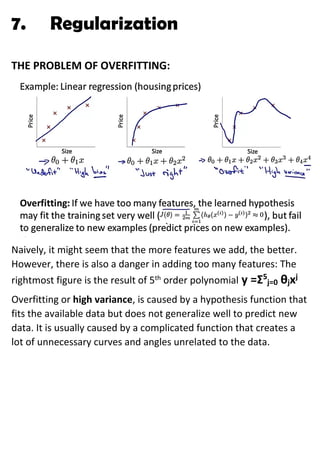
Naively, it might seem that the more features we add, the better.
However, there is also a danger in adding too many features: The
rightmost figure is the result of 5th
order polynomial y =Σ5
j=0 θjxj
Overfitting or high variance, is caused by a hypothesis function that
fits the available data but does not generalize well to predict new
data. It is usually caused by a complicated function that creates a
lot of unnecessary curves and angles unrelated to the data.
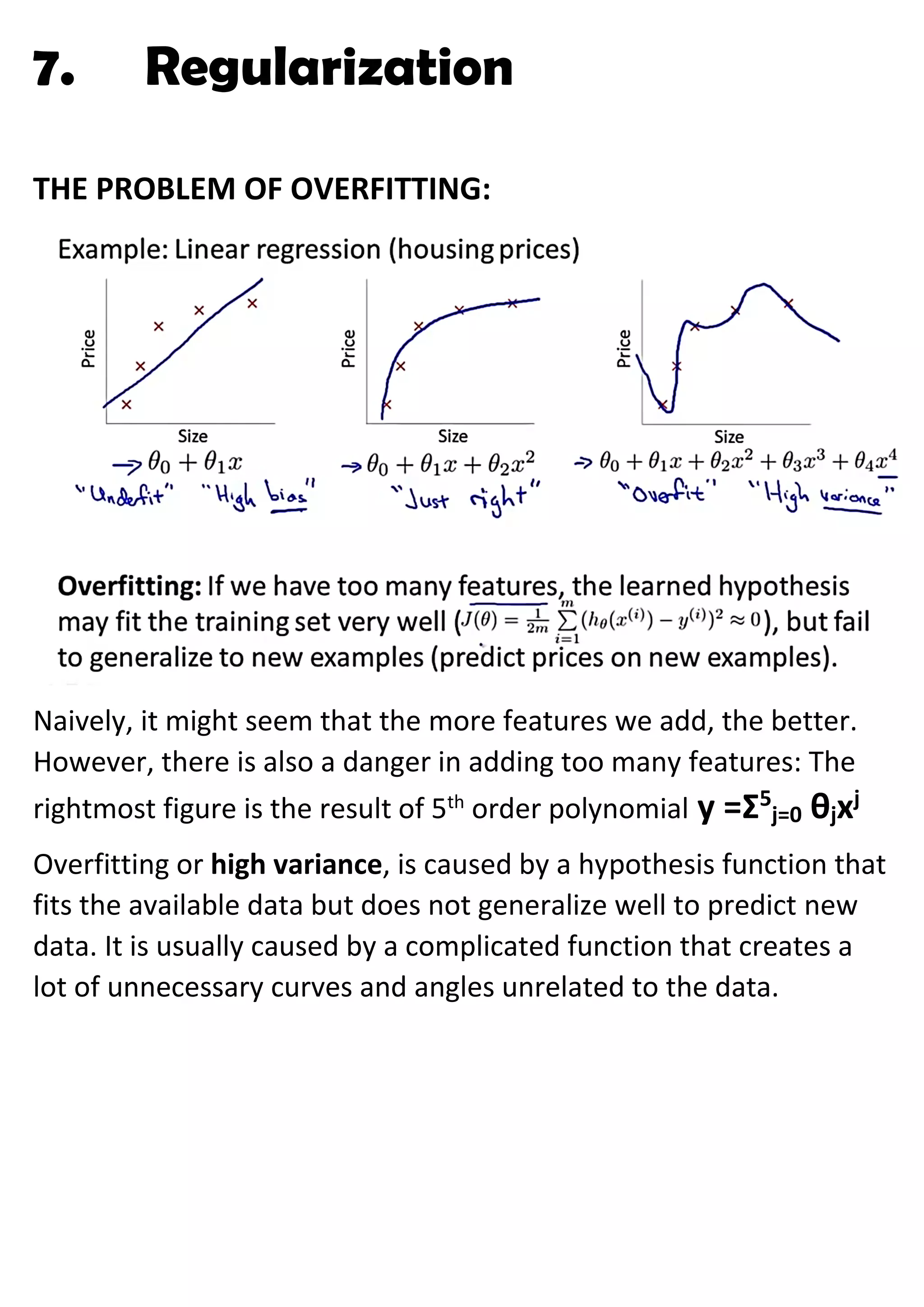
Addressing overfitting:
Model selection algos decide automatically which features to use
and which don’t, but they may also lead to deleting of important
features
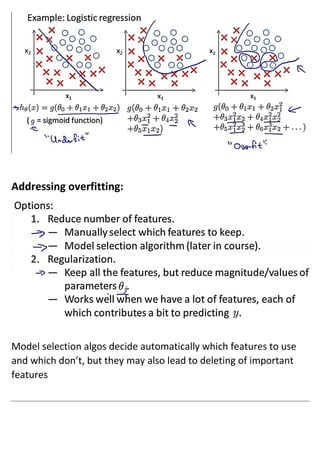
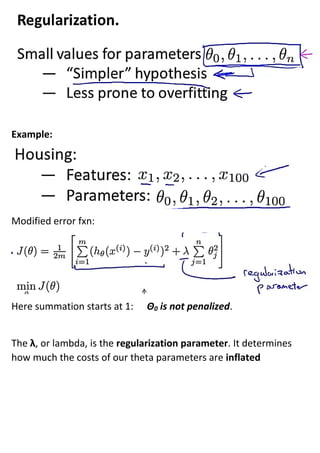
Cost function:
Our old error function:
Therefore:
h(x) =
If we have overfitting from our hypothesis function, we can reduce
the weight that some of the terms in our function carry, by
increasing their cost.
Example:
Modified error fxn:
Here summation starts at 1: Θ0 is not penalized.
The λ, or lambda, is the regularization parameter. It determines
how much the costs of our theta parameters are inflated
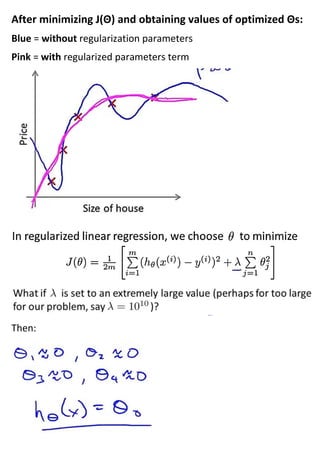
After minimizing J(Θ) and obtaining values of optimized Θs:
Blue = without regularization parameters
Pink = with regularized parameters term
Then:
The regularization parameter should be chosen carefully
MINIMIZINIG J(Θ): to find the optimal values of Θ
We can apply regularization to both linear regression and logistic
regression.
For linear regression:
There are 2 methods for using regularization in LINEAR
REGRESSION:
➢Gradient descent
➢Normal equations
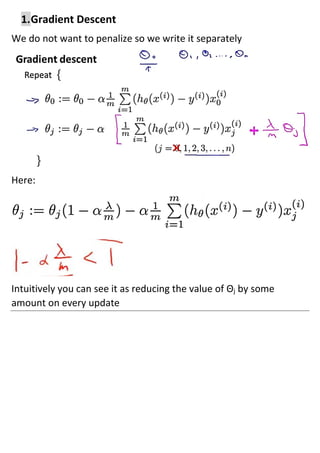
1.Gradient Descent
We do not want to penalize so we write it separately
Here:
Intuitively you can see it as reducing the value of Θj by some
amount on every update
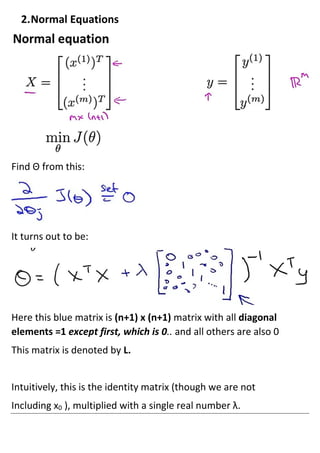
2.Normal Equations
Find Θ from this:
It turns out to be:
Here this blue matrix is (n+1) x (n+1) matrix with all diagonal
elements =1 except first, which is 0.. and all others are also 0
This matrix is denoted by L.
Intuitively, this is the identity matrix (though we are not
Including x0 ), multiplied with a single real number λ.
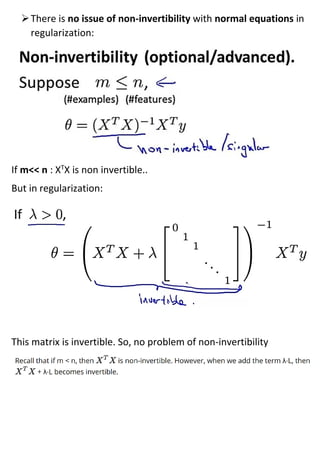
➢There is no issue of non-invertibility with normal equations in
regularization:
If m<< n : XTX is non invertible..
But in regularization:
This matrix is invertible. So, no problem of non-invertibility
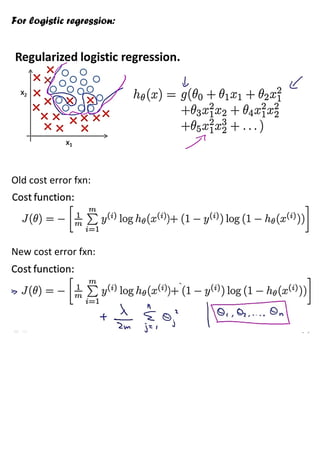
For logistic regression:
Old cost error fxn:
New cost error fxn:
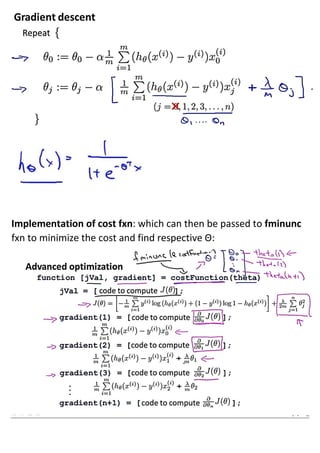
Implementation of cost fxn: which can then be passed to fminunc
fxn to minimize the cost and find respective Θ:

7 regularization

  • 1.
    7. Regularization THE PROBLEMOF OVERFITTING: Naively, it might seem that the more features we add, the better. However, there is also a danger in adding too many features: The rightmost figure is the result of 5th order polynomial y =Σ5 j=0 θjxj Overfitting or high variance, is caused by a hypothesis function that fits the available data but does not generalize well to predict new data. It is usually caused by a complicated function that creates a lot of unnecessary curves and angles unrelated to the data.
  • 2.
    Addressing overfitting: Model selectionalgos decide automatically which features to use and which don’t, but they may also lead to deleting of important features
  • 3.
    Cost function: Our olderror function: Therefore: h(x) = If we have overfitting from our hypothesis function, we can reduce the weight that some of the terms in our function carry, by increasing their cost.
  • 4.
    Example: Modified error fxn: Heresummation starts at 1: Θ0 is not penalized. The λ, or lambda, is the regularization parameter. It determines how much the costs of our theta parameters are inflated
  • 5.
    After minimizing J(Θ)and obtaining values of optimized Θs: Blue = without regularization parameters Pink = with regularized parameters term Then:
  • 6.
    The regularization parametershould be chosen carefully MINIMIZINIG J(Θ): to find the optimal values of Θ We can apply regularization to both linear regression and logistic regression. For linear regression: There are 2 methods for using regularization in LINEAR REGRESSION: ➢Gradient descent ➢Normal equations
  • 7.
    1.Gradient Descent We donot want to penalize so we write it separately Here: Intuitively you can see it as reducing the value of Θj by some amount on every update
  • 8.
    2.Normal Equations Find Θfrom this: It turns out to be: Here this blue matrix is (n+1) x (n+1) matrix with all diagonal elements =1 except first, which is 0.. and all others are also 0 This matrix is denoted by L. Intuitively, this is the identity matrix (though we are not Including x0 ), multiplied with a single real number λ.
  • 9.
    ➢There is noissue of non-invertibility with normal equations in regularization: If m<< n : XTX is non invertible.. But in regularization: This matrix is invertible. So, no problem of non-invertibility
  • 10.
    For logistic regression: Oldcost error fxn: New cost error fxn:
  • 11.
    Implementation of costfxn: which can then be passed to fminunc fxn to minimize the cost and find respective Θ: