Unit 5 Crossing cultures Noun phrases containing relative clauses and expectations Lic. Selene Rodríguez Lic. Norma Dzib   January 20 2008
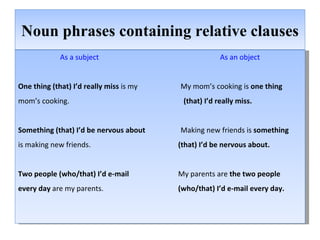
Noun phrases containing relative clauses As a subject As an object One thing (that) I’d really miss  is my    My mom’s cooking is  one thing mom’s cooking.   (that) I’d really miss. Something (that) I’d be nervous about   Making new friends is  something is making new friends. (that) I’d be nervous about. Two people (who/that) I’d e-mail My parents are  the two people  every day  are my parents. (who/that) I’d e-mail every day.
PRACTICE Complete the sentences about living in a foreign country. Use the phrases below. One thing I’d definitely be fascinated by is … …  is something I’d really miss. Two things I’d be homesick for are… …  are two things I’d be anxious about. Something that would depress me is … …  is one thing that I might be embarrassed about. The most uncomfortable thing would be … …  is something from home that I’d never miss. One thing I’d be insecure about is … …  are two things I’d be very enthusiastic about. my friends  trying new foods  making new friends  getting lost in a new city my family  my favorite food  being away from home  not understanding people getting sick  my room at home  speaking a new language  getting used to a different culture
This is a relative clause: The man who came to dinner Here are four kinds of relative clause.  The relative pronoun always refers to someone or something. The relative pronoun refers to A PERSON, and is THE SUBJECT: There is the  man who / that  came to se me The relative pronoun refers to A PERSON, and is THE OBJECT: There is the  woman ( - )  I spoke to  We can use WHO or THAT, but it is also common to omit the relative pronoun The relative pronoun refers to A “NON – PERSON”, and is THE SUBJECT: This is the  company that  made most profit. We can only use THAT in these sentences (or sometimes which) D. The relative pronoun refers to  A “NON – PERSON”, and is THE OBJECT This is the  company ( - )  I work for We can use THAT, but it is also common to omit the relative pronoun
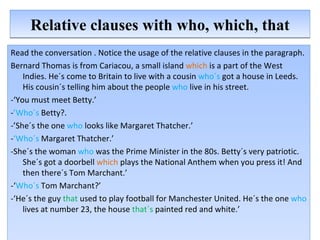
Relative clauses with who, which, that Read the conversation . Notice the usage of the relative clauses in the paragraph. Bernard Thomas is from Cariacou, a small island  which  is a part of the West Indies. He´s come to Britain to live with a cousin  who´s  got a house in Leeds. His cousin´s telling him about the people  who  live in his street. -‘You must meet Betty.’ - ’Who´s  Betty?. -’She´s the one  who  looks like Margaret Thatcher.’ - ‘Who´s  Margaret Thatcher.’ -She´s the woman  who  was the Prime Minister in the 80s. Betty´s very patriotic. She´s got a doorbell  which  plays the National Anthem when you press it! And then there´s Tom Marchant.’ -‘ Who´s  Tom Marchant?’ -‘He´s the guy  that  used to play football for Manchester United. He´s the one  who  lives at number 23, the house  that´s   painted red and white.’
Who/That for people  vs.   Which/That for things He´s come you live with a cousin  who´s got a flat in Leeds .  who´s got a flat in Leeds  is a relative clause.  A relative clause identifies a person or a thing . The clause  who´s got a flat in Leeds  identifies the cousin. We use the relative pronoun who for people, and which for things. She´s the one  who  looks like Margaret Thatcher. a doorbell  which   plays the National Anthem BUT we often use  that  instead of  who  and  which . She´s the one  that  looks like Margaret Thatcher. a doorbell  that  plays the National Anthem He´s the guy  that(or  who )  used to play football for Manchester United.  the house  that´s ( or  which is )   painted red and white With people we use who more often than that With things we use that more than which Note: sometimes we  must use who and which, not that. It will depend if is defining or non defining. In  non defining relative clauses we can´t leave out which and that. And we don’t use that in non-defining relative clauses.
PRACTICE
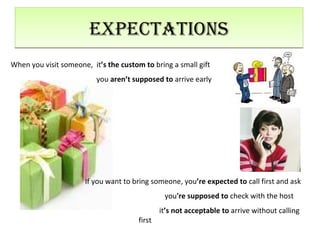
Expectations When you visit someone,  it ’s   the custom to  bring a small gift   you  aren’t supposed to  arrive early If you want to bring someone, you ’re   expected to  call first and ask   you 're   supposed to  check with the host   it ’s   not acceptable to  arrive without calling  first
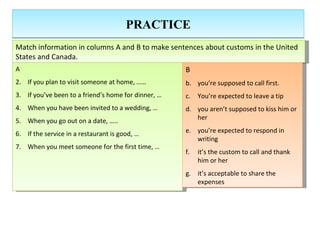
PRACTICE Match information in columns A and B to make sentences about customs in the United States and Canada. A If you plan to visit someone at home, …… If you’ve been to a friend’s home for dinner, … When you have been invited to a wedding, … When you go out on a date, ….. If the service in a restaurant is good, … When you meet someone for the first time, … B you’re supposed to call first. You’re expected to leave a tip you aren’t supposed to kiss him or her you’re expected to respond in writing it’s the custom to call and thank him or her it’s acceptable to share the expenses
PRACTICE Complete these sentences with information about your country or a country you know well. In ………., if people invite you to their home, …… When you go out with friends for dinner, ………. If a friend gets engaged to be married, ………. When a relative has a birthday,……… If a friend is in the hospital, ………. When some one is going to have a baby,……….
Your Vocabulary Another way to talk about: People.- Adult/ grown – up, fellow/guy/bloke, girl/lass, boy/lad, child/kid, baby, toddler, teenager, adolescent. Nice.- Sweet, attractive, adorable, pretty, good-looking. Nasty.- Selfish, grumpy (grouchy), miserable, stupid, lazy, narrow-minded, cruel, aggressive, violent, rough, dishonest, mean, stingy, disloyal, bad-tempered, Ignorant, too clever by half, crazy,  cynical, prejudiced, touchy, obstinate/stubborn, arrogant, proud, rude, ruthless, greedy, jealous, noisy. Neutral.- Absent-minded, forgetful, silly, shy, sentimental, emotional, sad, worried, nervous, scared/frightened, cheeky (fresh), naive, cunning/ crafty, quiet, noisy, lonely (lonesome).
Bibliography Richards, Jack C. Interchange Third Edition Cambridge University Press 2005 Shepherd, J. Multilevel English Grammar Programme Phoenix ELT 1996 Bolton , David and Goodey , Noel English Grammar in Steps Richmond Publishing 1996 Jones, Leo Ideas Teacher´s book Cambridge University Press 1994 Images www.grandecom.com   www.kleanbathandbody.com

U5 Interchange 3

  • 1.
    Unit 5 Crossingcultures Noun phrases containing relative clauses and expectations Lic. Selene Rodríguez Lic. Norma Dzib January 20 2008
  • 2.
    Noun phrases containingrelative clauses As a subject As an object One thing (that) I’d really miss is my My mom’s cooking is one thing mom’s cooking. (that) I’d really miss. Something (that) I’d be nervous about Making new friends is something is making new friends. (that) I’d be nervous about. Two people (who/that) I’d e-mail My parents are the two people every day are my parents. (who/that) I’d e-mail every day.
  • 3.
    PRACTICE Complete thesentences about living in a foreign country. Use the phrases below. One thing I’d definitely be fascinated by is … … is something I’d really miss. Two things I’d be homesick for are… … are two things I’d be anxious about. Something that would depress me is … … is one thing that I might be embarrassed about. The most uncomfortable thing would be … … is something from home that I’d never miss. One thing I’d be insecure about is … … are two things I’d be very enthusiastic about. my friends trying new foods making new friends getting lost in a new city my family my favorite food being away from home not understanding people getting sick my room at home speaking a new language getting used to a different culture
  • 4.
    This is arelative clause: The man who came to dinner Here are four kinds of relative clause. The relative pronoun always refers to someone or something. The relative pronoun refers to A PERSON, and is THE SUBJECT: There is the man who / that came to se me The relative pronoun refers to A PERSON, and is THE OBJECT: There is the woman ( - ) I spoke to We can use WHO or THAT, but it is also common to omit the relative pronoun The relative pronoun refers to A “NON – PERSON”, and is THE SUBJECT: This is the company that made most profit. We can only use THAT in these sentences (or sometimes which) D. The relative pronoun refers to A “NON – PERSON”, and is THE OBJECT This is the company ( - ) I work for We can use THAT, but it is also common to omit the relative pronoun
  • 5.
    Relative clauses withwho, which, that Read the conversation . Notice the usage of the relative clauses in the paragraph. Bernard Thomas is from Cariacou, a small island which is a part of the West Indies. He´s come to Britain to live with a cousin who´s got a house in Leeds. His cousin´s telling him about the people who live in his street. -‘You must meet Betty.’ - ’Who´s Betty?. -’She´s the one who looks like Margaret Thatcher.’ - ‘Who´s Margaret Thatcher.’ -She´s the woman who was the Prime Minister in the 80s. Betty´s very patriotic. She´s got a doorbell which plays the National Anthem when you press it! And then there´s Tom Marchant.’ -‘ Who´s Tom Marchant?’ -‘He´s the guy that used to play football for Manchester United. He´s the one who lives at number 23, the house that´s painted red and white.’
  • 6.
    Who/That for people vs. Which/That for things He´s come you live with a cousin who´s got a flat in Leeds . who´s got a flat in Leeds is a relative clause. A relative clause identifies a person or a thing . The clause who´s got a flat in Leeds identifies the cousin. We use the relative pronoun who for people, and which for things. She´s the one who looks like Margaret Thatcher. a doorbell which plays the National Anthem BUT we often use that instead of who and which . She´s the one that looks like Margaret Thatcher. a doorbell that plays the National Anthem He´s the guy that(or who ) used to play football for Manchester United. the house that´s ( or which is ) painted red and white With people we use who more often than that With things we use that more than which Note: sometimes we must use who and which, not that. It will depend if is defining or non defining. In non defining relative clauses we can´t leave out which and that. And we don’t use that in non-defining relative clauses.
  • 7.
  • 8.
    Expectations When youvisit someone, it ’s the custom to bring a small gift you aren’t supposed to arrive early If you want to bring someone, you ’re expected to call first and ask you 're supposed to check with the host it ’s not acceptable to arrive without calling first
  • 9.
    PRACTICE Match informationin columns A and B to make sentences about customs in the United States and Canada. A If you plan to visit someone at home, …… If you’ve been to a friend’s home for dinner, … When you have been invited to a wedding, … When you go out on a date, ….. If the service in a restaurant is good, … When you meet someone for the first time, … B you’re supposed to call first. You’re expected to leave a tip you aren’t supposed to kiss him or her you’re expected to respond in writing it’s the custom to call and thank him or her it’s acceptable to share the expenses
  • 10.
    PRACTICE Complete thesesentences with information about your country or a country you know well. In ………., if people invite you to their home, …… When you go out with friends for dinner, ………. If a friend gets engaged to be married, ………. When a relative has a birthday,……… If a friend is in the hospital, ………. When some one is going to have a baby,……….
  • 11.
    Your Vocabulary Anotherway to talk about: People.- Adult/ grown – up, fellow/guy/bloke, girl/lass, boy/lad, child/kid, baby, toddler, teenager, adolescent. Nice.- Sweet, attractive, adorable, pretty, good-looking. Nasty.- Selfish, grumpy (grouchy), miserable, stupid, lazy, narrow-minded, cruel, aggressive, violent, rough, dishonest, mean, stingy, disloyal, bad-tempered, Ignorant, too clever by half, crazy, cynical, prejudiced, touchy, obstinate/stubborn, arrogant, proud, rude, ruthless, greedy, jealous, noisy. Neutral.- Absent-minded, forgetful, silly, shy, sentimental, emotional, sad, worried, nervous, scared/frightened, cheeky (fresh), naive, cunning/ crafty, quiet, noisy, lonely (lonesome).
  • 12.
    Bibliography Richards, JackC. Interchange Third Edition Cambridge University Press 2005 Shepherd, J. Multilevel English Grammar Programme Phoenix ELT 1996 Bolton , David and Goodey , Noel English Grammar in Steps Richmond Publishing 1996 Jones, Leo Ideas Teacher´s book Cambridge University Press 1994 Images www.grandecom.com www.kleanbathandbody.com