RELATIVE
CLAUSES
  BACHILLERATO
Definition

A relative clause is a part of a sentence beginning with
  a relative pronoun (although this pronoun can be
  omitted in certain cases). For example:
     The school where I taught is called Alboraya English
      Centre.
     The man who went into the baker's bought a loaf of bread.
     My sister, who lives near London, is coming to visit me
      soon.
The relative pronoun must be just after the antecedent
  ( what it refers to)
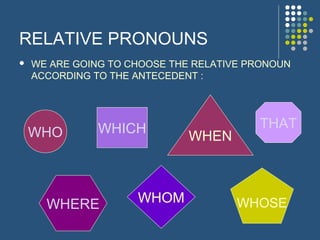
RELATIVE PRONOUNS
   WE ARE GOING TO CHOOSE THE RELATIVE PRONOUN
    ACCORDING TO THE ANTECEDENT :


               WHICH                     THAT
    WHO                       WHEN


      WHERE          WHOM             WHOSE
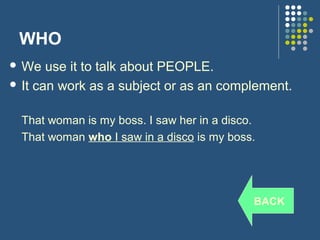
WHO
 We   use it to talk about PEOPLE.
 It can work as a subject or as an complement.


  That woman is my boss. I saw her in a disco.
  That woman who I saw in a disco is my boss.


                                             BACK
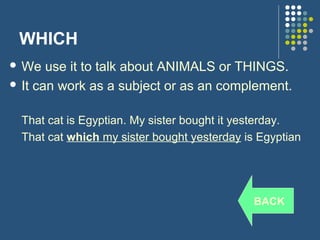
WHICH
 We   use it to talk about ANIMALS or THINGS.
 It can work as a subject or as an complement.


  That cat is Egyptian. My sister bought it yesterday.
  That cat which my sister bought yesterday is Egyptian


                                              BACK
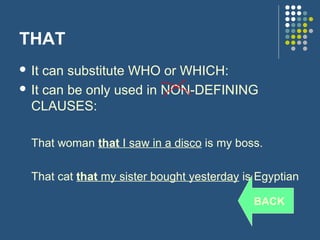
THAT
 It can substitute WHO or WHICH:
 It can be only used in NON-DEFINING
  CLAUSES:

  That woman that I saw in a disco is my boss.

  That cat that my sister bought yesterday is Egyptian

                                             BACK
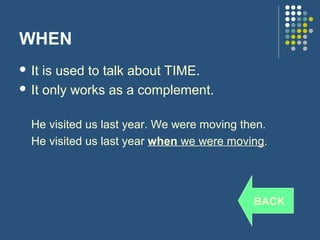
WHEN
 It is used to talk about TIME.
 It only works as a complement.


  He visited us last year. We were moving then.
  He visited us last year when we were moving.


                                            BACK
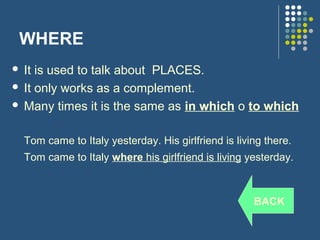
WHERE
 It is used to talk about PLACES.
 It only works as a complement.

 Many times it is the same as in which o to which


    Tom came to Italy yesterday. His girlfriend is living there.
    Tom came to Italy where his girlfriend is living yesterday.


                                                       BACK
WHOM

 We    are going to use it to talk about PEOPLE.
 It is usually used in formal English.

 It can be after a preposition.


     The woman to whom he was talking is his sister.


                                            BACK
WHOSE
 Itis used to talk about POSSESSION.
 In Spanish we translate it into “cuyo / cuya /
  cuyos / cuyas”

  Last week I found a dog. Its owner was very rich.
  Last week I found a dog WHOSE owner was very
    rich.


                                           BACK
Trickier relative pronouns

Four relative pronouns often seem to confuse people, but
  they're easy to use too.


WHICH
This can be used to refer to the whole part of the sentence
  that went before. Usually a pronoun refers to a noun, but
  this refers to more. For example:
     I've broken my leg, which means I can't walk.
     I've still got some money left, which is surprising.
WHAT


This can be literally translated to mean 'the
  thing that' or 'that which'. It is not used
  anywhere near as often as 'which' or 'that'
  and is not used in the same way. For
  example:

     A man's gotta do what a man's gotta do.
     I didn't know what he was going to do next.
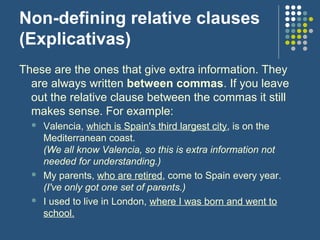
Non-defining relative clauses
(Explicativas)
These are the ones that give extra information. They
  are always written between commas. If you leave
  out the relative clause between the commas it still
  makes sense. For example:
     Valencia, which is Spain's third largest city, is on the
      Mediterranean coast.
      (We all know Valencia, so this is extra information not
      needed for understanding.)
     My parents, who are retired, come to Spain every year.
      (I've only got one set of parents.)
     I used to live in London, where I was born and went to
      school.
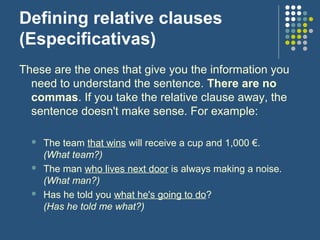
Defining relative clauses
(Especificativas)
These are the ones that give you the information you
  need to understand the sentence. There are no
  commas. If you take the relative clause away, the
  sentence doesn't make sense. For example:

     The team that wins will receive a cup and 1,000 €.
      (What team?)
     The man who lives next door is always making a noise.
      (What man?)
     Has he told you what he's going to do?
      (Has he told me what?)
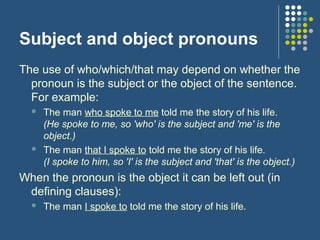
Subject and object pronouns
The use of who/which/that may depend on whether the
  pronoun is the subject or the object of the sentence.
  For example:
     The man who spoke to me told me the story of his life.
      (He spoke to me, so 'who' is the subject and 'me' is the
      object.)
     The man that I spoke to told me the story of his life.
      (I spoke to him, so 'I' is the subject and 'that' is the object.)
When the pronoun is the object it can be left out (in
 defining clauses):
     The man I spoke to told me the story of his life.
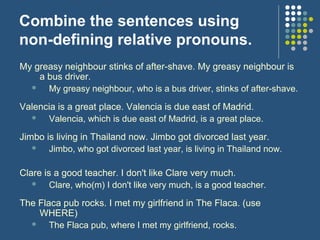
Combine the sentences using
non-defining relative pronouns.
My greasy neighbour stinks of after-shave. My greasy neighbour is
    a bus driver.
     My greasy neighbour, who is a bus driver, stinks of after-shave.

Valencia is a great place. Valencia is due east of Madrid.
     Valencia, which is due east of Madrid, is a great place.

Jimbo is living in Thailand now. Jimbo got divorced last year.
      Jimbo, who got divorced last year, is living in Thailand now.

Clare is a good teacher. I don't like Clare very much.
       Clare, who(m) I don't like very much, is a good teacher.

The Flaca pub rocks. I met my girlfriend in The Flaca. (use
    WHERE)
      The Flaca pub, where I met my girlfriend, rocks.
Combine the sentences using
defining relative pronouns (omit the
pronoun when it is possible)
That's the girl. She spoke to me yesterday.
     That's the girl who spoke to me yesterday.
What's the name of the book? You want me to
 read it.
     What's the name of the book (that) you want me
      to read?
     What's the name of the book (which) you want me
      to read?
     What's the name of the book you want me to
      read?
We stayed in a hotel. The hotel was very
 expensive.
     The hotel we stayed in was very expensive.
     The hotel (which) we stayed in was very
      expensive.
     The hotel (that) we stayed in was very expensive.
     The hotel where we stayed was very expensive.
     We stayed in a hotel which was very expensive.
I rent a house. It is very small.
     The house I rent is very small.
     The house (which) I rent is very small.
     The house (that) I rent is very small.
     I stay in a house which is very small.
The car was stolen. It was a BMW.
     The car which was stolen was a BMW.
     The car that was stolen was a BMW.
The man smoked forty cigarettes a day. He died of a
  heart attack.
     The man who died of a heart attack smoked forty cigarettes
      a day.
     The man who smoked forty cigarettes a day died of a heart
      attack.
That's the building. I work there.
     That's the building where I work.
That's the boy. His mother works in the post office.
     That's the boy whose mother works in the post office.
The businessman was very rich. I saw him last night.
     The businessman was very rich. I saw him last night.
     The businessman (whom) I saw last night was very rich.
     The businessman (who) I saw last night was very rich.
     The businessman (that) I saw last night was very rich.
That's the dog. Its owner is French.
     That's the dog whose owner is French.

Relative clauses 1

  • 1.
  • 2.
    Definition A relative clauseis a part of a sentence beginning with a relative pronoun (although this pronoun can be omitted in certain cases). For example:  The school where I taught is called Alboraya English Centre.  The man who went into the baker's bought a loaf of bread.  My sister, who lives near London, is coming to visit me soon. The relative pronoun must be just after the antecedent ( what it refers to)
  • 3.
    RELATIVE PRONOUNS  WE ARE GOING TO CHOOSE THE RELATIVE PRONOUN ACCORDING TO THE ANTECEDENT : WHICH THAT WHO WHEN WHERE WHOM WHOSE
  • 4.
    WHO  We use it to talk about PEOPLE.  It can work as a subject or as an complement. That woman is my boss. I saw her in a disco. That woman who I saw in a disco is my boss. BACK
  • 5.
    WHICH  We use it to talk about ANIMALS or THINGS.  It can work as a subject or as an complement. That cat is Egyptian. My sister bought it yesterday. That cat which my sister bought yesterday is Egyptian BACK
  • 6.
    THAT  It cansubstitute WHO or WHICH:  It can be only used in NON-DEFINING CLAUSES: That woman that I saw in a disco is my boss. That cat that my sister bought yesterday is Egyptian BACK
  • 7.
    WHEN  It isused to talk about TIME.  It only works as a complement. He visited us last year. We were moving then. He visited us last year when we were moving. BACK
  • 8.
    WHERE  It isused to talk about PLACES.  It only works as a complement.  Many times it is the same as in which o to which Tom came to Italy yesterday. His girlfriend is living there. Tom came to Italy where his girlfriend is living yesterday. BACK
  • 9.
    WHOM  We are going to use it to talk about PEOPLE.  It is usually used in formal English.  It can be after a preposition.  The woman to whom he was talking is his sister. BACK
  • 10.
    WHOSE  Itis usedto talk about POSSESSION.  In Spanish we translate it into “cuyo / cuya / cuyos / cuyas” Last week I found a dog. Its owner was very rich. Last week I found a dog WHOSE owner was very rich. BACK
  • 11.
    Trickier relative pronouns Fourrelative pronouns often seem to confuse people, but they're easy to use too. WHICH This can be used to refer to the whole part of the sentence that went before. Usually a pronoun refers to a noun, but this refers to more. For example:  I've broken my leg, which means I can't walk.  I've still got some money left, which is surprising.
  • 12.
    WHAT This can beliterally translated to mean 'the thing that' or 'that which'. It is not used anywhere near as often as 'which' or 'that' and is not used in the same way. For example:  A man's gotta do what a man's gotta do.  I didn't know what he was going to do next.
  • 13.
    Non-defining relative clauses (Explicativas) Theseare the ones that give extra information. They are always written between commas. If you leave out the relative clause between the commas it still makes sense. For example:  Valencia, which is Spain's third largest city, is on the Mediterranean coast. (We all know Valencia, so this is extra information not needed for understanding.)  My parents, who are retired, come to Spain every year. (I've only got one set of parents.)  I used to live in London, where I was born and went to school.
  • 14.
    Defining relative clauses (Especificativas) Theseare the ones that give you the information you need to understand the sentence. There are no commas. If you take the relative clause away, the sentence doesn't make sense. For example:  The team that wins will receive a cup and 1,000 €. (What team?)  The man who lives next door is always making a noise. (What man?)  Has he told you what he's going to do? (Has he told me what?)
  • 15.
    Subject and objectpronouns The use of who/which/that may depend on whether the pronoun is the subject or the object of the sentence. For example:  The man who spoke to me told me the story of his life. (He spoke to me, so 'who' is the subject and 'me' is the object.)  The man that I spoke to told me the story of his life. (I spoke to him, so 'I' is the subject and 'that' is the object.) When the pronoun is the object it can be left out (in defining clauses):  The man I spoke to told me the story of his life.
  • 17.
    Combine the sentencesusing non-defining relative pronouns. My greasy neighbour stinks of after-shave. My greasy neighbour is a bus driver.  My greasy neighbour, who is a bus driver, stinks of after-shave. Valencia is a great place. Valencia is due east of Madrid.  Valencia, which is due east of Madrid, is a great place. Jimbo is living in Thailand now. Jimbo got divorced last year.  Jimbo, who got divorced last year, is living in Thailand now. Clare is a good teacher. I don't like Clare very much.  Clare, who(m) I don't like very much, is a good teacher. The Flaca pub rocks. I met my girlfriend in The Flaca. (use WHERE)  The Flaca pub, where I met my girlfriend, rocks.
  • 18.
    Combine the sentencesusing defining relative pronouns (omit the pronoun when it is possible) That's the girl. She spoke to me yesterday.  That's the girl who spoke to me yesterday. What's the name of the book? You want me to read it.  What's the name of the book (that) you want me to read?  What's the name of the book (which) you want me to read?  What's the name of the book you want me to read?
  • 19.
    We stayed ina hotel. The hotel was very expensive.  The hotel we stayed in was very expensive.  The hotel (which) we stayed in was very expensive.  The hotel (that) we stayed in was very expensive.  The hotel where we stayed was very expensive.  We stayed in a hotel which was very expensive.
  • 20.
    I rent ahouse. It is very small.  The house I rent is very small.  The house (which) I rent is very small.  The house (that) I rent is very small.  I stay in a house which is very small. The car was stolen. It was a BMW.  The car which was stolen was a BMW.  The car that was stolen was a BMW. The man smoked forty cigarettes a day. He died of a heart attack.  The man who died of a heart attack smoked forty cigarettes a day.  The man who smoked forty cigarettes a day died of a heart attack.
  • 21.
    That's the building.I work there.  That's the building where I work. That's the boy. His mother works in the post office.  That's the boy whose mother works in the post office. The businessman was very rich. I saw him last night.  The businessman was very rich. I saw him last night.  The businessman (whom) I saw last night was very rich.  The businessman (who) I saw last night was very rich.  The businessman (that) I saw last night was very rich. That's the dog. Its owner is French.  That's the dog whose owner is French.