By: Ivon Ramírez
Santiago Rodríguez
Jeferson Rodríguez Vargas
Table of Contents
 Introduction
 Grammar structure
 Punctuation
 Examples
 Exercises
Introduction
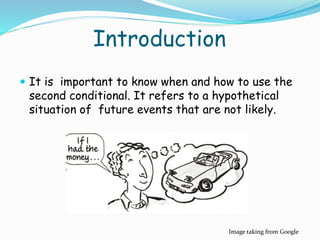
 It is important to know when and how to use the
second conditional. It refers to a hypothetical
situation of future events that are not likely.
Image taking from Google
Grammar Structure
It is important to take into account that in conditionals;
it is usual to see he, she and it with “were” instead of
“was”
e.g. If he were friendly, we would be good friends
If she were famous, she would be a singer.
If I were you, I would buy that car.
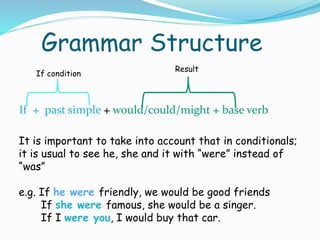
If + past simple + would/could/might + base verb
If condition
Result
Punctuation.
 The use of a comma is mandatory when the if clause
is at the beginning.
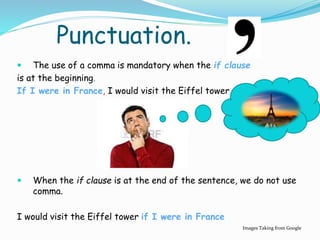
If I were in France, I would visit the Eiffel tower
 When the if clause is at the end of the sentence, we do not use
comma.
I would visit the Eiffel tower if I were in France
Images Taking from Google
Examples
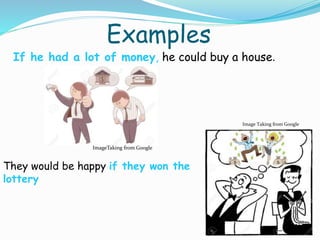
If he had a lot of money, he could buy a house.
They would be happy if they won the
lottery
ImageTaking from Google
Image Taking from Google
Examples of negative form
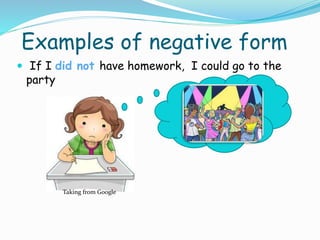
 If I did not have homework, I could go to the
party
Taking from Google
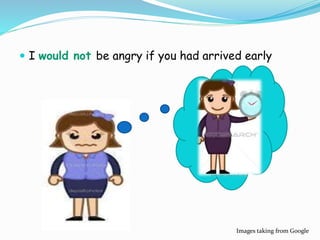
 I would not be angry if you had arrived early
Images taking from Google
Questions
In questions we can ask about assumptions or imaginary
situations.
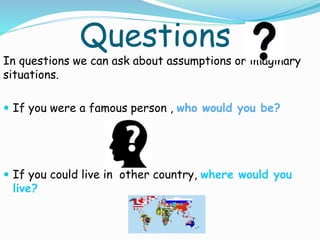
 If you were a famous person , who would you be?
 If you could live in other country, where would you
live?
Exercises to practice
• http://www.perfect-english-grammar.com/second-
conditional-exercise-1.html
• http://www.englishexercises.org/makeagame/viewgam
e.asp?id=3227

Second conditional

  • 1.
    By: Ivon Ramírez SantiagoRodríguez Jeferson Rodríguez Vargas
  • 2.
    Table of Contents Introduction  Grammar structure  Punctuation  Examples  Exercises
  • 3.
    Introduction  It isimportant to know when and how to use the second conditional. It refers to a hypothetical situation of future events that are not likely. Image taking from Google
  • 4.
    Grammar Structure It isimportant to take into account that in conditionals; it is usual to see he, she and it with “were” instead of “was” e.g. If he were friendly, we would be good friends If she were famous, she would be a singer. If I were you, I would buy that car. If + past simple + would/could/might + base verb If condition Result
  • 5.
    Punctuation.  The useof a comma is mandatory when the if clause is at the beginning. If I were in France, I would visit the Eiffel tower  When the if clause is at the end of the sentence, we do not use comma. I would visit the Eiffel tower if I were in France Images Taking from Google
  • 6.
    Examples If he hada lot of money, he could buy a house. They would be happy if they won the lottery ImageTaking from Google Image Taking from Google
  • 7.
    Examples of negativeform  If I did not have homework, I could go to the party Taking from Google
  • 8.
     I wouldnot be angry if you had arrived early Images taking from Google
  • 9.
    Questions In questions wecan ask about assumptions or imaginary situations.  If you were a famous person , who would you be?  If you could live in other country, where would you live?
  • 10.
    Exercises to practice •http://www.perfect-english-grammar.com/second- conditional-exercise-1.html • http://www.englishexercises.org/makeagame/viewgam e.asp?id=3227