Defining Relative
Clause
which – that- whose - who - when - where
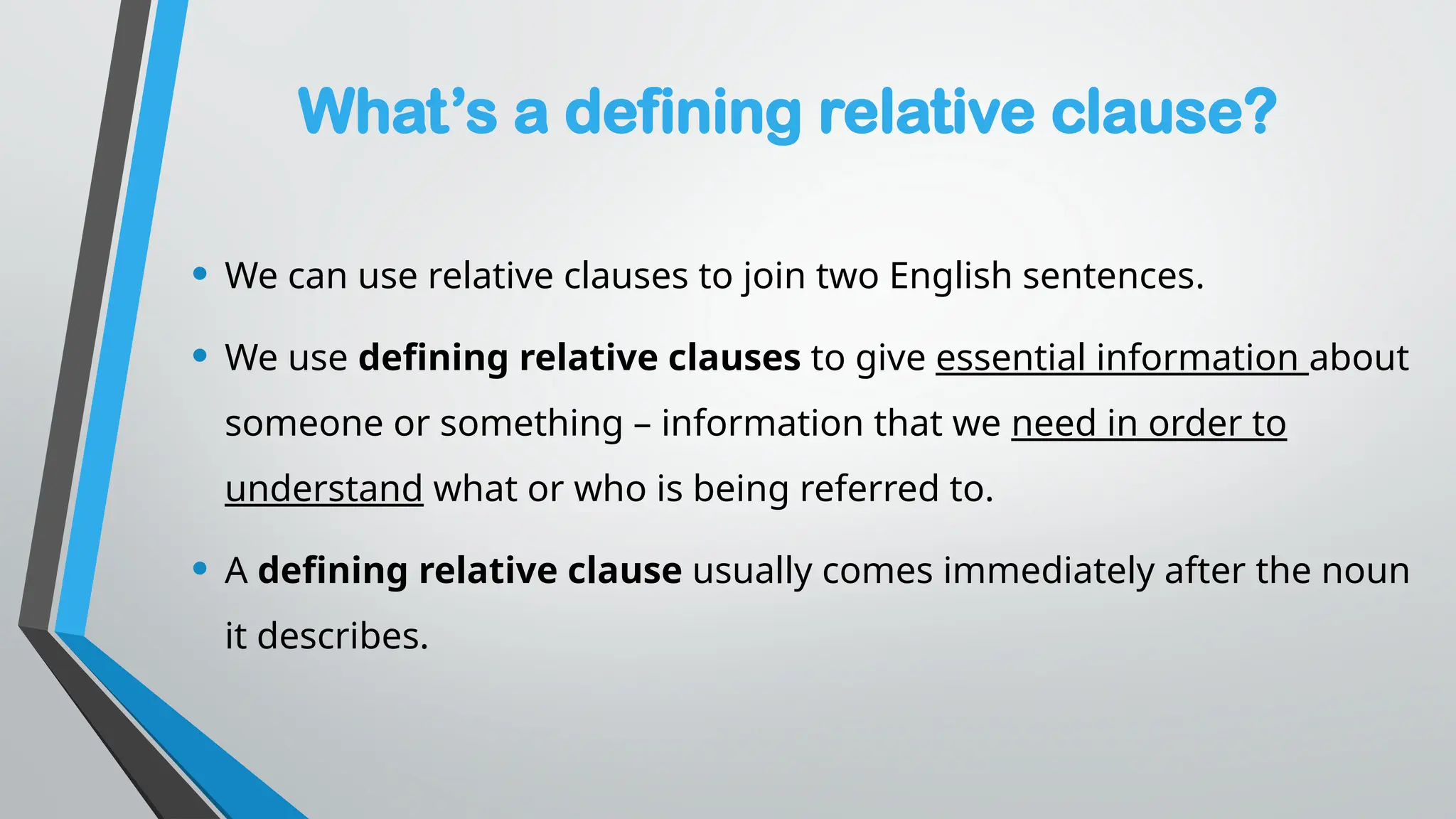
What’s a defining relative clause?
• We can use relative clauses to join two English sentences.
• We use defining relative clauses to give essential information about
someone or something – information that we need in order to
understand what or who is being referred to.
• A defining relative clause usually comes immediately after the noun
it describes.
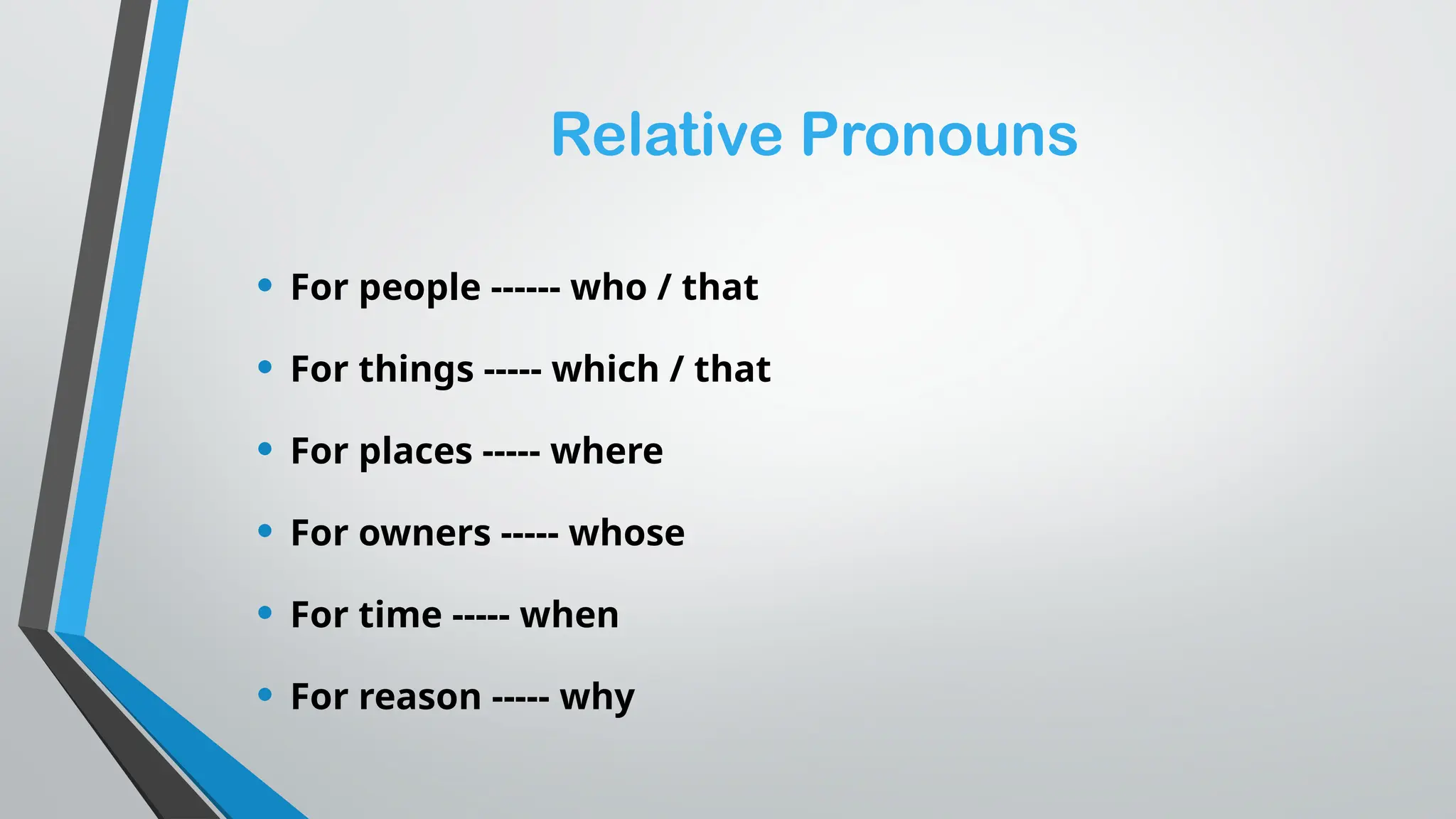
Relative Pronouns
• For people ------ who / that
• For things ----- which / that
• For places ----- where
• For owners ----- whose
• For time ----- when
• For reason ----- why
As a subject
The man is a doctor. He lives next door.
subject subject
The man who / that lives next door is a doctor.
defining relative clause
as a subject
who/that (for people)
More examples:
1. The girl is from India. She works in a bank.
The girl who / that works in a bank is from India.
subject
2. The waiter was rude. He was wearing a blue coat.
The waiter who/that was wearing a blue coat was very rude.
subject
3. My sister has two children. She lives in Paris.
My sister who/that lives in Paris has two children.
subject
The man is a doctor. I see him every morning.
subject object
Here ‘The man’ and ‘him’ are the same. In the first sentence ‘The man’
is the subject, but ‘him’ is the object of the second sentence. In this
situation we say;
The man who/that I see every morning is a doctor.
subject
Don’t use ‘her’ in relative clause because we use ‘who’ or ‘that’
instead of it.
Now look at this sentence!
More examples
1. The girl is from India. I met her at the party last night.
The girl who/that I met at the party last night is from India.
subject
2. The waiter was rude. My father argued with him.
The waiter who/that my father argued with was rude.
subject
3. My sister has two children. I haven’t seen her for ages.
My sister who/that I haven’t seen for ages has two children.
subject
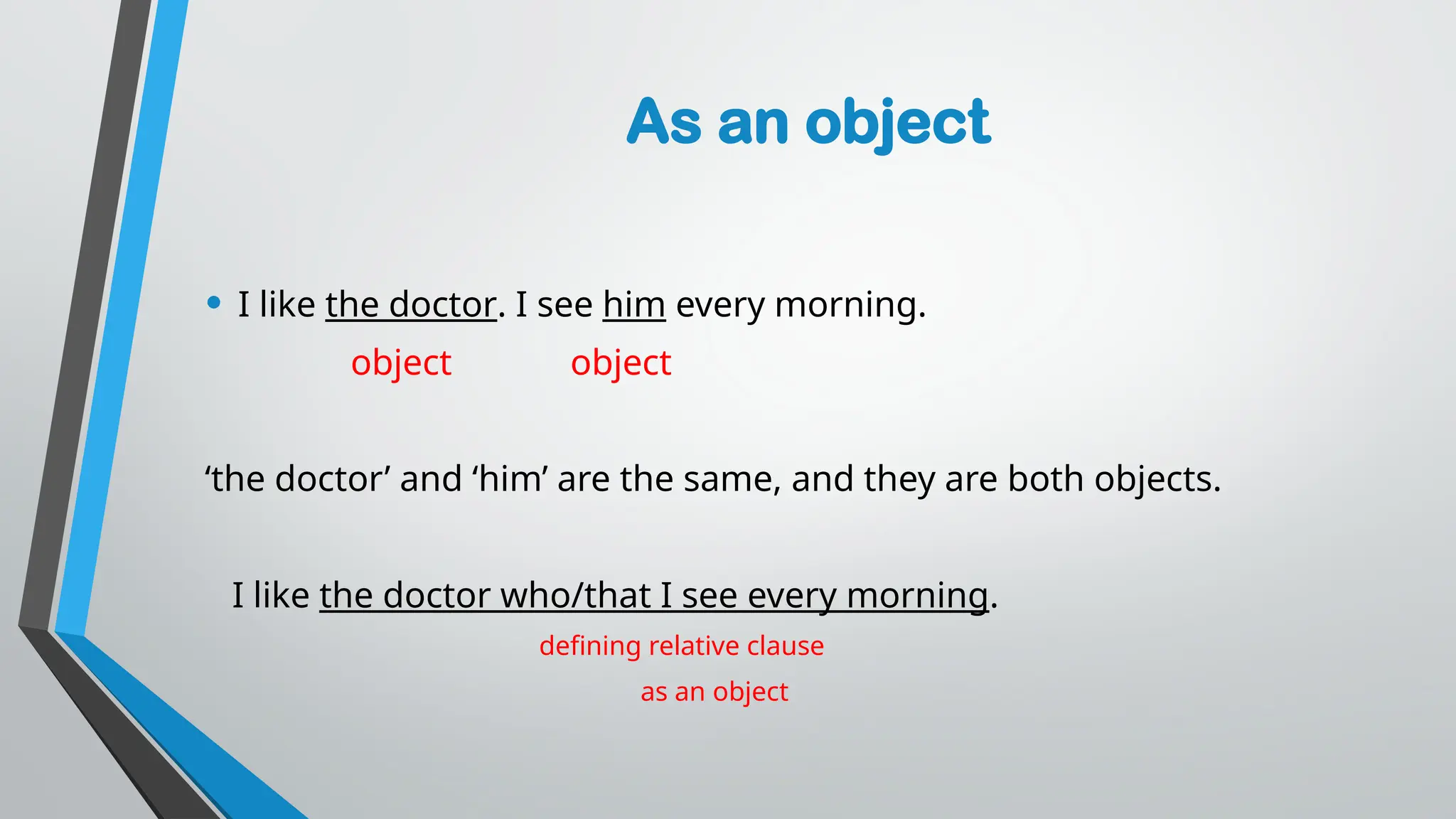
As an object
• I like the doctor. I see him every morning.
object object
‘the doctor’ and ‘him’ are the same, and they are both objects.
I like the doctor who/that I see every morning.
defining relative clause
as an object
More examples
1. Lucy called the manager. My father knows him.
Lucy called the manager who/that my father knows.
object
2. I met the secretary. Mr. Jones employed her.
I met the secretary who/that Mr. Jones employed.
object
3. I haven’t seen the girl. Jack has married her.
I haven’t seen the girl who/that Jack has married.
object
Now look at this
sentence!
• I know the doctor. He lives next door.
object subject
I know the doctor who/that lives next door.
In this sentence, we underline ‘the doctor’ and ‘He’ because
they are the same. ‘the doctor’ is the object of the first
sentence, but ‘He’ is the subject of the second sentence.
More examples
1. Did you know the man? He died in a car crash.
Did you know the man who/that died in a car crash?
object
2. Tom didn’t like the woman. She was wearing a red dress.
Tom didn’t like the woman who/that was wearing a red dress.
object
3. Where is the boy? He was playing in our garden.
Where is the boy who/that was playing in our garden?
object
which / that
The book is very exciting. It was written by Charles Dickens.
subject subject
Common things --- the book and it
Use ‘’which/that’’ after the book instead of ‘’it’’.
The book which / that was written by Charles Dickens is very exciting.
defining relative clause
as a subject
As a subject
More examples:
1. The house is on sale. It is in King Street.
The house which / that is in King Street is on sale.
subject
2. The food was great. It was cooked by Sally.
The food which/that was cooked by Sally was great.
subject
3. My sister has two children. She lives in Paris.
My sister who/that lives in Paris has two children.
subject
4. The book is very good. Tom gave me it yesterday.
The book which/that Tom gave me yesterday is very good.
subject
5. The waiter was rude. My father argued with him.
The waiter who/that my father argued with was rude.
subject
6. The bike was stolen. My dad bought it last week.
My bike which/that my dad bought last week was stolen.
subject
As an object
• I can’t find the pen. I bought it yesterday.
object object
‘the pen’ and ‘it’ are the same, and they are both objects.
I can’t find the pen which/that I bought yesterday.
defining relative clause
as an object
More examples
1. We loved the city. We visited it on holiday.
We loved the city which/that we visited on holiday.
object
2. This is the dress. I want to wear it for the party.
This is the dress which/that I want to wear for the party.
object
3. She didn’t like the book. Her teacher wanted her to read it.
She didn’t like the book which/that her teacher wanted her to read.
object
4. I’ve sold the computer. It was belong to my brother.
I’ve sold the computer which/that was belong to my brother.
object
5. Tom didn’t like the cake. It was baked by his sister.
Tom didn’t like the cake which/that was baked by his sister .
object
6. Where is the key? It was on the table.
Where is the key which/that was on the table?
object
where (for places)
The hotel was great. We stayed there last summet.
The hotel where we stayed last summer was great.
The cafe was very crowded. We saw Peter in that cafe.
The cafe where we saw Peter was very crowded.
As a subject
I didn’t like the city. I lived in that city for 5 years as a
student.
I didn’t like the city where I lived for 5 years a student.
We went to the restaurant. We met in that restaurant
10 years ago.
We went to the restaurant where we met 10 years ago.
As an object
Warning! where / which?
1. The hotel was very big. We saw it yesterday.
The hotel which/that we saw yesterday was very big.
2. The hotel was very big. We stayed there last summer.
The hotel where we stayed last summer was very big.
whose (for owners)
• We use ‘’whose’’ instead of his, her, its, their,..
As a subject
The woman was very sad. Her husband died in a car crash.
The woman whose husband died in car crash was very sad.
The school is so popular. Its students are very successful.
The school whose students are very successful is so popular.
As an object
The police is looking for the man. His son was arrested last night.
The police is looking for the man whose son was arrested last night.
Do you know the girl? Her hair is pink.
Do you know the girl whose hair is pink?
I can’t see the children. Their parents are waiting outside.
I can’t see the children whose parents are waiting outside.
when (for time)
1923 was the year. Atatürk founded the Turkish Republic in that year.
1923 was the year when Atatürk founded the Turkish Republic.
It was the year. We got married in that year.
It was the year when we got married.
Do you remember the day? We met Peter on that day.
Do you remember the day when we met Peter?
why (for reason)
The great weather is the reason. I moved here for that reason.
The great weather is the reason why I moved here.
Do you know the reason? Vicky quit working for that reason.
Do you know the reason why Vicky quit working?
Peter knows the reason. Sally is crying for that reason.
Peter knows the reason why Sally is crying.
which – that- whose - who - when - where
1. Dallas is the city ________ Kennedy was shot.
2. Bill Clinton was the president ________ wife was called
Hillary.
3. Sunday is the day ________ most countries respect a day of
rest in the week.
4. Rotterdam is the port ________ is the busiest in Europe.
5. Yasser Arafat is the person ________ is the Palestinian leader.
6. I know the doctor _______ lives next door.
where
whos
e
when
where
who
who/that
Join the sentences so that the 2nd
sentence becomes a defining relative
clause. Use relative pronouns: who, which, whose, when, where.
1. I have just greeted the girl. She is sitting next to my brother.
I have just greeted the girl WHO is sitting next to my brother.
2. Is David the student? David gets the best marks in your class.
Is David the student WHO gets the best marks in your class?
3. We met at the restaurant. Sally recommended it to us.
We met at the restaurant WHICH Sally recommended us.
4. The headmaster phoned Mrs Brown. Her daughter didn’t come to school yesterday.
The headmaster phoned Mrs Brown WHOSE daughter didn’t come to school
yesterday.

defining-relative-clause-grammar-guides_124940.pptx

  • 1.
    Defining Relative Clause which –that- whose - who - when - where
  • 2.
    What’s a definingrelative clause? • We can use relative clauses to join two English sentences. • We use defining relative clauses to give essential information about someone or something – information that we need in order to understand what or who is being referred to. • A defining relative clause usually comes immediately after the noun it describes.
  • 3.
    Relative Pronouns • Forpeople ------ who / that • For things ----- which / that • For places ----- where • For owners ----- whose • For time ----- when • For reason ----- why
  • 4.
    As a subject Theman is a doctor. He lives next door. subject subject The man who / that lives next door is a doctor. defining relative clause as a subject who/that (for people)
  • 5.
    More examples: 1. Thegirl is from India. She works in a bank. The girl who / that works in a bank is from India. subject 2. The waiter was rude. He was wearing a blue coat. The waiter who/that was wearing a blue coat was very rude. subject 3. My sister has two children. She lives in Paris. My sister who/that lives in Paris has two children. subject
  • 6.
    The man isa doctor. I see him every morning. subject object Here ‘The man’ and ‘him’ are the same. In the first sentence ‘The man’ is the subject, but ‘him’ is the object of the second sentence. In this situation we say; The man who/that I see every morning is a doctor. subject Don’t use ‘her’ in relative clause because we use ‘who’ or ‘that’ instead of it. Now look at this sentence!
  • 7.
    More examples 1. Thegirl is from India. I met her at the party last night. The girl who/that I met at the party last night is from India. subject 2. The waiter was rude. My father argued with him. The waiter who/that my father argued with was rude. subject 3. My sister has two children. I haven’t seen her for ages. My sister who/that I haven’t seen for ages has two children. subject
  • 8.
    As an object •I like the doctor. I see him every morning. object object ‘the doctor’ and ‘him’ are the same, and they are both objects. I like the doctor who/that I see every morning. defining relative clause as an object
  • 9.
    More examples 1. Lucycalled the manager. My father knows him. Lucy called the manager who/that my father knows. object 2. I met the secretary. Mr. Jones employed her. I met the secretary who/that Mr. Jones employed. object 3. I haven’t seen the girl. Jack has married her. I haven’t seen the girl who/that Jack has married. object
  • 10.
    Now look atthis sentence! • I know the doctor. He lives next door. object subject I know the doctor who/that lives next door. In this sentence, we underline ‘the doctor’ and ‘He’ because they are the same. ‘the doctor’ is the object of the first sentence, but ‘He’ is the subject of the second sentence.
  • 11.
    More examples 1. Didyou know the man? He died in a car crash. Did you know the man who/that died in a car crash? object 2. Tom didn’t like the woman. She was wearing a red dress. Tom didn’t like the woman who/that was wearing a red dress. object 3. Where is the boy? He was playing in our garden. Where is the boy who/that was playing in our garden? object
  • 12.
    which / that Thebook is very exciting. It was written by Charles Dickens. subject subject Common things --- the book and it Use ‘’which/that’’ after the book instead of ‘’it’’. The book which / that was written by Charles Dickens is very exciting. defining relative clause as a subject As a subject
  • 13.
    More examples: 1. Thehouse is on sale. It is in King Street. The house which / that is in King Street is on sale. subject 2. The food was great. It was cooked by Sally. The food which/that was cooked by Sally was great. subject 3. My sister has two children. She lives in Paris. My sister who/that lives in Paris has two children. subject
  • 14.
    4. The bookis very good. Tom gave me it yesterday. The book which/that Tom gave me yesterday is very good. subject 5. The waiter was rude. My father argued with him. The waiter who/that my father argued with was rude. subject 6. The bike was stolen. My dad bought it last week. My bike which/that my dad bought last week was stolen. subject
  • 15.
    As an object •I can’t find the pen. I bought it yesterday. object object ‘the pen’ and ‘it’ are the same, and they are both objects. I can’t find the pen which/that I bought yesterday. defining relative clause as an object
  • 16.
    More examples 1. Weloved the city. We visited it on holiday. We loved the city which/that we visited on holiday. object 2. This is the dress. I want to wear it for the party. This is the dress which/that I want to wear for the party. object 3. She didn’t like the book. Her teacher wanted her to read it. She didn’t like the book which/that her teacher wanted her to read. object
  • 17.
    4. I’ve soldthe computer. It was belong to my brother. I’ve sold the computer which/that was belong to my brother. object 5. Tom didn’t like the cake. It was baked by his sister. Tom didn’t like the cake which/that was baked by his sister . object 6. Where is the key? It was on the table. Where is the key which/that was on the table? object
  • 18.
    where (for places) Thehotel was great. We stayed there last summet. The hotel where we stayed last summer was great. The cafe was very crowded. We saw Peter in that cafe. The cafe where we saw Peter was very crowded. As a subject
  • 19.
    I didn’t likethe city. I lived in that city for 5 years as a student. I didn’t like the city where I lived for 5 years a student. We went to the restaurant. We met in that restaurant 10 years ago. We went to the restaurant where we met 10 years ago. As an object
  • 20.
    Warning! where /which? 1. The hotel was very big. We saw it yesterday. The hotel which/that we saw yesterday was very big. 2. The hotel was very big. We stayed there last summer. The hotel where we stayed last summer was very big.
  • 21.
    whose (for owners) •We use ‘’whose’’ instead of his, her, its, their,.. As a subject The woman was very sad. Her husband died in a car crash. The woman whose husband died in car crash was very sad. The school is so popular. Its students are very successful. The school whose students are very successful is so popular.
  • 22.
    As an object Thepolice is looking for the man. His son was arrested last night. The police is looking for the man whose son was arrested last night. Do you know the girl? Her hair is pink. Do you know the girl whose hair is pink? I can’t see the children. Their parents are waiting outside. I can’t see the children whose parents are waiting outside.
  • 23.
    when (for time) 1923was the year. Atatürk founded the Turkish Republic in that year. 1923 was the year when Atatürk founded the Turkish Republic. It was the year. We got married in that year. It was the year when we got married. Do you remember the day? We met Peter on that day. Do you remember the day when we met Peter?
  • 24.
    why (for reason) Thegreat weather is the reason. I moved here for that reason. The great weather is the reason why I moved here. Do you know the reason? Vicky quit working for that reason. Do you know the reason why Vicky quit working? Peter knows the reason. Sally is crying for that reason. Peter knows the reason why Sally is crying.
  • 26.
    which – that-whose - who - when - where 1. Dallas is the city ________ Kennedy was shot. 2. Bill Clinton was the president ________ wife was called Hillary. 3. Sunday is the day ________ most countries respect a day of rest in the week. 4. Rotterdam is the port ________ is the busiest in Europe. 5. Yasser Arafat is the person ________ is the Palestinian leader. 6. I know the doctor _______ lives next door. where whos e when where who who/that
  • 27.
    Join the sentencesso that the 2nd sentence becomes a defining relative clause. Use relative pronouns: who, which, whose, when, where. 1. I have just greeted the girl. She is sitting next to my brother. I have just greeted the girl WHO is sitting next to my brother. 2. Is David the student? David gets the best marks in your class. Is David the student WHO gets the best marks in your class? 3. We met at the restaurant. Sally recommended it to us. We met at the restaurant WHICH Sally recommended us. 4. The headmaster phoned Mrs Brown. Her daughter didn’t come to school yesterday. The headmaster phoned Mrs Brown WHOSE daughter didn’t come to school yesterday.

Editor's Notes

  • #4 There are two sentences here. I want to make only one sentence. First, I find the common things in two sentences. ‘The man’ in the first sentence and ‘He’ in the second sentence are the same. And they are both the subjects of the sentences. ‘The man’ is a person, so I need to use ‘who’ or ‘that’ after ‘The man’. However, I can’t use ‘He’ in my sentence because I use ‘who’ or ‘that’ instead of ‘He’.