This page last updated on 09-Mar-2004
EENS 204 Natural Disasters
Tulane University Prof. Stephen A. Nelson
Slope Stability, Triggering Events, Mass Wasting Events
Factors that Influence Slope Stability
Gravity
The main force responsible for mass wasting is gravity.
Gravity is the force that acts everywhere on the Earth's
surface, pulling everything in a direction toward the
center of the Earth. On a flat surface the force of
gravity acts downward. So long as the material remains
on the flat surface it will not move under the force of
gravity.
On a slope, the force of gravity can be resolved into
two components: a component acting perpendicular to
the slope and a component acting tangential to the
slope.
The perpendicular component of gravity, gp, helps to hold the object in place on the
slope. The tangential component of gravity, gt, causes a shear stress parallel to the slope
that pulls the object in the down-slope direction.
On a steeper slope, the shear stress or tangential component of gravity, gt, increases, and
the perpendicular component of gravity, gp, decreases.
The forces resisting movement down the slope are grouped under the term shear
strength which includes frictional resistance and cohesion among the particles that make
up the object.
Slope Stabity
3/9/2004Page 1 of 12
When the sheer stress becomes greater than the combination of forces holding the object
on the slope, the object will move down-slope.
Thus, down-slope movement is favored by steeper slope angles which increase the shear
stress, and anything that reduces the shear strength, such as lowering the cohesion among
the particles or lowering the frictional resistance. This is often expressed as the safety
factor, Fs, the ratio of shear strength to shear stress.
Fs = Shear Strength/Shear Stress
If the safety factor becomes less than 1.0, slope failure is expected.
The Role of Water
Although water is not always directly involved as the transporting medium in mass-wasting
processes, it does play an important role. Think about building a sand castle on the beach. If the
sand is totally dry, it is impossible to build a pile of sand with a steep face like a castle wall. If
the sand is somewhat wet, however, one can build a vertical wall. If the sand is too wet, then it
flows like a fluid and cannot remain in position as a wall.
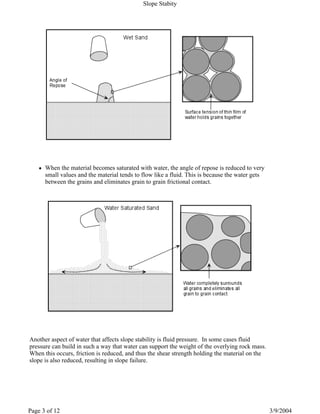
Dry unconsolidated grains will form a pile with a slope angle determined by the angle of
repose. The angle of repose is the steepest angle at which a pile of unconsolidated grains
remains stable, and is controlled by the frictional contact between the grains. In general,
for dry materials the angle of repose increases with increasing grain size, but usually lies
between about 30 and 37o.
Slightly wet unconsolidated materials exhibit a very high angle of repose because surface
tension between the water and the solid grains tends to hold the grains in place.
Slope Stabity
3/9/2004Page 2 of 12
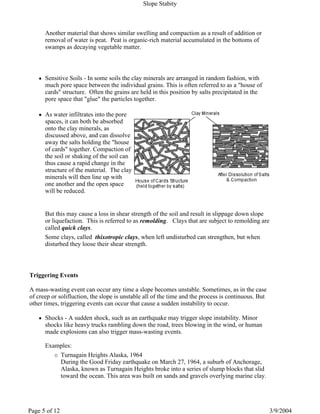
When the material becomes saturated with water, the angle of repose is reduced to very
small values and the material tends to flow like a fluid. This is because the water gets
between the grains and eliminates grain to grain frictional contact.
Another aspect of water that affects slope stability is fluid pressure. In some cases fluid
pressure can build in such a way that water can support the weight of the overlying rock mass.
When this occurs, friction is reduced, and thus the shear strength holding the material on the
slope is also reduced, resulting in slope failure.
Slope Stabity
3/9/2004Page 3 of 12
Troublesome Earth Materials
Liquefaction - As we have already discussed, liquefaction occurs when loose sediment
becomes oversaturated with water and individual grains loose grain to grain contact with
one another as water gets between them.
This can occur as a result
of ground shaking, as we
discussed during our
exploration of
earthquakes, or can occur
as water is added as a
result of heavy rainfall or
melting of ice or snow. It
can also occur gradually
by slow infiltration of
water into loose
sediments and soils.
The amount of water necessary to transform the sediment or soil from a solid mass into a
liquid mass varies with the type of material. Clay bearing sediments in general require
more water because water is first absorbed onto the clay minerals, making them even
more solid-like, then further water is needed to lift the individual grains away from each
other.
Expansive and Hydrocompacting Soils - These are soils that contain a high proportion of
a type of clay mineral called smectites or montmorillinites. Such clay minerals expand
when they become wet as water enters the crystal structure and increases the volume of
the mineral. When such clays dry out, the loss of water causes the volume to decrease
and the clays to shrink or compact (This process is referred to as hydrocompaction).
Slope Stabity
3/9/2004Page 4 of 12
Another material that shows similar swelling and compaction as a result of addition or
removal of water is peat. Peat is organic-rich material accumulated in the bottoms of
swamps as decaying vegetable matter.
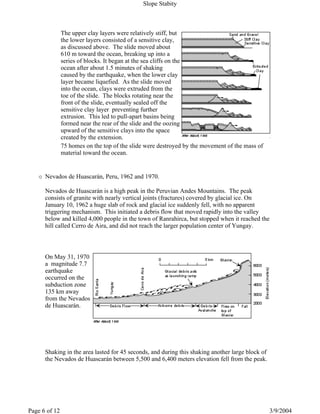
Sensitive Soils - In some soils the clay minerals are arranged in random fashion, with
much pore space between the individual grains. This is often referred to as a "house of
cards" structure. Often the grains are held in this position by salts precipitated in the
pore space that "glue" the particles together.
As water infiltrates into the pore
spaces, it can both be absorbed
onto the clay minerals, as
discussed above, and can dissolve
away the salts holding the "house
of cards" together. Compaction of
the soil or shaking of the soil can
thus cause a rapid change in the
structure of the material. The clay
minerals will then line up with
one another and the open space
will be reduced.
But this may cause a loss in shear strength of the soil and result in slippage down slope
or liquefaction. This is referred to as remolding. Clays that are subject to remolding are
called quick clays.
Some clays, called thixotropic clays, when left undisturbed can strengthen, but when
disturbed they loose their shear strength.
Triggering Events
A mass-wasting event can occur any time a slope becomes unstable. Sometimes, as in the case
of creep or solifluction, the slope is unstable all of the time and the process is continuous. But
other times, triggering events can occur that cause a sudden instability to occur.
Shocks - A sudden shock, such as an earthquake may trigger slope instability. Minor
shocks like heavy trucks rambling down the road, trees blowing in the wind, or human
made explosions can also trigger mass-wasting events.
Examples:
Turnagain Heights Alaska, 1964
During the Good Friday earthquake on March 27, 1964, a suburb of Anchorage,
Alaska, known as Turnagain Heights broke into a series of slump blocks that slid
toward the ocean. This area was built on sands and gravels overlying marine clay.
Slope Stabity
3/9/2004Page 5 of 12
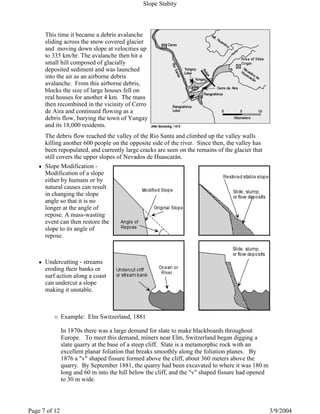
The upper clay layers were relatively stiff, but
the lower layers consisted of a sensitive clay,
as discussed above. The slide moved about
610 m toward the ocean, breaking up into a
series of blocks. It began at the sea cliffs on the
ocean after about 1.5 minutes of shaking
caused by the earthquake, when the lower clay
layer became liquefied. As the slide moved
into the ocean, clays were extruded from the
toe of the slide. The blocks rotating near the
front of the slide, eventually sealed off the
sensitive clay layer preventing further
extrusion. This led to pull-apart basins being
formed near the rear of the slide and the oozing
upward of the sensitive clays into the space
created by the extension.
75 homes on the top of the slide were destroyed by the movement of the mass of
material toward the ocean.
Nevados de Huascarán, Peru, 1962 and 1970.
Nevados de Huascarán is a high peak in the Peruvian Andes Mountains. The peak
consists of granite with nearly vertical joints (fractures) covered by glacial ice. On
January 10, 1962 a huge slab of rock and glacial ice suddenly fell, with no apparent
triggering mechanism. This initiated a debris flow that moved rapidly into the valley
below and killed 4,000 people in the town of Ranrahirca, but stopped when it reached the
hill called Cerro de Aira, and did not reach the larger population center of Yungay.
On May 31, 1970
a magnitude 7.7
earthquake
occurred on the
subduction zone
135 km away
from the Nevados
de Huascarán.
Shaking in the area lasted for 45 seconds, and during this shaking another large block of
the Nevados de Huascarán between 5,500 and 6,400 meters elevation fell from the peak.
Slope Stabity
3/9/2004Page 6 of 12
This time it became a debris avalanche
sliding across the snow covered glacier
and moving down slope at velocities up
to 335 km/hr. The avalanche then hit a
small hill composed of glacially
deposited sediment and was launched
into the air as an airborne debris
avalanche. From this airborne debris,
blocks the size of large houses fell on
real houses for another 4 km. The mass
then recombined in the vicinity of Cerro
de Aira and continued flowing as a
debris flow, burying the town of Yungay
and its 18,000 residents.
The debris flow reached the valley of the Rio Santa and climbed up the valley walls
killing another 600 people on the opposite side of the river. Since then, the valley has
been repopulated, and currently large cracks are seen on the remains of the glacier that
still covers the upper slopes of Nevados de Huascarán.
Slope Modification -
Modification of a slope
either by humans or by
natural causes can result
in changing the slope
angle so that it is no
longer at the angle of
repose. A mass-wasting
event can then restore the
slope to its angle of
repose.
Undercutting - streams
eroding their banks or
surf action along a coast
can undercut a slope
making it unstable.
Example: Elm Switzerland, 1881
In 1870s there was a large demand for slate to make blackboards throughout
Europe. To meet this demand, miners near Elm, Switzerland began digging a
slate quarry at the base of a steep cliff. Slate is a metamorphic rock with an
excellent planar foliation that breaks smoothly along the foliation planes. By
1876 a "v" shaped fissure formed above the cliff, about 360 meters above the
quarry. By September 1881, the quarry had been excavated to where it was 180 m
long and 60 m into the hill below the cliff, and the "v" shaped fissure had opened
to 30 m wide.
Slope Stabity
3/9/2004Page 7 of 12
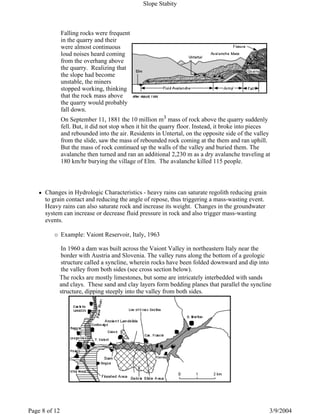
Falling rocks were frequent
in the quarry and their
were almost continuous
loud noises heard coming
from the overhang above
the quarry. Realizing that
the slope had become
unstable, the miners
stopped working, thinking
that the rock mass above
the quarry would probably
fall down.
On September 11, 1881 the 10 million m3 mass of rock above the quarry suddenly
fell. But, it did not stop when it hit the quarry floor. Instead, it broke into pieces
and rebounded into the air. Residents in Untertal, on the opposite side of the valley
from the slide, saw the mass of rebounded rock coming at the them and ran uphill.
But the mass of rock continued up the walls of the valley and buried them. The
avalanche then turned and ran an additional 2,230 m as a dry avalanche traveling at
180 km/hr burying the village of Elm. The avalanche killed 115 people.
Changes in Hydrologic Characteristics - heavy rains can saturate regolith reducing grain
to grain contact and reducing the angle of repose, thus triggering a mass-wasting event.
Heavy rains can also saturate rock and increase its weight. Changes in the groundwater
system can increase or decrease fluid pressure in rock and also trigger mass-wasting
events.
Example: Vaiont Reservoir, Italy, 1963
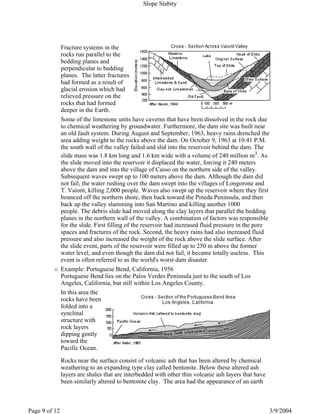
In 1960 a dam was built across the Vaiont Valley in northeastern Italy near the
border with Austria and Slovenia. The valley runs along the bottom of a geologic
structure called a syncline, wherein rocks have been folded downward and dip into
the valley from both sides (see cross section below).
The rocks are mostly limestones, but some are intricately interbedded with sands
and clays. These sand and clay layers form bedding planes that parallel the syncline
structure, dipping steeply into the valley from both sides.
Slope Stabity
3/9/2004Page 8 of 12
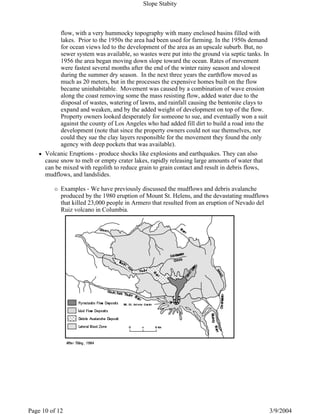
Fracture systems in the
rocks run parallel to the
bedding planes and
perpendicular to bedding
planes. The latter fractures
had formed as a result of
glacial erosion which had
relieved pressure on the
rocks that had formed
deeper in the Earth.
Some of the limestone units have caverns that have been dissolved in the rock due
to chemical weathering by groundwater. Furthermore, the dam site was built near
an old fault system. During August and September, 1963, heavy rains drenched the
area adding weight to the rocks above the dam. On October 9, 1963 at 10:41 P.M.
the south wall of the valley failed and slid into the reservoir behind the dam. The
slide mass was 1.8 km long and 1.6 km wide with a volume of 240 million m3. As
the slide moved into the reservoir it displaced the water, forcing it 240 meters
above the dam and into the village of Casso on the northern side of the valley.
Subsequent waves swept up to 100 meters above the dam. Although the dam did
not fail, the water rushing over the dam swept into the villages of Longorone and
T. Vaiont, killing 2,000 people. Waves also swept up the reservoir where they first
bounced off the northern shore, then back toward the Pineda Peninsula, and then
back up the valley slamming into San Martino and killing another 1000
people. The debris slide had moved along the clay layers that parallel the bedding
planes in the northern wall of the valley. A combination of factors was responsible
for the slide. First filling of the reservoir had increased fluid pressure in the pore
spaces and fractures of the rock. Second, the heavy rains had also increased fluid
pressure and also increased the weight of the rock above the slide surface. After
the slide event, parts of the reservoir were filled up to 250 m above the former
water level, and even though the dam did not fail, it became totally useless. This
event is often referred to as the world's worst dam disaster.
Example: Portuguese Bend, California, 1956
Portuguese Bend lies on the Palos Verdes Peninsula just to the south of Los
Angeles, California, but still within Los Angeles County.
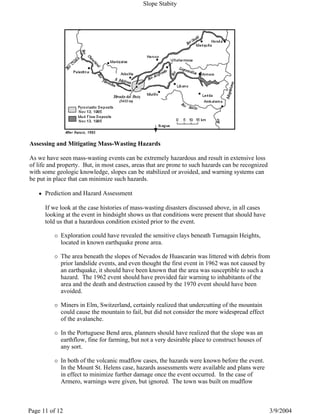
In this area the
rocks have been
folded into a
synclinal
structure with
rock layers
dipping gently
toward the
Pacific Ocean.
Rocks near the surface consist of volcanic ash that has been altered by chemical
weathering to an expanding type clay called bentonite. Below these altered ash
layers are shales that are interbedded with other thin volcanic ash layers that have
been similarly altered to bentonite clay. The area had the appearance of an earth
Slope Stabity
3/9/2004Page 9 of 12
flow, with a very hummocky topography with many enclosed basins filled with
lakes. Prior to the 1950s the area had been used for farming. In the 1950s demand
for ocean views led to the development of the area as an upscale suburb. But, no
sewer system was available, so wastes were put into the ground via septic tanks. In
1956 the area began moving down slope toward the ocean. Rates of movement
were fastest several months after the end of the winter rainy season and slowest
during the summer dry season. In the next three years the earthflow moved as
much as 20 meters, but in the processes the expensive homes built on the flow
became uninhabitable. Movement was caused by a combination of wave erosion
along the coast removing some the mass resisting flow, added water due to the
disposal of wastes, watering of lawns, and rainfall causing the bentonite clays to
expand and weaken, and by the added weight of development on top of the flow.
Property owners looked desperately for someone to sue, and eventually won a suit
against the county of Los Angeles who had added fill dirt to build a road into the
development (note that since the property owners could not sue themselves, nor
could they sue the clay layers responsible for the movement they found the only
agency with deep pockets that was available).
Volcanic Eruptions - produce shocks like explosions and earthquakes. They can also
cause snow to melt or empty crater lakes, rapidly releasing large amounts of water that
can be mixed with regolith to reduce grain to grain contact and result in debris flows,
mudflows, and landslides.
Examples - We have previously discussed the mudflows and debris avalanche
produced by the 1980 eruption of Mount St. Helens, and the devastating mudflows
that killed 23,000 people in Armero that resulted from an eruption of Nevado del
Ruiz volcano in Columbia.
Slope Stabity
3/9/2004Page 10 of 12
Assessing and Mitigating Mass-Wasting Hazards
As we have seen mass-wasting events can be extremely hazardous and result in extensive loss
of life and property. But, in most cases, areas that are prone to such hazards can be recognized
with some geologic knowledge, slopes can be stabilized or avoided, and warning systems can
be put in place that can minimize such hazards.
Prediction and Hazard Assessment
If we look at the case histories of mass-wasting disasters discussed above, in all cases
looking at the event in hindsight shows us that conditions were present that should have
told us that a hazardous condition existed prior to the event.
Exploration could have revealed the sensitive clays beneath Turnagain Heights,
located in known earthquake prone area.
The area beneath the slopes of Nevados de Huascarán was littered with debris from
prior landslide events, and even thought the first event in 1962 was not caused by
an earthquake, it should have been known that the area was susceptible to such a
hazard. The 1962 event should have provided fair warning to inhabitants of the
area and the death and destruction caused by the 1970 event should have been
avoided.
Miners in Elm, Switzerland, certainly realized that undercutting of the mountain
could cause the mountain to fail, but did not consider the more widespread effect
of the avalanche.
In the Portuguese Bend area, planners should have realized that the slope was an
earthflow, fine for farming, but not a very desirable place to construct houses of
any sort.
In both of the volcanic mudflow cases, the hazards were known before the event.
In the Mount St. Helens case, hazards assessments were available and plans were
in effect to minimize further damage once the event occurred. In the case of
Armero, warnings were given, but ignored. The town was built on mudflow
Slope Stabity
3/9/2004Page 11 of 12
References
Return to EENS 204 Homepage
deposits from prior mudflow events.
Because there is usually evidence in the form of distinctive deposits and geologic
structures left by recent mass wasting events, it is possible, if resources are available, to
construct maps of all areas prone to possible mass-wasting hazards. Planners can use
such hazards maps to make decisions about land use policies in such areas or, as will be
discussed below, steps can be taken to stabilize slopes to attempt to prevent a disaster.
Short-term prediction of mass-wasting events is somewhat more problematical. For
earthquake triggered events, the same problems that are inherent in earthquake prediction
are present. Slope destabilization and undercutting triggered events require the constant
attention of those undertaking or observing the slopes, many of whom are not educated in
the problems inherent in such processes. Mass-wasting hazards from volcanic eruptions
can be predicted with the same degree of certainty that volcanic eruptions can be
predicted, but again, the threat has to be realized and warnings need to be heeded.
Hydrologic conditions such as heavy precipitation can be forecast with some certainty,
and warnings can be issued to areas that might be susceptible to mass-wasting processes
caused by such conditions. Still, it is difficult of know exactly which hill slope of the
millions that exist will be vulnerable to an event triggered by heavy rainfall.
Prevention and Mitigation
All slopes are susceptible to mass-wasting hazards if a triggering event occurs. Thus, all
slopes should be assessed for potential mass-wasting hazards. Mass-wasting events can
sometimes be avoided by employing engineering techniques to make the slope more
stable. Among them are:
Steep slopes can be covered or sprayed with concrete to prevent rock falls.
Retaining walls could be built to stabilize a slope.
Drainage pipes could be inserted into the slope to more easily allow water to get
out and avoid increases in fluid pressure, the possibility of liquefaction, or
increased weight due to the addition of water.
Oversteepened slopes could be graded to reduce the slope to the natural angle of
repose.
In mountain valleys subject to mudflows, plans could be made to rapidly lower
levels of water in human-made reservoirs to catch and trap the mudflows.
Some slopes, however, cannot be stabilized. In these cases, humans should avoid these
areas or use them for purposes that will not increase susceptibility of lives or property to
mass-wasting hazards.
Slope Stabity
3/9/2004Page 12 of 12

Geohazards

  • 1.
    This page lastupdated on 09-Mar-2004 EENS 204 Natural Disasters Tulane University Prof. Stephen A. Nelson Slope Stability, Triggering Events, Mass Wasting Events Factors that Influence Slope Stability Gravity The main force responsible for mass wasting is gravity. Gravity is the force that acts everywhere on the Earth's surface, pulling everything in a direction toward the center of the Earth. On a flat surface the force of gravity acts downward. So long as the material remains on the flat surface it will not move under the force of gravity. On a slope, the force of gravity can be resolved into two components: a component acting perpendicular to the slope and a component acting tangential to the slope. The perpendicular component of gravity, gp, helps to hold the object in place on the slope. The tangential component of gravity, gt, causes a shear stress parallel to the slope that pulls the object in the down-slope direction. On a steeper slope, the shear stress or tangential component of gravity, gt, increases, and the perpendicular component of gravity, gp, decreases. The forces resisting movement down the slope are grouped under the term shear strength which includes frictional resistance and cohesion among the particles that make up the object. Slope Stabity 3/9/2004Page 1 of 12
  • 2.
    When the sheerstress becomes greater than the combination of forces holding the object on the slope, the object will move down-slope. Thus, down-slope movement is favored by steeper slope angles which increase the shear stress, and anything that reduces the shear strength, such as lowering the cohesion among the particles or lowering the frictional resistance. This is often expressed as the safety factor, Fs, the ratio of shear strength to shear stress. Fs = Shear Strength/Shear Stress If the safety factor becomes less than 1.0, slope failure is expected. The Role of Water Although water is not always directly involved as the transporting medium in mass-wasting processes, it does play an important role. Think about building a sand castle on the beach. If the sand is totally dry, it is impossible to build a pile of sand with a steep face like a castle wall. If the sand is somewhat wet, however, one can build a vertical wall. If the sand is too wet, then it flows like a fluid and cannot remain in position as a wall. Dry unconsolidated grains will form a pile with a slope angle determined by the angle of repose. The angle of repose is the steepest angle at which a pile of unconsolidated grains remains stable, and is controlled by the frictional contact between the grains. In general, for dry materials the angle of repose increases with increasing grain size, but usually lies between about 30 and 37o. Slightly wet unconsolidated materials exhibit a very high angle of repose because surface tension between the water and the solid grains tends to hold the grains in place. Slope Stabity 3/9/2004Page 2 of 12
  • 3.
    When the materialbecomes saturated with water, the angle of repose is reduced to very small values and the material tends to flow like a fluid. This is because the water gets between the grains and eliminates grain to grain frictional contact. Another aspect of water that affects slope stability is fluid pressure. In some cases fluid pressure can build in such a way that water can support the weight of the overlying rock mass. When this occurs, friction is reduced, and thus the shear strength holding the material on the slope is also reduced, resulting in slope failure. Slope Stabity 3/9/2004Page 3 of 12
  • 4.
    Troublesome Earth Materials Liquefaction- As we have already discussed, liquefaction occurs when loose sediment becomes oversaturated with water and individual grains loose grain to grain contact with one another as water gets between them. This can occur as a result of ground shaking, as we discussed during our exploration of earthquakes, or can occur as water is added as a result of heavy rainfall or melting of ice or snow. It can also occur gradually by slow infiltration of water into loose sediments and soils. The amount of water necessary to transform the sediment or soil from a solid mass into a liquid mass varies with the type of material. Clay bearing sediments in general require more water because water is first absorbed onto the clay minerals, making them even more solid-like, then further water is needed to lift the individual grains away from each other. Expansive and Hydrocompacting Soils - These are soils that contain a high proportion of a type of clay mineral called smectites or montmorillinites. Such clay minerals expand when they become wet as water enters the crystal structure and increases the volume of the mineral. When such clays dry out, the loss of water causes the volume to decrease and the clays to shrink or compact (This process is referred to as hydrocompaction). Slope Stabity 3/9/2004Page 4 of 12
  • 5.
    Another material thatshows similar swelling and compaction as a result of addition or removal of water is peat. Peat is organic-rich material accumulated in the bottoms of swamps as decaying vegetable matter. Sensitive Soils - In some soils the clay minerals are arranged in random fashion, with much pore space between the individual grains. This is often referred to as a "house of cards" structure. Often the grains are held in this position by salts precipitated in the pore space that "glue" the particles together. As water infiltrates into the pore spaces, it can both be absorbed onto the clay minerals, as discussed above, and can dissolve away the salts holding the "house of cards" together. Compaction of the soil or shaking of the soil can thus cause a rapid change in the structure of the material. The clay minerals will then line up with one another and the open space will be reduced. But this may cause a loss in shear strength of the soil and result in slippage down slope or liquefaction. This is referred to as remolding. Clays that are subject to remolding are called quick clays. Some clays, called thixotropic clays, when left undisturbed can strengthen, but when disturbed they loose their shear strength. Triggering Events A mass-wasting event can occur any time a slope becomes unstable. Sometimes, as in the case of creep or solifluction, the slope is unstable all of the time and the process is continuous. But other times, triggering events can occur that cause a sudden instability to occur. Shocks - A sudden shock, such as an earthquake may trigger slope instability. Minor shocks like heavy trucks rambling down the road, trees blowing in the wind, or human made explosions can also trigger mass-wasting events. Examples: Turnagain Heights Alaska, 1964 During the Good Friday earthquake on March 27, 1964, a suburb of Anchorage, Alaska, known as Turnagain Heights broke into a series of slump blocks that slid toward the ocean. This area was built on sands and gravels overlying marine clay. Slope Stabity 3/9/2004Page 5 of 12
  • 6.
    The upper claylayers were relatively stiff, but the lower layers consisted of a sensitive clay, as discussed above. The slide moved about 610 m toward the ocean, breaking up into a series of blocks. It began at the sea cliffs on the ocean after about 1.5 minutes of shaking caused by the earthquake, when the lower clay layer became liquefied. As the slide moved into the ocean, clays were extruded from the toe of the slide. The blocks rotating near the front of the slide, eventually sealed off the sensitive clay layer preventing further extrusion. This led to pull-apart basins being formed near the rear of the slide and the oozing upward of the sensitive clays into the space created by the extension. 75 homes on the top of the slide were destroyed by the movement of the mass of material toward the ocean. Nevados de Huascarán, Peru, 1962 and 1970. Nevados de Huascarán is a high peak in the Peruvian Andes Mountains. The peak consists of granite with nearly vertical joints (fractures) covered by glacial ice. On January 10, 1962 a huge slab of rock and glacial ice suddenly fell, with no apparent triggering mechanism. This initiated a debris flow that moved rapidly into the valley below and killed 4,000 people in the town of Ranrahirca, but stopped when it reached the hill called Cerro de Aira, and did not reach the larger population center of Yungay. On May 31, 1970 a magnitude 7.7 earthquake occurred on the subduction zone 135 km away from the Nevados de Huascarán. Shaking in the area lasted for 45 seconds, and during this shaking another large block of the Nevados de Huascarán between 5,500 and 6,400 meters elevation fell from the peak. Slope Stabity 3/9/2004Page 6 of 12
  • 7.
    This time itbecame a debris avalanche sliding across the snow covered glacier and moving down slope at velocities up to 335 km/hr. The avalanche then hit a small hill composed of glacially deposited sediment and was launched into the air as an airborne debris avalanche. From this airborne debris, blocks the size of large houses fell on real houses for another 4 km. The mass then recombined in the vicinity of Cerro de Aira and continued flowing as a debris flow, burying the town of Yungay and its 18,000 residents. The debris flow reached the valley of the Rio Santa and climbed up the valley walls killing another 600 people on the opposite side of the river. Since then, the valley has been repopulated, and currently large cracks are seen on the remains of the glacier that still covers the upper slopes of Nevados de Huascarán. Slope Modification - Modification of a slope either by humans or by natural causes can result in changing the slope angle so that it is no longer at the angle of repose. A mass-wasting event can then restore the slope to its angle of repose. Undercutting - streams eroding their banks or surf action along a coast can undercut a slope making it unstable. Example: Elm Switzerland, 1881 In 1870s there was a large demand for slate to make blackboards throughout Europe. To meet this demand, miners near Elm, Switzerland began digging a slate quarry at the base of a steep cliff. Slate is a metamorphic rock with an excellent planar foliation that breaks smoothly along the foliation planes. By 1876 a "v" shaped fissure formed above the cliff, about 360 meters above the quarry. By September 1881, the quarry had been excavated to where it was 180 m long and 60 m into the hill below the cliff, and the "v" shaped fissure had opened to 30 m wide. Slope Stabity 3/9/2004Page 7 of 12
  • 8.
    Falling rocks werefrequent in the quarry and their were almost continuous loud noises heard coming from the overhang above the quarry. Realizing that the slope had become unstable, the miners stopped working, thinking that the rock mass above the quarry would probably fall down. On September 11, 1881 the 10 million m3 mass of rock above the quarry suddenly fell. But, it did not stop when it hit the quarry floor. Instead, it broke into pieces and rebounded into the air. Residents in Untertal, on the opposite side of the valley from the slide, saw the mass of rebounded rock coming at the them and ran uphill. But the mass of rock continued up the walls of the valley and buried them. The avalanche then turned and ran an additional 2,230 m as a dry avalanche traveling at 180 km/hr burying the village of Elm. The avalanche killed 115 people. Changes in Hydrologic Characteristics - heavy rains can saturate regolith reducing grain to grain contact and reducing the angle of repose, thus triggering a mass-wasting event. Heavy rains can also saturate rock and increase its weight. Changes in the groundwater system can increase or decrease fluid pressure in rock and also trigger mass-wasting events. Example: Vaiont Reservoir, Italy, 1963 In 1960 a dam was built across the Vaiont Valley in northeastern Italy near the border with Austria and Slovenia. The valley runs along the bottom of a geologic structure called a syncline, wherein rocks have been folded downward and dip into the valley from both sides (see cross section below). The rocks are mostly limestones, but some are intricately interbedded with sands and clays. These sand and clay layers form bedding planes that parallel the syncline structure, dipping steeply into the valley from both sides. Slope Stabity 3/9/2004Page 8 of 12
  • 9.
    Fracture systems inthe rocks run parallel to the bedding planes and perpendicular to bedding planes. The latter fractures had formed as a result of glacial erosion which had relieved pressure on the rocks that had formed deeper in the Earth. Some of the limestone units have caverns that have been dissolved in the rock due to chemical weathering by groundwater. Furthermore, the dam site was built near an old fault system. During August and September, 1963, heavy rains drenched the area adding weight to the rocks above the dam. On October 9, 1963 at 10:41 P.M. the south wall of the valley failed and slid into the reservoir behind the dam. The slide mass was 1.8 km long and 1.6 km wide with a volume of 240 million m3. As the slide moved into the reservoir it displaced the water, forcing it 240 meters above the dam and into the village of Casso on the northern side of the valley. Subsequent waves swept up to 100 meters above the dam. Although the dam did not fail, the water rushing over the dam swept into the villages of Longorone and T. Vaiont, killing 2,000 people. Waves also swept up the reservoir where they first bounced off the northern shore, then back toward the Pineda Peninsula, and then back up the valley slamming into San Martino and killing another 1000 people. The debris slide had moved along the clay layers that parallel the bedding planes in the northern wall of the valley. A combination of factors was responsible for the slide. First filling of the reservoir had increased fluid pressure in the pore spaces and fractures of the rock. Second, the heavy rains had also increased fluid pressure and also increased the weight of the rock above the slide surface. After the slide event, parts of the reservoir were filled up to 250 m above the former water level, and even though the dam did not fail, it became totally useless. This event is often referred to as the world's worst dam disaster. Example: Portuguese Bend, California, 1956 Portuguese Bend lies on the Palos Verdes Peninsula just to the south of Los Angeles, California, but still within Los Angeles County. In this area the rocks have been folded into a synclinal structure with rock layers dipping gently toward the Pacific Ocean. Rocks near the surface consist of volcanic ash that has been altered by chemical weathering to an expanding type clay called bentonite. Below these altered ash layers are shales that are interbedded with other thin volcanic ash layers that have been similarly altered to bentonite clay. The area had the appearance of an earth Slope Stabity 3/9/2004Page 9 of 12
  • 10.
    flow, with avery hummocky topography with many enclosed basins filled with lakes. Prior to the 1950s the area had been used for farming. In the 1950s demand for ocean views led to the development of the area as an upscale suburb. But, no sewer system was available, so wastes were put into the ground via septic tanks. In 1956 the area began moving down slope toward the ocean. Rates of movement were fastest several months after the end of the winter rainy season and slowest during the summer dry season. In the next three years the earthflow moved as much as 20 meters, but in the processes the expensive homes built on the flow became uninhabitable. Movement was caused by a combination of wave erosion along the coast removing some the mass resisting flow, added water due to the disposal of wastes, watering of lawns, and rainfall causing the bentonite clays to expand and weaken, and by the added weight of development on top of the flow. Property owners looked desperately for someone to sue, and eventually won a suit against the county of Los Angeles who had added fill dirt to build a road into the development (note that since the property owners could not sue themselves, nor could they sue the clay layers responsible for the movement they found the only agency with deep pockets that was available). Volcanic Eruptions - produce shocks like explosions and earthquakes. They can also cause snow to melt or empty crater lakes, rapidly releasing large amounts of water that can be mixed with regolith to reduce grain to grain contact and result in debris flows, mudflows, and landslides. Examples - We have previously discussed the mudflows and debris avalanche produced by the 1980 eruption of Mount St. Helens, and the devastating mudflows that killed 23,000 people in Armero that resulted from an eruption of Nevado del Ruiz volcano in Columbia. Slope Stabity 3/9/2004Page 10 of 12
  • 11.
    Assessing and MitigatingMass-Wasting Hazards As we have seen mass-wasting events can be extremely hazardous and result in extensive loss of life and property. But, in most cases, areas that are prone to such hazards can be recognized with some geologic knowledge, slopes can be stabilized or avoided, and warning systems can be put in place that can minimize such hazards. Prediction and Hazard Assessment If we look at the case histories of mass-wasting disasters discussed above, in all cases looking at the event in hindsight shows us that conditions were present that should have told us that a hazardous condition existed prior to the event. Exploration could have revealed the sensitive clays beneath Turnagain Heights, located in known earthquake prone area. The area beneath the slopes of Nevados de Huascarán was littered with debris from prior landslide events, and even thought the first event in 1962 was not caused by an earthquake, it should have been known that the area was susceptible to such a hazard. The 1962 event should have provided fair warning to inhabitants of the area and the death and destruction caused by the 1970 event should have been avoided. Miners in Elm, Switzerland, certainly realized that undercutting of the mountain could cause the mountain to fail, but did not consider the more widespread effect of the avalanche. In the Portuguese Bend area, planners should have realized that the slope was an earthflow, fine for farming, but not a very desirable place to construct houses of any sort. In both of the volcanic mudflow cases, the hazards were known before the event. In the Mount St. Helens case, hazards assessments were available and plans were in effect to minimize further damage once the event occurred. In the case of Armero, warnings were given, but ignored. The town was built on mudflow Slope Stabity 3/9/2004Page 11 of 12
  • 12.
    References Return to EENS204 Homepage deposits from prior mudflow events. Because there is usually evidence in the form of distinctive deposits and geologic structures left by recent mass wasting events, it is possible, if resources are available, to construct maps of all areas prone to possible mass-wasting hazards. Planners can use such hazards maps to make decisions about land use policies in such areas or, as will be discussed below, steps can be taken to stabilize slopes to attempt to prevent a disaster. Short-term prediction of mass-wasting events is somewhat more problematical. For earthquake triggered events, the same problems that are inherent in earthquake prediction are present. Slope destabilization and undercutting triggered events require the constant attention of those undertaking or observing the slopes, many of whom are not educated in the problems inherent in such processes. Mass-wasting hazards from volcanic eruptions can be predicted with the same degree of certainty that volcanic eruptions can be predicted, but again, the threat has to be realized and warnings need to be heeded. Hydrologic conditions such as heavy precipitation can be forecast with some certainty, and warnings can be issued to areas that might be susceptible to mass-wasting processes caused by such conditions. Still, it is difficult of know exactly which hill slope of the millions that exist will be vulnerable to an event triggered by heavy rainfall. Prevention and Mitigation All slopes are susceptible to mass-wasting hazards if a triggering event occurs. Thus, all slopes should be assessed for potential mass-wasting hazards. Mass-wasting events can sometimes be avoided by employing engineering techniques to make the slope more stable. Among them are: Steep slopes can be covered or sprayed with concrete to prevent rock falls. Retaining walls could be built to stabilize a slope. Drainage pipes could be inserted into the slope to more easily allow water to get out and avoid increases in fluid pressure, the possibility of liquefaction, or increased weight due to the addition of water. Oversteepened slopes could be graded to reduce the slope to the natural angle of repose. In mountain valleys subject to mudflows, plans could be made to rapidly lower levels of water in human-made reservoirs to catch and trap the mudflows. Some slopes, however, cannot be stabilized. In these cases, humans should avoid these areas or use them for purposes that will not increase susceptibility of lives or property to mass-wasting hazards. Slope Stabity 3/9/2004Page 12 of 12