




GROUP NO 2
Shafi UW-14-CE-B.Sc-008
Sequence of Presentation
o Landslide
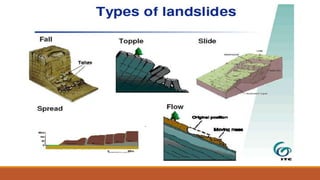
o Different Types of Landslides
oMain Factors that cause landslides
oHow to Minimize Landslide
o Landslide Safety measures
oLandslide lake in Pakistan
OBJECTIVES
To explain the effect of Landslide .
To explain landslide and how we can minimize landslide.
The goal is to achieve a maximum effective construction and
aware the people to avoid himself from death in case of land
sliding .
Discuss the place’s where the land sliding occur and point out
the weakness in construction and make better it in a future
Rotational
slides Translational
slides
Rock Fall:
Rock
toppling
Lateral
spreading Debris Flow
Rotational slides:
move along a surface of rupture that is curved and concave
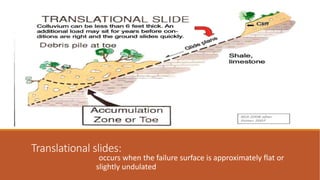
Translational slides:
occurs when the failure surface is approximately flat or
slightly undulated
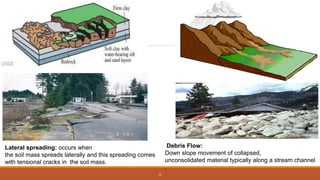
Lateral spreading: occurs when
the soil mass spreads laterally and this spreading comes
with tensional cracks in the soil mass.
Debris Flow:
Down slope movement of collapsed,
unconsolidated material typically along a stream channel
.
10
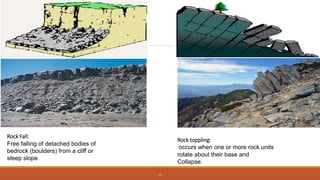
Rock Fall:
Free falling of detached bodies of
bedrock (boulders) from a cliff or
steep slope
Rock toppling:
occurs when one or more rock units
rotate about their base and
Collapse.
11
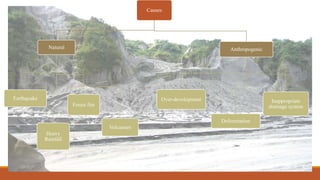
Causes
Natural
Earthquake
Heavy
Rainfall
Forest fire
Volcanoes
Anthropogenic
Over-development
Deforestation
Inappropriate
drainage system
1. Gravity: Gravity works more effectively on steeper slopes, but more gradual slopes may also be vulnerable.
1. Geological factors: Many slides occur in a geologic setting that places permeable sands and gravels above
impermeable layers of silt and clay, or bedrock.
Water seeps downward through the upper materials and accumulates on the top of the
underlying units, forming a zone of weakness
3. Heavy and prolonged rainfall: storm water runoff saturates soils on steep slopes or infiltration causes a
rapid rise in groundwater levels. As water tables rise, some slopes become
unstable that cause landslide.
4. Earthquakes: When plate tectonics move the soil that covers moves with it. When earthquakes occur on
areas with steep slopes, many times the soil slips causing landslides.
Furthermore, ashen debris flows caused by earthquakes can also trigger mass movement of soil.
.
Natural Factors
3. Forest fire: fires cause soil erosion and induce floods and landslides due to the
destruction of the natural vegetation. (E.g. ridges of Manipur-Nagaland border)
4. Volcanoes: Strato volcanoes are prone to sudden collapse, especially during wet
conditions. The conditions commonly prevail after volcanic eruptions that kill
vegetation over extensive areas and spread loose volcanic rocks over the landscape.
During subsequent rainy seasons, swollen rivers will erode the new deposits
and sometimes generate lahars that are dangerous to people downstream. (E.g. lahars at
Mount Pinatubo, Philippines in1990)
Natural Factors
1. Inappropriate drainage system: Natural drainage lines on slopes are blocked by
terracing/ contour bounding adopted to prevent soil erosion and to enhance
percolation during dry season for cultivation, without adequate provision for surface
drainage of excess storm water during high intensity rains increase the landslide
vulnerability.
2. Cutting & deep excavations on slopes: Developmental activities like construction
of buildings, road cutting, embankments, cut and fill structures causes modification
of natural slopes, blocking of surface drainage, loading of critical slopes and
withdrawal to toe support promoting vulnerability of critical slopes.
Anthropogenic Factors
3. Change in slope/land use pattern, deforestation, agricultural practices on steep
slopes: Deforestation and cultivation of seasonal crops and increase in settlements.
Improper land use practices such as heavy tilling, agricultural practices and
settlement patterns have contributed to creep and withdrawal of toe support in many
cases.
Anthropogenic Factors
How to Minimize Landslide Hazards
Passive Intervention
Active Preventive Intervention
Proper land use measures:
Structural measures
Non- Structural measures:
Landslide Hazard Mapping and Use of GIS:
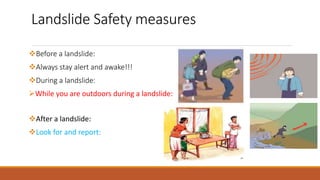
Landslide Safety measures
Before a landslide:
Always stay alert and awake!!!
During a landslide:
While you are outdoors during a landslide:
After a landslide:
Look for and report:
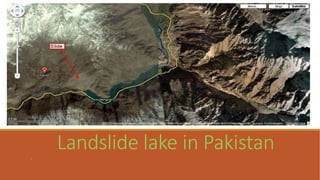
Landslide lake in Pakistan.
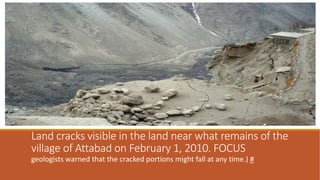
Land cracks visible in the land near what remains of the
village of Attabad on February 1, 2010. FOCUS
geologists warned that the cracked portions might fall at any time.) #
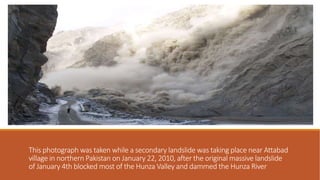
This photograph was taken while a secondary landslide was taking place near Attabad
village in northern Pakistan on January 22, 2010, after the original massive landslide
of January 4th blocked most of the Hunza Valley and dammed the Hunza River
.
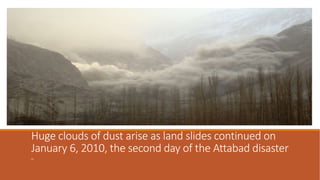
Huge clouds of dust arise as land slides continued on
January 6, 2010, the second day of the Attabad disaster
,,
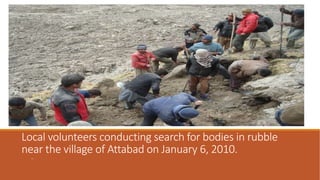
Local volunteers conducting search for bodies in rubble
near the village of Attabad on January 6, 2010.
..
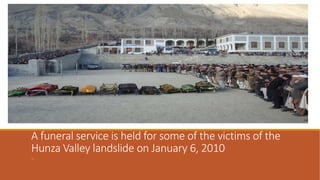
A funeral service is held for some of the victims of the
Hunza Valley landslide on January 6, 2010
..
THE END..

Landslides

  • 2.
    GROUP NO 2 ShafiUW-14-CE-B.Sc-008
  • 4.
    Sequence of Presentation oLandslide o Different Types of Landslides oMain Factors that cause landslides oHow to Minimize Landslide o Landslide Safety measures oLandslide lake in Pakistan
  • 5.
    OBJECTIVES To explain theeffect of Landslide . To explain landslide and how we can minimize landslide. The goal is to achieve a maximum effective construction and aware the people to avoid himself from death in case of land sliding . Discuss the place’s where the land sliding occur and point out the weakness in construction and make better it in a future
  • 7.
  • 8.
    Rotational slides: move alonga surface of rupture that is curved and concave
  • 9.
    Translational slides: occurs whenthe failure surface is approximately flat or slightly undulated
  • 10.
    Lateral spreading: occurswhen the soil mass spreads laterally and this spreading comes with tensional cracks in the soil mass. Debris Flow: Down slope movement of collapsed, unconsolidated material typically along a stream channel . 10
  • 11.
    Rock Fall: Free fallingof detached bodies of bedrock (boulders) from a cliff or steep slope Rock toppling: occurs when one or more rock units rotate about their base and Collapse. 11
  • 12.
  • 13.
    1. Gravity: Gravityworks more effectively on steeper slopes, but more gradual slopes may also be vulnerable. 1. Geological factors: Many slides occur in a geologic setting that places permeable sands and gravels above impermeable layers of silt and clay, or bedrock. Water seeps downward through the upper materials and accumulates on the top of the underlying units, forming a zone of weakness 3. Heavy and prolonged rainfall: storm water runoff saturates soils on steep slopes or infiltration causes a rapid rise in groundwater levels. As water tables rise, some slopes become unstable that cause landslide. 4. Earthquakes: When plate tectonics move the soil that covers moves with it. When earthquakes occur on areas with steep slopes, many times the soil slips causing landslides. Furthermore, ashen debris flows caused by earthquakes can also trigger mass movement of soil. . Natural Factors
  • 14.
    3. Forest fire:fires cause soil erosion and induce floods and landslides due to the destruction of the natural vegetation. (E.g. ridges of Manipur-Nagaland border) 4. Volcanoes: Strato volcanoes are prone to sudden collapse, especially during wet conditions. The conditions commonly prevail after volcanic eruptions that kill vegetation over extensive areas and spread loose volcanic rocks over the landscape. During subsequent rainy seasons, swollen rivers will erode the new deposits and sometimes generate lahars that are dangerous to people downstream. (E.g. lahars at Mount Pinatubo, Philippines in1990) Natural Factors
  • 15.
    1. Inappropriate drainagesystem: Natural drainage lines on slopes are blocked by terracing/ contour bounding adopted to prevent soil erosion and to enhance percolation during dry season for cultivation, without adequate provision for surface drainage of excess storm water during high intensity rains increase the landslide vulnerability. 2. Cutting & deep excavations on slopes: Developmental activities like construction of buildings, road cutting, embankments, cut and fill structures causes modification of natural slopes, blocking of surface drainage, loading of critical slopes and withdrawal to toe support promoting vulnerability of critical slopes. Anthropogenic Factors
  • 16.
    3. Change inslope/land use pattern, deforestation, agricultural practices on steep slopes: Deforestation and cultivation of seasonal crops and increase in settlements. Improper land use practices such as heavy tilling, agricultural practices and settlement patterns have contributed to creep and withdrawal of toe support in many cases. Anthropogenic Factors
  • 17.
    How to MinimizeLandslide Hazards Passive Intervention Active Preventive Intervention Proper land use measures: Structural measures Non- Structural measures: Landslide Hazard Mapping and Use of GIS:
  • 18.
    Landslide Safety measures Beforea landslide: Always stay alert and awake!!! During a landslide: While you are outdoors during a landslide: After a landslide: Look for and report:
  • 19.
  • 20.
    Land cracks visiblein the land near what remains of the village of Attabad on February 1, 2010. FOCUS geologists warned that the cracked portions might fall at any time.) #
  • 21.
    This photograph wastaken while a secondary landslide was taking place near Attabad village in northern Pakistan on January 22, 2010, after the original massive landslide of January 4th blocked most of the Hunza Valley and dammed the Hunza River .
  • 22.
    Huge clouds ofdust arise as land slides continued on January 6, 2010, the second day of the Attabad disaster ,,
  • 23.
    Local volunteers conductingsearch for bodies in rubble near the village of Attabad on January 6, 2010. ..
  • 24.
    A funeral serviceis held for some of the victims of the Hunza Valley landslide on January 6, 2010 ..
  • 25.