7 M A I N T Y P E S O F
S T A T I S T I C A L
A N A L Y S I S
DESCRIPTIVE TYPE
INFERENTIAL TYPE
PREDICTIVE ANALYTICS
CAUSAL ANALYSIS
EXPLORATORY DATA ANALYSIS (EDA)
MECHANISTIC ANALYSIS
As the name suggests, the descriptive statistic is used to describe! It describes
the basic features of data and shows or summarizes data in a rational way.
However, descriptive statistics do not allow making conclusions. You can not get
conclusions and make generalizations that extend beyond the data at hand.
Inferential statistics is a result of more complicated mathematical
estimations, and allow us to infer trends about a larger population
based on samples of “subjects” taken from it.
This type of statistical analysis is used to study the relationships between variables
within a sample, and you can make conclusions, generalizations or predictions
about a bigger population.
Predictive analytics uses techniques such as statistical algorithms and
machine learning to define the likelihood of future results, behavior,
and trends based on both new and historical data.
It is important to note that no statistical method can “predict” the future with 100%
surety. Businesses use these statistics to answer the question “What might happen?”.
Prescriptive analytics is a study which examines data to answer the
question “What should be done?”
Prescriptive analytics aim to find the optimal recommendations for a
decision making process. It is all about providing advice.
PRESCRIPTIVE ANALYTICS
When you would like to understand and identify the reasons why
things are as they are, causal analysis comes to help. This type of
analysis answers the question “Why?”
The business world is full of events that lead to failure. The causal seeks to
identify the reasons why? It is better to find causes and to treat them instead
of treating symptoms.
EDA is an analysis approach that focuses on identifying general
patterns in the data and to find previously unknown relationships.
EDA alone should not be used for generalizing or predicting. EDA is used for taking a
bird’s eye view of the data and trying to make some feeling or sense of it. Commonly, It is
the first step in data analysis, performed before other formal statistical techniques.
The mechanistic analysis is about understanding the exact changes in
given variables that lead to changes in other variables. However,
mechanistic does not consider external influences.
The assumption is that a given system is affected by the interaction of its own
components. It is useful on those systems for which there are very clear definitions. 
http://intellspot.com

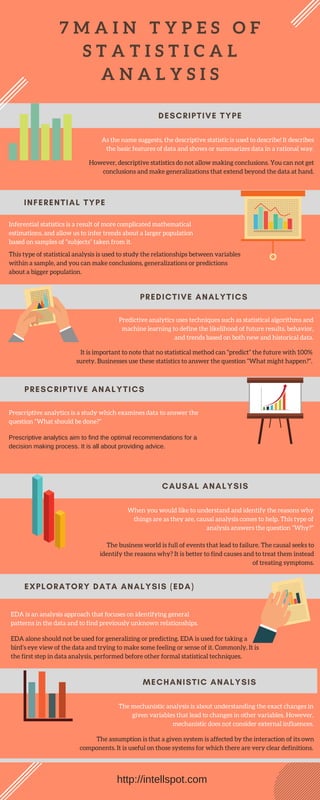
Types of statistical analysis infographic

  • 1.
    7 M AI N T Y P E S O F S T A T I S T I C A L A N A L Y S I S DESCRIPTIVE TYPE INFERENTIAL TYPE PREDICTIVE ANALYTICS CAUSAL ANALYSIS EXPLORATORY DATA ANALYSIS (EDA) MECHANISTIC ANALYSIS As the name suggests, the descriptive statistic is used to describe! It describes the basic features of data and shows or summarizes data in a rational way. However, descriptive statistics do not allow making conclusions. You can not get conclusions and make generalizations that extend beyond the data at hand. Inferential statistics is a result of more complicated mathematical estimations, and allow us to infer trends about a larger population based on samples of “subjects” taken from it. This type of statistical analysis is used to study the relationships between variables within a sample, and you can make conclusions, generalizations or predictions about a bigger population. Predictive analytics uses techniques such as statistical algorithms and machine learning to define the likelihood of future results, behavior, and trends based on both new and historical data. It is important to note that no statistical method can “predict” the future with 100% surety. Businesses use these statistics to answer the question “What might happen?”. Prescriptive analytics is a study which examines data to answer the question “What should be done?” Prescriptive analytics aim to find the optimal recommendations for a decision making process. It is all about providing advice. PRESCRIPTIVE ANALYTICS When you would like to understand and identify the reasons why things are as they are, causal analysis comes to help. This type of analysis answers the question “Why?” The business world is full of events that lead to failure. The causal seeks to identify the reasons why? It is better to find causes and to treat them instead of treating symptoms. EDA is an analysis approach that focuses on identifying general patterns in the data and to find previously unknown relationships. EDA alone should not be used for generalizing or predicting. EDA is used for taking a bird’s eye view of the data and trying to make some feeling or sense of it. Commonly, It is the first step in data analysis, performed before other formal statistical techniques. The mechanistic analysis is about understanding the exact changes in given variables that lead to changes in other variables. However, mechanistic does not consider external influences. The assumption is that a given system is affected by the interaction of its own components. It is useful on those systems for which there are very clear definitions.  http://intellspot.com