Welcome
to
School of Business,
Woxsen University
Business statistics
by
Prof. Venkat Reddy Yasa
Qualification’s: M. Sc-Applied Mathematics., MBA ., (Ph.D.)
Experience : Having 21 years of experience in teaching.
Subjects I teach: Statistics, Quantitative techniques and
Operations Research.
Introduction to Statistics
What is Statistics?
Definition of Statistics
What is Statistics ?
Statistics is defined as the science of decision making with calculated
risks in the face of uncertainty.
(or)
Statistics can also be simply defined as, the collection,
presentation and interpretation of data.
Origin and history of Statistics
 The History of statistics can be said to start around 1749 although, over time, there have been changes to
the interpretation of the word statistics. In early times, the meaning was restricted to information about
states.
 By the 18th century, the term “Statistics" designated the systematic collection of demographic factors and
economic data related to states.
 In the early 19th century, collection intensified, and the meaning of "statistics" broadened to include the
discipline concerned with the collection, summary, and analysis of data.
 Today, data are collected, and statistics are computed and widely distributed in government, business, most
of the sciences and sports etc.,…
 Currently, statistics and statistical methods play a key role in doing data analysis and to become a sound
data analyst.
Scope and Importance of Statistics
 Statistics and business: Statistics is used in Business and operations in the following areas:
• Planning
• Production
• Inventory management
• Supply chain management
• Marketing
• Sales and demand forecasting
• Services
• Logistics
• HRM
 Statistics and industry: In industry, statistics is widely used in quality control. In production
engineering, to find out, whether the product is confirming to the specifications or not. Statistical
tools, such as inspection plan, control chart etc.
Scope and Importance of Statistics
 Statistics and modern science: In medical science the statistical tools are used for collection,
presentation and analysis of observed facts relating to causes and incidence of diseases and the
result of application of various drugs and medicine are of great importance.
 Statistics and war: In war the theory of decision function( Operations Research) can be a great
assistance to the military personnel and in designing the action plan for “maximum destruction
with minimum effort.”
 Statistics and planning: Statistics is indispensable into planning in the modern age
which is termed as “the age of planning”. Almost all over the world the governments are
re-storing to planning for economic development by using electoral statistics database.
 Statistics and economics: Statistical data analysis and statistical techniques are
immensely useful in solving economy related problems, such as wages, price, trend
analysis, demand analysis etc.,
Statistics in Business and Management
 Marketing: Statistical analysis is frequently done in formulating suitable strategies as per the
markets, so that the goods/services are reachable to the ultimate consumer. A skill full analysis of
data on various demographic factors like purchasing power, age group, habits and custom’s of
consumer, logistics cost etc., will open the venues for the new markets/target markets.
 Production: In the field of production, statistical data and statistical analysis play phenomenal
role. The decision about what to produce? How to produce? When to produce? For whom to
produce is based largely on statistical analysis.
 Banking: Banking institute’s have found the importance of establishing research and
department( R & D) within their organization for the purpose of gathering and analysis of
information, not only regarding their own business but also regarding general economic situation
and every segment of business in which they may have interest.
 Investment: Statistics greatly assists investors in making clear and valued judgment in his investment decision
in selecting securities which are safe and have the best prospects of yielding a good income.
 Purchase and vendor management: The purchase department, in discharging their function, makes use of
statistical data to frame suitable purchase policies, such as what to buy? What quantity to buy? What time to
buy? Where to buy? From whom to buy?
 Budget Management: The top level and middle level management control’s and combines statistical and
accounting method’s in making the overall budget for the up coming new financial year, which includes sales
volumes, profit margin’s, materials, labor and other input costs, net profits and capital requirement.
Functions of Statistics
 To present facts in definite form
 Precision to the facts
 Comparisons
 Formulation and testing of Hypothesis
 Forecasting
 Policy making
 It enlarges Knowledge
 To measures Uncertainty
Branches of Statistics
Descriptive Statistics
Descriptive Statistics deals with the collection and presentation
of data. This is usually the first part of a statistical analysis. It is
usually not as simple as it sounds, and the statistician needs to
be aware of designing experiments, choosing the right focus
group and avoid biases that are so easy to creep into the
experiment.
Inferential Statistics
Inferential statistics, as the name suggests, involves drawing the
right conclusions from the statistical analysis that has been
performed using descriptive statistics. In the end, it is the
inferences that make studies important, and this aspect is dealt
with in inferential statistics.
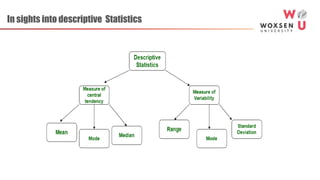
In sights into descriptive Statistics
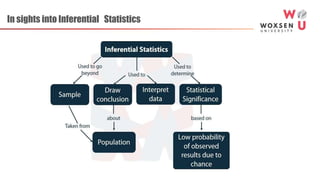
In sights into Inferential Statistics
Computers and Statistics
• Computational statistics, or statistical computing, is the interface
between statistics and computer science.
• What is Statistical Analysis Software?
• Statistical analysis software products
are specialized programs designed to
allow users to perform complex
statistical analysis. These products
typically provide tools for the
organization, interpretation, and
presentation of selected data sets.
Statistical solutions typically package
these data management capabilities
with features specific to statistical
analysis. Statistical analysis
capabilities refer to capabilities that
support analysis methodologies such
as regression analysis, predictive
analytics, and statistical modelling,
among many others.
Top 7 Statistical Analysis Software’s as on date.
• SPSS ( IBM)-Statistical package for social sciences
• R-Software( R Foundation)
• MATLAB ( The MathWorks)
• Microsoft Excel
• SAS ( Statistical Analysis Software)
• GraphPad Prism
• Minitab
• Conclusion: There is a range of different software tools
available, and each offers something slightly different to the
user – what you choose will depend on a range of factors,
including your research question, knowledge of statistics,
and experience of coding.
Limitations of Statistics
• Statistics laws are true on an average. Statistics are aggregates of facts. So
single observation is not a statistics, it deals with groups and aggregates only.
• Statistical methods are best applicable on quantitative data.
• Statistical cannot be applied to heterogeneous data.
• If sufficient care is not exercised in collecting, analyzing and interpretation the data,
statistical results might be misleading.
• Only a person who has an expert knowledge of statistics can handle statistical data
efficiently.
• Some errors are possible in statistical decisions. Particularly the inferential statistics
involves certain errors. We do not know whether an error has been committed or not.
THANK YOU
FORUM IS NOW OPEN FOR Q & A

Introduction to Statistics PPT (1).pptx

  • 1.
  • 2.
    Business statistics by Prof. VenkatReddy Yasa Qualification’s: M. Sc-Applied Mathematics., MBA ., (Ph.D.) Experience : Having 21 years of experience in teaching. Subjects I teach: Statistics, Quantitative techniques and Operations Research.
  • 3.
  • 4.
    Definition of Statistics Whatis Statistics ? Statistics is defined as the science of decision making with calculated risks in the face of uncertainty. (or) Statistics can also be simply defined as, the collection, presentation and interpretation of data.
  • 5.
    Origin and historyof Statistics  The History of statistics can be said to start around 1749 although, over time, there have been changes to the interpretation of the word statistics. In early times, the meaning was restricted to information about states.  By the 18th century, the term “Statistics" designated the systematic collection of demographic factors and economic data related to states.  In the early 19th century, collection intensified, and the meaning of "statistics" broadened to include the discipline concerned with the collection, summary, and analysis of data.  Today, data are collected, and statistics are computed and widely distributed in government, business, most of the sciences and sports etc.,…  Currently, statistics and statistical methods play a key role in doing data analysis and to become a sound data analyst.
  • 6.
    Scope and Importanceof Statistics  Statistics and business: Statistics is used in Business and operations in the following areas: • Planning • Production • Inventory management • Supply chain management • Marketing • Sales and demand forecasting • Services • Logistics • HRM  Statistics and industry: In industry, statistics is widely used in quality control. In production engineering, to find out, whether the product is confirming to the specifications or not. Statistical tools, such as inspection plan, control chart etc.
  • 7.
    Scope and Importanceof Statistics  Statistics and modern science: In medical science the statistical tools are used for collection, presentation and analysis of observed facts relating to causes and incidence of diseases and the result of application of various drugs and medicine are of great importance.  Statistics and war: In war the theory of decision function( Operations Research) can be a great assistance to the military personnel and in designing the action plan for “maximum destruction with minimum effort.”  Statistics and planning: Statistics is indispensable into planning in the modern age which is termed as “the age of planning”. Almost all over the world the governments are re-storing to planning for economic development by using electoral statistics database.  Statistics and economics: Statistical data analysis and statistical techniques are immensely useful in solving economy related problems, such as wages, price, trend analysis, demand analysis etc.,
  • 8.
    Statistics in Businessand Management  Marketing: Statistical analysis is frequently done in formulating suitable strategies as per the markets, so that the goods/services are reachable to the ultimate consumer. A skill full analysis of data on various demographic factors like purchasing power, age group, habits and custom’s of consumer, logistics cost etc., will open the venues for the new markets/target markets.  Production: In the field of production, statistical data and statistical analysis play phenomenal role. The decision about what to produce? How to produce? When to produce? For whom to produce is based largely on statistical analysis.  Banking: Banking institute’s have found the importance of establishing research and department( R & D) within their organization for the purpose of gathering and analysis of information, not only regarding their own business but also regarding general economic situation and every segment of business in which they may have interest.
  • 9.
     Investment: Statisticsgreatly assists investors in making clear and valued judgment in his investment decision in selecting securities which are safe and have the best prospects of yielding a good income.  Purchase and vendor management: The purchase department, in discharging their function, makes use of statistical data to frame suitable purchase policies, such as what to buy? What quantity to buy? What time to buy? Where to buy? From whom to buy?  Budget Management: The top level and middle level management control’s and combines statistical and accounting method’s in making the overall budget for the up coming new financial year, which includes sales volumes, profit margin’s, materials, labor and other input costs, net profits and capital requirement.
  • 10.
    Functions of Statistics To present facts in definite form  Precision to the facts  Comparisons  Formulation and testing of Hypothesis  Forecasting  Policy making  It enlarges Knowledge  To measures Uncertainty
  • 11.
    Branches of Statistics DescriptiveStatistics Descriptive Statistics deals with the collection and presentation of data. This is usually the first part of a statistical analysis. It is usually not as simple as it sounds, and the statistician needs to be aware of designing experiments, choosing the right focus group and avoid biases that are so easy to creep into the experiment. Inferential Statistics Inferential statistics, as the name suggests, involves drawing the right conclusions from the statistical analysis that has been performed using descriptive statistics. In the end, it is the inferences that make studies important, and this aspect is dealt with in inferential statistics.
  • 12.
    In sights intodescriptive Statistics
  • 13.
    In sights intoInferential Statistics
  • 14.
    Computers and Statistics •Computational statistics, or statistical computing, is the interface between statistics and computer science. • What is Statistical Analysis Software? • Statistical analysis software products are specialized programs designed to allow users to perform complex statistical analysis. These products typically provide tools for the organization, interpretation, and presentation of selected data sets. Statistical solutions typically package these data management capabilities with features specific to statistical analysis. Statistical analysis capabilities refer to capabilities that support analysis methodologies such as regression analysis, predictive analytics, and statistical modelling, among many others.
  • 15.
    Top 7 StatisticalAnalysis Software’s as on date. • SPSS ( IBM)-Statistical package for social sciences • R-Software( R Foundation) • MATLAB ( The MathWorks) • Microsoft Excel • SAS ( Statistical Analysis Software) • GraphPad Prism • Minitab • Conclusion: There is a range of different software tools available, and each offers something slightly different to the user – what you choose will depend on a range of factors, including your research question, knowledge of statistics, and experience of coding.
  • 16.
    Limitations of Statistics •Statistics laws are true on an average. Statistics are aggregates of facts. So single observation is not a statistics, it deals with groups and aggregates only. • Statistical methods are best applicable on quantitative data. • Statistical cannot be applied to heterogeneous data. • If sufficient care is not exercised in collecting, analyzing and interpretation the data, statistical results might be misleading. • Only a person who has an expert knowledge of statistics can handle statistical data efficiently. • Some errors are possible in statistical decisions. Particularly the inferential statistics involves certain errors. We do not know whether an error has been committed or not.
  • 17.
    THANK YOU FORUM ISNOW OPEN FOR Q & A