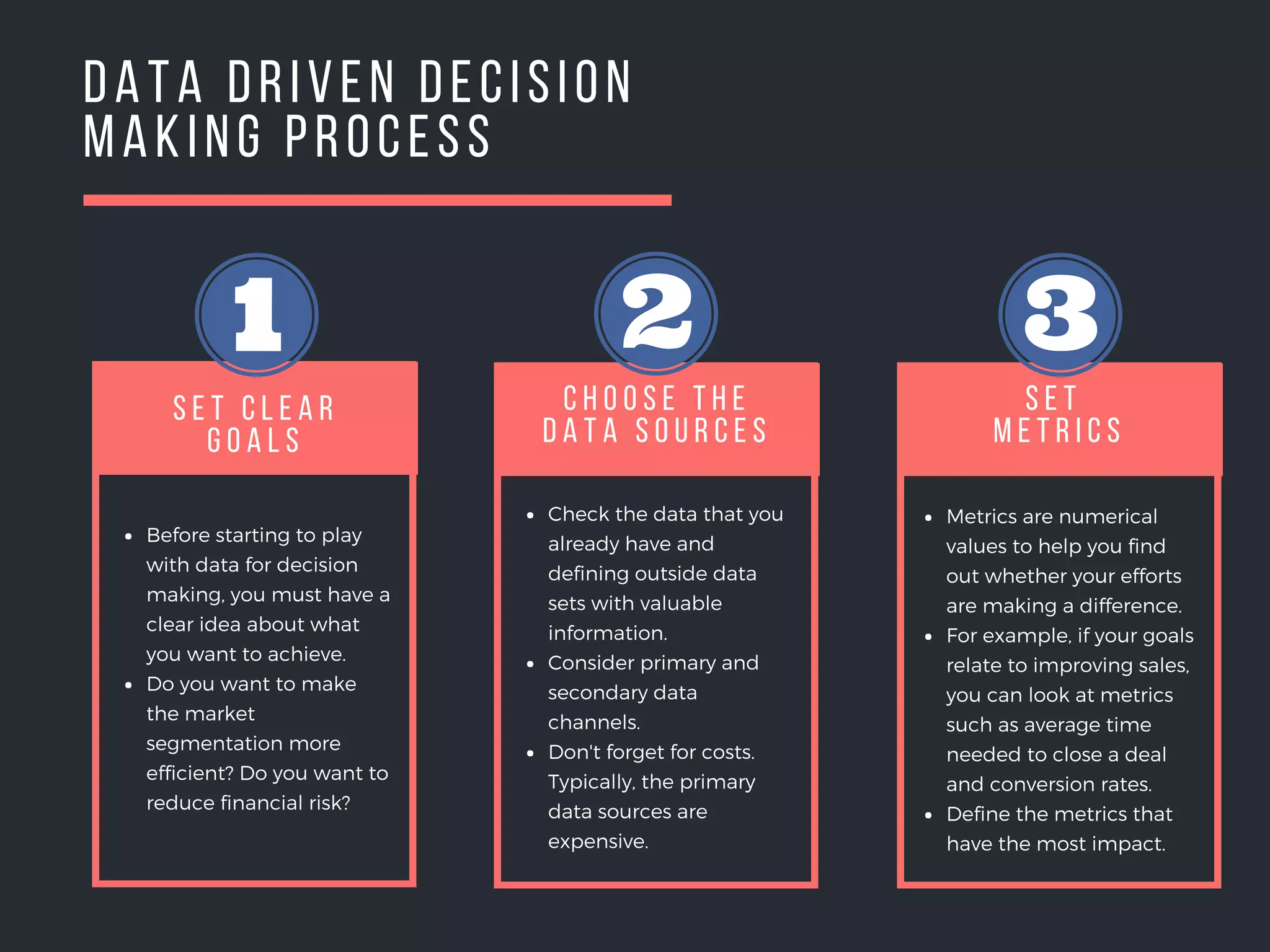
DATA DRIVEN DECISION
MAKING PROCESS
S E T  
M E T R I C S
Metrics are numerical
values to help you find
out whether your efforts
are making a difference.
For example, if your goals
relate to improving sales,
you can look at metrics
such as average time
needed to close a deal
and conversion rates.
Define the metrics that
have the most impact.
C H O O S E T H E
D A T A S O U R C E S
S E T C L E A R
G O A L S
Before starting to play
with data for decision
making, you must have a
clear idea about what
you want to achieve.
Do you want to make
the market
segmentation more
efficient? Do you want to
reduce financial risk? 
Check the data that you
already have and
defining outside data
sets with valuable
information. 
Consider primary and
secondary data
channels.
Don't forget for costs.
Typically, the primary
data sources are
expensive.
  G E T T H E
K E Y P E O P L E
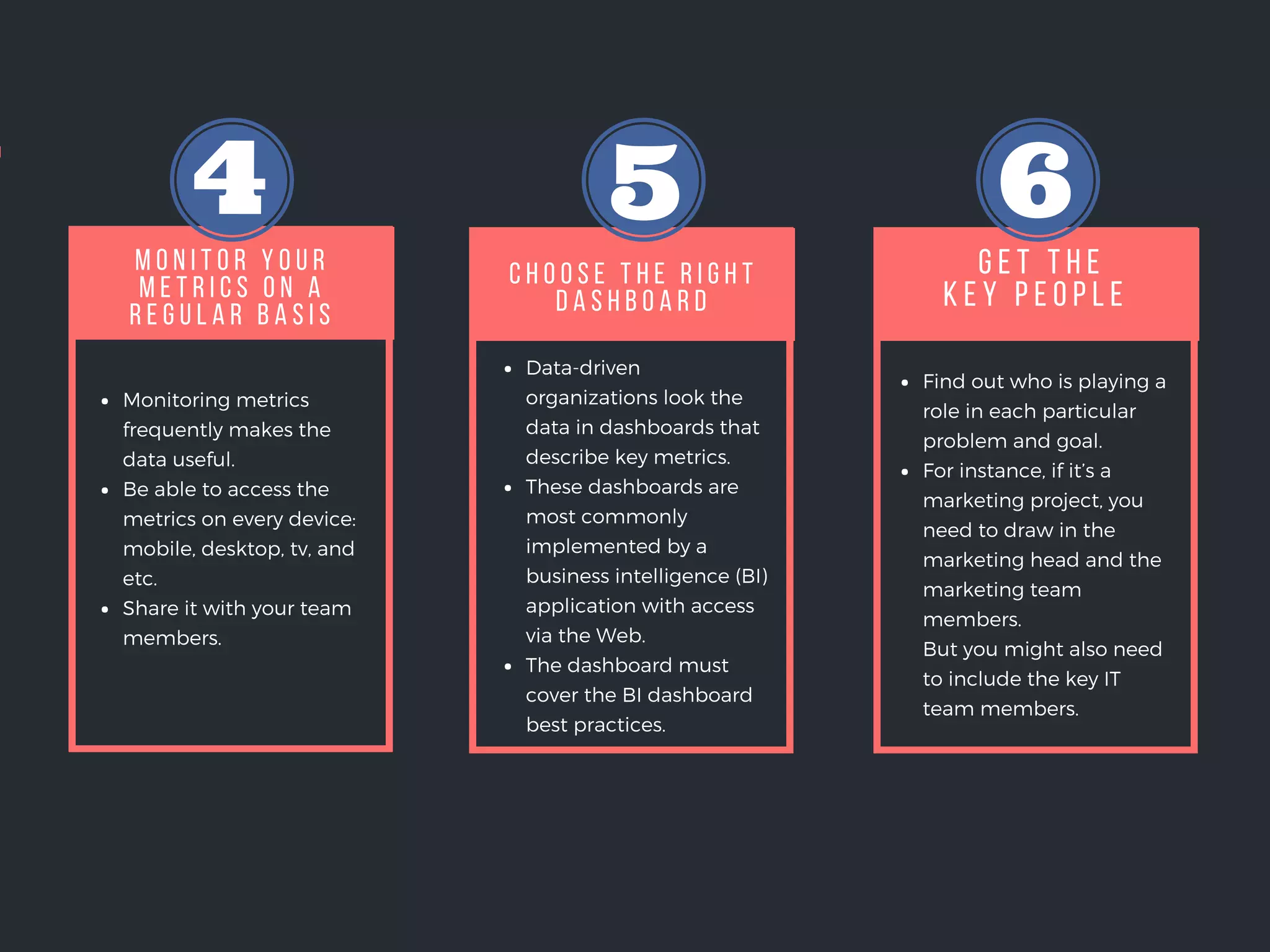
Find out who is playing a
role in each particular
problem and goal.
For instance, if it’s a
marketing project, you
need to draw in the
marketing head and the
marketing team
members.
But you might also need
to include the key IT
team members.
C H O O S E T H E R I G H T
D A S H B O A R D
M O N I T O R Y O U R
M E T R I C S O N A
R E G U L A R B A S I S
Monitoring metrics
frequently makes the
data useful.
Be able to access the
metrics on every device:
mobile, desktop, tv, and
etc.
Share it with your team
members.
Data-driven
organizations look the
data in dashboards that
describe key metrics.
These dashboards are
most commonly
implemented by a
business intelligence (BI)
application with access
via the Web.
The dashboard must
cover the BI dashboard
best practices.
A N A L Y Z E Y O U R
D A T A
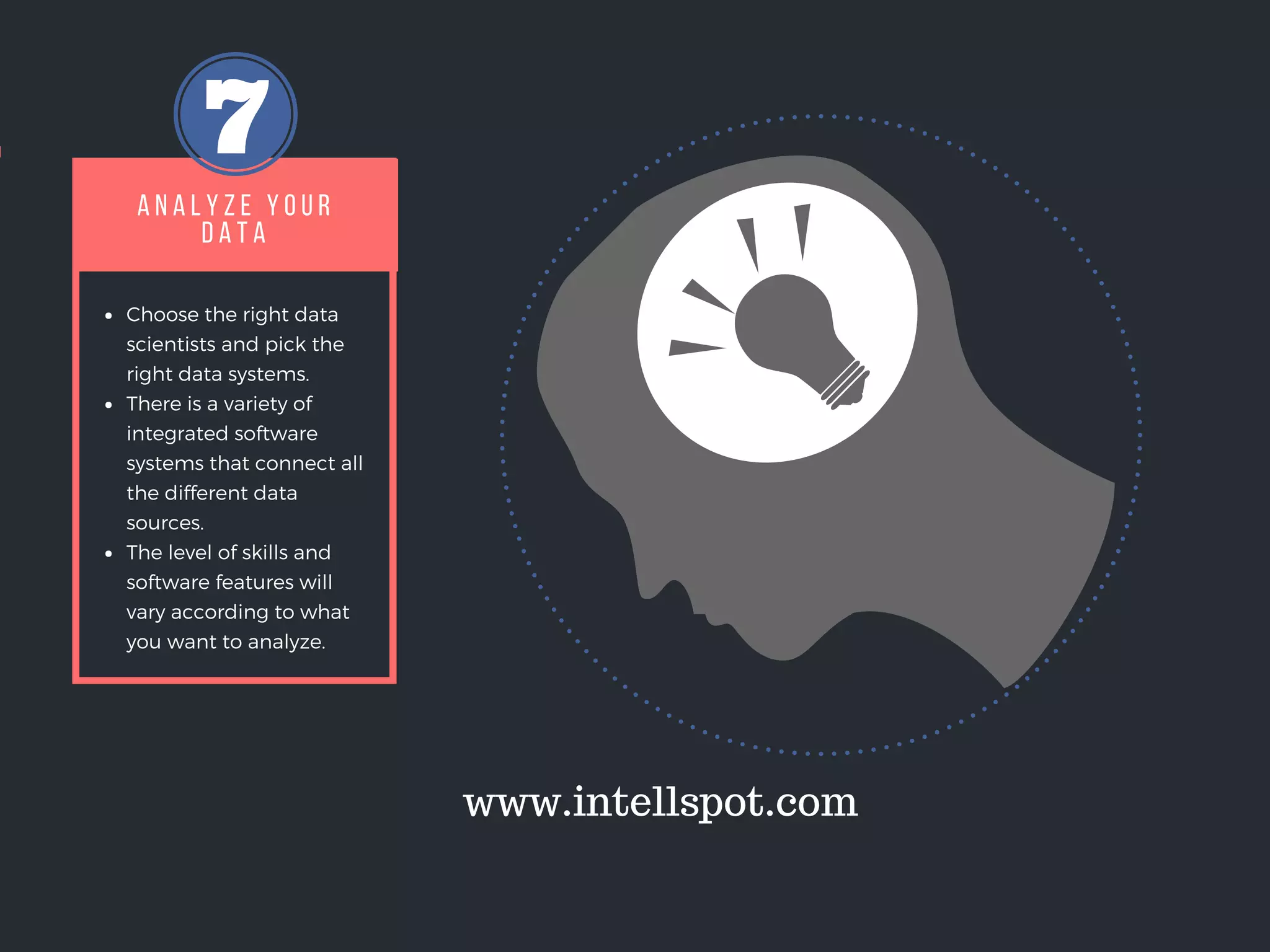
Choose the right data
scientists and pick the
right data systems.
There is a variety of
integrated software
systems that connect all
the different data
sources.
The level of skills and
software features will
vary according to what
you want to analyze.
www.intellspot.com

Data driven decision making process - infographic

  • 1.
    DATA DRIVEN DECISION MAKINGPROCESS S E T   M E T R I C S Metrics are numerical values to help you find out whether your efforts are making a difference. For example, if your goals relate to improving sales, you can look at metrics such as average time needed to close a deal and conversion rates. Define the metrics that have the most impact. C H O O S E T H E D A T A S O U R C E S S E T C L E A R G O A L S Before starting to play with data for decision making, you must have a clear idea about what you want to achieve. Do you want to make the market segmentation more efficient? Do you want to reduce financial risk?  Check the data that you already have and defining outside data sets with valuable information.  Consider primary and secondary data channels. Don't forget for costs. Typically, the primary data sources are expensive.
  • 2.
      G ET T H E K E Y P E O P L E Find out who is playing a role in each particular problem and goal. For instance, if it’s a marketing project, you need to draw in the marketing head and the marketing team members. But you might also need to include the key IT team members. C H O O S E T H E R I G H T D A S H B O A R D M O N I T O R Y O U R M E T R I C S O N A R E G U L A R B A S I S Monitoring metrics frequently makes the data useful. Be able to access the metrics on every device: mobile, desktop, tv, and etc. Share it with your team members. Data-driven organizations look the data in dashboards that describe key metrics. These dashboards are most commonly implemented by a business intelligence (BI) application with access via the Web. The dashboard must cover the BI dashboard best practices.
  • 3.
    A N AL Y Z E Y O U R D A T A Choose the right data scientists and pick the right data systems. There is a variety of integrated software systems that connect all the different data sources. The level of skills and software features will vary according to what you want to analyze. www.intellspot.com