EDUCATIONAL STATISTICS
PRESENTED BY DR. HINA JALAL
Basic Statistics
Sampling
Types of Sampling
2
VARIABLE
The word variable is something that varies or something that is subject
to variation.
It has no definite value but can assume any set of values.
In other words we can say that a variable is a characteristic that
varies from one person to another.
It is a characteristic, number or quantity that increases or decreases
over time in different situations. 7/16/2020 4
V
ARIABLES
 A variable in research simply refers to a person, place, thing, or phenomenon that you are
trying to measure in some way. The best way to understand the difference between
a dependent and independent variable is that the meaning of each is implied by what the
words tell us about the variable you are using.
 There are three main variables: independent variable, dependent variable and
controlled variables.
 Main types of variables
• DEPENDENT VARIABLES.
• INDEPENDENT VARIABLES.
• INTERVENING VARIABLES.
• EXTRANEOUS VARIABLES.
• MODERATOR VARIABLES.
• MADIATOR VARIABLES.
• CONTROL VARIABLES.
INDEPENDENT AND DEPENDENT VARIABLES
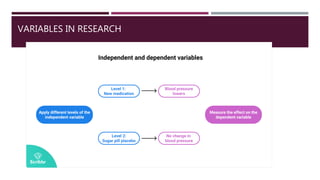
 In research, change variables are referred as independent
variables while the outcome variables are known as dependent
variables.
 Dependent variable: called test variables, the outcome of an
experiment. When independent variable changed, what happens to
dependent variable. (achievement score)
 Independent variable: variable that has power to change
dependent variable. Plotted on the x-axis. Also called treatment
variables. 7/16/2020 14
INTERVENING AND EXTRANEOUS VARIABLES
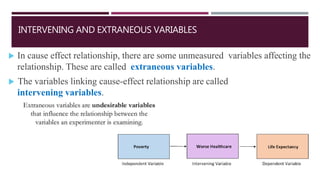
 In cause effect relationship, there are some unmeasured variables affecting the
relationship. These are called extraneous variables.
 The variables linking cause-effect relationship are called
intervening variables.
7/16/2020 8
VARIABLE TYPES…..
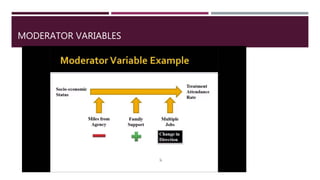
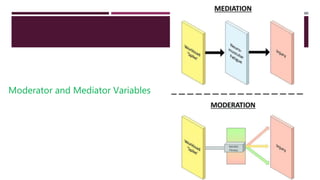
 Moderating variable: changes the strength of an effect between independent
and dependent variables. For example, psychotherapy may reduce stress levels
for women more than men, so sex moderates the effect between psychotherapy
and stress levels.
 Nuisance Variable: an extraneous variable that increases variability
overall.
 Outcome variable: similar in meaning to a dependent variable, but used in a
non-experimental study.
7/16/2020 23
VARIABLES IN RESEARCH
MODERATOR VARIABLES
Moderator and Mediator Variables
DATA
7/16/2020 10
 Data is any information collected by the researcher.
 Primary Data is originated by the researcher for the first time for
addressing his research problem.
 The data can be collected using various methods like survey,
observations, physical testing, mailed questionnaire, questionnaire
filled and sent by enumerators, personal interviews, telephonic
interviews, focus groups discussion, case studies.
SECONDARY DATA
7/16/2020 11
.
 The information already collected and recorded by any other person
with a purpose not relating to current research problem.
 It is readily available form of data and saves time and cast of the
researcher. This data may be limited in a number of ways like
relevance and accuracy.
 Examples of secondary data are censuses data, publications, internal
records of the organizations, reports, books, websites, journal articles.
POPULATION AND SAMPLE
7/16/2020
30
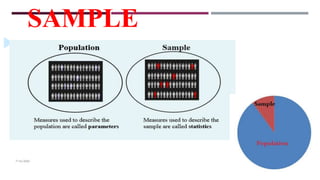
 A research Population is a large collection of individuals or objects to
which the researcher wants to apply the study results.
 Population is the main focus of a research question. Aresearch
population is also known as a well-defined collection of individuals
or objects known to have similar characteristics.
 Sample:
 A small and representative part of individuals having same
attributes and characteristics is called sample. A sample is simply
a subset or subgroup of population
SAMPLE
7/16/2020

31
TYPES OF POPULATION
 The Target Population is referred to the entire group of individuals
or objects to which a researcher is interested to generalize the
conclusions. This type of population usually has varying degree of
characteristics.
 The Accessible Population is also known as the study population. It
is the population to which a researcher can apply the conclusions of
the study. This population is a subset of the target population.
7/16/2020 32
METHODS
7/16/2020 15
Sampling
Methods
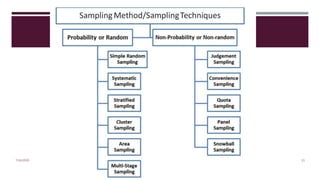
PROBABILITY SAMPLING
7/16/2020 16
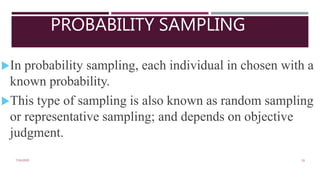
In probability sampling, each individual in chosen with a
known probability.
This type of sampling is also known as random sampling
or representative sampling; and depends on objective
judgment.
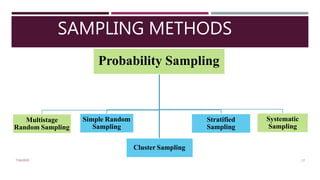
SAMPLING METHODS
7/16/2020 17
Probability Sampling
Multistage
Random Sampling
Simple Random
Sampling
Cluster Sampling
Stratified
Sampling
Systematic
Sampling
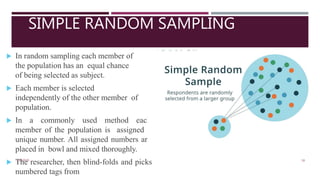
SIMPLE RANDOM SAMPLING
7/16/2020 18
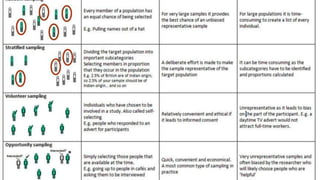
 In random sampling each member of
the population has an equal chance
of being selected as subject.
 Each member is selected
independently of the other member of
population.
 In a commonly used method each
member of the population is assigned a
unique number. All assigned numbers are
placed in bowl and mixed thoroughly.
 The researcher, then blind-folds and picks
numbered tags from
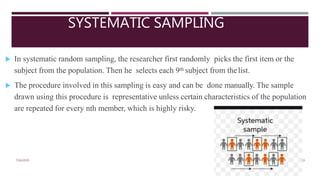
SYSTEMATIC SAMPLING
7/16/2020 19
 In systematic random sampling, the researcher first randomly picks the first item or the
subject from the population. Then he selects each 9th subject from thelist.
 The procedure involved in this sampling is easy and can be done manually. The sample
drawn using this procedure is representative unless certain characteristics of the population
are repeated for every nth member, which is highly risky.
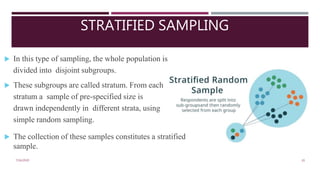
STRATIFIED SAMPLING
7/16/2020 20
 In this type of sampling, the whole population is
divided into disjoint subgroups.
 These subgroups are called stratum. From each
stratum a sample of pre-specified size is
drawn independently in different strata, using
simple random sampling.
 The collection of these samples constitutes a stratified
sample.
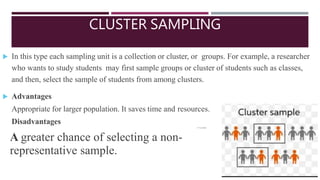
CLUSTER SAMPLING
A greater chance of selecting a non-
representative sample.
 In this type each sampling unit is a collection or cluster, or groups. For example, a researcher
who wants to study students may first sample groups or cluster of students such as classes,
and then, select the sample of students from among clusters.
 Advantages
Appropriate for larger population. It saves time and resources.
Disadvantages
7/16/2020 43
NON-PROBABILITY SAMPLING
7/16/2020 23
This technique depends on subjective judgment.
It is a process where probabilities cannot be assigned to the
individuals objectively.
It means that samples are gathered in a way does not give all
individuals in the population equal chances of being
selected.
Choose these methods could result in biased data or a limited
ability to make general inferences based on the findings.
SAMPLING METHODS
7/16/2020 24
Non-Probability Sampling
Judgmental
Sampling
Quota
Sampling
Convenient
Sampling
Extensive
Sampling
Snowball
Sampling
CONVENIENT SAMPLING
7/16/2020 25
In this technique a researcher relies on available subjects, such as
stopping peoples in the markets or on street corners as they pass by.
This method is extremely risky and does not allow the researcher to
have any control over the representativeness of the sample.
It is useful when the researcher wants to know the opinion of the
masses on a current issue; or the characteristics of people passing by
on streets at a certain point of time; or
if time and resources are limited in such a way that the research
would not be possible otherwise.
JUDGMENTAL OR PURPOSIVE SAMPLING
7/16/2020 26
In this technique a sample is selected on the bases of the
knowledge of population and the purpose of the study.
For example, when an educational psychologist wants
to study the emotional and psychological effects of corporal
punishment, he will create a sample that will include only
those students who ever had received corporal punishment.
SNOWBALL SAMPLING
7/16/2020
48
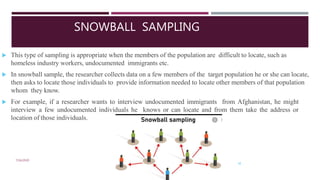
 This type of sampling is appropriate when the members of the population are difficult to locate, such as
homeless industry workers, undocumented immigrants etc.
 In snowball sample, the researcher collects data on a few members of the target population he or she can locate,
then asks to locate those individuals to provide information needed to locate other members of that population
whom they know.
 For example, if a researcher wants to interview undocumented immigrants from Afghanistan, he might
interview a few undocumented individuals he knows or can locate and from them take the address or
location of those individuals.
QUOTA SAMPLING
7/16/2020 49
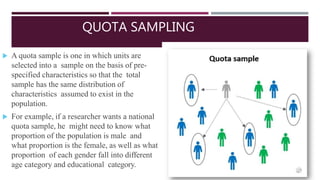
 A quota sample is one in which units are
selected into a sample on the basis of pre-
specified characteristics so that the total
sample has the same distribution of
characteristics assumed to exist in the
population.
 For example, if a researcher wants a national
quota sample, he might need to know what
proportion of the population is male and
what proportion is the female, as well as what
proportion of each gender fall into different
age category and educational category.
SELF ASSESSMENTACTIVITY
7/16/2020 29
 Q. 1. Define variable. Write commonly used types of variable?
Q. 2. What do you understand by the term “data”?
Q. 3. Write down the types of data?
Q. 4. What is population?
Q. 5. What do you understand by the target population?
Q. 6. What do you mean by the assessable population?
Q. 7. What do you mean by the term “sample”?
Q. 8. Write down the types of probability sampling.
Q. 9. Write down the types of non-probability sampling.

Basics of Educational Statistics (Sampling and Types)

  • 1.
    EDUCATIONAL STATISTICS PRESENTED BYDR. HINA JALAL Basic Statistics Sampling Types of Sampling 2
  • 2.
    VARIABLE The word variableis something that varies or something that is subject to variation. It has no definite value but can assume any set of values. In other words we can say that a variable is a characteristic that varies from one person to another. It is a characteristic, number or quantity that increases or decreases over time in different situations. 7/16/2020 4
  • 3.
    V ARIABLES  A variablein research simply refers to a person, place, thing, or phenomenon that you are trying to measure in some way. The best way to understand the difference between a dependent and independent variable is that the meaning of each is implied by what the words tell us about the variable you are using.  There are three main variables: independent variable, dependent variable and controlled variables.  Main types of variables • DEPENDENT VARIABLES. • INDEPENDENT VARIABLES. • INTERVENING VARIABLES. • EXTRANEOUS VARIABLES. • MODERATOR VARIABLES. • MADIATOR VARIABLES. • CONTROL VARIABLES.
  • 4.
    INDEPENDENT AND DEPENDENTVARIABLES  In research, change variables are referred as independent variables while the outcome variables are known as dependent variables.  Dependent variable: called test variables, the outcome of an experiment. When independent variable changed, what happens to dependent variable. (achievement score)  Independent variable: variable that has power to change dependent variable. Plotted on the x-axis. Also called treatment variables. 7/16/2020 14
  • 5.
    INTERVENING AND EXTRANEOUSVARIABLES  In cause effect relationship, there are some unmeasured variables affecting the relationship. These are called extraneous variables.  The variables linking cause-effect relationship are called intervening variables. 7/16/2020 8
  • 6.
    VARIABLE TYPES…..  Moderatingvariable: changes the strength of an effect between independent and dependent variables. For example, psychotherapy may reduce stress levels for women more than men, so sex moderates the effect between psychotherapy and stress levels.  Nuisance Variable: an extraneous variable that increases variability overall.  Outcome variable: similar in meaning to a dependent variable, but used in a non-experimental study. 7/16/2020 23
  • 7.
  • 8.
  • 9.
  • 10.
    DATA 7/16/2020 10  Datais any information collected by the researcher.  Primary Data is originated by the researcher for the first time for addressing his research problem.  The data can be collected using various methods like survey, observations, physical testing, mailed questionnaire, questionnaire filled and sent by enumerators, personal interviews, telephonic interviews, focus groups discussion, case studies.
  • 11.
    SECONDARY DATA 7/16/2020 11 . The information already collected and recorded by any other person with a purpose not relating to current research problem.  It is readily available form of data and saves time and cast of the researcher. This data may be limited in a number of ways like relevance and accuracy.  Examples of secondary data are censuses data, publications, internal records of the organizations, reports, books, websites, journal articles.
  • 12.
    POPULATION AND SAMPLE 7/16/2020 30 A research Population is a large collection of individuals or objects to which the researcher wants to apply the study results.  Population is the main focus of a research question. Aresearch population is also known as a well-defined collection of individuals or objects known to have similar characteristics.  Sample:  A small and representative part of individuals having same attributes and characteristics is called sample. A sample is simply a subset or subgroup of population
  • 13.
  • 14.
    TYPES OF POPULATION The Target Population is referred to the entire group of individuals or objects to which a researcher is interested to generalize the conclusions. This type of population usually has varying degree of characteristics.  The Accessible Population is also known as the study population. It is the population to which a researcher can apply the conclusions of the study. This population is a subset of the target population. 7/16/2020 32
  • 15.
  • 16.
    PROBABILITY SAMPLING 7/16/2020 16 Inprobability sampling, each individual in chosen with a known probability. This type of sampling is also known as random sampling or representative sampling; and depends on objective judgment.
  • 17.
    SAMPLING METHODS 7/16/2020 17 ProbabilitySampling Multistage Random Sampling Simple Random Sampling Cluster Sampling Stratified Sampling Systematic Sampling
  • 18.
    SIMPLE RANDOM SAMPLING 7/16/202018  In random sampling each member of the population has an equal chance of being selected as subject.  Each member is selected independently of the other member of population.  In a commonly used method each member of the population is assigned a unique number. All assigned numbers are placed in bowl and mixed thoroughly.  The researcher, then blind-folds and picks numbered tags from
  • 19.
    SYSTEMATIC SAMPLING 7/16/2020 19 In systematic random sampling, the researcher first randomly picks the first item or the subject from the population. Then he selects each 9th subject from thelist.  The procedure involved in this sampling is easy and can be done manually. The sample drawn using this procedure is representative unless certain characteristics of the population are repeated for every nth member, which is highly risky.
  • 20.
    STRATIFIED SAMPLING 7/16/2020 20 In this type of sampling, the whole population is divided into disjoint subgroups.  These subgroups are called stratum. From each stratum a sample of pre-specified size is drawn independently in different strata, using simple random sampling.  The collection of these samples constitutes a stratified sample.
  • 21.
    CLUSTER SAMPLING A greaterchance of selecting a non- representative sample.  In this type each sampling unit is a collection or cluster, or groups. For example, a researcher who wants to study students may first sample groups or cluster of students such as classes, and then, select the sample of students from among clusters.  Advantages Appropriate for larger population. It saves time and resources. Disadvantages 7/16/2020 43
  • 23.
    NON-PROBABILITY SAMPLING 7/16/2020 23 Thistechnique depends on subjective judgment. It is a process where probabilities cannot be assigned to the individuals objectively. It means that samples are gathered in a way does not give all individuals in the population equal chances of being selected. Choose these methods could result in biased data or a limited ability to make general inferences based on the findings.
  • 24.
    SAMPLING METHODS 7/16/2020 24 Non-ProbabilitySampling Judgmental Sampling Quota Sampling Convenient Sampling Extensive Sampling Snowball Sampling
  • 25.
    CONVENIENT SAMPLING 7/16/2020 25 Inthis technique a researcher relies on available subjects, such as stopping peoples in the markets or on street corners as they pass by. This method is extremely risky and does not allow the researcher to have any control over the representativeness of the sample. It is useful when the researcher wants to know the opinion of the masses on a current issue; or the characteristics of people passing by on streets at a certain point of time; or if time and resources are limited in such a way that the research would not be possible otherwise.
  • 26.
    JUDGMENTAL OR PURPOSIVESAMPLING 7/16/2020 26 In this technique a sample is selected on the bases of the knowledge of population and the purpose of the study. For example, when an educational psychologist wants to study the emotional and psychological effects of corporal punishment, he will create a sample that will include only those students who ever had received corporal punishment.
  • 27.
    SNOWBALL SAMPLING 7/16/2020 48  Thistype of sampling is appropriate when the members of the population are difficult to locate, such as homeless industry workers, undocumented immigrants etc.  In snowball sample, the researcher collects data on a few members of the target population he or she can locate, then asks to locate those individuals to provide information needed to locate other members of that population whom they know.  For example, if a researcher wants to interview undocumented immigrants from Afghanistan, he might interview a few undocumented individuals he knows or can locate and from them take the address or location of those individuals.
  • 28.
    QUOTA SAMPLING 7/16/2020 49 A quota sample is one in which units are selected into a sample on the basis of pre- specified characteristics so that the total sample has the same distribution of characteristics assumed to exist in the population.  For example, if a researcher wants a national quota sample, he might need to know what proportion of the population is male and what proportion is the female, as well as what proportion of each gender fall into different age category and educational category.
  • 29.
    SELF ASSESSMENTACTIVITY 7/16/2020 29 Q. 1. Define variable. Write commonly used types of variable? Q. 2. What do you understand by the term “data”? Q. 3. Write down the types of data? Q. 4. What is population? Q. 5. What do you understand by the target population? Q. 6. What do you mean by the assessable population? Q. 7. What do you mean by the term “sample”? Q. 8. Write down the types of probability sampling. Q. 9. Write down the types of non-probability sampling.