Image Noise 
Dr. Robert A. Schowengerdt 
Techniques for Image Processing and Classifications in Remote Sensing 
Remote Sensing 
By KeTang
APPLICATIONS 
zSignal estimation in presence of noise 
zDetecting known features in a noisy background 
zCoherent (periodic) noise removal
TYPES OF NOISE 
¾Photoelectronic 
¾photon noise 
¾thermal noise 
¾Impulse 
¾salt noise 
¾pepper noise 
¾salt and pepper noise 
¾line drop 
¾Structured 
¾periodic, stationary 
¾periodic, nonstationary 
¾aperiodic 
¾detector striping 
¾detector banding
Photonelectronicnoise 
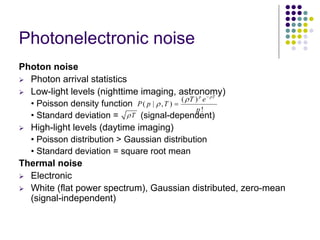
Photon noise ¾Photon arrival statistics ¾Low-light levels (nighttime imaging, astronomy) •Poisson density function•Standard deviation = (signal-dependent) ¾High-light levels (daytime imaging) •Poisson distribution > Gaussian distribution•Standard deviation = square root meanThermal noise ¾Electronic ¾White (flat power spectrum), Gaussian distributed, zero-mean (signal-independent) ()(|,) ! pTTePpTp ρρρ − = Tρ
Photoelectronicnoise model 
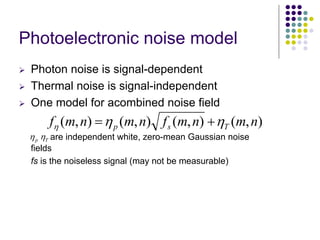
¾Photon noise is signal-dependent ¾Thermal noise is signal-independent ¾One model for acombinednoise fieldare independent white, zero-mean Gaussian noise fieldsfsis the noiseless signal (may not be measurable) ),(),(),(),(nmnmfnmnmfTspηηη+= Tη pη
Noisy image model 
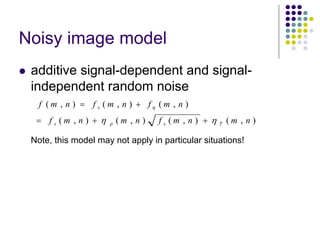
zadditive signal-dependent and signal- independent random noiseNote, this model may not apply in particular situations! ),(),(),(),( ),(),(),( nmnmfnmnmfnmfnmfnmfTspss ηηη ++= +=
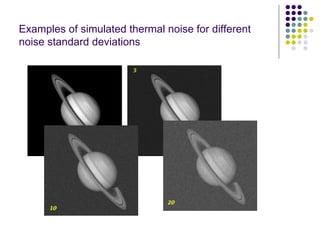
Examples of simulated thermal noise for different noise standard deviations
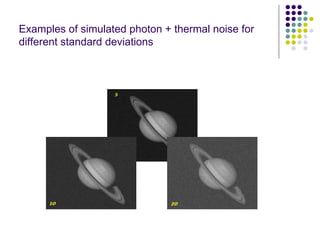
Examples of simulated photon + thermal noise for different standard deviations
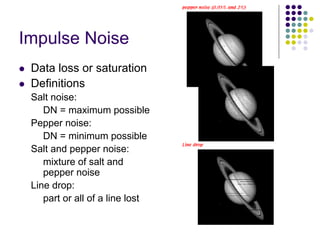
Impulse Noise 
zData loss or saturation 
zDefinitions 
Salt noise: 
DN = maximum possible 
Pepper noise: 
DN = minimum possible 
Salt and pepper noise: 
mixture of salt and pepper noise 
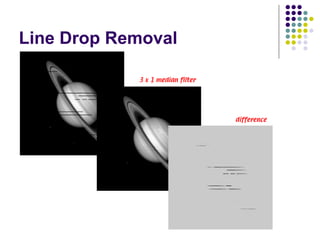
Line drop: 
part or all of a line lost
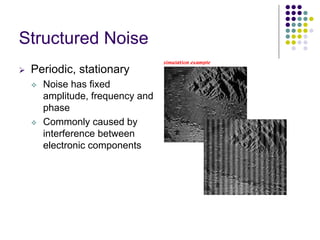
Structured Noise 
¾Periodic, stationary 
™Noise has fixed amplitude, frequency and phase 
™Commonly caused by interference between electronic components
Structured Noise 
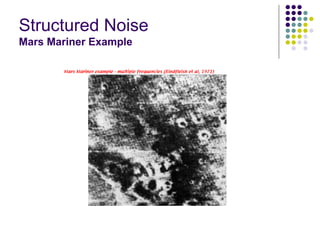
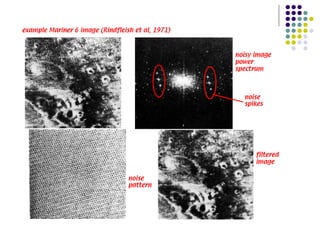
Mars Mariner Example
Structured Noise 
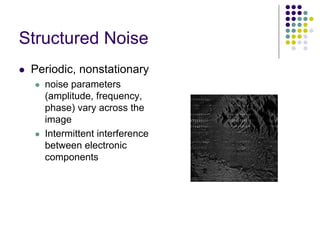
zPeriodic, nonstationary 
znoise parameters (amplitude, frequency, phase) vary across the image 
zIntermittent interference between electronic components
Structured Noise 
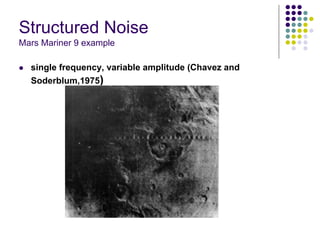
Mars Mariner 9 example 
zsingle frequency, variable amplitude (Chavez and Soderblum,1975)
Structured Noise 
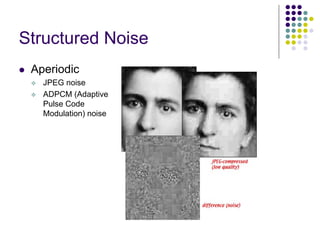
zAperiodic 
™JPEG noise 
™ADPCM (Adaptive Pulse Code Modulation) noise
Structured Noise 
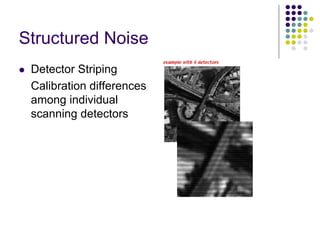
zDetector Striping 
Calibration differences among individual scanning detectors
Structured Noise 
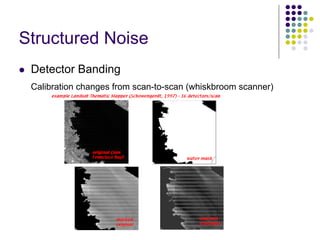
zDetector Banding 
Calibration changes from scan-to-scan (whiskbroom scanner)
PhotoelectronicNoise 
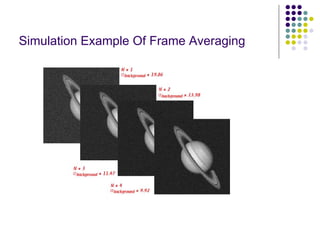
zFrame averaging ¾If available, average N frames of same object ¾If noise is independent frame-to-frame, variance will be reduced by ¾Requires multiple, co-registered framesN/2η σ
Simulation Example Of Frame Averaging
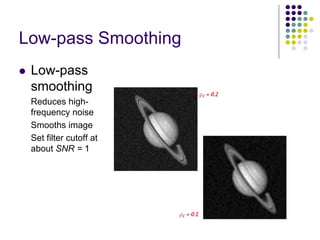
Low-pass Smoothing 
zLow-pass smoothing 
Reduces high- frequency noise 
Smoothsimage 
Set filter cutoff at about SNR = 1
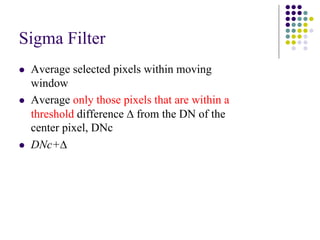
Sigma Filter 
zAverage selected pixels within moving window 
zAverage only those pixels that are within a threshold difference Δ from the DN of the center pixel, DNc 
zDNc+Δ
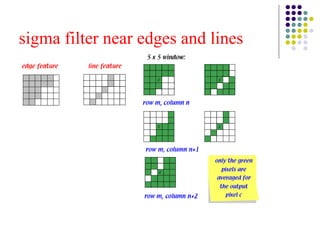
sigma filter near edges and lines
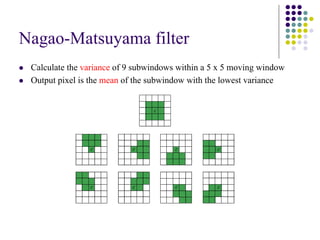
Nagao-Matsuyamafilter 
zCalculate the variance of 9 subwindowswithin a 5 x 5 moving window 
zOutput pixel is the mean of the subwindowwith the lowest variance
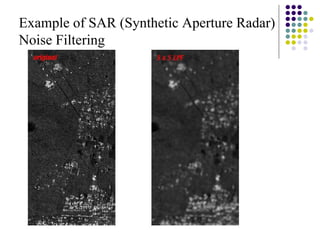
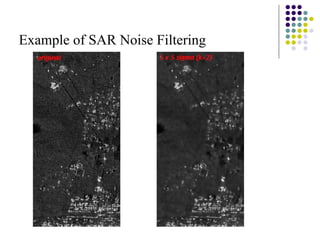
Example of SAR (Synthetic Aperture Radar) Noise Filtering
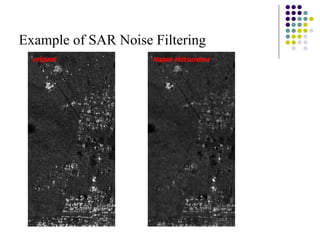
Example of SAR Noise Filtering
Impulse Noise 
zSalt and pepper noise DN is “outlier”relative to neighboring pixel DNs 
zUse algorithms that compare test pixel to neighbors
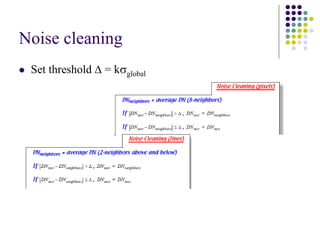
Noise cleaning 
zSet threshold Δ = kσglobal
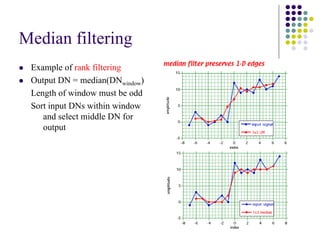
Median filtering 
zExample of rank filtering 
zOutput DN = median(DNwindow) 
Length of window must be odd 
Sort input DNswithin window and select middle DN for output
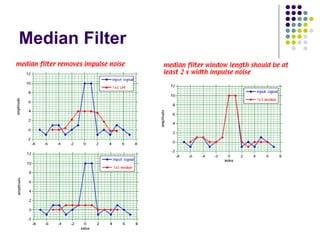
Median Filter
Median Filter 
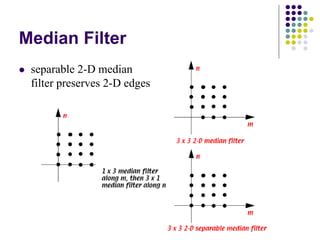
zseparable 2-D median filter preserves 2-D edges
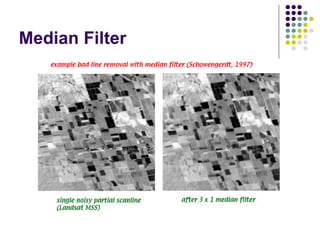
Median Filter
Line Drop Removal
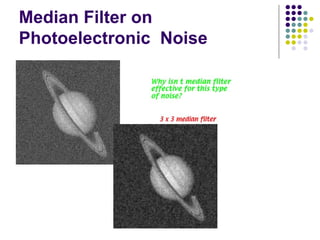
Median Filter on Photoelectronic Noise
Structured Noise 
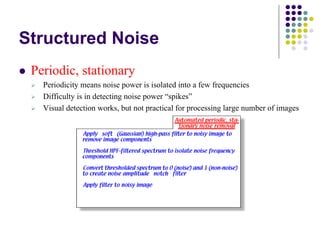
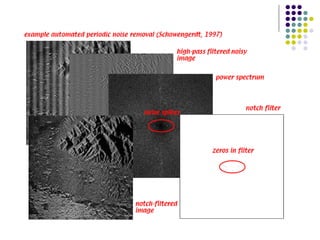
zPeriodic, stationary 
¾Periodicity means noise power is isolated into a few frequencies 
¾Difficulty is in detecting noise power “spikes” 
¾Visual detection works, but not practical for processing large number of images
Structured Noise 
zNot really automated filter design 
zTwo parameters must be supplied: 
¾width of Gaussian HPF 
¾power spectrum threshold for notch filter

Types of noise

  • 1.
    Image Noise Dr.Robert A. Schowengerdt Techniques for Image Processing and Classifications in Remote Sensing Remote Sensing By KeTang
  • 2.
    APPLICATIONS zSignal estimationin presence of noise zDetecting known features in a noisy background zCoherent (periodic) noise removal
  • 3.
    TYPES OF NOISE ¾Photoelectronic ¾photon noise ¾thermal noise ¾Impulse ¾salt noise ¾pepper noise ¾salt and pepper noise ¾line drop ¾Structured ¾periodic, stationary ¾periodic, nonstationary ¾aperiodic ¾detector striping ¾detector banding
  • 4.
    Photonelectronicnoise Photon noise¾Photon arrival statistics ¾Low-light levels (nighttime imaging, astronomy) •Poisson density function•Standard deviation = (signal-dependent) ¾High-light levels (daytime imaging) •Poisson distribution > Gaussian distribution•Standard deviation = square root meanThermal noise ¾Electronic ¾White (flat power spectrum), Gaussian distributed, zero-mean (signal-independent) ()(|,) ! pTTePpTp ρρρ − = Tρ
  • 5.
    Photoelectronicnoise model ¾Photonnoise is signal-dependent ¾Thermal noise is signal-independent ¾One model for acombinednoise fieldare independent white, zero-mean Gaussian noise fieldsfsis the noiseless signal (may not be measurable) ),(),(),(),(nmnmfnmnmfTspηηη+= Tη pη
  • 6.
    Noisy image model zadditive signal-dependent and signal- independent random noiseNote, this model may not apply in particular situations! ),(),(),(),( ),(),(),( nmnmfnmnmfnmfnmfnmfTspss ηηη ++= +=
  • 7.
    Examples of simulatedthermal noise for different noise standard deviations
  • 8.
    Examples of simulatedphoton + thermal noise for different standard deviations
  • 9.
    Impulse Noise zDataloss or saturation zDefinitions Salt noise: DN = maximum possible Pepper noise: DN = minimum possible Salt and pepper noise: mixture of salt and pepper noise Line drop: part or all of a line lost
  • 10.
    Structured Noise ¾Periodic,stationary ™Noise has fixed amplitude, frequency and phase ™Commonly caused by interference between electronic components
  • 11.
    Structured Noise MarsMariner Example
  • 12.
    Structured Noise zPeriodic,nonstationary znoise parameters (amplitude, frequency, phase) vary across the image zIntermittent interference between electronic components
  • 13.
    Structured Noise MarsMariner 9 example zsingle frequency, variable amplitude (Chavez and Soderblum,1975)
  • 14.
    Structured Noise zAperiodic ™JPEG noise ™ADPCM (Adaptive Pulse Code Modulation) noise
  • 15.
    Structured Noise zDetectorStriping Calibration differences among individual scanning detectors
  • 16.
    Structured Noise zDetectorBanding Calibration changes from scan-to-scan (whiskbroom scanner)
  • 17.
    PhotoelectronicNoise zFrame averaging¾If available, average N frames of same object ¾If noise is independent frame-to-frame, variance will be reduced by ¾Requires multiple, co-registered framesN/2η σ
  • 18.
    Simulation Example OfFrame Averaging
  • 19.
    Low-pass Smoothing zLow-passsmoothing Reduces high- frequency noise Smoothsimage Set filter cutoff at about SNR = 1
  • 20.
    Sigma Filter zAverageselected pixels within moving window zAverage only those pixels that are within a threshold difference Δ from the DN of the center pixel, DNc zDNc+Δ
  • 21.
    sigma filter nearedges and lines
  • 22.
    Nagao-Matsuyamafilter zCalculate thevariance of 9 subwindowswithin a 5 x 5 moving window zOutput pixel is the mean of the subwindowwith the lowest variance
  • 23.
    Example of SAR(Synthetic Aperture Radar) Noise Filtering
  • 24.
    Example of SARNoise Filtering
  • 25.
    Example of SARNoise Filtering
  • 26.
    Impulse Noise zSaltand pepper noise DN is “outlier”relative to neighboring pixel DNs zUse algorithms that compare test pixel to neighbors
  • 27.
    Noise cleaning zSetthreshold Δ = kσglobal
  • 28.
    Median filtering zExampleof rank filtering zOutput DN = median(DNwindow) Length of window must be odd Sort input DNswithin window and select middle DN for output
  • 29.
  • 30.
    Median Filter zseparable2-D median filter preserves 2-D edges
  • 31.
  • 32.
  • 33.
    Median Filter onPhotoelectronic Noise
  • 34.
    Structured Noise zPeriodic,stationary ¾Periodicity means noise power is isolated into a few frequencies ¾Difficulty is in detecting noise power “spikes” ¾Visual detection works, but not practical for processing large number of images
  • 37.
    Structured Noise zNotreally automated filter design zTwo parameters must be supplied: ¾width of Gaussian HPF ¾power spectrum threshold for notch filter