Copyright of @Rasmussen CollegeEffective instruction through understanding learning styles
My students are not understanding what I am conveying! What do I do?Change your teaching style to match your students’ learning styles.
Module ObjectiveImprove your training ability by understanding and conceptualizing learning styles in relation to a student(s) preferred method of comprehension and enhance achievement.
What is a learning style?According to Ellis (1985), the way a person prefers to receive, store and retrieve material is known as a person’s preferred learning style.
Different Types of Learning StylesThere are three basic categories of learning styles:VisualAuditoryKinesthetic/TactileVAK ModelThere are two additional ones that should be mentioned as well:Reading and WritingEnvironmental
CharacteristicsProcess material when it is presented in a visual manner.IllustrationsGraphsImagesDemonstratedMemoryDoodlesDifficulty with verbal instructions.HandoutsText IllustrationsPower Point WorksheetsThe Visual LearnerTeaching Strategies
CharacteristicsProcess information via  spoken words.May prefer to read aloud.Difficulty with written instructions.DialogueGroup Collaboration/Study GroupsLecturesAllow for recordingsReview directionsAuditory LearnerTeaching Strategies
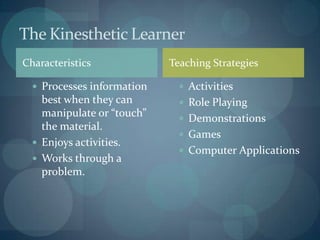
CharacteristicsProcesses information best when they can manipulate or “touch” the material.Enjoys activities.Works through a problem.ActivitiesRole PlayingDemonstrationsGamesComputer ApplicationsThe Kinesthetic LearnerTeaching Strategies
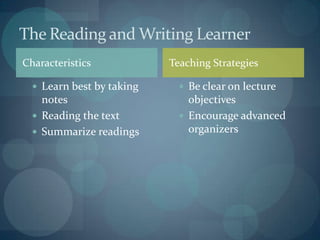
CharacteristicsLearn best by taking notes Reading the textSummarize readingsBe clear on lecture objectivesEncourage advanced organizersThe Reading and Writing LearnerTeaching Strategies
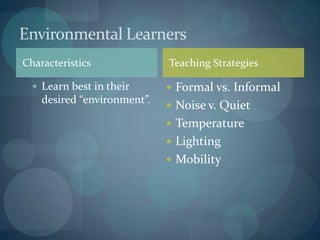
CharacteristicsLearn best in their desired “environment”.Formal vs. InformalNoise v. QuietTemperatureLightingMobilityEnvironmental LearnersTeaching Strategies
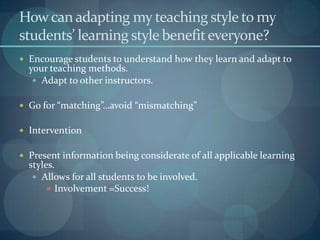
How can adapting my teaching style to my students’ learning style benefit everyone?Encourage students to understand how they learn and adapt to your teaching methods.Adapt to other instructors.Go for “matching”…avoid “mismatching”InterventionPresent information being considerate of all applicable learning styles. Allows for all students to be involved.Involvement =Success!
Enhance your Learning ExperienceEllis, Rod. 1985. Understanding Second Language 	Acquisition. Oxford, England: Oxford 		University Press.Feldman, R.S. (2010).  P.O.W.E.R. Learning and 	Your Life: Essentials of Student Success.  	McGraw-Hill Companies, Inc.; Boston, 	Massachusetts Ferrett, S. K. (1997).  Peak Performance: Success in 	College & Beyond. McGraw-Hill Companies, 	Inc.; Chicago, Illinois
Copyright of @Rasmussen CollegeAbout the Author: This presentation was created by Melissa Opheium,

Types of Learners

  • 1.
    Copyright of @RasmussenCollegeEffective instruction through understanding learning styles
  • 2.
    My students arenot understanding what I am conveying! What do I do?Change your teaching style to match your students’ learning styles.
  • 3.
    Module ObjectiveImprove yourtraining ability by understanding and conceptualizing learning styles in relation to a student(s) preferred method of comprehension and enhance achievement.
  • 4.
    What is alearning style?According to Ellis (1985), the way a person prefers to receive, store and retrieve material is known as a person’s preferred learning style.
  • 5.
    Different Types ofLearning StylesThere are three basic categories of learning styles:VisualAuditoryKinesthetic/TactileVAK ModelThere are two additional ones that should be mentioned as well:Reading and WritingEnvironmental
  • 6.
    CharacteristicsProcess material whenit is presented in a visual manner.IllustrationsGraphsImagesDemonstratedMemoryDoodlesDifficulty with verbal instructions.HandoutsText IllustrationsPower Point WorksheetsThe Visual LearnerTeaching Strategies
  • 7.
    CharacteristicsProcess information via spoken words.May prefer to read aloud.Difficulty with written instructions.DialogueGroup Collaboration/Study GroupsLecturesAllow for recordingsReview directionsAuditory LearnerTeaching Strategies
  • 8.
    CharacteristicsProcesses information bestwhen they can manipulate or “touch” the material.Enjoys activities.Works through a problem.ActivitiesRole PlayingDemonstrationsGamesComputer ApplicationsThe Kinesthetic LearnerTeaching Strategies
  • 9.
    CharacteristicsLearn best bytaking notes Reading the textSummarize readingsBe clear on lecture objectivesEncourage advanced organizersThe Reading and Writing LearnerTeaching Strategies
  • 10.
    CharacteristicsLearn best intheir desired “environment”.Formal vs. InformalNoise v. QuietTemperatureLightingMobilityEnvironmental LearnersTeaching Strategies
  • 11.
    How can adaptingmy teaching style to my students’ learning style benefit everyone?Encourage students to understand how they learn and adapt to your teaching methods.Adapt to other instructors.Go for “matching”…avoid “mismatching”InterventionPresent information being considerate of all applicable learning styles. Allows for all students to be involved.Involvement =Success!
  • 12.
    Enhance your LearningExperienceEllis, Rod. 1985. Understanding Second Language Acquisition. Oxford, England: Oxford University Press.Feldman, R.S. (2010). P.O.W.E.R. Learning and Your Life: Essentials of Student Success. McGraw-Hill Companies, Inc.; Boston, Massachusetts Ferrett, S. K. (1997). Peak Performance: Success in College & Beyond. McGraw-Hill Companies, Inc.; Chicago, Illinois
  • 13.
    Copyright of @RasmussenCollegeAbout the Author: This presentation was created by Melissa Opheium,