Marjorie B. Malveda
Instructor I
Functions
Our Learning Outcomes
• State the definition of a function
• Determine the domain and range of a function
• Perform the fundamental operations, Including composition, of functions
WHAT WE'LL COVER IN THIS SESSION
“
3
-refers to what something does
“
4
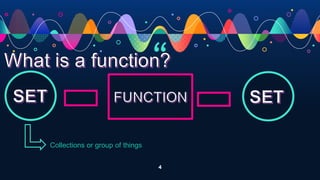
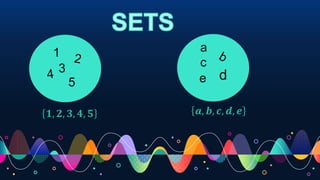
Collections or group of things
1
3
5
a
c
d
e
𝟏, 𝟐, 𝟑, 𝟒, 𝟓 𝒂, 𝒃, 𝒄, 𝒅, 𝒆
“
6
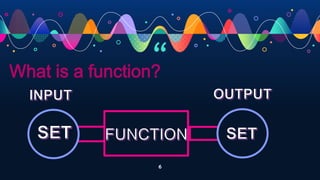
What is a function?
“
7
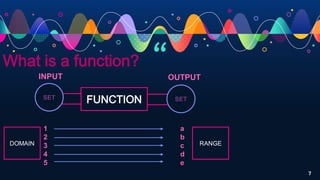
What is a function?
FUNCTION
SET SET
INPUT OUTPUT
1
2
3
4
5
a
b
c
d
e
DOMAIN RANGE
8
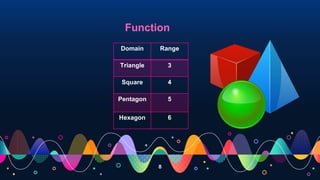
Function
Domain Range
Triangle 3
Square 4
Pentagon 5
Hexagon 6
9
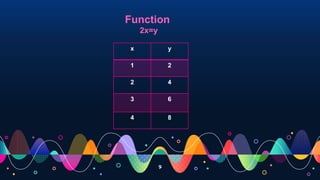
Function
x y
1 2
2 4
3 6
4 8
2x=y
10
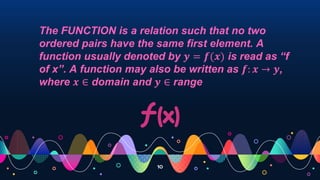
The FUNCTION is a relation such that no two
ordered pairs have the same first element. A
function usually denoted by 𝒚 = 𝒇(𝒙) is read as “f
of x”. A function may also be written as 𝒇: 𝒙 → 𝒚,
where 𝒙 ∈ domain and 𝒚 ∈ range
11
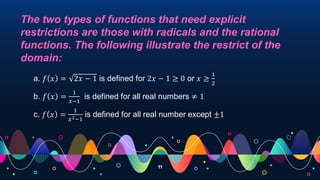
The two types of functions that need explicit
restrictions are those with radicals and the rational
functions. The following illustrate the restrict of the
domain:
a. 𝑓 𝑥 = 2𝑥 − 1 is defined for 2𝑥 − 1 ≥ 0 or 𝑥 ≥
1
2
b. 𝑓 𝑥 =
1
𝑥−1
is defined for all real numbers ≠ 1
c. 𝑓 𝑥 =
1
𝑥2−1
is defined for all real number except ±1
12
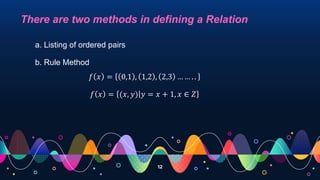
There are two methods in defining a Relation
a. Listing of ordered pairs
𝑓 𝑥 = 0,1 , 1,2 , 2,3 … … . .
b. Rule Method
𝑓 𝑥 = ȁ
(𝑥, 𝑦) 𝑦 = 𝑥 + 1, 𝑥 ∈ 𝑍
13
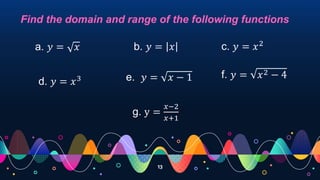
Find the domain and range of the following functions
a. 𝑦 = 𝑥
e. 𝑦 = 𝑥 − 1
g. y =
𝑥−2
𝑥+1
b. 𝑦 = 𝑥 c. 𝑦 = 𝑥2
d. 𝑦 = 𝑥3 f. 𝑦 = 𝑥2 − 4
14
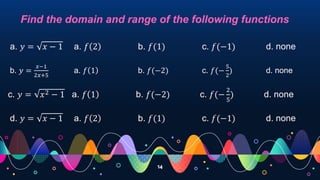
Find the domain and range of the following functions
a. 𝑦 = 𝑥 − 1 a. 𝑓 2 b. 𝑓(1) c. 𝑓(−1) d. none
b. 𝑦 =
𝑥−1
2𝑥+5
a. 𝑓 1 b. 𝑓(−2) c. 𝑓(−
5
2
) d. none
c. 𝑦 = 𝑥2 − 1 a. 𝑓 1 b. 𝑓(−2) c. 𝑓(−
2
5
) d. none
d. 𝑦 = 𝑥 − 1 a. 𝑓 2 b. 𝑓(1) c. 𝑓(−1) d. none
15
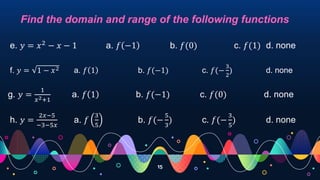
Find the domain and range of the following functions
e. 𝑦 = 𝑥2
− 𝑥 − 1 a. 𝑓 −1 b. 𝑓(0) c. 𝑓(1) d. none
f. 𝑦 = 1 − 𝑥2 a. 𝑓 1 b. 𝑓(−1) c. 𝑓(−
3
2
) d. none
g. 𝑦 =
1
𝑥2+1
a. 𝑓 1 b. 𝑓(−1) c. 𝑓(0) d. none
h. 𝑦 =
2𝑥−5
−3−5𝑥
a. 𝑓
3
5
b. 𝑓(−
5
3
) c. 𝑓(−
3
5
) d. none
“
16
17
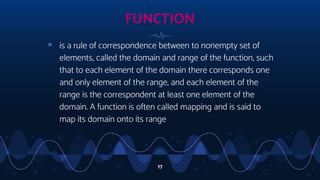
▹ is a rule of correspondence between to nonempty set of
elements, called the domain and range of the function, such
that to each element of the domain there corresponds one
and only element of the range, and each element of the
range is the correspondent at least one element of the
domain. A function is often called mapping and is said to
map its domain onto its range
FUNCTION
18
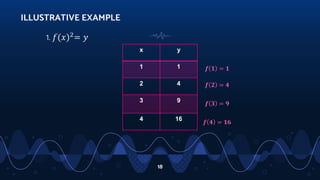
1. 𝑓(𝑥)2
= 𝑦
ILLUSTRATIVE EXAMPLE
x y
1 1
2 4
3 9
4 16
𝒇 𝟏 = 𝟏
𝒇 𝟐 = 𝟒
𝒇 𝟑 = 𝟗
𝒇 𝟒 = 𝟏𝟔
19
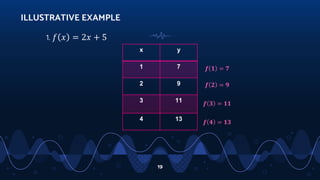
1. 𝑓 𝑥 = 2𝑥 + 5
ILLUSTRATIVE EXAMPLE
x y
1 7
2 9
3 11
4 13
𝒇 𝟏 = 𝟕
𝒇 𝟐 = 𝟗
𝒇 𝟑 = 𝟏𝟏
𝒇 𝟒 = 𝟏𝟑
20
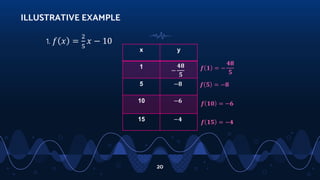
1. 𝑓 𝑥 =
2
5
𝑥 − 10
ILLUSTRATIVE EXAMPLE
x y
1
−
𝟒𝟖
𝟓
5 −𝟖
10 −𝟔
15 −𝟒
𝒇 𝟏 = −
𝟒𝟖
𝟓
𝒇 𝟓 = −𝟖
𝒇 𝟏𝟎 = −𝟔
𝒇 𝟏𝟓 = −𝟒
21
ILLUSTRATIVE EXAMPLE
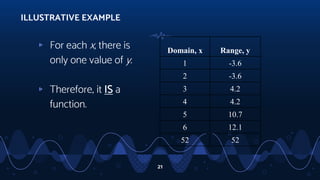
▹ For each x, there is
only one value of y.
▹ Therefore, it IS a
function.
Domain, x Range, y
1 -3.6
2 -3.6
3 4.2
4 4.2
5 10.7
6 12.1
52 52
22
ILLUSTRATIVE EXAMPLE
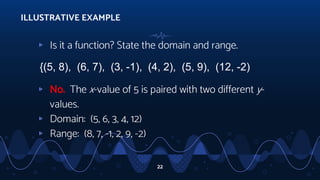
▹ Is it a function? State the domain and range.
▹ No. The x-value of 5 is paired with two different y-
values.
▹ Domain: (5, 6, 3, 4, 12)
▹ Range: (8, 7, -1, 2, 9, -2)
{(5, 8), (6, 7), (3, -1), (4, 2), (5, 9), (12, -2)
23
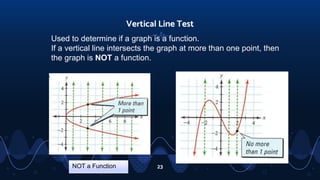
Vertical Line Test
Used to determine if a graph is a function.
If a vertical line intersects the graph at more than one point, then
the graph is NOT a function.
NOT a Function
24
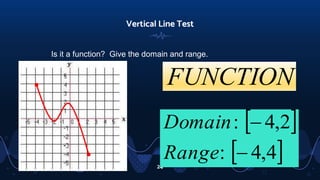
Vertical Line Test
Is it a function? Give the domain and range.
 
 
4
,
4
:
2
,
4
:
−
−
Range
Domain
FUNCTION
25
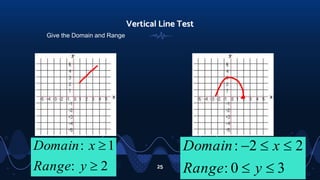
Vertical Line Test
Give the Domain and Range
2
:
1
:


y
Range
x
Domain
3
0
:
2
2
:




−
y
Range
x
Domain
26
Functional Notation
We have seen an equation written in the form y = some
expression in x.
Another way of writing this is to use functional notation.
For Example, you could write y = x²
as f(x) = x².
“
27
𝒇(𝒙)
“
28
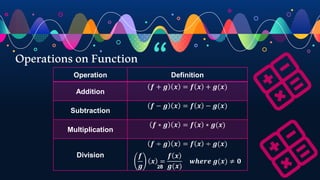
OperationsonFunction
Operation Definition
Addition
𝒇 + 𝒈 𝒙 = 𝒇 𝒙 + 𝒈(𝒙)
Subtraction
𝒇 − 𝒈 𝒙 = 𝒇 𝒙 − 𝒈(𝒙)
Multiplication
𝒇 ∗ 𝒈 𝒙 = 𝒇 𝒙 ∗ 𝒈(𝒙)
Division
𝒇 ÷ 𝒈 𝒙 = 𝒇 𝒙 ÷ 𝒈(𝒙)
𝒇
𝒈
𝒙 =
𝒇 𝒙
𝒈(𝒙)
𝒘𝒉𝒆𝒓𝒆 𝒈(𝒙) ≠ 𝟎
“
29
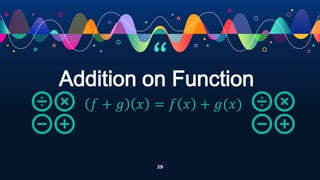
Addition on Function
𝑓 + 𝑔 𝑥 = 𝑓 𝑥 + 𝑔(𝑥)
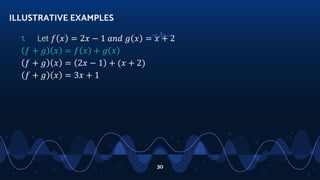
1. Let 𝑓 𝑥 = 2𝑥 − 1 𝑎𝑛𝑑 𝑔 𝑥 = 𝑥 + 2
𝑓 + 𝑔 𝑥 = 𝑓 𝑥 + 𝑔 𝑥
𝑓 + 𝑔 𝑥 = 2𝑥 − 1 + (𝑥 + 2)
𝑓 + 𝑔 𝑥 = 3𝑥 + 1
ILLUSTRATIVE EXAMPLES
30
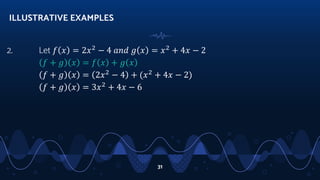
2. Let 𝑓 𝑥 = 2𝑥2
− 4 𝑎𝑛𝑑 𝑔 𝑥 = 𝑥2
+ 4𝑥 − 2
𝑓 + 𝑔 𝑥 = 𝑓 𝑥 + 𝑔 𝑥
𝑓 + 𝑔 𝑥 = 2𝑥2
− 4 + (𝑥2
+ 4𝑥 − 2)
𝑓 + 𝑔 𝑥 = 3𝑥2
+ 4𝑥 − 6
ILLUSTRATIVE EXAMPLES
31
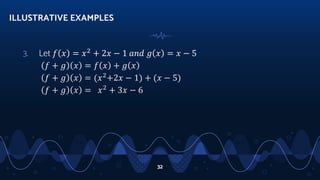
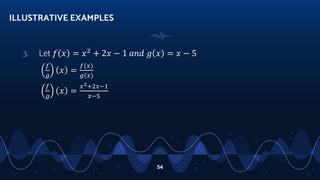
3. Let 𝑓 𝑥 = 𝑥2
+ 2𝑥 − 1 𝑎𝑛𝑑 𝑔 𝑥 = 𝑥 − 5
𝑓 + 𝑔 𝑥 = 𝑓 𝑥 + 𝑔 𝑥
𝑓 + 𝑔 𝑥 = (𝑥2
+2𝑥 − 1) + (𝑥 − 5)
𝑓 + 𝑔 𝑥 = 𝑥2
+ 3𝑥 − 6
ILLUSTRATIVE EXAMPLES
32
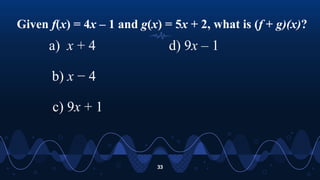
Given f(x) = 4x – 1 and g(x) = 5x + 2, what is (f + g)(x)?
33
a) x + 4
b) x − 4
c) 9x + 1
d) 9x – 1
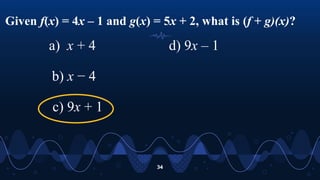
Given f(x) = 4x – 1 and g(x) = 5x + 2, what is (f + g)(x)?
34
a) x + 4
b) x − 4
c) 9x + 1
d) 9x – 1
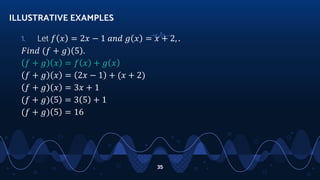
1. Let 𝑓 𝑥 = 2𝑥 − 1 𝑎𝑛𝑑 𝑔 𝑥 = 𝑥 + 2, .
𝐹𝑖𝑛𝑑 (𝑓 + 𝑔) 5 .
𝑓 + 𝑔 𝑥 = 𝑓 𝑥 + 𝑔 𝑥
𝑓 + 𝑔 𝑥 = 2𝑥 − 1 + (𝑥 + 2)
𝑓 + 𝑔 𝑥 = 3𝑥 + 1
(𝑓 + 𝑔) 5 = 3 5 + 1
(𝑓 + 𝑔) 5 = 16
ILLUSTRATIVE EXAMPLES
35
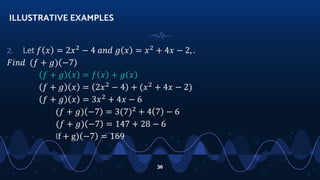
2. Let 𝑓 𝑥 = 2𝑥2
− 4 𝑎𝑛𝑑 𝑔 𝑥 = 𝑥2
+ 4𝑥 − 2, .
𝐹𝑖𝑛𝑑 (𝑓 + 𝑔) −7
𝑓 + 𝑔 𝑥 = 𝑓 𝑥 + 𝑔 𝑥
𝑓 + 𝑔 𝑥 = 2𝑥2
− 4 + (𝑥2
+ 4𝑥 − 2)
𝑓 + 𝑔 𝑥 = 3𝑥2
+ 4𝑥 − 6
(𝑓 + 𝑔) −7 = 3(7)2
+ 4 7 − 6
(𝑓 + 𝑔) −7 = 147 + 28 − 6
(f + g) −7 = 169
ILLUSTRATIVE EXAMPLES
36
“
37
Subtraction on Function
𝑓 − 𝑔 𝑥 = 𝑓 𝑥 − 𝑔(𝑥)
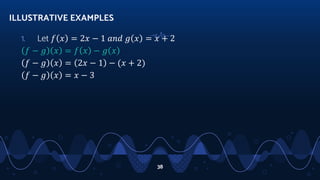
1. Let 𝑓 𝑥 = 2𝑥 − 1 𝑎𝑛𝑑 𝑔 𝑥 = 𝑥 + 2
𝑓 − 𝑔 𝑥 = 𝑓 𝑥 − 𝑔 𝑥
𝑓 − 𝑔 𝑥 = 2𝑥 − 1 − (𝑥 + 2)
𝑓 − 𝑔 𝑥 = 𝑥 − 3
ILLUSTRATIVE EXAMPLES
38
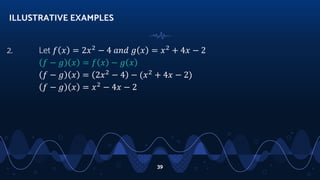
2. Let 𝑓 𝑥 = 2𝑥2
− 4 𝑎𝑛𝑑 𝑔 𝑥 = 𝑥2
+ 4𝑥 − 2
𝑓 − 𝑔 𝑥 = 𝑓 𝑥 − 𝑔 𝑥
𝑓 − 𝑔 𝑥 = 2𝑥2
− 4 − (𝑥2
+ 4𝑥 − 2)
𝑓 − 𝑔 𝑥 = 𝑥2
− 4𝑥 − 2
ILLUSTRATIVE EXAMPLES
39
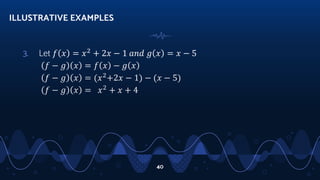
3. Let 𝑓 𝑥 = 𝑥2
+ 2𝑥 − 1 𝑎𝑛𝑑 𝑔 𝑥 = 𝑥 − 5
𝑓 − 𝑔 𝑥 = 𝑓 𝑥 − 𝑔 𝑥
𝑓 − 𝑔 𝑥 = (𝑥2
+2𝑥 − 1) − (𝑥 − 5)
𝑓 − 𝑔 𝑥 = 𝑥2
+ 𝑥 + 4
ILLUSTRATIVE EXAMPLES
40
Given f(x) = 4x – 1 and g(x) = 5x + 2, what is (f - g)(x)?
41
a) x + 3
b) x − 5
c) 5x + 1
d) −x – 3
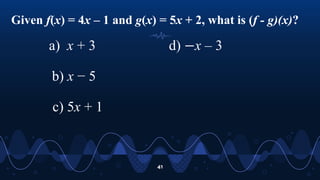
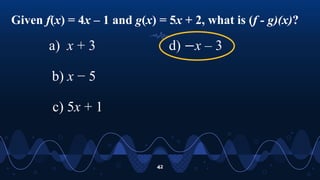
Given f(x) = 4x – 1 and g(x) = 5x + 2, what is (f - g)(x)?
42
a) x + 3
b) x − 5
c) 5x + 1
d) −x – 3
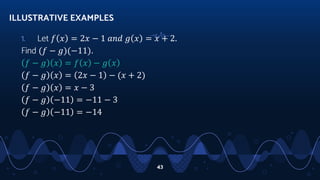
1. Let 𝑓 𝑥 = 2𝑥 − 1 𝑎𝑛𝑑 𝑔 𝑥 = 𝑥 + 2.
Find (𝑓 − 𝑔)(−11).
𝑓 − 𝑔 𝑥 = 𝑓 𝑥 − 𝑔 𝑥
𝑓 − 𝑔 𝑥 = 2𝑥 − 1 − (𝑥 + 2)
𝑓 − 𝑔 𝑥 = 𝑥 − 3
𝑓 − 𝑔 −11 = −11 − 3
𝑓 − 𝑔 −11 = −14
ILLUSTRATIVE EXAMPLES
43
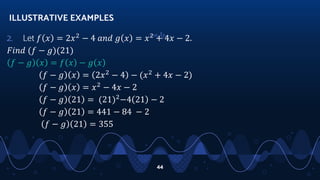
2. Let 𝑓 𝑥 = 2𝑥2
− 4 𝑎𝑛𝑑 𝑔 𝑥 = 𝑥2
+ 4𝑥 − 2.
𝐹𝑖𝑛𝑑 (𝑓 − 𝑔)(21)
𝑓 − 𝑔 𝑥 = 𝑓 𝑥 − 𝑔 𝑥
𝑓 − 𝑔 𝑥 = 2𝑥2
− 4 − (𝑥2
+ 4𝑥 − 2)
𝑓 − 𝑔 𝑥 = 𝑥2
− 4𝑥 − 2
𝑓 − 𝑔 21 = (21)2
−4 21 − 2
𝑓 − 𝑔 21 = 441 − 84 − 2
𝑓 − 𝑔 21 = 355
ILLUSTRATIVE EXAMPLES
44
“
45
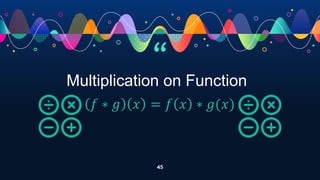
Multiplication on Function
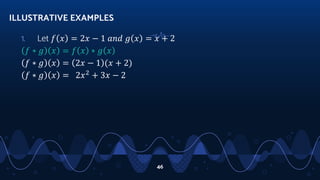
𝑓 ∗ 𝑔 𝑥 = 𝑓 𝑥 ∗ 𝑔(𝑥)
1. Let 𝑓 𝑥 = 2𝑥 − 1 𝑎𝑛𝑑 𝑔 𝑥 = 𝑥 + 2
𝑓 ∗ 𝑔 𝑥 = 𝑓 𝑥 ∗ 𝑔 𝑥
𝑓 ∗ 𝑔 𝑥 = 2𝑥 − 1 (𝑥 + 2)
𝑓 ∗ 𝑔 𝑥 = 2𝑥2
+ 3𝑥 − 2
ILLUSTRATIVE EXAMPLES
46
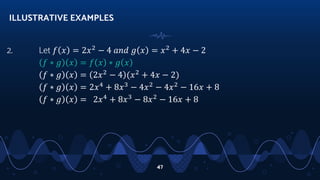
2. Let 𝑓 𝑥 = 2𝑥2
− 4 𝑎𝑛𝑑 𝑔 𝑥 = 𝑥2
+ 4𝑥 − 2
𝑓 ∗ 𝑔 𝑥 = 𝑓 𝑥 ∗ 𝑔 𝑥
𝑓 ∗ 𝑔 𝑥 = 2𝑥2
− 4 (𝑥2
+ 4𝑥 − 2)
𝑓 ∗ 𝑔 𝑥 = 2𝑥4
+ 8𝑥3
− 4𝑥2
− 4𝑥2
− 16𝑥 + 8
𝑓 ∗ 𝑔 𝑥 = 2𝑥4
+ 8𝑥3
− 8𝑥2
− 16𝑥 + 8
ILLUSTRATIVE EXAMPLES
47
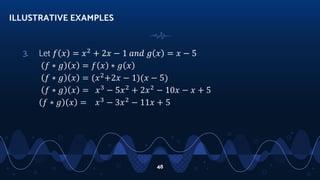
3. Let 𝑓 𝑥 = 𝑥2
+ 2𝑥 − 1 𝑎𝑛𝑑 𝑔 𝑥 = 𝑥 − 5
𝑓 ∗ 𝑔 𝑥 = 𝑓 𝑥 ∗ 𝑔 𝑥
𝑓 ∗ 𝑔 𝑥 = (𝑥2
+2𝑥 − 1)(𝑥 − 5)
𝑓 ∗ 𝑔 𝑥 = 𝑥3
− 5𝑥2
+ 2𝑥2
− 10𝑥 − 𝑥 + 5
𝑓 ∗ 𝑔 𝑥 = 𝑥3
− 3𝑥2
− 11𝑥 + 5
ILLUSTRATIVE EXAMPLES
48
49
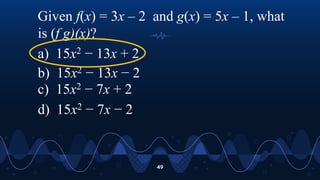
Given f(x) = 3x – 2 and g(x) = 5x – 1, what
is (f g)(x)?
a) 15x2 − 13x + 2
b) 15x2 − 13x − 2
c) 15x2 − 7x + 2
d) 15x2 − 7x − 2
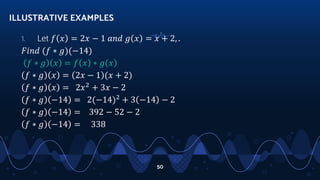
1. Let 𝑓 𝑥 = 2𝑥 − 1 𝑎𝑛𝑑 𝑔 𝑥 = 𝑥 + 2, .
𝐹𝑖𝑛𝑑 (𝑓 ∗ 𝑔)(−14)
𝑓 ∗ 𝑔 𝑥 = 𝑓 𝑥 ∗ 𝑔 𝑥
𝑓 ∗ 𝑔 𝑥 = 2𝑥 − 1 (𝑥 + 2)
𝑓 ∗ 𝑔 𝑥 = 2𝑥2
+ 3𝑥 − 2
𝑓 ∗ 𝑔 −14 = 2(−14)2
+ 3 −14 − 2
𝑓 ∗ 𝑔 −14 = 392 − 52 − 2
𝑓 ∗ 𝑔 −14 = 338
ILLUSTRATIVE EXAMPLES
50
“
51
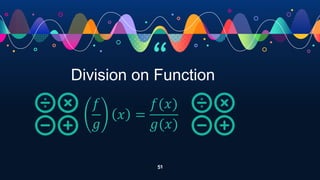
Division on Function
𝑓
𝑔
𝑥 =
𝑓(𝑥)
𝑔(𝑥)
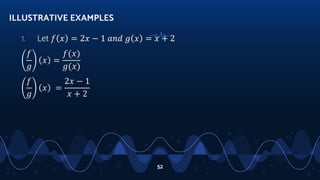
1. Let 𝑓 𝑥 = 2𝑥 − 1 𝑎𝑛𝑑 𝑔 𝑥 = 𝑥 + 2
𝑓
𝑔
𝑥 =
𝑓(𝑥)
𝑔(𝑥)
𝑓
𝑔
𝑥 =
2𝑥 − 1
𝑥 + 2
ILLUSTRATIVE EXAMPLES
52
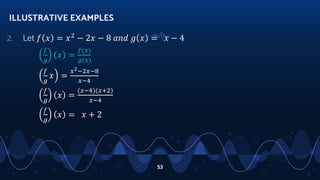
2. Let 𝑓 𝑥 = 𝑥2
− 2𝑥 − 8 𝑎𝑛𝑑 𝑔 𝑥 = 𝑥 − 4
𝑓
𝑔
𝑥 =
𝑓(𝑥)
𝑔(𝑥)
𝑓
𝑔
𝑥 =
𝑥2−2𝑥−8
𝑥−4
𝑓
𝑔
𝑥 =
(𝑥−4)(𝑥+2)
𝑥−4
𝑓
𝑔
𝑥 = 𝑥 + 2
ILLUSTRATIVE EXAMPLES
53
3. Let 𝑓 𝑥 = 𝑥2
+ 2𝑥 − 1 𝑎𝑛𝑑 𝑔 𝑥 = 𝑥 − 5
𝑓
𝑔
𝑥 =
𝑓(𝑥)
𝑔(𝑥)
𝑓
𝑔
𝑥 =
𝑥2+2𝑥−1
𝑥−5
ILLUSTRATIVE EXAMPLES
54
55
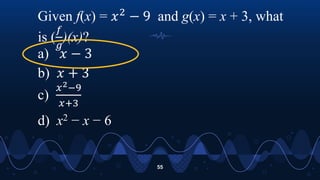
Given f(x) = 𝑥2
− 9 and g(x) = x + 3, what
is (
𝑓
𝑔
)(x)?
a) 𝑥 − 3
b) 𝑥 + 3
c)
𝑥2−9
𝑥+3
d) x2 − x − 6
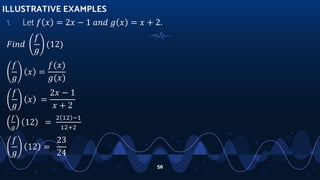
1. Let 𝑓 𝑥 = 2𝑥 − 1 𝑎𝑛𝑑 𝑔 𝑥 = 𝑥 + 2.
𝐹𝑖𝑛𝑑
𝑓
𝑔
(12)
𝑓
𝑔
𝑥 =
𝑓(𝑥)
𝑔(𝑥)
𝑓
𝑔
𝑥 =
2𝑥 − 1
𝑥 + 2
𝑓
𝑔
12 =
2 12 −1
12+2
𝑓
𝑔
12 =
23
24
ILLUSTRATIVE EXAMPLES
56
“
57
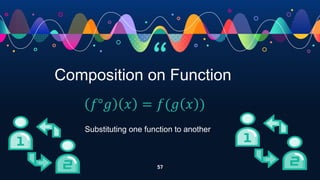
Composition on Function
𝑓°𝑔 𝑥 = 𝑓(𝑔 𝑥 )
Substituting one function to another
“
58
Composition on Function
Function Composition is just more substitution, very similar to
what we have been doing with finding the value of a function.
The difference is we will be substituting another function instead
of a number ...
“
59
Composition on Function
The term "composition of functions" (or "composite
function") refers to the combining together of two or
more functions in a manner where the output from
one function becomes the input for the next function.
“
60
Composition on Function
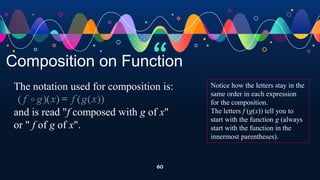
The notation used for composition is:
and is read "f composed with g of x"
or " f of g of x".
Notice how the letters stay in the
same order in each expression
for the composition.
The letters f (g(x)) tell you to
start with the function g (always
start with the function in the
innermost parentheses).
“
61
Composition on Function
Given the functions:
𝑓 𝑥 = 𝑥 + 1, 𝑔 𝑥 = 2𝑥
Find: (𝑓°𝑔)(𝑥)
(𝑓°𝑔) 𝑥 = 2x + 1
“
62
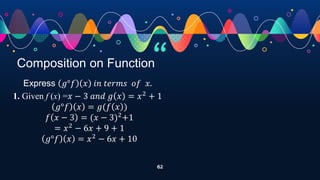
Composition on Function
Express 𝑔°𝑓 𝑥 𝑖𝑛 𝑡𝑒𝑟𝑚𝑠 𝑜𝑓 𝑥.
1. Given f (x) =𝑥 − 3 𝑎𝑛𝑑 𝑔 𝑥 = 𝑥2
+ 1
𝑔°𝑓 𝑥 = 𝑔(𝑓 𝑥 )
𝑓 𝑥 − 3 = (𝑥 − 3)2
+1
= 𝑥2
− 6𝑥 + 9 + 1
𝑔°𝑓 𝑥 = 𝑥2
− 6𝑥 + 10
“
63
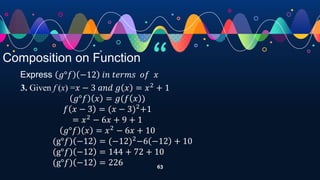
Composition on Function
Express 𝑔°𝑓 −12 𝑖𝑛 𝑡𝑒𝑟𝑚𝑠 𝑜𝑓 𝑥
3. Given f (x) =𝑥 − 3 𝑎𝑛𝑑 𝑔 𝑥 = 𝑥2
+ 1
𝑔°𝑓 𝑥 = 𝑔(𝑓 𝑥 )
𝑓 𝑥 − 3 = (𝑥 − 3)2
+1
= 𝑥2
− 6𝑥 + 9 + 1
𝑔°𝑓 𝑥 = 𝑥2
− 6𝑥 + 10
(g°𝑓) −12 = (−12)2
−6 −12 + 10
(g°𝑓) −12 = 144 + 72 + 10
(g°𝑓) −12 = 226
64
65
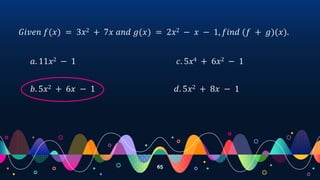
𝐺𝑖𝑣𝑒𝑛 𝑓(𝑥) = 3𝑥2 + 7𝑥 𝑎𝑛𝑑 𝑔(𝑥) = 2𝑥2 − 𝑥 − 1, 𝑓𝑖𝑛𝑑 (𝑓 + 𝑔)(𝑥).
𝑎. 11𝑥2 − 1
𝑏. 5𝑥2 + 6𝑥 − 1
𝑐. 5𝑥4 + 6𝑥2 − 1
𝑑. 5𝑥2 + 8𝑥 − 1
66
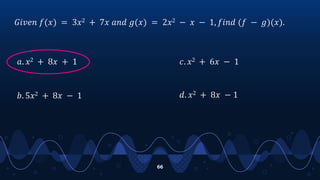
𝐺𝑖𝑣𝑒𝑛 𝑓(𝑥) = 3𝑥2 + 7𝑥 𝑎𝑛𝑑 𝑔(𝑥) = 2𝑥2 − 𝑥 − 1, 𝑓𝑖𝑛𝑑 (𝑓 − 𝑔)(𝑥).
𝑎. 𝑥2 + 8𝑥 + 1
𝑏. 5𝑥2 + 8𝑥 − 1
𝑐. 𝑥2 + 6𝑥 − 1
𝑑. 𝑥2 + 8𝑥 − 1
67
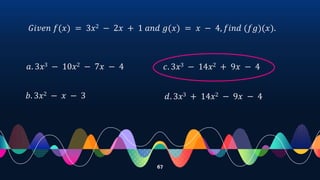
𝐺𝑖𝑣𝑒𝑛 𝑓(𝑥) = 3𝑥2 − 2𝑥 + 1 𝑎𝑛𝑑 𝑔(𝑥) = 𝑥 − 4, 𝑓𝑖𝑛𝑑 (𝑓𝑔)(𝑥).
𝑎. 3𝑥3 − 10𝑥2 − 7𝑥 − 4
𝑏. 3𝑥2 − 𝑥 − 3
𝑐. 3𝑥3 − 14𝑥2 + 9𝑥 − 4
𝑑. 3𝑥3 + 14𝑥2 − 9𝑥 − 4
68
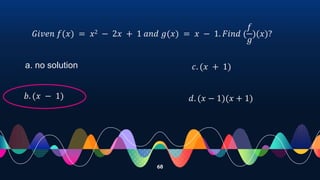
𝐺𝑖𝑣𝑒𝑛 𝑓(𝑥) = 𝑥2 − 2𝑥 + 1 𝑎𝑛𝑑 𝑔(𝑥) = 𝑥 − 1. 𝐹𝑖𝑛𝑑 (
𝑓
𝑔
)(𝑥)?
a. no solution
𝑏. (𝑥 − 1)
𝑐. (𝑥 + 1)
𝑑. (𝑥 − 1)(𝑥 + 1)
69
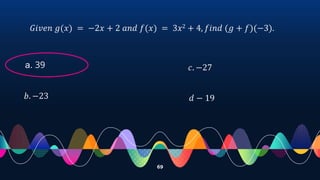
𝐺𝑖𝑣𝑒𝑛 𝑔(𝑥) = −2𝑥 + 2 𝑎𝑛𝑑 𝑓(𝑥) = 3𝑥2 + 4, 𝑓𝑖𝑛𝑑 (𝑔 + 𝑓)(−3).
a. 39
𝑏. −23
𝑐. −27
𝑑 − 19
70
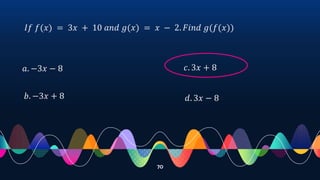
𝐼𝑓 𝑓(𝑥) = 3𝑥 + 10 𝑎𝑛𝑑 𝑔(𝑥) = 𝑥 − 2. 𝐹𝑖𝑛𝑑 𝑔(𝑓(𝑥))
𝑎. −3𝑥 − 8
𝑏. −3𝑥 + 8
𝑐. 3𝑥 + 8
𝑑. 3𝑥 − 8
71
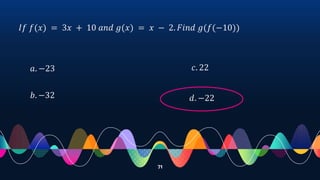
𝐼𝑓 𝑓(𝑥) = 3𝑥 + 10 𝑎𝑛𝑑 𝑔(𝑥) = 𝑥 − 2. 𝐹𝑖𝑛𝑑 𝑔(𝑓(−10))
𝑎. −23
𝑏. −32
𝑐. 22
𝑑. −22
“
72
A Function can be classified as Even, Odd or Neither. This
classification can be determined graphically or
algebraically.
Odd and Even Functions
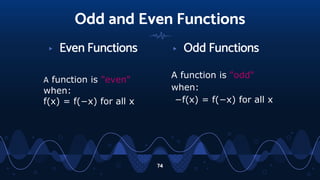
▹ Even Functions
A function is "even"
when:
f(x) = f(−x) for all x
▹ Odd Functions
A function is "odd"
when:
−f(x) = f(−x) for all x
74
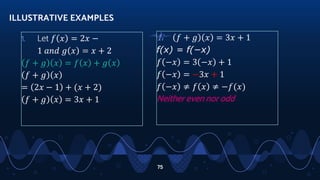
1. Let 𝑓 𝑥 = 2𝑥 −
1 𝑎𝑛𝑑 𝑔 𝑥 = 𝑥 + 2
𝑓 + 𝑔 𝑥 = 𝑓 𝑥 + 𝑔 𝑥
𝑓 + 𝑔 𝑥
= 2𝑥 − 1 + (𝑥 + 2)
𝑓 + 𝑔 𝑥 = 3𝑥 + 1
ILLUSTRATIVE EXAMPLES
75
1. 𝑓 + 𝑔 𝑥 = 3𝑥 + 1
f(x) = f(−x)
𝑓 −𝑥 = 3 −𝑥 + 1
𝑓 −𝑥 = −3𝑥 + 1
𝑓 −𝑥 ≠ 𝑓 𝑥 ≠ −𝑓(𝑥)
Neither even nor odd
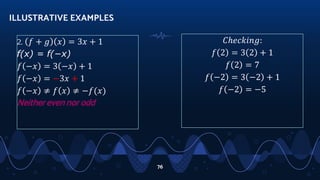
𝐶ℎ𝑒𝑐𝑘𝑖𝑛𝑔:
𝑓 2 = 3 2 + 1
𝑓 2 = 7
𝑓 −2 = 3 −2 + 1
𝑓 −2 = −5
ILLUSTRATIVE EXAMPLES
76
2. 𝑓 + 𝑔 𝑥 = 3𝑥 + 1
f(x) = f(−x)
𝑓 −𝑥 = 3 −𝑥 + 1
𝑓 −𝑥 = −3𝑥 + 1
𝑓 −𝑥 ≠ 𝑓 𝑥 ≠ −𝑓(𝑥)
Neither even nor odd
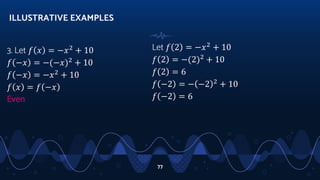
3. Let 𝑓 𝑥 = −𝑥2
+ 10
𝑓 −𝑥 = −(−𝑥)2
+ 10
𝑓 −𝑥 = −𝑥2
+ 10
𝑓 𝑥 = 𝑓 −𝑥
Even
ILLUSTRATIVE EXAMPLES
77
Let 𝑓 2 = −𝑥2
+ 10
𝑓 2 = −(2)2
+ 10
𝑓 2 = 6
𝑓 −2 = − −2 2
+ 10
𝑓 −2 = 6
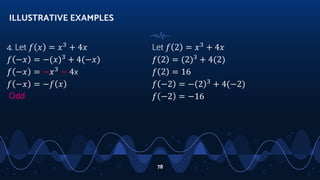
4. Let 𝑓 𝑥 = 𝑥3
+ 4𝑥
𝑓 −𝑥 = −(𝑥)3
+ 4(−𝑥)
𝑓 −𝑥 = −𝑥3
− 4x
𝑓 −𝑥 = −𝑓 𝑥
Odd
ILLUSTRATIVE EXAMPLES
78
Let 𝑓 2 = 𝑥3
+ 4𝑥
𝑓 2 = (2)3
+ 4(2)
𝑓 2 = 16
𝑓 −2 = − 2 3
+ 4(−2)
𝑓 −2 = −16
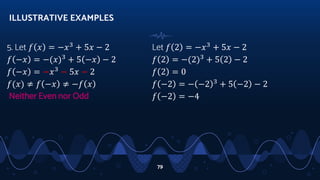
5. Let 𝑓 𝑥 = −𝑥3
+ 5𝑥 − 2
𝑓 −𝑥 = −(𝑥)3
+ 5 −𝑥 − 2
𝑓 −𝑥 = −𝑥3
− 5𝑥 − 2
𝑓(𝑥) ≠ 𝑓 −𝑥 ≠ −𝑓 𝑥
Neither Even nor Odd
ILLUSTRATIVE EXAMPLES
79
Let 𝑓 2 = −𝑥3
+ 5𝑥 − 2
𝑓 2 = −(2)3
+ 5 2 − 2
𝑓 2 = 0
𝑓 −2 = − −2 3
+ 5 −2 − 2
𝑓 −2 = −4
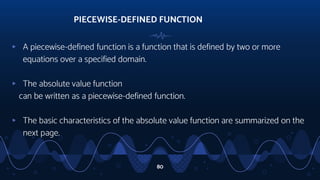
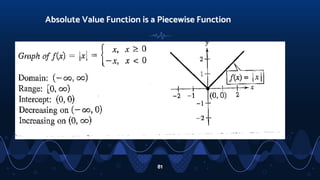
▹ A piecewise-defined function is a function that is defined by two or more
equations over a specified domain.
▹ The absolute value function
can be written as a piecewise-defined function.
▹ The basic characteristics of the absolute value function are summarized on the
next page.
PIECEWISE-DEFINED FUNCTION
80
Absolute Value Function is a Piecewise Function
81
Absolute Value Function is a Piecewise Function
82
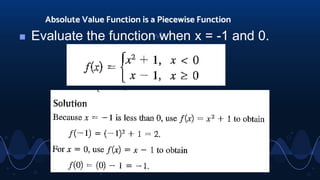
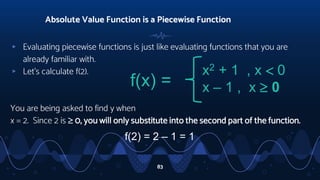
◼ Evaluate the function when x = -1 and 0.
▹ Evaluating piecewise functions is just like evaluating functions that you are
already familiar with.
▹ Let’s calculate f(2).
You are being asked to find y when
x = 2. Since 2 is  0, you will only substitute into the second part of the function.
Absolute Value Function is a Piecewise Function
83
f(x) =
x2 + 1 , x  0
x – 1 , x  0
f(2) = 2 – 1 = 1
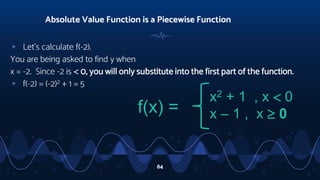
▹ Let’s calculate f(-2).
You are being asked to find y when
x = -2. Since -2 is  0, you will only substitute into the first part of the function.
▹ f(-2) = (-2)2 + 1 = 5
Absolute Value Function is a Piecewise Function
84
f(x) =
x2 + 1 , x  0
x – 1 , x  0
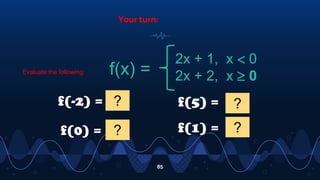
Your turn:
85
f(x) =
2x + 1, x  0
2x + 2, x  0
Evaluate the following:
f(-2) = -3
?
f(0) = 2
?
f(5) = 12
?
f(1) = 4
?
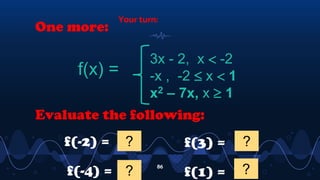
Your turn:
86
One more:
f(x) =
3x - 2, x  -2
-x , -2  x  1
x2 – 7x, x  1
Evaluate the following:
f(-2) = 2
?
f(-4) = -14
?
f(3) = -12
?
f(1) = -6
?

FUNCTIONS L.1.pdf

  • 1.
  • 2.
    Our Learning Outcomes •State the definition of a function • Determine the domain and range of a function • Perform the fundamental operations, Including composition, of functions WHAT WE'LL COVER IN THIS SESSION
  • 3.
    “ 3 -refers to whatsomething does
  • 4.
  • 5.
    1 3 5 a c d e 𝟏, 𝟐, 𝟑,𝟒, 𝟓 𝒂, 𝒃, 𝒄, 𝒅, 𝒆
  • 6.
    “ 6 What is afunction?
  • 7.
    “ 7 What is afunction? FUNCTION SET SET INPUT OUTPUT 1 2 3 4 5 a b c d e DOMAIN RANGE
  • 8.
  • 9.
    9 Function x y 1 2 24 3 6 4 8 2x=y
  • 10.
    10 The FUNCTION isa relation such that no two ordered pairs have the same first element. A function usually denoted by 𝒚 = 𝒇(𝒙) is read as “f of x”. A function may also be written as 𝒇: 𝒙 → 𝒚, where 𝒙 ∈ domain and 𝒚 ∈ range
  • 11.
    11 The two typesof functions that need explicit restrictions are those with radicals and the rational functions. The following illustrate the restrict of the domain: a. 𝑓 𝑥 = 2𝑥 − 1 is defined for 2𝑥 − 1 ≥ 0 or 𝑥 ≥ 1 2 b. 𝑓 𝑥 = 1 𝑥−1 is defined for all real numbers ≠ 1 c. 𝑓 𝑥 = 1 𝑥2−1 is defined for all real number except ±1
  • 12.
    12 There are twomethods in defining a Relation a. Listing of ordered pairs 𝑓 𝑥 = 0,1 , 1,2 , 2,3 … … . . b. Rule Method 𝑓 𝑥 = ȁ (𝑥, 𝑦) 𝑦 = 𝑥 + 1, 𝑥 ∈ 𝑍
  • 13.
    13 Find the domainand range of the following functions a. 𝑦 = 𝑥 e. 𝑦 = 𝑥 − 1 g. y = 𝑥−2 𝑥+1 b. 𝑦 = 𝑥 c. 𝑦 = 𝑥2 d. 𝑦 = 𝑥3 f. 𝑦 = 𝑥2 − 4
  • 14.
    14 Find the domainand range of the following functions a. 𝑦 = 𝑥 − 1 a. 𝑓 2 b. 𝑓(1) c. 𝑓(−1) d. none b. 𝑦 = 𝑥−1 2𝑥+5 a. 𝑓 1 b. 𝑓(−2) c. 𝑓(− 5 2 ) d. none c. 𝑦 = 𝑥2 − 1 a. 𝑓 1 b. 𝑓(−2) c. 𝑓(− 2 5 ) d. none d. 𝑦 = 𝑥 − 1 a. 𝑓 2 b. 𝑓(1) c. 𝑓(−1) d. none
  • 15.
    15 Find the domainand range of the following functions e. 𝑦 = 𝑥2 − 𝑥 − 1 a. 𝑓 −1 b. 𝑓(0) c. 𝑓(1) d. none f. 𝑦 = 1 − 𝑥2 a. 𝑓 1 b. 𝑓(−1) c. 𝑓(− 3 2 ) d. none g. 𝑦 = 1 𝑥2+1 a. 𝑓 1 b. 𝑓(−1) c. 𝑓(0) d. none h. 𝑦 = 2𝑥−5 −3−5𝑥 a. 𝑓 3 5 b. 𝑓(− 5 3 ) c. 𝑓(− 3 5 ) d. none
  • 16.
  • 17.
    17 ▹ is arule of correspondence between to nonempty set of elements, called the domain and range of the function, such that to each element of the domain there corresponds one and only element of the range, and each element of the range is the correspondent at least one element of the domain. A function is often called mapping and is said to map its domain onto its range FUNCTION
  • 18.
    18 1. 𝑓(𝑥)2 = 𝑦 ILLUSTRATIVEEXAMPLE x y 1 1 2 4 3 9 4 16 𝒇 𝟏 = 𝟏 𝒇 𝟐 = 𝟒 𝒇 𝟑 = 𝟗 𝒇 𝟒 = 𝟏𝟔
  • 19.
    19 1. 𝑓 𝑥= 2𝑥 + 5 ILLUSTRATIVE EXAMPLE x y 1 7 2 9 3 11 4 13 𝒇 𝟏 = 𝟕 𝒇 𝟐 = 𝟗 𝒇 𝟑 = 𝟏𝟏 𝒇 𝟒 = 𝟏𝟑
  • 20.
    20 1. 𝑓 𝑥= 2 5 𝑥 − 10 ILLUSTRATIVE EXAMPLE x y 1 − 𝟒𝟖 𝟓 5 −𝟖 10 −𝟔 15 −𝟒 𝒇 𝟏 = − 𝟒𝟖 𝟓 𝒇 𝟓 = −𝟖 𝒇 𝟏𝟎 = −𝟔 𝒇 𝟏𝟓 = −𝟒
  • 21.
    21 ILLUSTRATIVE EXAMPLE ▹ Foreach x, there is only one value of y. ▹ Therefore, it IS a function. Domain, x Range, y 1 -3.6 2 -3.6 3 4.2 4 4.2 5 10.7 6 12.1 52 52
  • 22.
    22 ILLUSTRATIVE EXAMPLE ▹ Isit a function? State the domain and range. ▹ No. The x-value of 5 is paired with two different y- values. ▹ Domain: (5, 6, 3, 4, 12) ▹ Range: (8, 7, -1, 2, 9, -2) {(5, 8), (6, 7), (3, -1), (4, 2), (5, 9), (12, -2)
  • 23.
    23 Vertical Line Test Usedto determine if a graph is a function. If a vertical line intersects the graph at more than one point, then the graph is NOT a function. NOT a Function
  • 24.
    24 Vertical Line Test Isit a function? Give the domain and range.     4 , 4 : 2 , 4 : − − Range Domain FUNCTION
  • 25.
    25 Vertical Line Test Givethe Domain and Range 2 : 1 :   y Range x Domain 3 0 : 2 2 :     − y Range x Domain
  • 26.
    26 Functional Notation We haveseen an equation written in the form y = some expression in x. Another way of writing this is to use functional notation. For Example, you could write y = x² as f(x) = x².
  • 27.
  • 28.
    “ 28 OperationsonFunction Operation Definition Addition 𝒇 +𝒈 𝒙 = 𝒇 𝒙 + 𝒈(𝒙) Subtraction 𝒇 − 𝒈 𝒙 = 𝒇 𝒙 − 𝒈(𝒙) Multiplication 𝒇 ∗ 𝒈 𝒙 = 𝒇 𝒙 ∗ 𝒈(𝒙) Division 𝒇 ÷ 𝒈 𝒙 = 𝒇 𝒙 ÷ 𝒈(𝒙) 𝒇 𝒈 𝒙 = 𝒇 𝒙 𝒈(𝒙) 𝒘𝒉𝒆𝒓𝒆 𝒈(𝒙) ≠ 𝟎
  • 29.
    “ 29 Addition on Function 𝑓+ 𝑔 𝑥 = 𝑓 𝑥 + 𝑔(𝑥)
  • 30.
    1. Let 𝑓𝑥 = 2𝑥 − 1 𝑎𝑛𝑑 𝑔 𝑥 = 𝑥 + 2 𝑓 + 𝑔 𝑥 = 𝑓 𝑥 + 𝑔 𝑥 𝑓 + 𝑔 𝑥 = 2𝑥 − 1 + (𝑥 + 2) 𝑓 + 𝑔 𝑥 = 3𝑥 + 1 ILLUSTRATIVE EXAMPLES 30
  • 31.
    2. Let 𝑓𝑥 = 2𝑥2 − 4 𝑎𝑛𝑑 𝑔 𝑥 = 𝑥2 + 4𝑥 − 2 𝑓 + 𝑔 𝑥 = 𝑓 𝑥 + 𝑔 𝑥 𝑓 + 𝑔 𝑥 = 2𝑥2 − 4 + (𝑥2 + 4𝑥 − 2) 𝑓 + 𝑔 𝑥 = 3𝑥2 + 4𝑥 − 6 ILLUSTRATIVE EXAMPLES 31
  • 32.
    3. Let 𝑓𝑥 = 𝑥2 + 2𝑥 − 1 𝑎𝑛𝑑 𝑔 𝑥 = 𝑥 − 5 𝑓 + 𝑔 𝑥 = 𝑓 𝑥 + 𝑔 𝑥 𝑓 + 𝑔 𝑥 = (𝑥2 +2𝑥 − 1) + (𝑥 − 5) 𝑓 + 𝑔 𝑥 = 𝑥2 + 3𝑥 − 6 ILLUSTRATIVE EXAMPLES 32
  • 33.
    Given f(x) =4x – 1 and g(x) = 5x + 2, what is (f + g)(x)? 33 a) x + 4 b) x − 4 c) 9x + 1 d) 9x – 1
  • 34.
    Given f(x) =4x – 1 and g(x) = 5x + 2, what is (f + g)(x)? 34 a) x + 4 b) x − 4 c) 9x + 1 d) 9x – 1
  • 35.
    1. Let 𝑓𝑥 = 2𝑥 − 1 𝑎𝑛𝑑 𝑔 𝑥 = 𝑥 + 2, . 𝐹𝑖𝑛𝑑 (𝑓 + 𝑔) 5 . 𝑓 + 𝑔 𝑥 = 𝑓 𝑥 + 𝑔 𝑥 𝑓 + 𝑔 𝑥 = 2𝑥 − 1 + (𝑥 + 2) 𝑓 + 𝑔 𝑥 = 3𝑥 + 1 (𝑓 + 𝑔) 5 = 3 5 + 1 (𝑓 + 𝑔) 5 = 16 ILLUSTRATIVE EXAMPLES 35
  • 36.
    2. Let 𝑓𝑥 = 2𝑥2 − 4 𝑎𝑛𝑑 𝑔 𝑥 = 𝑥2 + 4𝑥 − 2, . 𝐹𝑖𝑛𝑑 (𝑓 + 𝑔) −7 𝑓 + 𝑔 𝑥 = 𝑓 𝑥 + 𝑔 𝑥 𝑓 + 𝑔 𝑥 = 2𝑥2 − 4 + (𝑥2 + 4𝑥 − 2) 𝑓 + 𝑔 𝑥 = 3𝑥2 + 4𝑥 − 6 (𝑓 + 𝑔) −7 = 3(7)2 + 4 7 − 6 (𝑓 + 𝑔) −7 = 147 + 28 − 6 (f + g) −7 = 169 ILLUSTRATIVE EXAMPLES 36
  • 37.
    “ 37 Subtraction on Function 𝑓− 𝑔 𝑥 = 𝑓 𝑥 − 𝑔(𝑥)
  • 38.
    1. Let 𝑓𝑥 = 2𝑥 − 1 𝑎𝑛𝑑 𝑔 𝑥 = 𝑥 + 2 𝑓 − 𝑔 𝑥 = 𝑓 𝑥 − 𝑔 𝑥 𝑓 − 𝑔 𝑥 = 2𝑥 − 1 − (𝑥 + 2) 𝑓 − 𝑔 𝑥 = 𝑥 − 3 ILLUSTRATIVE EXAMPLES 38
  • 39.
    2. Let 𝑓𝑥 = 2𝑥2 − 4 𝑎𝑛𝑑 𝑔 𝑥 = 𝑥2 + 4𝑥 − 2 𝑓 − 𝑔 𝑥 = 𝑓 𝑥 − 𝑔 𝑥 𝑓 − 𝑔 𝑥 = 2𝑥2 − 4 − (𝑥2 + 4𝑥 − 2) 𝑓 − 𝑔 𝑥 = 𝑥2 − 4𝑥 − 2 ILLUSTRATIVE EXAMPLES 39
  • 40.
    3. Let 𝑓𝑥 = 𝑥2 + 2𝑥 − 1 𝑎𝑛𝑑 𝑔 𝑥 = 𝑥 − 5 𝑓 − 𝑔 𝑥 = 𝑓 𝑥 − 𝑔 𝑥 𝑓 − 𝑔 𝑥 = (𝑥2 +2𝑥 − 1) − (𝑥 − 5) 𝑓 − 𝑔 𝑥 = 𝑥2 + 𝑥 + 4 ILLUSTRATIVE EXAMPLES 40
  • 41.
    Given f(x) =4x – 1 and g(x) = 5x + 2, what is (f - g)(x)? 41 a) x + 3 b) x − 5 c) 5x + 1 d) −x – 3
  • 42.
    Given f(x) =4x – 1 and g(x) = 5x + 2, what is (f - g)(x)? 42 a) x + 3 b) x − 5 c) 5x + 1 d) −x – 3
  • 43.
    1. Let 𝑓𝑥 = 2𝑥 − 1 𝑎𝑛𝑑 𝑔 𝑥 = 𝑥 + 2. Find (𝑓 − 𝑔)(−11). 𝑓 − 𝑔 𝑥 = 𝑓 𝑥 − 𝑔 𝑥 𝑓 − 𝑔 𝑥 = 2𝑥 − 1 − (𝑥 + 2) 𝑓 − 𝑔 𝑥 = 𝑥 − 3 𝑓 − 𝑔 −11 = −11 − 3 𝑓 − 𝑔 −11 = −14 ILLUSTRATIVE EXAMPLES 43
  • 44.
    2. Let 𝑓𝑥 = 2𝑥2 − 4 𝑎𝑛𝑑 𝑔 𝑥 = 𝑥2 + 4𝑥 − 2. 𝐹𝑖𝑛𝑑 (𝑓 − 𝑔)(21) 𝑓 − 𝑔 𝑥 = 𝑓 𝑥 − 𝑔 𝑥 𝑓 − 𝑔 𝑥 = 2𝑥2 − 4 − (𝑥2 + 4𝑥 − 2) 𝑓 − 𝑔 𝑥 = 𝑥2 − 4𝑥 − 2 𝑓 − 𝑔 21 = (21)2 −4 21 − 2 𝑓 − 𝑔 21 = 441 − 84 − 2 𝑓 − 𝑔 21 = 355 ILLUSTRATIVE EXAMPLES 44
  • 45.
    “ 45 Multiplication on Function 𝑓∗ 𝑔 𝑥 = 𝑓 𝑥 ∗ 𝑔(𝑥)
  • 46.
    1. Let 𝑓𝑥 = 2𝑥 − 1 𝑎𝑛𝑑 𝑔 𝑥 = 𝑥 + 2 𝑓 ∗ 𝑔 𝑥 = 𝑓 𝑥 ∗ 𝑔 𝑥 𝑓 ∗ 𝑔 𝑥 = 2𝑥 − 1 (𝑥 + 2) 𝑓 ∗ 𝑔 𝑥 = 2𝑥2 + 3𝑥 − 2 ILLUSTRATIVE EXAMPLES 46
  • 47.
    2. Let 𝑓𝑥 = 2𝑥2 − 4 𝑎𝑛𝑑 𝑔 𝑥 = 𝑥2 + 4𝑥 − 2 𝑓 ∗ 𝑔 𝑥 = 𝑓 𝑥 ∗ 𝑔 𝑥 𝑓 ∗ 𝑔 𝑥 = 2𝑥2 − 4 (𝑥2 + 4𝑥 − 2) 𝑓 ∗ 𝑔 𝑥 = 2𝑥4 + 8𝑥3 − 4𝑥2 − 4𝑥2 − 16𝑥 + 8 𝑓 ∗ 𝑔 𝑥 = 2𝑥4 + 8𝑥3 − 8𝑥2 − 16𝑥 + 8 ILLUSTRATIVE EXAMPLES 47
  • 48.
    3. Let 𝑓𝑥 = 𝑥2 + 2𝑥 − 1 𝑎𝑛𝑑 𝑔 𝑥 = 𝑥 − 5 𝑓 ∗ 𝑔 𝑥 = 𝑓 𝑥 ∗ 𝑔 𝑥 𝑓 ∗ 𝑔 𝑥 = (𝑥2 +2𝑥 − 1)(𝑥 − 5) 𝑓 ∗ 𝑔 𝑥 = 𝑥3 − 5𝑥2 + 2𝑥2 − 10𝑥 − 𝑥 + 5 𝑓 ∗ 𝑔 𝑥 = 𝑥3 − 3𝑥2 − 11𝑥 + 5 ILLUSTRATIVE EXAMPLES 48
  • 49.
    49 Given f(x) =3x – 2 and g(x) = 5x – 1, what is (f g)(x)? a) 15x2 − 13x + 2 b) 15x2 − 13x − 2 c) 15x2 − 7x + 2 d) 15x2 − 7x − 2
  • 50.
    1. Let 𝑓𝑥 = 2𝑥 − 1 𝑎𝑛𝑑 𝑔 𝑥 = 𝑥 + 2, . 𝐹𝑖𝑛𝑑 (𝑓 ∗ 𝑔)(−14) 𝑓 ∗ 𝑔 𝑥 = 𝑓 𝑥 ∗ 𝑔 𝑥 𝑓 ∗ 𝑔 𝑥 = 2𝑥 − 1 (𝑥 + 2) 𝑓 ∗ 𝑔 𝑥 = 2𝑥2 + 3𝑥 − 2 𝑓 ∗ 𝑔 −14 = 2(−14)2 + 3 −14 − 2 𝑓 ∗ 𝑔 −14 = 392 − 52 − 2 𝑓 ∗ 𝑔 −14 = 338 ILLUSTRATIVE EXAMPLES 50
  • 51.
  • 52.
    1. Let 𝑓𝑥 = 2𝑥 − 1 𝑎𝑛𝑑 𝑔 𝑥 = 𝑥 + 2 𝑓 𝑔 𝑥 = 𝑓(𝑥) 𝑔(𝑥) 𝑓 𝑔 𝑥 = 2𝑥 − 1 𝑥 + 2 ILLUSTRATIVE EXAMPLES 52
  • 53.
    2. Let 𝑓𝑥 = 𝑥2 − 2𝑥 − 8 𝑎𝑛𝑑 𝑔 𝑥 = 𝑥 − 4 𝑓 𝑔 𝑥 = 𝑓(𝑥) 𝑔(𝑥) 𝑓 𝑔 𝑥 = 𝑥2−2𝑥−8 𝑥−4 𝑓 𝑔 𝑥 = (𝑥−4)(𝑥+2) 𝑥−4 𝑓 𝑔 𝑥 = 𝑥 + 2 ILLUSTRATIVE EXAMPLES 53
  • 54.
    3. Let 𝑓𝑥 = 𝑥2 + 2𝑥 − 1 𝑎𝑛𝑑 𝑔 𝑥 = 𝑥 − 5 𝑓 𝑔 𝑥 = 𝑓(𝑥) 𝑔(𝑥) 𝑓 𝑔 𝑥 = 𝑥2+2𝑥−1 𝑥−5 ILLUSTRATIVE EXAMPLES 54
  • 55.
    55 Given f(x) =𝑥2 − 9 and g(x) = x + 3, what is ( 𝑓 𝑔 )(x)? a) 𝑥 − 3 b) 𝑥 + 3 c) 𝑥2−9 𝑥+3 d) x2 − x − 6
  • 56.
    1. Let 𝑓𝑥 = 2𝑥 − 1 𝑎𝑛𝑑 𝑔 𝑥 = 𝑥 + 2. 𝐹𝑖𝑛𝑑 𝑓 𝑔 (12) 𝑓 𝑔 𝑥 = 𝑓(𝑥) 𝑔(𝑥) 𝑓 𝑔 𝑥 = 2𝑥 − 1 𝑥 + 2 𝑓 𝑔 12 = 2 12 −1 12+2 𝑓 𝑔 12 = 23 24 ILLUSTRATIVE EXAMPLES 56
  • 57.
    “ 57 Composition on Function 𝑓°𝑔𝑥 = 𝑓(𝑔 𝑥 ) Substituting one function to another
  • 58.
    “ 58 Composition on Function FunctionComposition is just more substitution, very similar to what we have been doing with finding the value of a function. The difference is we will be substituting another function instead of a number ...
  • 59.
    “ 59 Composition on Function Theterm "composition of functions" (or "composite function") refers to the combining together of two or more functions in a manner where the output from one function becomes the input for the next function.
  • 60.
    “ 60 Composition on Function Thenotation used for composition is: and is read "f composed with g of x" or " f of g of x". Notice how the letters stay in the same order in each expression for the composition. The letters f (g(x)) tell you to start with the function g (always start with the function in the innermost parentheses).
  • 61.
    “ 61 Composition on Function Giventhe functions: 𝑓 𝑥 = 𝑥 + 1, 𝑔 𝑥 = 2𝑥 Find: (𝑓°𝑔)(𝑥) (𝑓°𝑔) 𝑥 = 2x + 1
  • 62.
    “ 62 Composition on Function Express𝑔°𝑓 𝑥 𝑖𝑛 𝑡𝑒𝑟𝑚𝑠 𝑜𝑓 𝑥. 1. Given f (x) =𝑥 − 3 𝑎𝑛𝑑 𝑔 𝑥 = 𝑥2 + 1 𝑔°𝑓 𝑥 = 𝑔(𝑓 𝑥 ) 𝑓 𝑥 − 3 = (𝑥 − 3)2 +1 = 𝑥2 − 6𝑥 + 9 + 1 𝑔°𝑓 𝑥 = 𝑥2 − 6𝑥 + 10
  • 63.
    “ 63 Composition on Function Express𝑔°𝑓 −12 𝑖𝑛 𝑡𝑒𝑟𝑚𝑠 𝑜𝑓 𝑥 3. Given f (x) =𝑥 − 3 𝑎𝑛𝑑 𝑔 𝑥 = 𝑥2 + 1 𝑔°𝑓 𝑥 = 𝑔(𝑓 𝑥 ) 𝑓 𝑥 − 3 = (𝑥 − 3)2 +1 = 𝑥2 − 6𝑥 + 9 + 1 𝑔°𝑓 𝑥 = 𝑥2 − 6𝑥 + 10 (g°𝑓) −12 = (−12)2 −6 −12 + 10 (g°𝑓) −12 = 144 + 72 + 10 (g°𝑓) −12 = 226
  • 64.
  • 65.
    65 𝐺𝑖𝑣𝑒𝑛 𝑓(𝑥) =3𝑥2 + 7𝑥 𝑎𝑛𝑑 𝑔(𝑥) = 2𝑥2 − 𝑥 − 1, 𝑓𝑖𝑛𝑑 (𝑓 + 𝑔)(𝑥). 𝑎. 11𝑥2 − 1 𝑏. 5𝑥2 + 6𝑥 − 1 𝑐. 5𝑥4 + 6𝑥2 − 1 𝑑. 5𝑥2 + 8𝑥 − 1
  • 66.
    66 𝐺𝑖𝑣𝑒𝑛 𝑓(𝑥) =3𝑥2 + 7𝑥 𝑎𝑛𝑑 𝑔(𝑥) = 2𝑥2 − 𝑥 − 1, 𝑓𝑖𝑛𝑑 (𝑓 − 𝑔)(𝑥). 𝑎. 𝑥2 + 8𝑥 + 1 𝑏. 5𝑥2 + 8𝑥 − 1 𝑐. 𝑥2 + 6𝑥 − 1 𝑑. 𝑥2 + 8𝑥 − 1
  • 67.
    67 𝐺𝑖𝑣𝑒𝑛 𝑓(𝑥) =3𝑥2 − 2𝑥 + 1 𝑎𝑛𝑑 𝑔(𝑥) = 𝑥 − 4, 𝑓𝑖𝑛𝑑 (𝑓𝑔)(𝑥). 𝑎. 3𝑥3 − 10𝑥2 − 7𝑥 − 4 𝑏. 3𝑥2 − 𝑥 − 3 𝑐. 3𝑥3 − 14𝑥2 + 9𝑥 − 4 𝑑. 3𝑥3 + 14𝑥2 − 9𝑥 − 4
  • 68.
    68 𝐺𝑖𝑣𝑒𝑛 𝑓(𝑥) =𝑥2 − 2𝑥 + 1 𝑎𝑛𝑑 𝑔(𝑥) = 𝑥 − 1. 𝐹𝑖𝑛𝑑 ( 𝑓 𝑔 )(𝑥)? a. no solution 𝑏. (𝑥 − 1) 𝑐. (𝑥 + 1) 𝑑. (𝑥 − 1)(𝑥 + 1)
  • 69.
    69 𝐺𝑖𝑣𝑒𝑛 𝑔(𝑥) =−2𝑥 + 2 𝑎𝑛𝑑 𝑓(𝑥) = 3𝑥2 + 4, 𝑓𝑖𝑛𝑑 (𝑔 + 𝑓)(−3). a. 39 𝑏. −23 𝑐. −27 𝑑 − 19
  • 70.
    70 𝐼𝑓 𝑓(𝑥) =3𝑥 + 10 𝑎𝑛𝑑 𝑔(𝑥) = 𝑥 − 2. 𝐹𝑖𝑛𝑑 𝑔(𝑓(𝑥)) 𝑎. −3𝑥 − 8 𝑏. −3𝑥 + 8 𝑐. 3𝑥 + 8 𝑑. 3𝑥 − 8
  • 71.
    71 𝐼𝑓 𝑓(𝑥) =3𝑥 + 10 𝑎𝑛𝑑 𝑔(𝑥) = 𝑥 − 2. 𝐹𝑖𝑛𝑑 𝑔(𝑓(−10)) 𝑎. −23 𝑏. −32 𝑐. 22 𝑑. −22
  • 72.
  • 73.
    A Function canbe classified as Even, Odd or Neither. This classification can be determined graphically or algebraically.
  • 74.
    Odd and EvenFunctions ▹ Even Functions A function is "even" when: f(x) = f(−x) for all x ▹ Odd Functions A function is "odd" when: −f(x) = f(−x) for all x 74
  • 75.
    1. Let 𝑓𝑥 = 2𝑥 − 1 𝑎𝑛𝑑 𝑔 𝑥 = 𝑥 + 2 𝑓 + 𝑔 𝑥 = 𝑓 𝑥 + 𝑔 𝑥 𝑓 + 𝑔 𝑥 = 2𝑥 − 1 + (𝑥 + 2) 𝑓 + 𝑔 𝑥 = 3𝑥 + 1 ILLUSTRATIVE EXAMPLES 75 1. 𝑓 + 𝑔 𝑥 = 3𝑥 + 1 f(x) = f(−x) 𝑓 −𝑥 = 3 −𝑥 + 1 𝑓 −𝑥 = −3𝑥 + 1 𝑓 −𝑥 ≠ 𝑓 𝑥 ≠ −𝑓(𝑥) Neither even nor odd
  • 76.
    𝐶ℎ𝑒𝑐𝑘𝑖𝑛𝑔: 𝑓 2 =3 2 + 1 𝑓 2 = 7 𝑓 −2 = 3 −2 + 1 𝑓 −2 = −5 ILLUSTRATIVE EXAMPLES 76 2. 𝑓 + 𝑔 𝑥 = 3𝑥 + 1 f(x) = f(−x) 𝑓 −𝑥 = 3 −𝑥 + 1 𝑓 −𝑥 = −3𝑥 + 1 𝑓 −𝑥 ≠ 𝑓 𝑥 ≠ −𝑓(𝑥) Neither even nor odd
  • 77.
    3. Let 𝑓𝑥 = −𝑥2 + 10 𝑓 −𝑥 = −(−𝑥)2 + 10 𝑓 −𝑥 = −𝑥2 + 10 𝑓 𝑥 = 𝑓 −𝑥 Even ILLUSTRATIVE EXAMPLES 77 Let 𝑓 2 = −𝑥2 + 10 𝑓 2 = −(2)2 + 10 𝑓 2 = 6 𝑓 −2 = − −2 2 + 10 𝑓 −2 = 6
  • 78.
    4. Let 𝑓𝑥 = 𝑥3 + 4𝑥 𝑓 −𝑥 = −(𝑥)3 + 4(−𝑥) 𝑓 −𝑥 = −𝑥3 − 4x 𝑓 −𝑥 = −𝑓 𝑥 Odd ILLUSTRATIVE EXAMPLES 78 Let 𝑓 2 = 𝑥3 + 4𝑥 𝑓 2 = (2)3 + 4(2) 𝑓 2 = 16 𝑓 −2 = − 2 3 + 4(−2) 𝑓 −2 = −16
  • 79.
    5. Let 𝑓𝑥 = −𝑥3 + 5𝑥 − 2 𝑓 −𝑥 = −(𝑥)3 + 5 −𝑥 − 2 𝑓 −𝑥 = −𝑥3 − 5𝑥 − 2 𝑓(𝑥) ≠ 𝑓 −𝑥 ≠ −𝑓 𝑥 Neither Even nor Odd ILLUSTRATIVE EXAMPLES 79 Let 𝑓 2 = −𝑥3 + 5𝑥 − 2 𝑓 2 = −(2)3 + 5 2 − 2 𝑓 2 = 0 𝑓 −2 = − −2 3 + 5 −2 − 2 𝑓 −2 = −4
  • 80.
    ▹ A piecewise-definedfunction is a function that is defined by two or more equations over a specified domain. ▹ The absolute value function can be written as a piecewise-defined function. ▹ The basic characteristics of the absolute value function are summarized on the next page. PIECEWISE-DEFINED FUNCTION 80
  • 81.
    Absolute Value Functionis a Piecewise Function 81
  • 82.
    Absolute Value Functionis a Piecewise Function 82 ◼ Evaluate the function when x = -1 and 0.
  • 83.
    ▹ Evaluating piecewisefunctions is just like evaluating functions that you are already familiar with. ▹ Let’s calculate f(2). You are being asked to find y when x = 2. Since 2 is  0, you will only substitute into the second part of the function. Absolute Value Function is a Piecewise Function 83 f(x) = x2 + 1 , x  0 x – 1 , x  0 f(2) = 2 – 1 = 1
  • 84.
    ▹ Let’s calculatef(-2). You are being asked to find y when x = -2. Since -2 is  0, you will only substitute into the first part of the function. ▹ f(-2) = (-2)2 + 1 = 5 Absolute Value Function is a Piecewise Function 84 f(x) = x2 + 1 , x  0 x – 1 , x  0
  • 85.
    Your turn: 85 f(x) = 2x+ 1, x  0 2x + 2, x  0 Evaluate the following: f(-2) = -3 ? f(0) = 2 ? f(5) = 12 ? f(1) = 4 ?
  • 86.
    Your turn: 86 One more: f(x)= 3x - 2, x  -2 -x , -2  x  1 x2 – 7x, x  1 Evaluate the following: f(-2) = 2 ? f(-4) = -14 ? f(3) = -12 ? f(1) = -6 ?