FUNCTIONS
FUNCTIONS
FUNCTIONS
EXERCISE 1
PROBLEMS
FUNCTIONS
1) If f = {(4,5), (5,6), (6,-4)} and g = { (4,-4), (6,5), (8,5)} then
find i) f+g
fdom = {4,5,6},
Solution
fdomgdom
gdom = {4,6,8}
= {4,6} = x (say)
Before performing any
algebraic operations,
we find fdomgdom
To find f+g, f-g, fg, f/g we take
first elements 4,6 and
corresponding operations
performed on 2nd coordinates
FUNCTIONS
f+g
f-g=
i) f+g
Solution
= {(4,1),(6,1)}
ii) f-g
Solution
= {(4,9),(6,-9)}
f={(4,5), (5,6), (6, -4)}
g={(4,-4), (6,5), (8,5)}
4,5-4
= 6,-4+5
4,5+4 6,-4-5
,
,
FUNCTIONS
-8+20
10-16
2f 2nd ordinates of f multiplied by 2
4g2nd ordinates of g multiplied by 4
2f={(4,10), (5, 12), (6, -8)}
iii) 2f+4g
Solution
and 4g = {(4,-16), (6,20), (8,20)}
Now 2f+4g=
f={(4,5), (5,6), (6, -4)}
g={(4,-4), (6,5), (8,5)}
4, 6,
,
={(4,-6), (6,12)}
FUNCTIONS
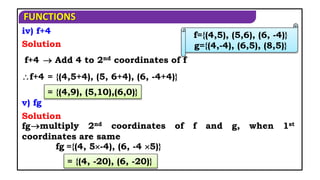
f+4
f+4
fg
fg
iv) f+4
Solution
 Add 4 to 2nd coordinates of f
= {(4,5+4), (5, 6+4), (6, -4+4)}
= {(4,9), (5,10),(6,0)}
v) fg
Solution
multiply 2nd coordinates of f and g, when 1st
coordinates are same
={(4, 5-4), (6, -4 5)}
= {(4, -20), (6, -20)}
f={(4,5), (5,6), (6, -4)}
g={(4,-4), (6,5), (8,5)}
FUNCTIONS
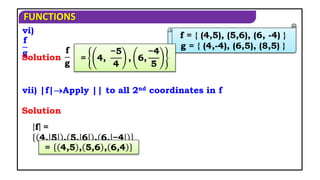
vi)
f
g
Solution
vii) |f|Apply || to all 2nd coordinates in f
Solution
f = { (4,5), (5,6), (6, -4) }
g = { (4,-4), (6,5), (8,5) }
f
g
= 4,
−5
4
, 6,
−4
5
f =
4, 5 , 5, 6 , 6, −4
= 4,5 , 5,6 , 6,4
FUNCTIONS
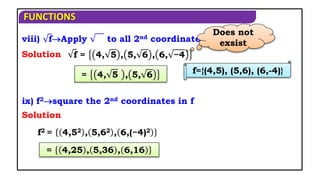
ix) f2square the 2nd coordinates in f
viii) fApply to all 2nd coordinates in f
Solution
Solution
Does not
exsist
f={(4,5), (5,6), (6,-4)}
f = 4, 5 , 5, 6 , 6, −4
= 4, 5 , 5, 6
f2 = 4,52 , 5,62 , 6,(−4)2
= 4,25 , 5,36 , 6,16
FUNCTIONS
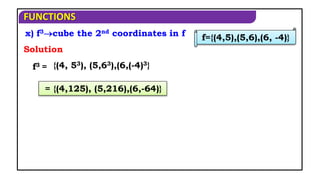
f3 =
x) f3cube the 2nd coordinates in f
Solution
{(4, 53), (5,63),(6,(-4)3}
= {(4,125), (5,216),(6,-64)}
f={(4,5),(5,6),(6, -4)}
FUNCTIONS
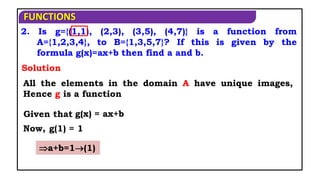
2. Is g={(1,1), (2,3), (3,5), (4,7)} is a function from
A={1,2,3,4}, to B={1,3,5,7}? If this is given by the
formula g(x)=ax+b then find a and b.
All the elements in the domain A have unique images,
Hence g is a function
Given that
Now,
Solution
g(x) = ax+b
g(1) = 1
a+b=1(1)
FUNCTIONS
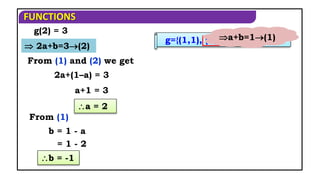
From (1) and (2) we get
2a+(1–a) = 3
From (1)
a+1 = 3
a = 2
b = 1 - a
b = -1
g(2) = 3
 2a+b=3(2)
= 1 - 2
g={(1,1), (2,3), (3,5), (4,7)}
a+b=1(1)
FUNCTIONS
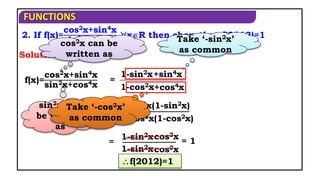
2. If f(x)=
cos2x+sin4x
sin2x+cos4x
xR then show that f(2012)=1
Solution:
=
1-sin2x+sin4x
1-cos2x+cos4x
cos2x can be
written as
sin2x can
be written
as
=
1-sin2x(1-sin2x)
1-cos2x(1-cos2x)
Take ‘-sin2x’
as common
Take ‘-cos2x’
as common
=
1-sin2xcos2x
1-sin2xcos2x
f(x)=
cos2x+sin4x
sin2x+cos4x
= 1
f(2012)=1
FUNCTIONS
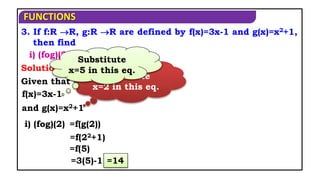
3. If f:R R, g:R R are defined by f(x)=3x-1 and g(x)=x2+1,
then find
Solution
i) (fog)(2)
Given that
f(x)=3x-1
and g(x)=x2+1
i) (fog)(2) =f(g(2))
=f(22+1)
=f(5)
=3(5)-1
Substitute
x=2 in this eq.
Substitute
x=5 in this eq.
=14
FUNCTIONS
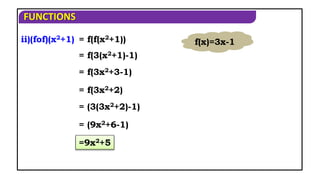
ii)(fof)(x2+1) = f(f(x2+1))
= f(3(x2+1)-1)
= f(3x2+3-1)
= f(3x2+2)
= (3(3x2+2)-1)
= (9x2+6-1)
=9x2+5
f(x)=3x-1
FUNCTIONS
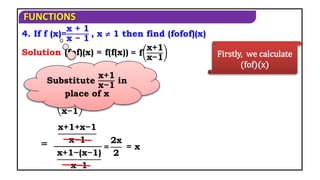
4. If f (x)=
x + 1
x − 1
, x  1 then find (fofof)(x)
Solution Firstly, we calculate
(fof)(x)
(fof)(x) = f(f(x)) = f
x+1
x−1
x+1
x−1
+1
x+1
x−1
−1
=
x+1+x−1
x−1
x+1−(x−1)
x−1
=
Substitute
x+1
x−1
in
place of x
= x
=
2x
2
FUNCTIONS
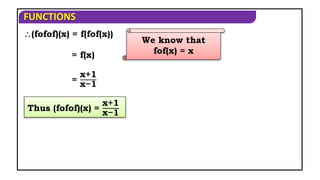
(fofof)(x) = f(fof(x))
Thus (fofof)(x) =
x+1
x−1
= f(x)
=
x+1
x−1
We know that
fof(x) = x
FUNCTIONS
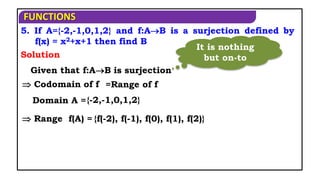
5. If A={-2,-1,0,1,2} and f:AB is a surjection defined by
f(x) = x2+x+1 then find B
Solution
Given that f:AB is surjection
 Codomain of f =Range of f
Domain A ={-2,-1,0,1,2}
 Range f(A) = {f(-2), f(-1), f(0), f(1), f(2)}
It is nothing
but on-to
FUNCTIONS
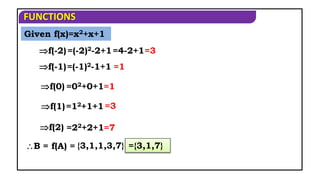
Given f(x)=x2+x+1
f(-2)=(-2)2-2+1=4-2+1=3
f(-1)=(-1)2-1+1 =1
f(0) =02+0+1=1
f(1)=12+1+1=3
f(2) =22+2+1=7
B = f(A) = {3,1,1,3,7} ={3,1,7}
FUNCTIONS
6. If A = 0,
π
6
,
π
4
,
π
3
,
π
2
and f:AB is a surjection defined by
f(x)=cosx then find B
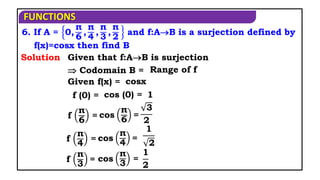
Solution Given that f:AB is surjection
 Codomain B =
Given f(x) =
f (0) =
cosx
cos (0) = 1
f
π
6
= cos
π
6
=
3
2
f
π
4
= cos
π
4
=
1
2
f
π
3
= cos
π
3
=
1
2
Range of f
FUNCTIONS
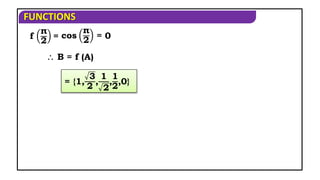
 B = f (A)
= {1,
3
2
,
1
2
,
1
2
,0}
f
π
2
= cos
π
2
= 0
FUNCTIONS
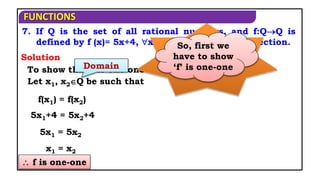
 f is one-one
7. If Q is the set of all rational numbers, and f:QQ is
defined by f (x)= 5x+4, xQ, show that f is a bijection.
Solution
To show that f is one one
When a
function is
said to be
bijection?
If it is both
one-one and
onto function
So, first we
have to show
‘f’ is one-one
Domain
Let x1, x2Q be such that
f(x1) = f(x2)
5x1+4 = 5x2+4
5x1 = 5x2
x1 = x2
FUNCTIONS
such that f(x)=y
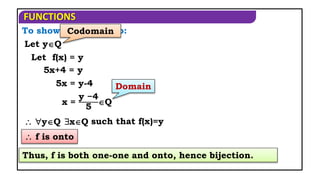
To show that f is onto:
 f is onto
Thus, f is both one-one and onto, hence bijection.
Codomain
Let yQ
Let f(x) = y
5x+4 = y
5x = y-4
x =
y −4
5
Q
 yQ xQ
Domain
FUNCTIONS
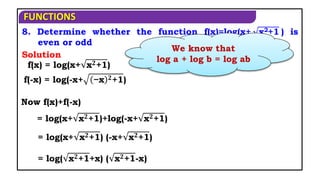
8. Determine whether the function f(x)=log(x+ x2+1 ) is
even or odd
Solution
We know that
log a + log b = log ab
f(x) = log(x+ x𝟐+1)
f(-x) = log(-x+ −x 𝟐+1)
Now f(x)+f(-x)
= log(x+ x𝟐+1) (-x+ x𝟐+1)
= log( x𝟐+1+x) ( x𝟐+1-x)
= log(x+ x𝟐+1)+log(-x+ x𝟐+1)
FUNCTIONS
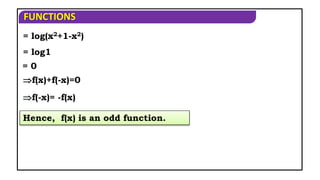
Hence, f(x) is an odd function.
= log1
f(x)+f(-x)=0
f(-x)= -f(x)
= log(x2+1-x2)
= 0
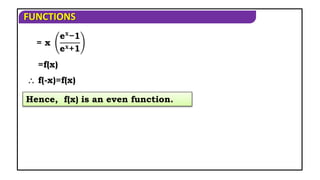
FUNCTIONS
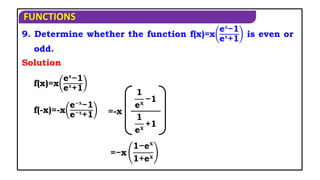
9. Determine whether the function f(x)=x
e𝐱
−1
e𝐱
+1
is even or
odd.
Solution
f(x)=x
e𝐱
−1
e𝐱
+1
f(-x)=-x
e−𝐱
−1
e−𝐱
+1
1
e𝐱
−1
1
e𝐱
+1
=-x
=−x
1−e𝐱
1+e𝐱
FUNCTIONS
Hence, f(x) is an even function.
 f(-x)=f(x)
= x
e𝐱
−1
e𝐱+1
=f(x)
FUNCTIONS
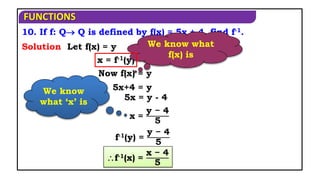
10. If f: Q Q is defined by f(x) = 5x + 4, find f-1.
Solution
We know
what ‘x’ is
Let f(x) = y
Now f(x) = y
x =
y − 4
5
x = f-1(y)
5x = y - 4
f-1(y) =
y − 4
5
f-1(x) =
x − 4
5
5x+4 = y
We know what
f(x) is
FUNCTIONS
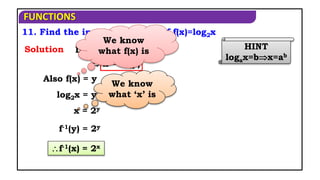
11. Find the inverse function of f(x)=log2x
HINT
logax=bx=ab
Solution Let f(x) = y
Also f(x) = y
f-1(y) = 2y
f-1(x) = 2x
 x = f-1(y)
log2x = y
x = 2y
We know
what ‘x’ is
We know
what f(x) is
FUNCTIONS
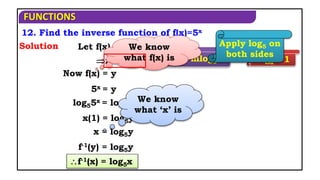
12. Find the inverse function of f(x)=5x
Solution
logbam=mlogba logaa=1
Apply log5 on
both sides
Now f(x) = y
log55x = log5y
x(1) = log5y
x = log5y
f-1(x) = log5x
Let f(x) = y
x = f-1(y)
5x = y
f-1(y) = log5y
We know
what ‘x’ is
We know
what f(x) is
FUNCTIONS
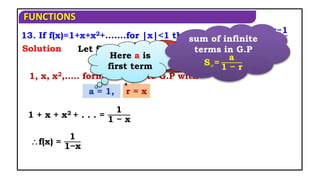
1, x, x2,….. form an infinite G.P with
13. If f(x)=1+x+x2+.......for |x|<1 then show that f-1(x)=
x−1
x
Solution
a = 1, r = x
1 + x + x2 + . . . =
1
1 − x
Let f(x) = y
x = f-1(y)
f(x) =
1
1−x
Here r is
common ratio
Here a is
first term
sum of infinite
terms in G.P
S∞=
a
1 − r
FUNCTIONS
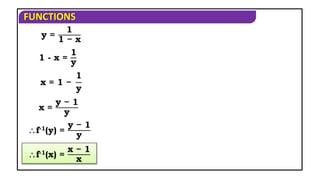
f-1(x) =
x − 1
x
f-1(y) =
y − 1
y
y =
1
1 − x
1 - x =
1
y
x = 1 −
1
y
x =
y − 1
y
FUNCTIONS
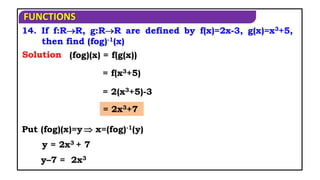
14. If f:RR, g:RR are defined by f(x)=2x-3, g(x)=x3+5,
then find (fog)-1(x)
(fog)(x) = f(g(x))
Put (fog)(x)=y
Solution
= f(x3+5)
= 2(x3+5)-3
= 2x3+7
 x=(fog)-1(y)
y = 2x3 + 7
y–7 = 2x3
FUNCTIONS
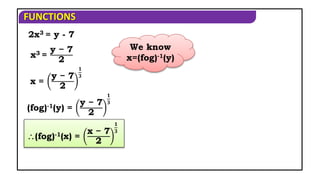
(fog)-1(y) =
y − 7
2
𝟏
𝟑
(fog)-1(x) =
x − 7
2
𝟏
𝟑
x3 =
y − 7
2
x =
y − 7
2
𝟏
𝟑
2x3 = y - 7
We know
x=(fog)-1(y)
FUNCTIONS
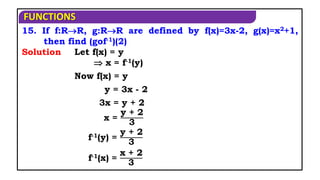
15. If f:RR, g:RR are defined by f(x)=3x-2, g(x)=x2+1,
then find (gof-1)(2)
Now f(x) = y
Solution
y = 3x - 2
3x = y + 2
x =
y + 2
3
Let f(x) = y
 x = f-1(y)
f-1(y) =
y + 2
3
f-1(x) =
x + 2
3
FUNCTIONS
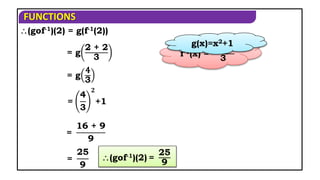
(gof-1)(2) = g(f-1(2))
= g
2 + 2
3
=
4
3
𝟐
+1
=
16 + 9
9
= g
4
3
(gof-1)(2) =
25
9
=
25
9
f-1(x) =
x + 2
3
g(x)=x2+1
FUNCTIONS
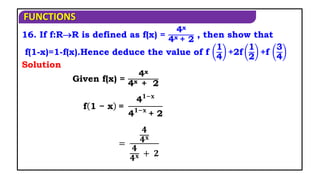
16. If f:RR is defined as f(x) =
4x
4x + 2
, then show that
f(1-x)=1-f(x).Hence deduce the value of f
1
4
+2f
1
2
+f
3
4
Given f(x) =
4x
4x + 2
Solution
f 1 − x =
4𝟏−𝐱
4𝟏−𝐱
+ 2
=
𝟒
𝟒𝐱
𝟒
𝟒𝐱 + 𝟐
FUNCTIONS
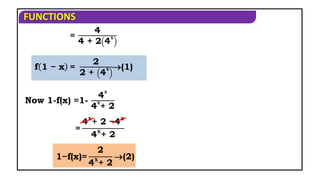
Now 1-f(x) =1-
4
𝐱
4
𝐱
+ 2
=
4
4 + 2 4
𝐱
f 1 − x =
2
2 + 4
𝐱 (1)
=
4𝐱
+ 2 −4𝐱
4𝐱
+ 2
1−f(x)=
2
4𝐱
+ 2
(2)
FUNCTIONS
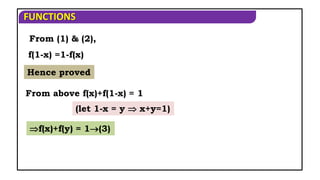
Hence proved
From (1) & (2),
f(1-x) =1-f(x)
From above f(x)+f(1-x) = 1
f(x)+f(y) = 1(3)
(let 1-x = y  x+y=1)
FUNCTIONS
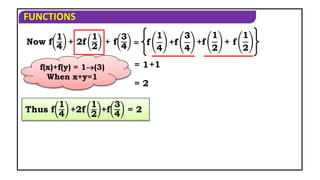
= 1
= 2
Thus f
1
4
+2f
1
2
+f
3
4
= 2
Now f
1
4
+ 2f
1
2
+ f
3
4 f
1
4
+f
3
4
+f
1
2
+ f
1
2
=
f(x)+f(y) = 1(3)
When x+y=1
+1
FUNCTIONS
(d,4)
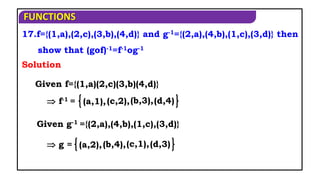
17.f={(1,a),(2,c),(3,b),(4,d)} and g-1={(2,a),(4,b),(1,c),(3,d)} then
show that (gof)-1=f-1og-1
Given f={(1,a)(2,c)(3,b)(4,d)}
Solution
(a,1),
 f-1 = (c,2),(b,3),
Given g-1 ={(2,a),(4,b),(1,c),(3,d)}
(d,3)
(a,2),
 g = (b,4),(c,1),
FUNCTIONS
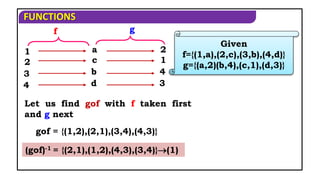
f g
Let us find gof with f taken first
and g next
gof = {(1,2),(2,1),(3,4),(4,3)}
(gof)-1 = {(2,1),(1,2),(4,3),(3,4)}(1)
Given
f={(1,a),(2,c),(3,b),(4,d)}
g={(a,2)(b,4),(c,1),(d,3)}
1 a
2 c
3 b
4 d
2
1
4
3
FUNCTIONS
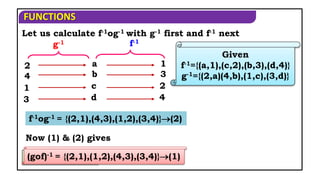
Let us calculate f-1og-1 with g-1 first and f-1 next
g-1 f-1
2 a
4 b
1 c
3 d
1
3
2
4
Given
f-1={(a,1),(c,2),(b,3),(d,4)}
g-1={(2,a)(4,b),(1,c),(3,d)}
f-1og-1 = {(2,1),(4,3),(1,2),(3,4)}(2)
Now (1) & (2) gives
(gof)-1 = f-1og-1
(gof)-1 = {(2,1),(1,2),(4,3),(3,4)}(1)
FUNCTIONS
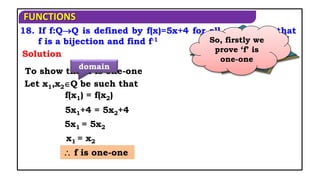
18. If f:QQ is defined by f(x)=5x+4 for all xQ, show that
f is a bijection and find f-1
Solution
When is a
function said to
be bijection?
If it is both
one-one and
on-to function
So, firstly we
prove ‘f’ is
one-one
To show that f is one-one
Let x1,x2Q be such that
domain
 f is one-one
f(x1) = f(x2)
5x1+4 = 5x2+4
5x1 = 5x2
x1 = x2
FUNCTIONS
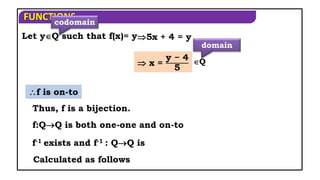
Let yQ such that f(x)= y5x + 4 = y
 x =
y − 4
5
f is on-to
Thus, f is a bijection.
f:QQ is both one-one and on-to
Calculated as follows
f-1 exists and f-1 : QQ is
Q
codomain
domain
FUNCTIONS
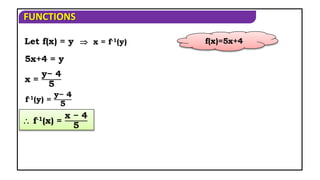
Let f(x) = y
5x+4 = y
 f-1(x) =
x − 4
5
x =
y− 4
5
f(x)=5x+4
 x = f-1(y)
f-1(y) =
y− 4
5
FUNCTIONS
(1)
If 0  x  2
If 2 < x  3
Solution
then show that f[0, 3]  [0, 3] and find fof ?
19. If f : [0, 3]  [0, 3] is defined by
1 + x, 0  x  2,
3 - x, 2 < x  3
f(x) =
1  1 + x  3
-3  - x < -2
(2)
3 - 3  3 - x < 3 - 2
0  3 - x < 1
If you add 1
If you
multiply with
‘-’
If you add ‘3’
from (1) and (2) if you
substitute any
value [0,3] in f(x)
the resultant
must lie in [0,3]
FUNCTIONS
From (1) and (2) f [0,3]  [0,3]
When 0  x  1 we have
fof(x) = f(f(x))
= f(1+x)
= 2+x [∵11+x2]
= 1+1+x
When 1<x2 we have
fof(x) = f(f(x))
= f(1+x)
= 3-(1+x)
Here
f(x)=1+x
Here
f(x)=3-x
=2-x [∵2<1+x3]
FUNCTIONS
When 2<x3 we have
fof(x)=f(f(x))
=f(3-x)
=1+3-x
=4-x [∵ 03-x<1]
fof(x)=
2+x,0x<1
2-x,1<x2
4-x,2<x3
FUNCTIONS
Thank you…

FUNCTION EX 1 PROBLEMS WITH SOLUTION UPTO JEE LEVEL

  • 1.
  • 2.
  • 3.
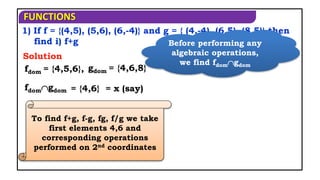
    FUNCTIONS 1) If f= {(4,5), (5,6), (6,-4)} and g = { (4,-4), (6,5), (8,5)} then find i) f+g fdom = {4,5,6}, Solution fdomgdom gdom = {4,6,8} = {4,6} = x (say) Before performing any algebraic operations, we find fdomgdom To find f+g, f-g, fg, f/g we take first elements 4,6 and corresponding operations performed on 2nd coordinates
  • 4.
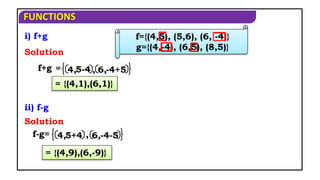
    FUNCTIONS f+g f-g= i) f+g Solution = {(4,1),(6,1)} ii)f-g Solution = {(4,9),(6,-9)} f={(4,5), (5,6), (6, -4)} g={(4,-4), (6,5), (8,5)} 4,5-4 = 6,-4+5 4,5+4 6,-4-5 , ,
  • 5.
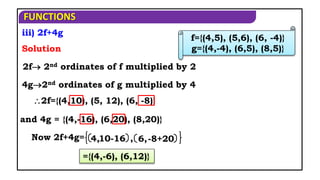
    FUNCTIONS -8+20 10-16 2f 2nd ordinatesof f multiplied by 2 4g2nd ordinates of g multiplied by 4 2f={(4,10), (5, 12), (6, -8)} iii) 2f+4g Solution and 4g = {(4,-16), (6,20), (8,20)} Now 2f+4g= f={(4,5), (5,6), (6, -4)} g={(4,-4), (6,5), (8,5)} 4, 6, , ={(4,-6), (6,12)}
  • 6.
    FUNCTIONS f+4 f+4 fg fg iv) f+4 Solution  Add4 to 2nd coordinates of f = {(4,5+4), (5, 6+4), (6, -4+4)} = {(4,9), (5,10),(6,0)} v) fg Solution multiply 2nd coordinates of f and g, when 1st coordinates are same ={(4, 5-4), (6, -4 5)} = {(4, -20), (6, -20)} f={(4,5), (5,6), (6, -4)} g={(4,-4), (6,5), (8,5)}
  • 7.
    FUNCTIONS vi) f g Solution vii) |f|Apply ||to all 2nd coordinates in f Solution f = { (4,5), (5,6), (6, -4) } g = { (4,-4), (6,5), (8,5) } f g = 4, −5 4 , 6, −4 5 f = 4, 5 , 5, 6 , 6, −4 = 4,5 , 5,6 , 6,4
  • 8.
    FUNCTIONS ix) f2square the2nd coordinates in f viii) fApply to all 2nd coordinates in f Solution Solution Does not exsist f={(4,5), (5,6), (6,-4)} f = 4, 5 , 5, 6 , 6, −4 = 4, 5 , 5, 6 f2 = 4,52 , 5,62 , 6,(−4)2 = 4,25 , 5,36 , 6,16
  • 9.
    FUNCTIONS f3 = x) f3cubethe 2nd coordinates in f Solution {(4, 53), (5,63),(6,(-4)3} = {(4,125), (5,216),(6,-64)} f={(4,5),(5,6),(6, -4)}
  • 10.
    FUNCTIONS 2. Is g={(1,1),(2,3), (3,5), (4,7)} is a function from A={1,2,3,4}, to B={1,3,5,7}? If this is given by the formula g(x)=ax+b then find a and b. All the elements in the domain A have unique images, Hence g is a function Given that Now, Solution g(x) = ax+b g(1) = 1 a+b=1(1)
  • 11.
    FUNCTIONS From (1) and(2) we get 2a+(1–a) = 3 From (1) a+1 = 3 a = 2 b = 1 - a b = -1 g(2) = 3  2a+b=3(2) = 1 - 2 g={(1,1), (2,3), (3,5), (4,7)} a+b=1(1)
  • 12.
    FUNCTIONS 2. If f(x)= cos2x+sin4x sin2x+cos4x xRthen show that f(2012)=1 Solution: = 1-sin2x+sin4x 1-cos2x+cos4x cos2x can be written as sin2x can be written as = 1-sin2x(1-sin2x) 1-cos2x(1-cos2x) Take ‘-sin2x’ as common Take ‘-cos2x’ as common = 1-sin2xcos2x 1-sin2xcos2x f(x)= cos2x+sin4x sin2x+cos4x = 1 f(2012)=1
  • 13.
    FUNCTIONS 3. If f:RR, g:R R are defined by f(x)=3x-1 and g(x)=x2+1, then find Solution i) (fog)(2) Given that f(x)=3x-1 and g(x)=x2+1 i) (fog)(2) =f(g(2)) =f(22+1) =f(5) =3(5)-1 Substitute x=2 in this eq. Substitute x=5 in this eq. =14
  • 14.
    FUNCTIONS ii)(fof)(x2+1) = f(f(x2+1)) =f(3(x2+1)-1) = f(3x2+3-1) = f(3x2+2) = (3(3x2+2)-1) = (9x2+6-1) =9x2+5 f(x)=3x-1
  • 15.
    FUNCTIONS 4. If f(x)= x + 1 x − 1 , x  1 then find (fofof)(x) Solution Firstly, we calculate (fof)(x) (fof)(x) = f(f(x)) = f x+1 x−1 x+1 x−1 +1 x+1 x−1 −1 = x+1+x−1 x−1 x+1−(x−1) x−1 = Substitute x+1 x−1 in place of x = x = 2x 2
  • 16.
    FUNCTIONS (fofof)(x) = f(fof(x)) Thus(fofof)(x) = x+1 x−1 = f(x) = x+1 x−1 We know that fof(x) = x
  • 17.
    FUNCTIONS 5. If A={-2,-1,0,1,2}and f:AB is a surjection defined by f(x) = x2+x+1 then find B Solution Given that f:AB is surjection  Codomain of f =Range of f Domain A ={-2,-1,0,1,2}  Range f(A) = {f(-2), f(-1), f(0), f(1), f(2)} It is nothing but on-to
  • 18.
    FUNCTIONS Given f(x)=x2+x+1 f(-2)=(-2)2-2+1=4-2+1=3 f(-1)=(-1)2-1+1 =1 f(0)=02+0+1=1 f(1)=12+1+1=3 f(2) =22+2+1=7 B = f(A) = {3,1,1,3,7} ={3,1,7}
  • 19.
    FUNCTIONS 6. If A= 0, π 6 , π 4 , π 3 , π 2 and f:AB is a surjection defined by f(x)=cosx then find B Solution Given that f:AB is surjection  Codomain B = Given f(x) = f (0) = cosx cos (0) = 1 f π 6 = cos π 6 = 3 2 f π 4 = cos π 4 = 1 2 f π 3 = cos π 3 = 1 2 Range of f
  • 20.
    FUNCTIONS  B =f (A) = {1, 3 2 , 1 2 , 1 2 ,0} f π 2 = cos π 2 = 0
  • 21.
    FUNCTIONS  f isone-one 7. If Q is the set of all rational numbers, and f:QQ is defined by f (x)= 5x+4, xQ, show that f is a bijection. Solution To show that f is one one When a function is said to be bijection? If it is both one-one and onto function So, first we have to show ‘f’ is one-one Domain Let x1, x2Q be such that f(x1) = f(x2) 5x1+4 = 5x2+4 5x1 = 5x2 x1 = x2
  • 22.
    FUNCTIONS such that f(x)=y Toshow that f is onto:  f is onto Thus, f is both one-one and onto, hence bijection. Codomain Let yQ Let f(x) = y 5x+4 = y 5x = y-4 x = y −4 5 Q  yQ xQ Domain
  • 23.
    FUNCTIONS 8. Determine whetherthe function f(x)=log(x+ x2+1 ) is even or odd Solution We know that log a + log b = log ab f(x) = log(x+ x𝟐+1) f(-x) = log(-x+ −x 𝟐+1) Now f(x)+f(-x) = log(x+ x𝟐+1) (-x+ x𝟐+1) = log( x𝟐+1+x) ( x𝟐+1-x) = log(x+ x𝟐+1)+log(-x+ x𝟐+1)
  • 24.
    FUNCTIONS Hence, f(x) isan odd function. = log1 f(x)+f(-x)=0 f(-x)= -f(x) = log(x2+1-x2) = 0
  • 25.
    FUNCTIONS 9. Determine whetherthe function f(x)=x e𝐱 −1 e𝐱 +1 is even or odd. Solution f(x)=x e𝐱 −1 e𝐱 +1 f(-x)=-x e−𝐱 −1 e−𝐱 +1 1 e𝐱 −1 1 e𝐱 +1 =-x =−x 1−e𝐱 1+e𝐱
  • 26.
    FUNCTIONS Hence, f(x) isan even function.  f(-x)=f(x) = x e𝐱 −1 e𝐱+1 =f(x)
  • 27.
    FUNCTIONS 10. If f:Q Q is defined by f(x) = 5x + 4, find f-1. Solution We know what ‘x’ is Let f(x) = y Now f(x) = y x = y − 4 5 x = f-1(y) 5x = y - 4 f-1(y) = y − 4 5 f-1(x) = x − 4 5 5x+4 = y We know what f(x) is
  • 28.
    FUNCTIONS 11. Find theinverse function of f(x)=log2x HINT logax=bx=ab Solution Let f(x) = y Also f(x) = y f-1(y) = 2y f-1(x) = 2x  x = f-1(y) log2x = y x = 2y We know what ‘x’ is We know what f(x) is
  • 29.
    FUNCTIONS 12. Find theinverse function of f(x)=5x Solution logbam=mlogba logaa=1 Apply log5 on both sides Now f(x) = y log55x = log5y x(1) = log5y x = log5y f-1(x) = log5x Let f(x) = y x = f-1(y) 5x = y f-1(y) = log5y We know what ‘x’ is We know what f(x) is
  • 30.
    FUNCTIONS 1, x, x2,…..form an infinite G.P with 13. If f(x)=1+x+x2+.......for |x|<1 then show that f-1(x)= x−1 x Solution a = 1, r = x 1 + x + x2 + . . . = 1 1 − x Let f(x) = y x = f-1(y) f(x) = 1 1−x Here r is common ratio Here a is first term sum of infinite terms in G.P S∞= a 1 − r
  • 31.
    FUNCTIONS f-1(x) = x −1 x f-1(y) = y − 1 y y = 1 1 − x 1 - x = 1 y x = 1 − 1 y x = y − 1 y
  • 32.
    FUNCTIONS 14. If f:RR,g:RR are defined by f(x)=2x-3, g(x)=x3+5, then find (fog)-1(x) (fog)(x) = f(g(x)) Put (fog)(x)=y Solution = f(x3+5) = 2(x3+5)-3 = 2x3+7  x=(fog)-1(y) y = 2x3 + 7 y–7 = 2x3
  • 33.
    FUNCTIONS (fog)-1(y) = y −7 2 𝟏 𝟑 (fog)-1(x) = x − 7 2 𝟏 𝟑 x3 = y − 7 2 x = y − 7 2 𝟏 𝟑 2x3 = y - 7 We know x=(fog)-1(y)
  • 34.
    FUNCTIONS 15. If f:RR,g:RR are defined by f(x)=3x-2, g(x)=x2+1, then find (gof-1)(2) Now f(x) = y Solution y = 3x - 2 3x = y + 2 x = y + 2 3 Let f(x) = y  x = f-1(y) f-1(y) = y + 2 3 f-1(x) = x + 2 3
  • 35.
    FUNCTIONS (gof-1)(2) = g(f-1(2)) =g 2 + 2 3 = 4 3 𝟐 +1 = 16 + 9 9 = g 4 3 (gof-1)(2) = 25 9 = 25 9 f-1(x) = x + 2 3 g(x)=x2+1
  • 36.
    FUNCTIONS 16. If f:RRis defined as f(x) = 4x 4x + 2 , then show that f(1-x)=1-f(x).Hence deduce the value of f 1 4 +2f 1 2 +f 3 4 Given f(x) = 4x 4x + 2 Solution f 1 − x = 4𝟏−𝐱 4𝟏−𝐱 + 2 = 𝟒 𝟒𝐱 𝟒 𝟒𝐱 + 𝟐
  • 37.
    FUNCTIONS Now 1-f(x) =1- 4 𝐱 4 𝐱 +2 = 4 4 + 2 4 𝐱 f 1 − x = 2 2 + 4 𝐱 (1) = 4𝐱 + 2 −4𝐱 4𝐱 + 2 1−f(x)= 2 4𝐱 + 2 (2)
  • 38.
    FUNCTIONS Hence proved From (1)& (2), f(1-x) =1-f(x) From above f(x)+f(1-x) = 1 f(x)+f(y) = 1(3) (let 1-x = y  x+y=1)
  • 39.
    FUNCTIONS = 1 = 2 Thusf 1 4 +2f 1 2 +f 3 4 = 2 Now f 1 4 + 2f 1 2 + f 3 4 f 1 4 +f 3 4 +f 1 2 + f 1 2 = f(x)+f(y) = 1(3) When x+y=1 +1
  • 40.
    FUNCTIONS (d,4) 17.f={(1,a),(2,c),(3,b),(4,d)} and g-1={(2,a),(4,b),(1,c),(3,d)}then show that (gof)-1=f-1og-1 Given f={(1,a)(2,c)(3,b)(4,d)} Solution (a,1),  f-1 = (c,2),(b,3), Given g-1 ={(2,a),(4,b),(1,c),(3,d)} (d,3) (a,2),  g = (b,4),(c,1),
  • 41.
    FUNCTIONS f g Let usfind gof with f taken first and g next gof = {(1,2),(2,1),(3,4),(4,3)} (gof)-1 = {(2,1),(1,2),(4,3),(3,4)}(1) Given f={(1,a),(2,c),(3,b),(4,d)} g={(a,2)(b,4),(c,1),(d,3)} 1 a 2 c 3 b 4 d 2 1 4 3
  • 42.
    FUNCTIONS Let us calculatef-1og-1 with g-1 first and f-1 next g-1 f-1 2 a 4 b 1 c 3 d 1 3 2 4 Given f-1={(a,1),(c,2),(b,3),(d,4)} g-1={(2,a)(4,b),(1,c),(3,d)} f-1og-1 = {(2,1),(4,3),(1,2),(3,4)}(2) Now (1) & (2) gives (gof)-1 = f-1og-1 (gof)-1 = {(2,1),(1,2),(4,3),(3,4)}(1)
  • 43.
    FUNCTIONS 18. If f:QQis defined by f(x)=5x+4 for all xQ, show that f is a bijection and find f-1 Solution When is a function said to be bijection? If it is both one-one and on-to function So, firstly we prove ‘f’ is one-one To show that f is one-one Let x1,x2Q be such that domain  f is one-one f(x1) = f(x2) 5x1+4 = 5x2+4 5x1 = 5x2 x1 = x2
  • 44.
    FUNCTIONS Let yQ suchthat f(x)= y5x + 4 = y  x = y − 4 5 f is on-to Thus, f is a bijection. f:QQ is both one-one and on-to Calculated as follows f-1 exists and f-1 : QQ is Q codomain domain
  • 45.
    FUNCTIONS Let f(x) =y 5x+4 = y  f-1(x) = x − 4 5 x = y− 4 5 f(x)=5x+4  x = f-1(y) f-1(y) = y− 4 5
  • 46.
    FUNCTIONS (1) If 0 x  2 If 2 < x  3 Solution then show that f[0, 3]  [0, 3] and find fof ? 19. If f : [0, 3]  [0, 3] is defined by 1 + x, 0  x  2, 3 - x, 2 < x  3 f(x) = 1  1 + x  3 -3  - x < -2 (2) 3 - 3  3 - x < 3 - 2 0  3 - x < 1 If you add 1 If you multiply with ‘-’ If you add ‘3’ from (1) and (2) if you substitute any value [0,3] in f(x) the resultant must lie in [0,3]
  • 47.
    FUNCTIONS From (1) and(2) f [0,3]  [0,3] When 0  x  1 we have fof(x) = f(f(x)) = f(1+x) = 2+x [∵11+x2] = 1+1+x When 1<x2 we have fof(x) = f(f(x)) = f(1+x) = 3-(1+x) Here f(x)=1+x Here f(x)=3-x =2-x [∵2<1+x3]
  • 48.
    FUNCTIONS When 2<x3 wehave fof(x)=f(f(x)) =f(3-x) =1+3-x =4-x [∵ 03-x<1] fof(x)= 2+x,0x<1 2-x,1<x2 4-x,2<x3
  • 49.