Types of Civil Engineering
Drawing
Ahmad Hassan 2016-Civ-321
Proposal & Perspective Drawing
• First architect collects data and requirements for
the building such as the
• Funds available,
• Plot size,
• Use of the building,
• Number of stories desired,
• North direction,
• Plot-level
• Especially in comparison with road level,
required room sizes, etc.
• Then he makes a number of proposals keeping in
mind the by-laws of the controlling authorities.
• For proposals, plans and elevation are drawn on
a very small scale like 1/8 or 1/16 while the
section is usually not needed.
• Plans and elevation, in these drawings, are made
attractive even by coloring and, if needed,
perspectives are also drawn to impress the client.
• The proposals are then discussed with the client
and changes are made according to his wishes.
• Sometimes, if the client dislikes the proposals
altogether, new proposals are to be made.
• Offering of proposals is continued till the client is
satisfied with a certain plan.
Submission Drawing
• Submission drawing is usually a legal drawing
used to approve the plan from the controlling
authority like LDA, MDA and CDA.
• Plan (Ground Floor, First Floor, and so on),
Elevation and section is drawn in this drawing are
most commonly drawn on 1/8 scale. Section here
is used to give important heights but all the details
are not required.
• That is why it is also drawn on 1/8 scale and is
taken through such a portion so that it is the
simplest sectional view.
• Submission Drawing Also Contains
• Site Plan
• Location Plan
Site Plan
• Site plan is required in the submission drawing
for plots greater in size than 10 marlas.
• Site plan shows the block of actual building or the
constructed portion as compared to the total plot
area. It is drawn on a very small; scale like 1/16
or 1/32.
• If site plan is included In the drawing, the main
plans are only drawn for the constructed portion
without showing the open spaces and the
boundary wall.
• Various services are also shown in the site
plan, for example, if sewerage line is passing,
two or three man-holes of the main line are
shown and then connection for the plot is
indicated.
• Further comments are written like -disposal to
WASA Sewerage Line" etc.
Site Plan
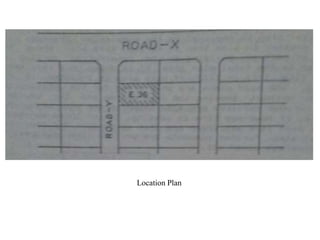
Location Plan
• Location plan is also drawn to indicate the
location of the plot, on a scale like 1/64.
• It is a part-plan of the total scheme; one or two
main roads with their names and neighboring
plots are shown.
• Doors, windows and ventilators are Marked by
D1, D2, , W1, W2, and V1, V2, in the plans.
• The sizes of these components and other related
details are given in the form of a table called
Schedule of Openings.
Location Plan
Working Drawing
• Working drawing are those which are used to
carry out construction on site according to
design
• Example of the working drawing is
• Architectural working Drawing
• Structural Working Drawing
It Includes
• Foundation Plan
• Plumbing Details
• Detail of Door and Windows
• Electric Fitting Plan
• After approval of the plan, through the
submission drawing, architectural working
drawings are made in which all the details are
given which are necessary for construction.
• The sections are drawn on enlarged scale and as
many number of sections are used as needed to
clearly ,plain the Structure.
• On blown-up scales, stair details and details of
kitchen and bathrooms etc. are also shown.
• Further, position of various types of furniture's
Indicated in the plans.
• More than one elevations are drawn to represent
the shape from different directions.
• In working drawings, we can make small changes
from the approved plans like alteration in the
position of door. and windows and small
adjustments in the internal sizes of the rooms
• After structural and plumbing design of the
building, working drawings are made to show the
results of these designs.
Completion Drawing
• After construction of the building, drawings
are made according to the actually constructed
features called completion or as-built
drawings.
• These drawings are then submitted to the
authorities to get the completion certificate and
only after their approval the owner can legally
occupy the building.

Types of civil engineering drawing

  • 1.
    Types of CivilEngineering Drawing Ahmad Hassan 2016-Civ-321
  • 2.
    Proposal & PerspectiveDrawing • First architect collects data and requirements for the building such as the • Funds available, • Plot size, • Use of the building, • Number of stories desired, • North direction, • Plot-level • Especially in comparison with road level, required room sizes, etc.
  • 3.
    • Then hemakes a number of proposals keeping in mind the by-laws of the controlling authorities. • For proposals, plans and elevation are drawn on a very small scale like 1/8 or 1/16 while the section is usually not needed.
  • 4.
    • Plans andelevation, in these drawings, are made attractive even by coloring and, if needed, perspectives are also drawn to impress the client. • The proposals are then discussed with the client and changes are made according to his wishes. • Sometimes, if the client dislikes the proposals altogether, new proposals are to be made. • Offering of proposals is continued till the client is satisfied with a certain plan.
  • 5.
    Submission Drawing • Submissiondrawing is usually a legal drawing used to approve the plan from the controlling authority like LDA, MDA and CDA. • Plan (Ground Floor, First Floor, and so on), Elevation and section is drawn in this drawing are most commonly drawn on 1/8 scale. Section here is used to give important heights but all the details are not required. • That is why it is also drawn on 1/8 scale and is taken through such a portion so that it is the simplest sectional view.
  • 6.
    • Submission DrawingAlso Contains • Site Plan • Location Plan
  • 7.
    Site Plan • Siteplan is required in the submission drawing for plots greater in size than 10 marlas. • Site plan shows the block of actual building or the constructed portion as compared to the total plot area. It is drawn on a very small; scale like 1/16 or 1/32. • If site plan is included In the drawing, the main plans are only drawn for the constructed portion without showing the open spaces and the boundary wall.
  • 8.
    • Various servicesare also shown in the site plan, for example, if sewerage line is passing, two or three man-holes of the main line are shown and then connection for the plot is indicated. • Further comments are written like -disposal to WASA Sewerage Line" etc.
  • 9.
  • 10.
    Location Plan • Locationplan is also drawn to indicate the location of the plot, on a scale like 1/64. • It is a part-plan of the total scheme; one or two main roads with their names and neighboring plots are shown. • Doors, windows and ventilators are Marked by D1, D2, , W1, W2, and V1, V2, in the plans. • The sizes of these components and other related details are given in the form of a table called Schedule of Openings.
  • 11.
  • 12.
    Working Drawing • Workingdrawing are those which are used to carry out construction on site according to design • Example of the working drawing is • Architectural working Drawing • Structural Working Drawing
  • 13.
    It Includes • FoundationPlan • Plumbing Details • Detail of Door and Windows • Electric Fitting Plan
  • 14.
    • After approvalof the plan, through the submission drawing, architectural working drawings are made in which all the details are given which are necessary for construction. • The sections are drawn on enlarged scale and as many number of sections are used as needed to clearly ,plain the Structure. • On blown-up scales, stair details and details of kitchen and bathrooms etc. are also shown. • Further, position of various types of furniture's Indicated in the plans.
  • 15.
    • More thanone elevations are drawn to represent the shape from different directions. • In working drawings, we can make small changes from the approved plans like alteration in the position of door. and windows and small adjustments in the internal sizes of the rooms • After structural and plumbing design of the building, working drawings are made to show the results of these designs.
  • 16.
    Completion Drawing • Afterconstruction of the building, drawings are made according to the actually constructed features called completion or as-built drawings. • These drawings are then submitted to the authorities to get the completion certificate and only after their approval the owner can legally occupy the building.