ļ‚–
ANALYSIS OF RATES
Prepared by:
Simarpreet Singh
A.P, Civil Engg.
ACET, Amritsar
simarpreet_batra@yahoo.com
ļ‚” Definition
ļ‚” Factors
ļ‚” Importance
ļ‚” Terminology
ļ‚” Examples
ļ‚” The process of determining rate of any work in
Civil Engineering project like earthwork,
concrete work, brickwork, plastering, painting
etc. is known as Analysis of Rates or simply Rate
Analysis.
ļ‚” The rates of these works further help in
determining cost of particular work and in turn
cost of the project.
ļ‚” The rate of any process or work depends on
various factors.
The various factors that are involved in determining
rate of any process or work are mentioned below :
ļ‚” Specifications of works and material about their
quality, proportion and constructional operation
method.
ļ‚” Quantity of materials and their costs.
ļ‚” Cost of labour and their wages.
ļ‚” Location of site of work and the distances from
source and conveyance charges.
ļ‚” Overhead and establishment charges
ļ‚” Profit
ļ‚” To determine the actual cost per unit of the
items.
ļ‚” To work out the economical use of materials and
processes in completing the particulars item.
ļ‚” To calculate the cost of extra items which are
not provided in the contract bond, but are to be
executed as per the directions of the
department.
ļ‚” To revise the schedule of rates due to increase in
the cost of material and labour or due to change
in technique.
ļ‚” Labour : May be classified into three types.
ļ‚§ Skilled Ist class
ļ‚§ Skilled IInd class
ļ‚§ Unskilled
Labour charges can be obtained from Schedule of Rates. 30% of
the skilled labour in data should be taken as Ist class and
remaining 70% as IInd class.
ļ‚” Lead Statement :The distance between the source of
availability of material and construction site is known as
Lead and is calculated in km.The conveyance cost of
material depends on lead
ļ‚§ The lead statement will give the total cost of materials per unit
item including first cost, conveyance loading-unloading,
stacking charges etc.
S.No. Materials Cost at
Source
Per Lead in Km Conveyance
charges per
Km
1 Rough Stone 260.00 cum 18 5.00/cum
2 Sand 12.00 cum 25 4.00/cum
3 Cement 2100.00 tonn Local -
S.No. Mtls. Cost at
Source
Per Lead
in
Km
Conveyance
charges Rs.
Total
Conveyance
charges Rs.
Total Cost
Rs.
1 Rough
Stone
260.00 cum 18 5.00/cum 5Ɨ18= 90.00 260+90=
350.00
2 Sand 12.00 cum 25 4.00/cum 4Ɨ25= 100.00 100+12=
112.00
3 Cement 2100.00 tonn Local - - 2100/
tonn
Analysis of Rates from Lead Statement
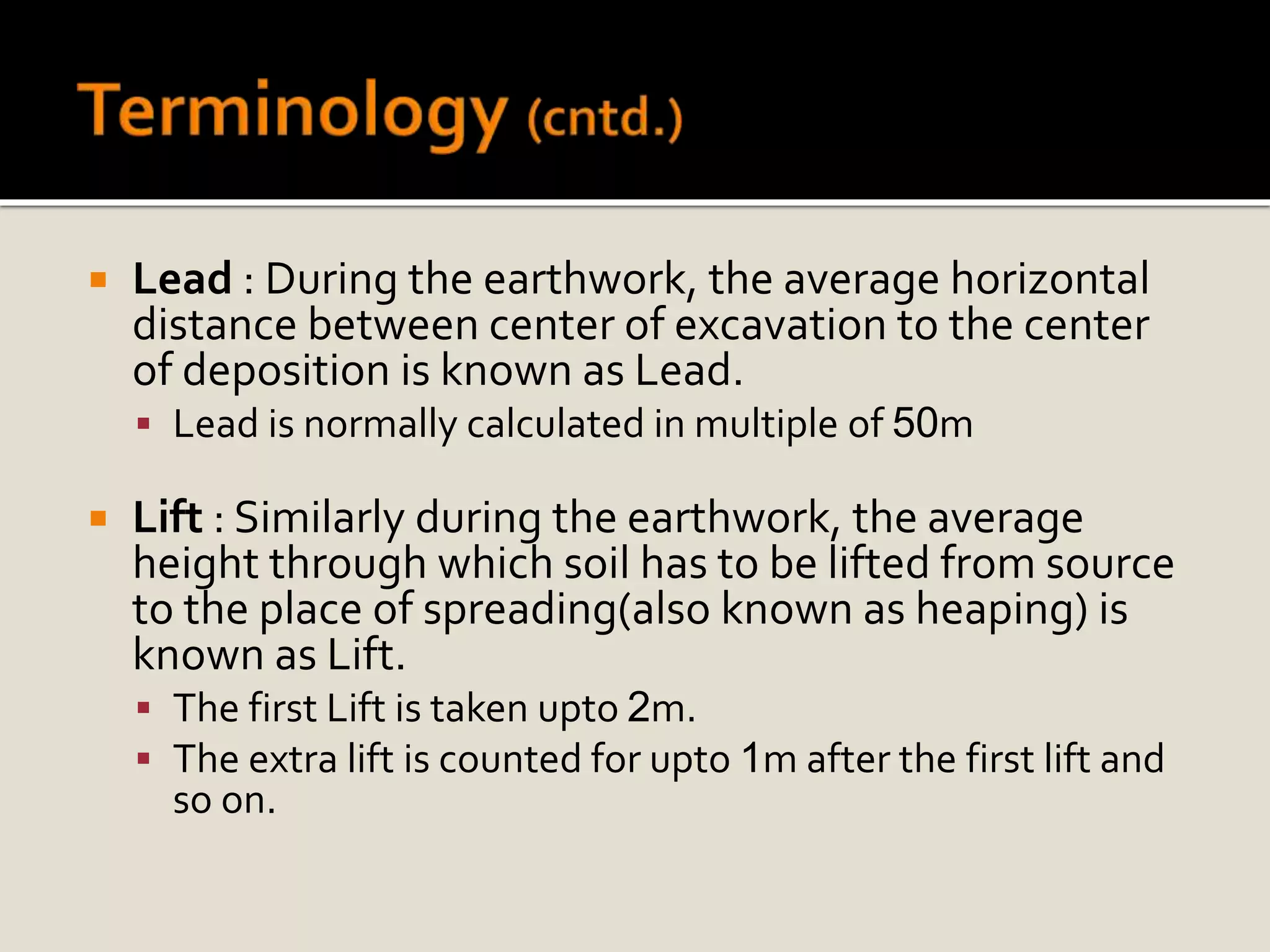
ļ‚” Lead : During the earthwork, the average horizontal
distance between center of excavation to the center
of deposition is known as Lead.
ļ‚§ Lead is normally calculated in multiple of 50m
ļ‚” Lift : Similarly during the earthwork, the average
height through which soil has to be lifted from source
to the place of spreading(also known as heaping) is
known as Lift.
ļ‚§ The first Lift is taken upto 2m.
ļ‚§ The extra lift is counted for upto 1m after the first lift and
so on.
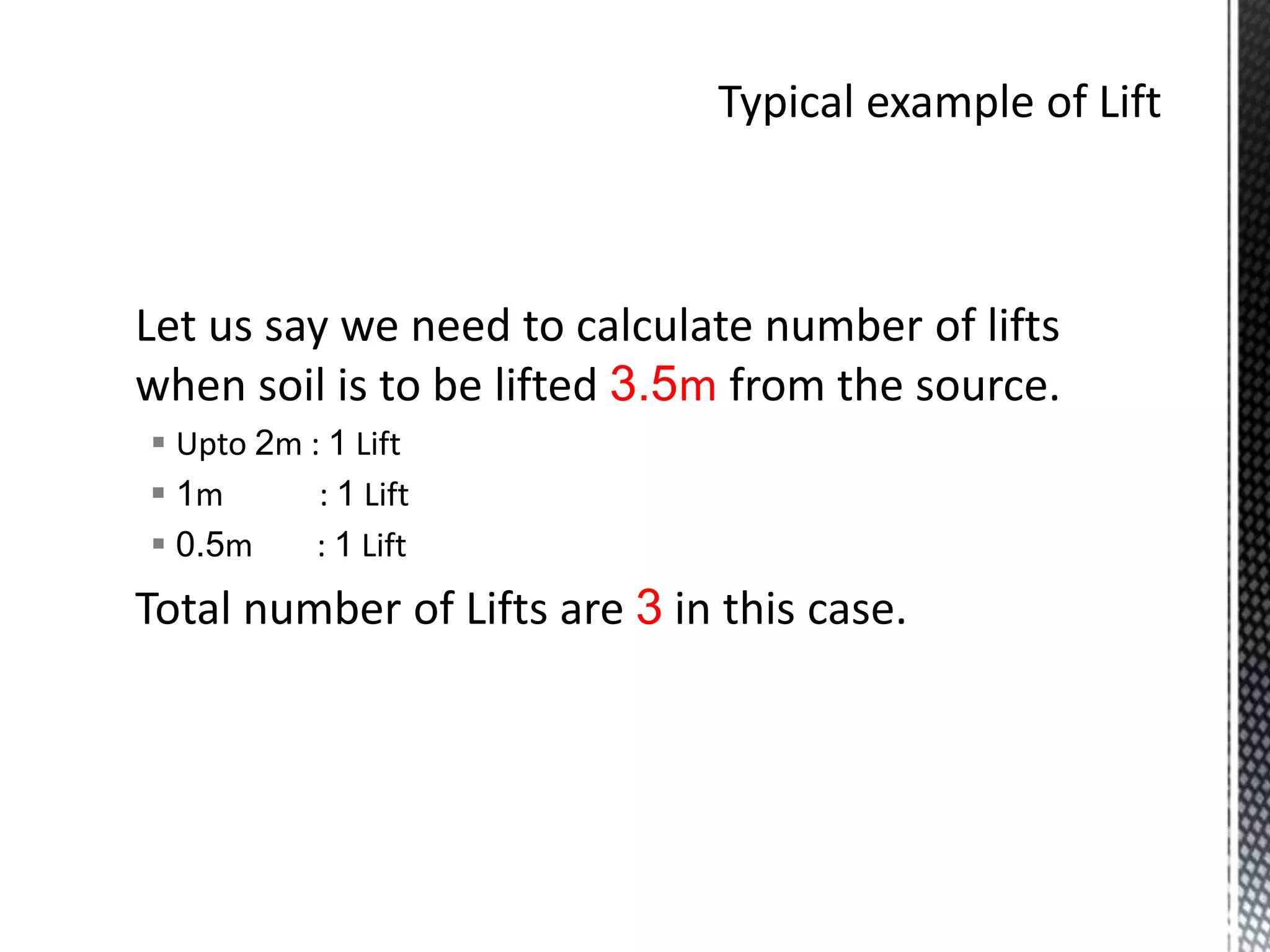
Let us say we need to calculate number of lifts
when soil is to be lifted 3.5m from the source.
ļ‚§ Upto 2m : 1 Lift
ļ‚§ 1m : 1 Lift
ļ‚§ 0.5m : 1 Lift
Total number of Lifts are 3 in this case.
For practicing how to carry out Rate Analysis ,
please refer the following books :
ļ‚§ Estimating and Costing by B.N. Datta, UBSPD,
New Delhi
ļ‚§ Estimating and Costing by G.S. Birdie, Dhanpat
Rai Publication New Delhi
ļ‚§ Estimating and Costing byV.N. Chakravorty,
Calcutta
ļ‚§ Civil Engg. Contracts & Estimates by B.S. Patil,
Orient-Longman Ltd., New Delhi
THANK YOU
Any Questions
?

Analysis of rates

  • 1.
    ļ‚– ANALYSIS OF RATES Preparedby: Simarpreet Singh A.P, Civil Engg. ACET, Amritsar simarpreet_batra@yahoo.com
  • 2.
    ļ‚” Definition ļ‚” Factors ļ‚”Importance ļ‚” Terminology ļ‚” Examples
  • 3.
    ļ‚” The processof determining rate of any work in Civil Engineering project like earthwork, concrete work, brickwork, plastering, painting etc. is known as Analysis of Rates or simply Rate Analysis. ļ‚” The rates of these works further help in determining cost of particular work and in turn cost of the project. ļ‚” The rate of any process or work depends on various factors.
  • 4.
    The various factorsthat are involved in determining rate of any process or work are mentioned below : ļ‚” Specifications of works and material about their quality, proportion and constructional operation method. ļ‚” Quantity of materials and their costs. ļ‚” Cost of labour and their wages. ļ‚” Location of site of work and the distances from source and conveyance charges. ļ‚” Overhead and establishment charges ļ‚” Profit
  • 5.
    ļ‚” To determinethe actual cost per unit of the items. ļ‚” To work out the economical use of materials and processes in completing the particulars item. ļ‚” To calculate the cost of extra items which are not provided in the contract bond, but are to be executed as per the directions of the department. ļ‚” To revise the schedule of rates due to increase in the cost of material and labour or due to change in technique.
  • 6.
    ļ‚” Labour :May be classified into three types. ļ‚§ Skilled Ist class ļ‚§ Skilled IInd class ļ‚§ Unskilled Labour charges can be obtained from Schedule of Rates. 30% of the skilled labour in data should be taken as Ist class and remaining 70% as IInd class. ļ‚” Lead Statement :The distance between the source of availability of material and construction site is known as Lead and is calculated in km.The conveyance cost of material depends on lead ļ‚§ The lead statement will give the total cost of materials per unit item including first cost, conveyance loading-unloading, stacking charges etc.
  • 7.
    S.No. Materials Costat Source Per Lead in Km Conveyance charges per Km 1 Rough Stone 260.00 cum 18 5.00/cum 2 Sand 12.00 cum 25 4.00/cum 3 Cement 2100.00 tonn Local - S.No. Mtls. Cost at Source Per Lead in Km Conveyance charges Rs. Total Conveyance charges Rs. Total Cost Rs. 1 Rough Stone 260.00 cum 18 5.00/cum 5Ɨ18= 90.00 260+90= 350.00 2 Sand 12.00 cum 25 4.00/cum 4Ɨ25= 100.00 100+12= 112.00 3 Cement 2100.00 tonn Local - - 2100/ tonn Analysis of Rates from Lead Statement
  • 8.
    ļ‚” Lead :During the earthwork, the average horizontal distance between center of excavation to the center of deposition is known as Lead. ļ‚§ Lead is normally calculated in multiple of 50m ļ‚” Lift : Similarly during the earthwork, the average height through which soil has to be lifted from source to the place of spreading(also known as heaping) is known as Lift. ļ‚§ The first Lift is taken upto 2m. ļ‚§ The extra lift is counted for upto 1m after the first lift and so on.
  • 9.
    Let us saywe need to calculate number of lifts when soil is to be lifted 3.5m from the source. ļ‚§ Upto 2m : 1 Lift ļ‚§ 1m : 1 Lift ļ‚§ 0.5m : 1 Lift Total number of Lifts are 3 in this case.
  • 10.
    For practicing howto carry out Rate Analysis , please refer the following books : ļ‚§ Estimating and Costing by B.N. Datta, UBSPD, New Delhi ļ‚§ Estimating and Costing by G.S. Birdie, Dhanpat Rai Publication New Delhi ļ‚§ Estimating and Costing byV.N. Chakravorty, Calcutta ļ‚§ Civil Engg. Contracts & Estimates by B.S. Patil, Orient-Longman Ltd., New Delhi
  • 11.