


- Chandan Mitra
- MBA – 2nd semester
- Adamas University
Research Methodology and Areas of Research in
Management
Research Methodology
Content List:
Definition of Research
Purpose of Research and the objectives of Research
Why do we Research
What is Research Methodology and its importance
Types of Research
Research in Management
Application of Research in broad areas of Management
Bibliography
Page no. 1
Page no. 2
Page no. 3
Page no. 4
Page no. 5-7
Page no. 8-10
Page no. 11-16
Page no. 17
Research is a careful and detailed study into a specific problem, concern, by using
the scientific method. It's the adult form of the science fair projects back in elementary
school, where we try and learn something by performing an experiment. This is the
best way by turning the issue into a question, with the intent of the research to answer
the question.
What is Research??
Definitions of Research
“The main goal of research is the gathering and interpreting information to answer
the questions” - Hyllegard, Mood and Morrow, 1996
“Research is a systematic way of asking questions or systematic method of inquiry” –
Drew, Hardman and Hart, 1996
Page: 1
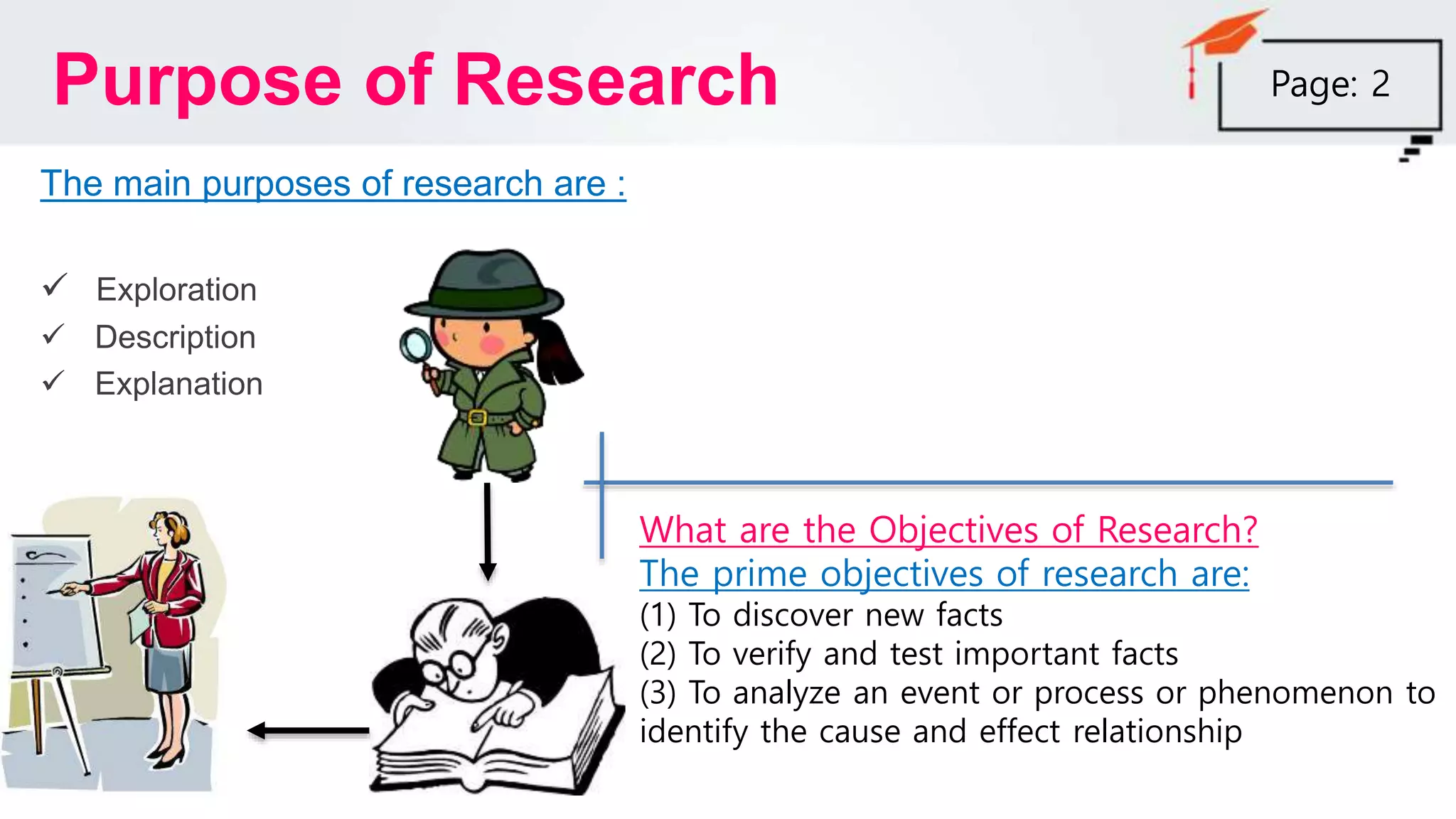
Purpose of Research
The main purposes of research are :
 Exploration
 Description
 Explanation
Page: 2
What are the Objectives of Research?
The prime objectives of research are:
(1) To discover new facts
(2) To verify and test important facts
(3) To analyze an event or process or phenomenon to
identify the cause and effect relationship
Why do we research?
A lot of what we do in our daily lives is based on common sense, what we ha
ve learnt from others or what we have learnt through personal experience or
observation. But sometimes common sense is not the best approach and so
metimes there are conflicting theories about what is best or what works in a
particular situation. Moreover, what works in one situation or for one conditio
n might be ineffective or even dangerous in another, or when combined with
other measures. Common sense approaches may overlook the impact of ext
ernal factors which may contribute to what is observed. Even in the domain
of healthcare, there are gaps in knowledge, theories about how something m
ight work better and ideas for improvement.
Page: 3
What is Research Methodology
Research methodology is a systematic way to solve a problem. It is a science of studying how research is to
be carried out. Essentially, the procedures by which researchers go about their work of describing, explaining
and predicting phenomena are called research methodology. It is also defined as the study of methods by
which knowledge is gained. Its aim is to give the work plan of research.
Page: 4
Importance of Research Methodology in Research:
(i) which is a suitable method for the chosen problem?
(ii) what is the order of accuracy of the result of a method?
(iii) what is the efficiency of the method?
Types of Research
There are several types of research, those are:
 Pure / Basic research
i. Also called as the fundamental or the theoretical research.
ii. Is basic and original.
iii. Can lead to the discovery of a new theory.
iv. Can result in the development or refinement of a theory that already exists.
 Applied research
i. Based on the concept of the pure research.
ii. Is problem oriented.
iii. Helps in finding results or solutions for real life problems.
iv. Provides evidence of usefulness to society.
v. Provides data that can lead to the acceleration of the process of generalization.
Page: 5
…continue
 Exploratory / Problem Oriented Research
i. Involves exploring a general aspect.
ii. Includes studying of a problem, about which nothing or a very little is known.
iii. Follows a very formal approach of research.
iv. Helps in knowing the feasibility in attempting a study.
 Descriptive / Problem Solving Research
i. More specific in nature and working than exploratory research.
ii. Existing theories can be easily put under test by empirical observations.
iii. It consumes a lot of time.
iv. Descriptive part of the findings.
Page: 6
…continue
 Quantitative Research
 Qualitative Research
i. Quantitative research is based on the measurement of quantity o
r amount.
ii. It is applicable to phenomena that can be expressed in terms of
quantity.
iii. to apply quantative research in practice is relatively a difficult job
and therefore, while doing such research, one should seek guida
nce from experimental psychologists.
i. Qualitative research, on the other hand, is concerned with qualitative p
henomenon, i.e., phenomena relating to or involving quality or kind.
ii. ‘Motivation Research’, is an important type of qualitative research.
iii. Qualitative research is specially important in the behavioral sciences w
here the aim is to discover the underlying motives of human behavior.
Page: 7
Researches in Management
With regard to the primary focus or objective of the research, we can categorize
three different types of Research in Management:
Theory building research:
This kind of research is primarily aimed at developing management
theories, and by so doing, improving our understanding and knowledge of the management process.
It seeks to develop theories based on, observations, experience, intuition and so on. Much academic
research in management is of this nature.
Theory testing research:
This kind of research is primarily aimed at testing out theories
of management. This testing involves the process of observations and measurements so as to
be able to arrive at the decision as to whether or not, or what parts of a theory
can be rejected and which, therefore, can remain final theories or hypotheses. Again, much academic
research in management falls into this category.
Page: 8
…continue
Problem centred/practical research
This type of research is primarily aimed at investigating a practical problem,
question or issue in a specific organization or management context with a
view to resolving the problem and subsequently making recommendations
for courses of action. The primary focus of such research, then, is not academic
or knowledge building for its own sake, but rather is aimed at investigating and
proposing solutions to real-life management problems. This is not to say that
this type of research does not potentially add to the body of theory and knowledge
about management and indeed some of the most significant contributions to our
knowledge and understanding in this area have stemmed from what was essentially
problem-centered consultancy type research. The main focus remains in giving a proper
And practical solution of the discussed problem.
Page: 9
…continue
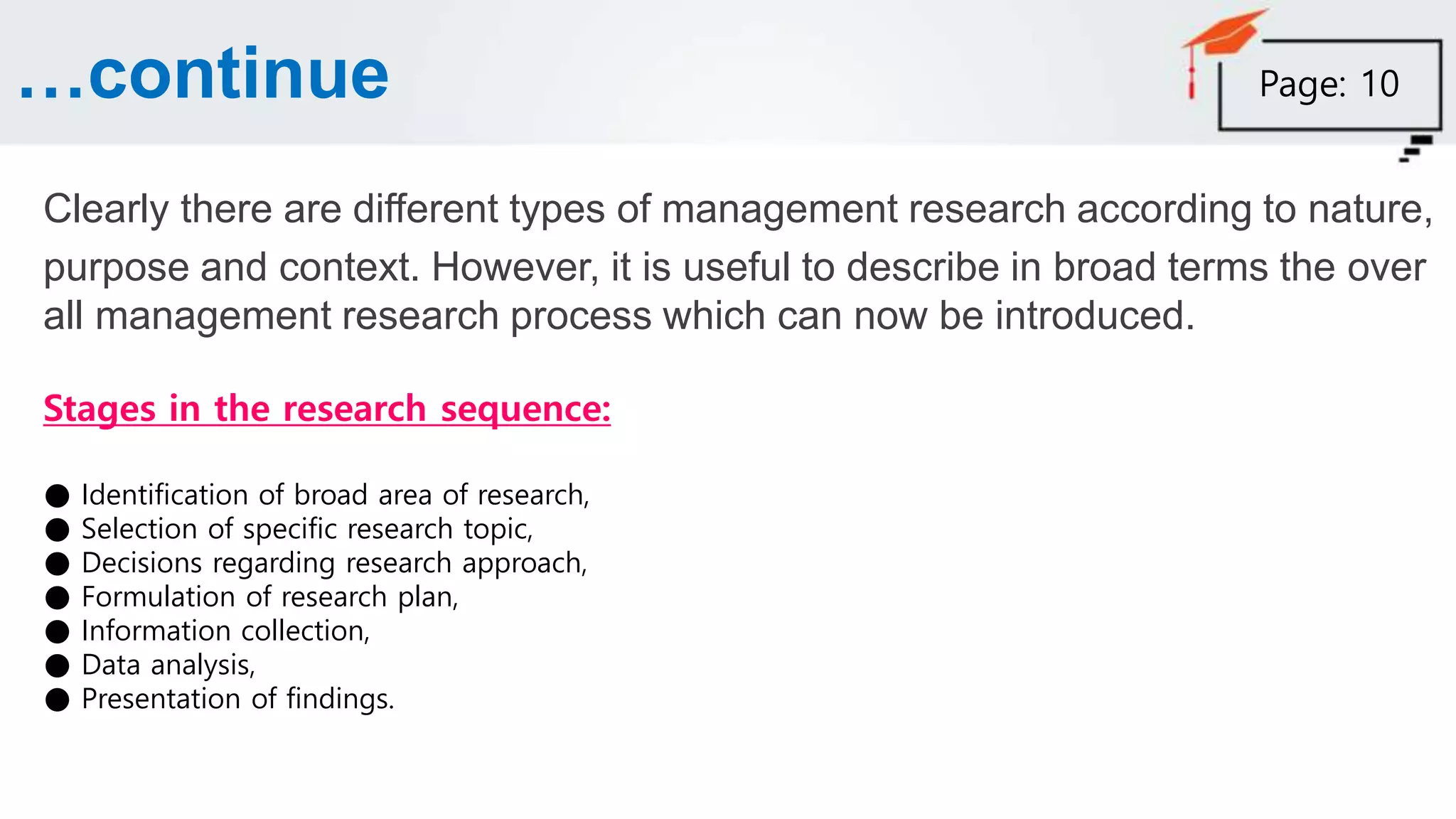
Clearly there are different types of management research according to nature,
purpose and context. However, it is useful to describe in broad terms the over
all management research process which can now be introduced.
Stages in the research sequence:
● Identification of broad area of research,
● Selection of specific research topic,
● Decisions regarding research approach,
● Formulation of research plan,
● Information collection,
● Data analysis,
● Presentation of findings.
Page: 10
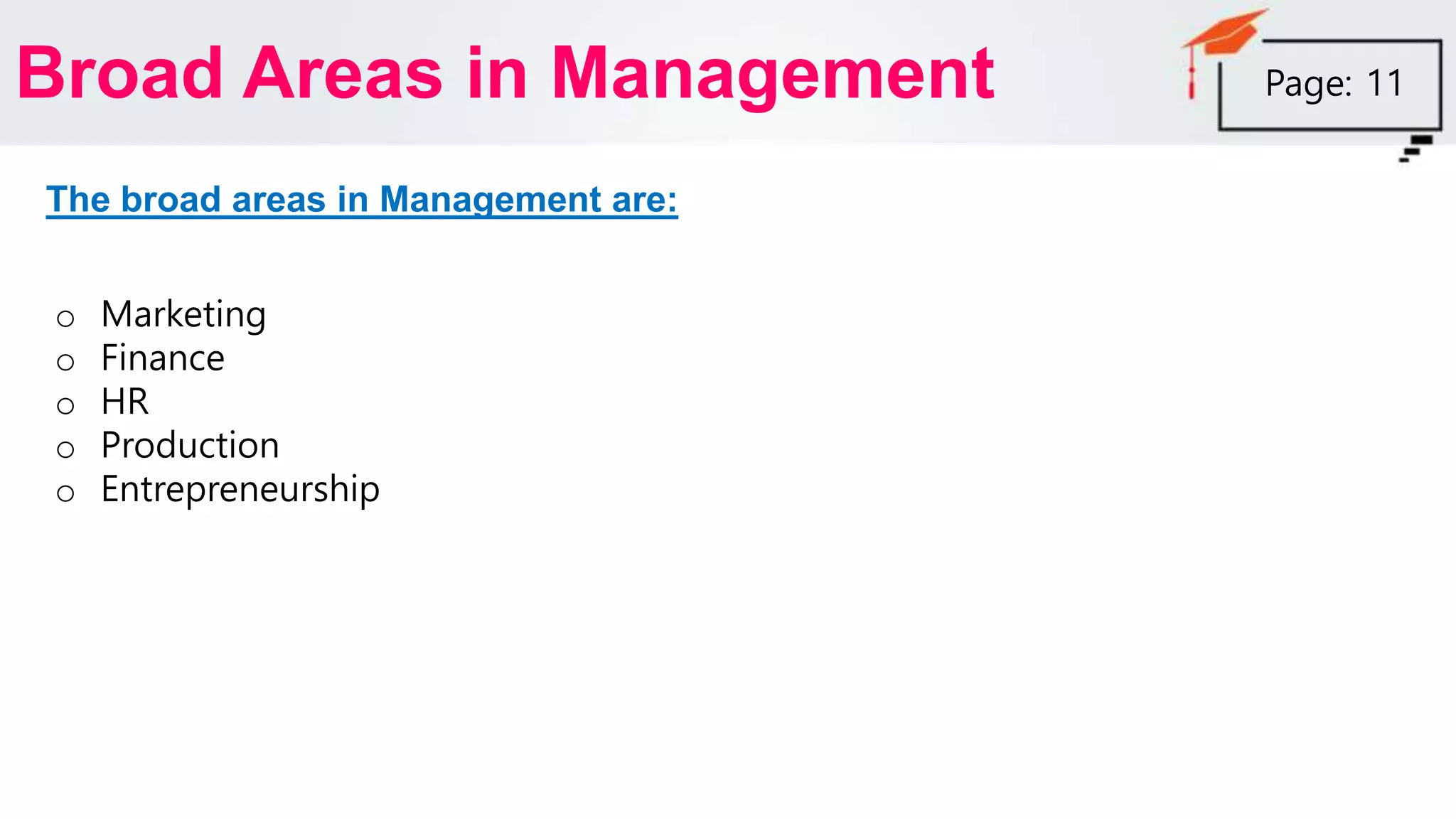
Broad Areas in Management
The broad areas in Management are:
o Marketing
o Finance
o HR
o Production
o Entrepreneurship
Page: 11
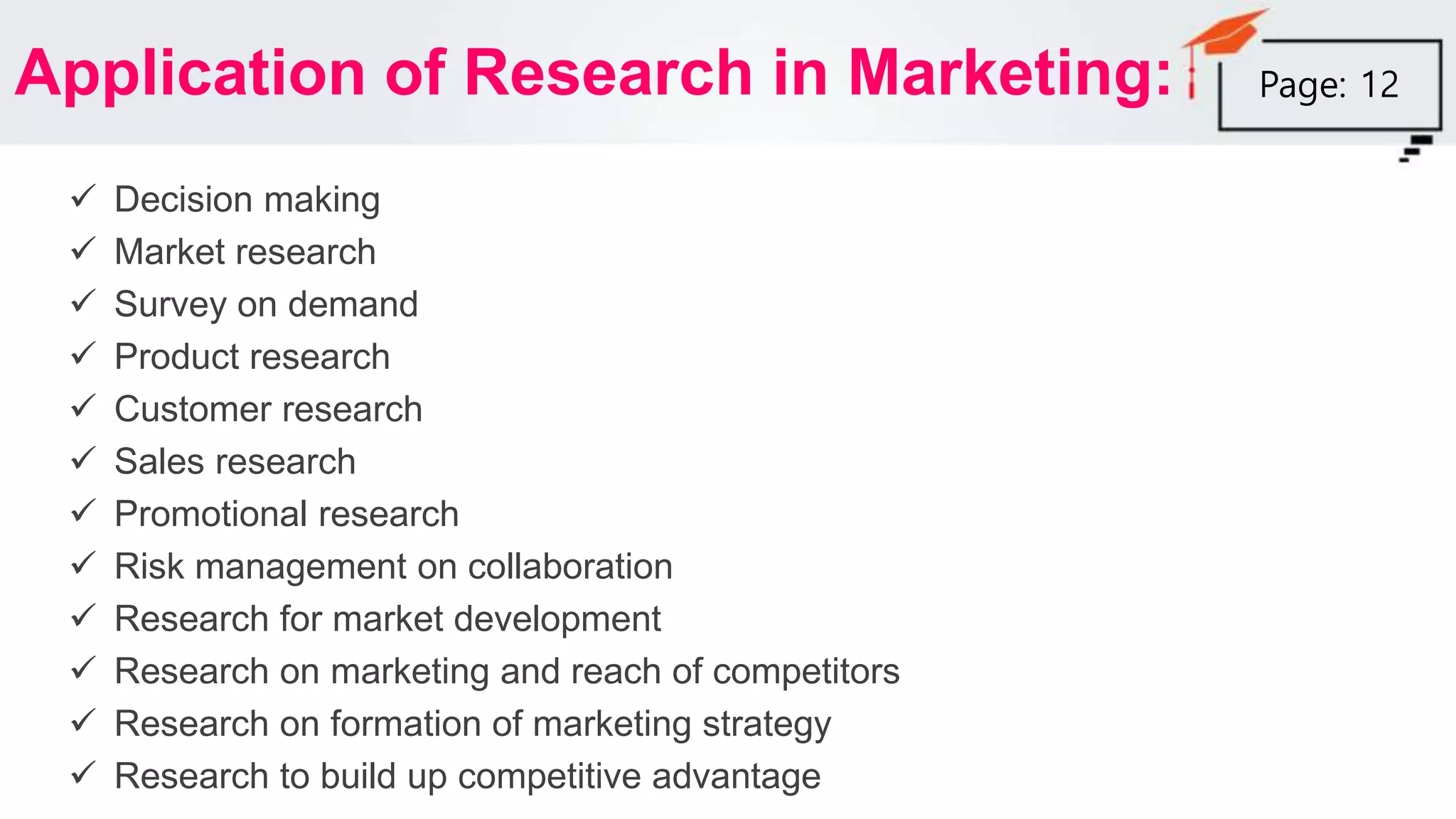
Application of Research in Marketing:
 Decision making
 Market research
 Survey on demand
 Product research
 Customer research
 Sales research
 Promotional research
 Risk management on collaboration
 Research for market development
 Research on marketing and reach of competitors
 Research on formation of marketing strategy
 Research to build up competitive advantage
Page: 12
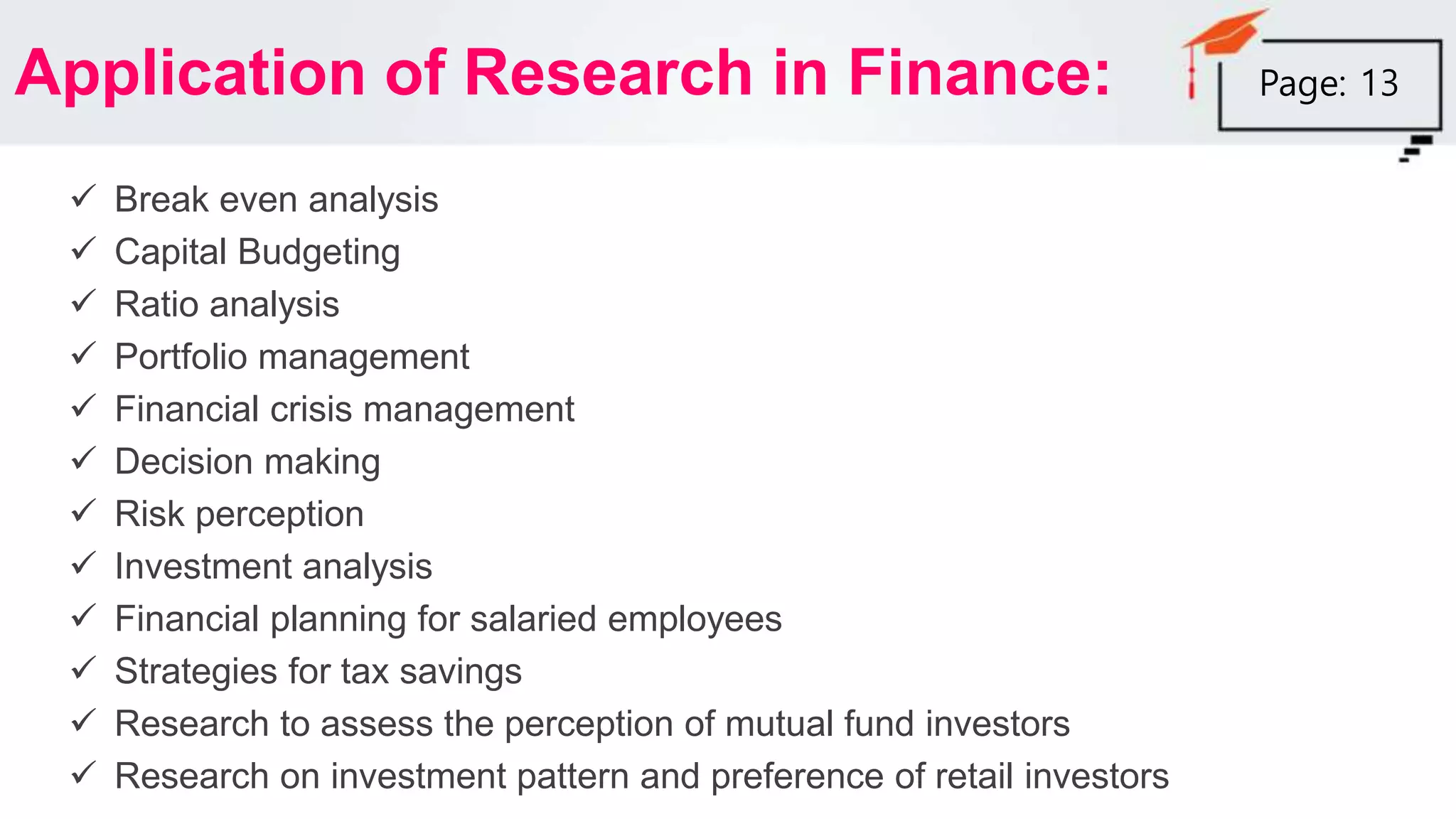
Application of Research in Finance:
 Break even analysis
 Capital Budgeting
 Ratio analysis
 Portfolio management
 Financial crisis management
 Decision making
 Risk perception
 Investment analysis
 Financial planning for salaried employees
 Strategies for tax savings
 Research to assess the perception of mutual fund investors
 Research on investment pattern and preference of retail investors
Page: 13
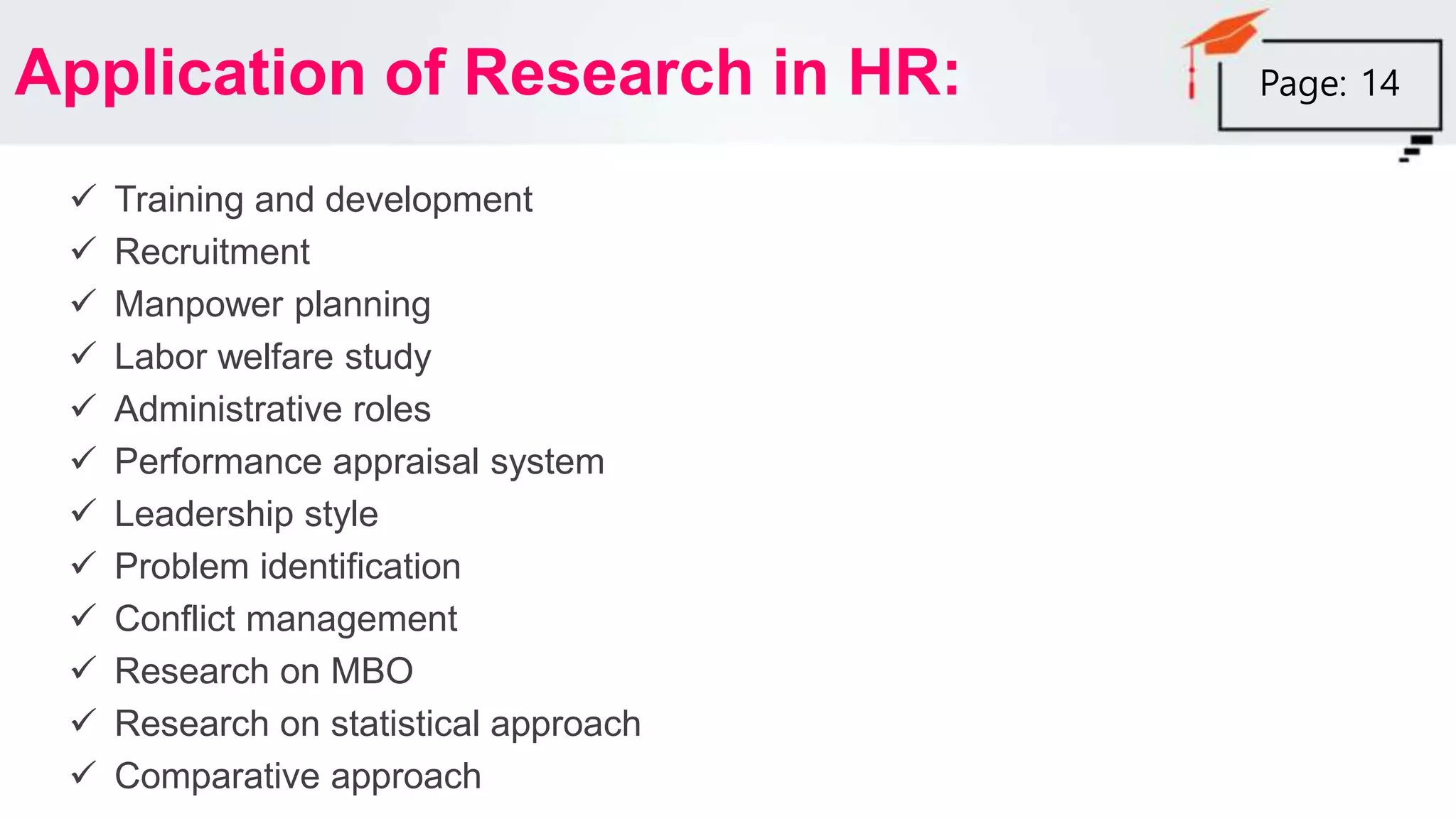
Application of Research in HR:
 Training and development
 Recruitment
 Manpower planning
 Labor welfare study
 Administrative roles
 Performance appraisal system
 Leadership style
 Problem identification
 Conflict management
 Research on MBO
 Research on statistical approach
 Comparative approach
Page: 14
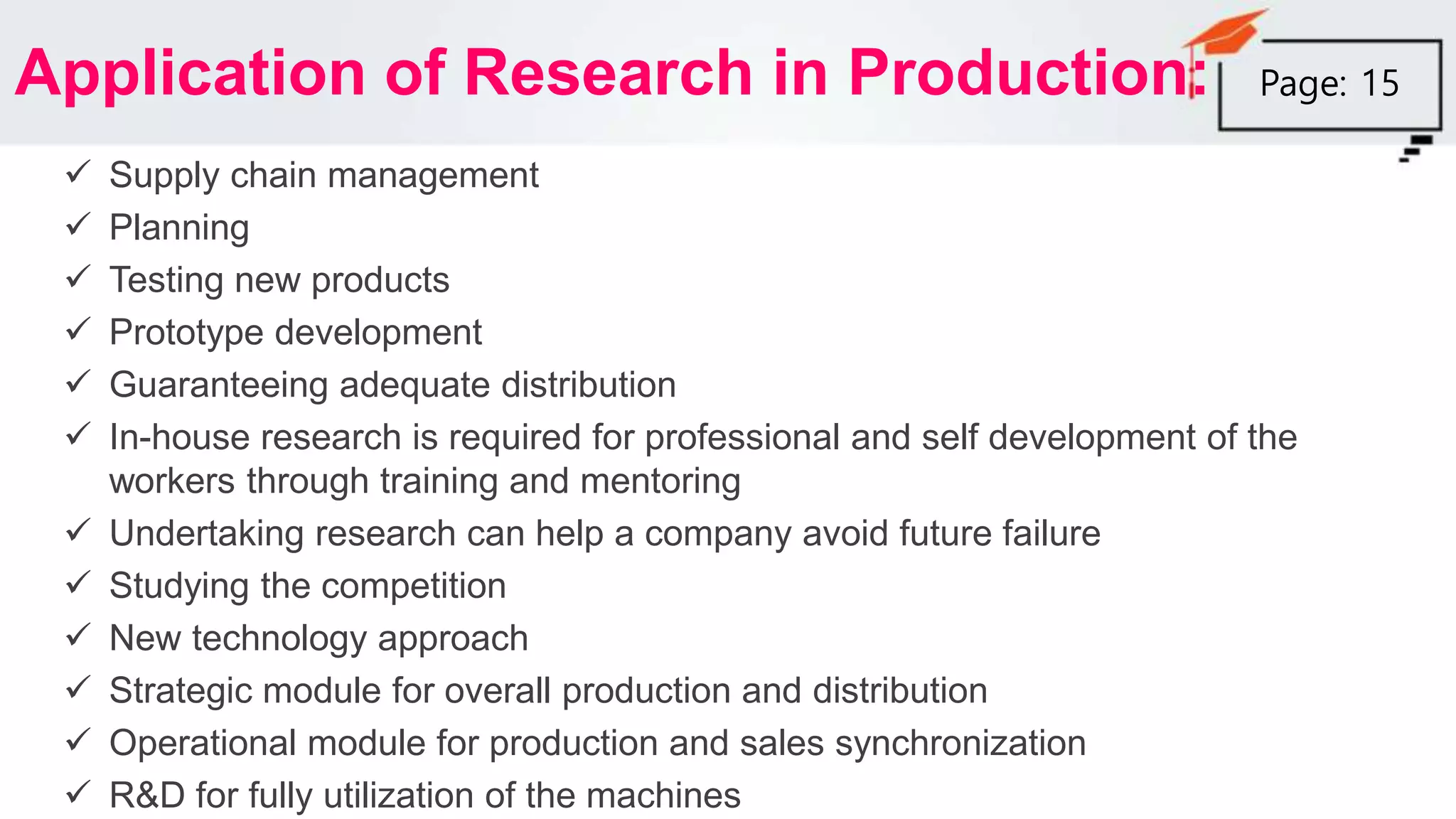
Application of Research in Production:
 Supply chain management
 Planning
 Testing new products
 Prototype development
 Guaranteeing adequate distribution
 In-house research is required for professional and self development of the
workers through training and mentoring
 Undertaking research can help a company avoid future failure
 Studying the competition
 New technology approach
 Strategic module for overall production and distribution
 Operational module for production and sales synchronization
 R&D for fully utilization of the machines
Page: 15
Application of Research in Entrepreneurship:
 Proper planning
 Market situation
 Barriers in startup
 Diversification and reverse strategy
 Existing competitors or substitutes
 Competitive advantage
 Differentiation from others
 Investment decisions
 Govt. rules and regulations
 Social culture and practices to utilize the opportunities
Page: 16
Bibliography:
• http://www.slideshare.net
• Adapted from Gill, J. and Johnson, P. (1997) p. 3
• http://www.mbaofficial.com
• http://www.mbaknol.com
• http://universalteacher.com
• https://www.business-school.ed.ac.uk
• http://www.whatishumanresource.com
• http://shop.cipd.co.uk
• https://www.researchgate.net
• https://www.jstor.org
• http://programmer2programmer.net
• And other ( 2 pfd files)
Page: 17
Chandan

Research Methodology and the Application of Research in Management

  • 1.
    - Chandan Mitra -MBA – 2nd semester - Adamas University Research Methodology and Areas of Research in Management Research Methodology
  • 2.
    Content List: Definition ofResearch Purpose of Research and the objectives of Research Why do we Research What is Research Methodology and its importance Types of Research Research in Management Application of Research in broad areas of Management Bibliography Page no. 1 Page no. 2 Page no. 3 Page no. 4 Page no. 5-7 Page no. 8-10 Page no. 11-16 Page no. 17
  • 3.
    Research is acareful and detailed study into a specific problem, concern, by using the scientific method. It's the adult form of the science fair projects back in elementary school, where we try and learn something by performing an experiment. This is the best way by turning the issue into a question, with the intent of the research to answer the question. What is Research?? Definitions of Research “The main goal of research is the gathering and interpreting information to answer the questions” - Hyllegard, Mood and Morrow, 1996 “Research is a systematic way of asking questions or systematic method of inquiry” – Drew, Hardman and Hart, 1996 Page: 1
  • 4.
    Purpose of Research Themain purposes of research are :  Exploration  Description  Explanation Page: 2 What are the Objectives of Research? The prime objectives of research are: (1) To discover new facts (2) To verify and test important facts (3) To analyze an event or process or phenomenon to identify the cause and effect relationship
  • 5.
    Why do weresearch? A lot of what we do in our daily lives is based on common sense, what we ha ve learnt from others or what we have learnt through personal experience or observation. But sometimes common sense is not the best approach and so metimes there are conflicting theories about what is best or what works in a particular situation. Moreover, what works in one situation or for one conditio n might be ineffective or even dangerous in another, or when combined with other measures. Common sense approaches may overlook the impact of ext ernal factors which may contribute to what is observed. Even in the domain of healthcare, there are gaps in knowledge, theories about how something m ight work better and ideas for improvement. Page: 3
  • 6.
    What is ResearchMethodology Research methodology is a systematic way to solve a problem. It is a science of studying how research is to be carried out. Essentially, the procedures by which researchers go about their work of describing, explaining and predicting phenomena are called research methodology. It is also defined as the study of methods by which knowledge is gained. Its aim is to give the work plan of research. Page: 4 Importance of Research Methodology in Research: (i) which is a suitable method for the chosen problem? (ii) what is the order of accuracy of the result of a method? (iii) what is the efficiency of the method?
  • 7.
    Types of Research Thereare several types of research, those are:  Pure / Basic research i. Also called as the fundamental or the theoretical research. ii. Is basic and original. iii. Can lead to the discovery of a new theory. iv. Can result in the development or refinement of a theory that already exists.  Applied research i. Based on the concept of the pure research. ii. Is problem oriented. iii. Helps in finding results or solutions for real life problems. iv. Provides evidence of usefulness to society. v. Provides data that can lead to the acceleration of the process of generalization. Page: 5
  • 8.
    …continue  Exploratory /Problem Oriented Research i. Involves exploring a general aspect. ii. Includes studying of a problem, about which nothing or a very little is known. iii. Follows a very formal approach of research. iv. Helps in knowing the feasibility in attempting a study.  Descriptive / Problem Solving Research i. More specific in nature and working than exploratory research. ii. Existing theories can be easily put under test by empirical observations. iii. It consumes a lot of time. iv. Descriptive part of the findings. Page: 6
  • 9.
    …continue  Quantitative Research Qualitative Research i. Quantitative research is based on the measurement of quantity o r amount. ii. It is applicable to phenomena that can be expressed in terms of quantity. iii. to apply quantative research in practice is relatively a difficult job and therefore, while doing such research, one should seek guida nce from experimental psychologists. i. Qualitative research, on the other hand, is concerned with qualitative p henomenon, i.e., phenomena relating to or involving quality or kind. ii. ‘Motivation Research’, is an important type of qualitative research. iii. Qualitative research is specially important in the behavioral sciences w here the aim is to discover the underlying motives of human behavior. Page: 7
  • 10.
    Researches in Management Withregard to the primary focus or objective of the research, we can categorize three different types of Research in Management: Theory building research: This kind of research is primarily aimed at developing management theories, and by so doing, improving our understanding and knowledge of the management process. It seeks to develop theories based on, observations, experience, intuition and so on. Much academic research in management is of this nature. Theory testing research: This kind of research is primarily aimed at testing out theories of management. This testing involves the process of observations and measurements so as to be able to arrive at the decision as to whether or not, or what parts of a theory can be rejected and which, therefore, can remain final theories or hypotheses. Again, much academic research in management falls into this category. Page: 8
  • 11.
    …continue Problem centred/practical research Thistype of research is primarily aimed at investigating a practical problem, question or issue in a specific organization or management context with a view to resolving the problem and subsequently making recommendations for courses of action. The primary focus of such research, then, is not academic or knowledge building for its own sake, but rather is aimed at investigating and proposing solutions to real-life management problems. This is not to say that this type of research does not potentially add to the body of theory and knowledge about management and indeed some of the most significant contributions to our knowledge and understanding in this area have stemmed from what was essentially problem-centered consultancy type research. The main focus remains in giving a proper And practical solution of the discussed problem. Page: 9
  • 12.
    …continue Clearly there aredifferent types of management research according to nature, purpose and context. However, it is useful to describe in broad terms the over all management research process which can now be introduced. Stages in the research sequence: ● Identification of broad area of research, ● Selection of specific research topic, ● Decisions regarding research approach, ● Formulation of research plan, ● Information collection, ● Data analysis, ● Presentation of findings. Page: 10
  • 13.
    Broad Areas inManagement The broad areas in Management are: o Marketing o Finance o HR o Production o Entrepreneurship Page: 11
  • 14.
    Application of Researchin Marketing:  Decision making  Market research  Survey on demand  Product research  Customer research  Sales research  Promotional research  Risk management on collaboration  Research for market development  Research on marketing and reach of competitors  Research on formation of marketing strategy  Research to build up competitive advantage Page: 12
  • 15.
    Application of Researchin Finance:  Break even analysis  Capital Budgeting  Ratio analysis  Portfolio management  Financial crisis management  Decision making  Risk perception  Investment analysis  Financial planning for salaried employees  Strategies for tax savings  Research to assess the perception of mutual fund investors  Research on investment pattern and preference of retail investors Page: 13
  • 16.
    Application of Researchin HR:  Training and development  Recruitment  Manpower planning  Labor welfare study  Administrative roles  Performance appraisal system  Leadership style  Problem identification  Conflict management  Research on MBO  Research on statistical approach  Comparative approach Page: 14
  • 17.
    Application of Researchin Production:  Supply chain management  Planning  Testing new products  Prototype development  Guaranteeing adequate distribution  In-house research is required for professional and self development of the workers through training and mentoring  Undertaking research can help a company avoid future failure  Studying the competition  New technology approach  Strategic module for overall production and distribution  Operational module for production and sales synchronization  R&D for fully utilization of the machines Page: 15
  • 18.
    Application of Researchin Entrepreneurship:  Proper planning  Market situation  Barriers in startup  Diversification and reverse strategy  Existing competitors or substitutes  Competitive advantage  Differentiation from others  Investment decisions  Govt. rules and regulations  Social culture and practices to utilize the opportunities Page: 16
  • 19.
    Bibliography: • http://www.slideshare.net • Adaptedfrom Gill, J. and Johnson, P. (1997) p. 3 • http://www.mbaofficial.com • http://www.mbaknol.com • http://universalteacher.com • https://www.business-school.ed.ac.uk • http://www.whatishumanresource.com • http://shop.cipd.co.uk • https://www.researchgate.net • https://www.jstor.org • http://programmer2programmer.net • And other ( 2 pfd files) Page: 17
  • 20.