






GROUP PROJECT
TOPIC : CONJOINT ANALYSIS

PRESENTING BY:
Ashish Dahiya

044

Aravind Uppala 123
Dasari Pradeep 126

Sangam Lalsivaraju 138
Rajesh Mishra 151
Neetu Gupta

155
Introduction to Conjoint analysis
• Conjoint analysis attempts to determine the relative
importance, consumers attach to salient attributes and the
utilities they attach to the level of attributes.
• This information is derived from consumer evaluations of
brand profiles composed of these attributes and their
levels .
• The respondents are presented with stimuli that consists of
attribute levels.
Contd…
• They are asked to evaluate these stimuli that consist of
combinations of attribute levels in terms of their
desirability.
• Based on the evaluations utility of each level of attribute is
determined with help of Conjoint analysis.
Purpose
Conjoint analysis has been used in marketing for a variety of
purposes, some includes:
• Determining the relative importance of attributes in the
consumer choice process
• Estimating market share of brands that differ in attribute
levels
• Determining the composition of the most preferred brand
• Segmenting the market based on similarity of preferences
for attribute levels
Area of application
• New Product Launch
Research Objective
• To determining the composition of most

preferred product ( Car type, fuel Type and
Price) , where the customer finds maximum
utility.
Research Design
Sample Design
• The method which we chose to get sample

frame is Convenient sampling, the sample size
is 20.
Data Collection Design
• Data was collected from the respondent’s

order of preferences through the list of
combinations that were provided by us.
Statistical Design
• The combinations were generated by

orthogonal method from SPSS.
• The responses were tabulated manually on
SPSS data file.
Operational Design
• The operations were carried out with the

Syntax of a pre-programmed conjoint analysis.
• The results were analyzed with the help of
utilities table and importance table.
Combinations
SL.No

Profile ID

Car Type

Fuel Type

Price in Lakhs

1

1

Sedan

CNG

6

2

2

Sedan

Petrol

8

3

3

Sedan

Diesel

9

4

4

SUV

CNG

8

5

5

SUV

Petrol

9

6

6

SUV

Diesel

6

7

7

MUV

CNG

9

8

8

MUV

Petrol

6

9

9

MUV

Diesel

8
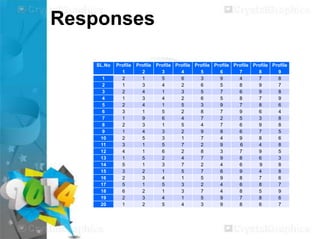
Responses
SL.No
1
2
3
4
5
6
7
8
9
10
11
12
13
14
15
16
17
18
19
20

Profile
1
2
1
2
1
2
3
1
2
1
2
3
4
1
5
3
2
5
6
2
1

Profile Profile Profile Profile Profile Profile Profile Profile
2
3
4
5
6
7
8
9
1
5
6
3
9
4
7
8
3
4
2
6
5
8
9
7
4
1
3
5
7
6
9
8
3
4
2
6
5
8
7
9
4
1
5
3
9
7
8
6
1
5
2
8
7
9
6
4
9
6
4
7
2
5
3
8
3
1
5
4
7
6
9
8
4
3
2
9
8
6
7
5
5
3
1
7
4
9
8
6
1
5
7
2
9
6
4
8
1
6
2
8
3
7
9
5
5
2
4
7
9
8
6
3
1
3
7
2
4
6
9
8
2
1
5
7
6
9
4
8
3
4
1
5
9
8
7
6
1
5
3
2
4
6
8
7
2
1
3
7
4
8
5
9
3
4
1
5
9
7
8
6
2
5
4
3
9
8
6
7
Analysis
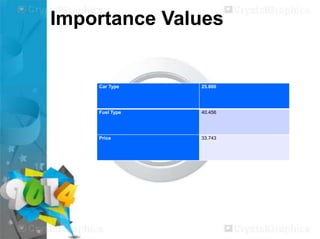
Importance Values

Car Type

25.800

Fuel Type

40.456

Price

33.743
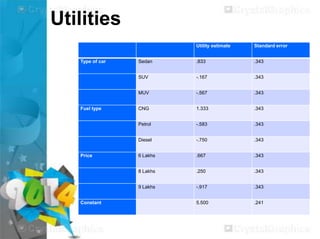
Utilities
Utility estimate

-.167

.343

-.567

.343

CNG

1.333

.343

-.583

.343

Diesel

-.750

.343

6 Lakhs

.667

.343

8 Lakhs

.250

.343

9 Lakhs
Constant

.343

Petrol

Price

.833

MUV
Fuel type

Sedan
SUV

Type of car

Standard error

-.917

.343

5.500

.241
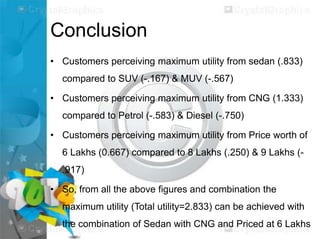
Conclusion
• Customers perceiving maximum utility from sedan (.833)

compared to SUV (-.167) & MUV (-.567)
• Customers perceiving maximum utility from CNG (1.333)
compared to Petrol (-.583) & Diesel (-.750)

• Customers perceiving maximum utility from Price worth of
6 Lakhs (0.667) compared to 8 Lakhs (.250) & 9 Lakhs (.917)
• So, from all the above figures and combination the
maximum utility (Total utility=2.833) can be achieved with
the combination of Sedan with CNG and Priced at 6 Lakhs
Contd…
• The next alternative to get better utility (Total Utility=2.416)
is from Sedan with CNG priced at 8 Lakhs
• The minimum Utility (Total Utility= -2.234)is found in MUV
with Diesel Priced at 9 Lakhs
Conjoint analysis advance marketing research

Conjoint analysis advance marketing research

  • 1.
    GROUP PROJECT TOPIC :CONJOINT ANALYSIS PRESENTING BY: Ashish Dahiya 044 Aravind Uppala 123 Dasari Pradeep 126 Sangam Lalsivaraju 138 Rajesh Mishra 151 Neetu Gupta 155
  • 2.
    Introduction to Conjointanalysis • Conjoint analysis attempts to determine the relative importance, consumers attach to salient attributes and the utilities they attach to the level of attributes. • This information is derived from consumer evaluations of brand profiles composed of these attributes and their levels . • The respondents are presented with stimuli that consists of attribute levels.
  • 3.
    Contd… • They areasked to evaluate these stimuli that consist of combinations of attribute levels in terms of their desirability. • Based on the evaluations utility of each level of attribute is determined with help of Conjoint analysis.
  • 4.
    Purpose Conjoint analysis hasbeen used in marketing for a variety of purposes, some includes: • Determining the relative importance of attributes in the consumer choice process • Estimating market share of brands that differ in attribute levels • Determining the composition of the most preferred brand • Segmenting the market based on similarity of preferences for attribute levels
  • 5.
    Area of application •New Product Launch
  • 6.
    Research Objective • Todetermining the composition of most preferred product ( Car type, fuel Type and Price) , where the customer finds maximum utility.
  • 7.
  • 8.
    Sample Design • Themethod which we chose to get sample frame is Convenient sampling, the sample size is 20.
  • 9.
    Data Collection Design •Data was collected from the respondent’s order of preferences through the list of combinations that were provided by us.
  • 10.
    Statistical Design • Thecombinations were generated by orthogonal method from SPSS. • The responses were tabulated manually on SPSS data file.
  • 11.
    Operational Design • Theoperations were carried out with the Syntax of a pre-programmed conjoint analysis. • The results were analyzed with the help of utilities table and importance table.
  • 12.
    Combinations SL.No Profile ID Car Type FuelType Price in Lakhs 1 1 Sedan CNG 6 2 2 Sedan Petrol 8 3 3 Sedan Diesel 9 4 4 SUV CNG 8 5 5 SUV Petrol 9 6 6 SUV Diesel 6 7 7 MUV CNG 9 8 8 MUV Petrol 6 9 9 MUV Diesel 8
  • 13.
    Responses SL.No 1 2 3 4 5 6 7 8 9 10 11 12 13 14 15 16 17 18 19 20 Profile 1 2 1 2 1 2 3 1 2 1 2 3 4 1 5 3 2 5 6 2 1 Profile Profile ProfileProfile Profile Profile Profile Profile 2 3 4 5 6 7 8 9 1 5 6 3 9 4 7 8 3 4 2 6 5 8 9 7 4 1 3 5 7 6 9 8 3 4 2 6 5 8 7 9 4 1 5 3 9 7 8 6 1 5 2 8 7 9 6 4 9 6 4 7 2 5 3 8 3 1 5 4 7 6 9 8 4 3 2 9 8 6 7 5 5 3 1 7 4 9 8 6 1 5 7 2 9 6 4 8 1 6 2 8 3 7 9 5 5 2 4 7 9 8 6 3 1 3 7 2 4 6 9 8 2 1 5 7 6 9 4 8 3 4 1 5 9 8 7 6 1 5 3 2 4 6 8 7 2 1 3 7 4 8 5 9 3 4 1 5 9 7 8 6 2 5 4 3 9 8 6 7
  • 14.
  • 15.
  • 16.
    Utilities Utility estimate -.167 .343 -.567 .343 CNG 1.333 .343 -.583 .343 Diesel -.750 .343 6 Lakhs .667 .343 8Lakhs .250 .343 9 Lakhs Constant .343 Petrol Price .833 MUV Fuel type Sedan SUV Type of car Standard error -.917 .343 5.500 .241
  • 17.
    Conclusion • Customers perceivingmaximum utility from sedan (.833) compared to SUV (-.167) & MUV (-.567) • Customers perceiving maximum utility from CNG (1.333) compared to Petrol (-.583) & Diesel (-.750) • Customers perceiving maximum utility from Price worth of 6 Lakhs (0.667) compared to 8 Lakhs (.250) & 9 Lakhs (.917) • So, from all the above figures and combination the maximum utility (Total utility=2.833) can be achieved with the combination of Sedan with CNG and Priced at 6 Lakhs
  • 18.
    Contd… • The nextalternative to get better utility (Total Utility=2.416) is from Sedan with CNG priced at 8 Lakhs • The minimum Utility (Total Utility= -2.234)is found in MUV with Diesel Priced at 9 Lakhs