Types of
Business Research
1Dr. Amitabh Mishra
Types of Business Research
1. Descriptive vs. Analytical
2. Applied vs. Fundamental
3. Quantitative vs. Qualitative
4. Conceptual vs. Empirical
5. Some other types
1. One time Research vs. Longitudinal
Research
2. Field setting or Laboratory or
Simulation Research
3. Clinical or Diagnostic Research
4. Exploratory vs. Formalized Research
5. Historical Research
6. Conclusion oriented or Decision
oriented
Dr. Amitabh Mishra 2
Descriptive vs. Analytical
• Descriptive Research (Ex-post facto research):
– Description of state of affairs as it exists at present
– No control over variables
– Can only report what has happened or already happening
• Analytical Research :
– Researcher has to use facts or information already available and
analyze these to make a critical evaluation of the material.
3Dr. Amitabh Mishra
Applied vs. Fundamental
• Applied (Action) Research:
– Aims to finding a solution for an immediate problem facing the
society or business organization
• Fundamental (Basic or Pure) Research:
– Concerned with generalizations and formulation of theory;
– Directed towards finding information that has broad range of
applications and
– Adds to already existing organized body of scientific knowledge
4Dr. Amitabh Mishra
Quantitative vs. Qualitative
• Quantitative Research:
– Based on measurement of quantity or amount
• Qualitative Research:
– Concerned with phenomenon relating to or involving
quality
– Aims at discovering underlying motives and desires
5Dr. Amitabh Mishra
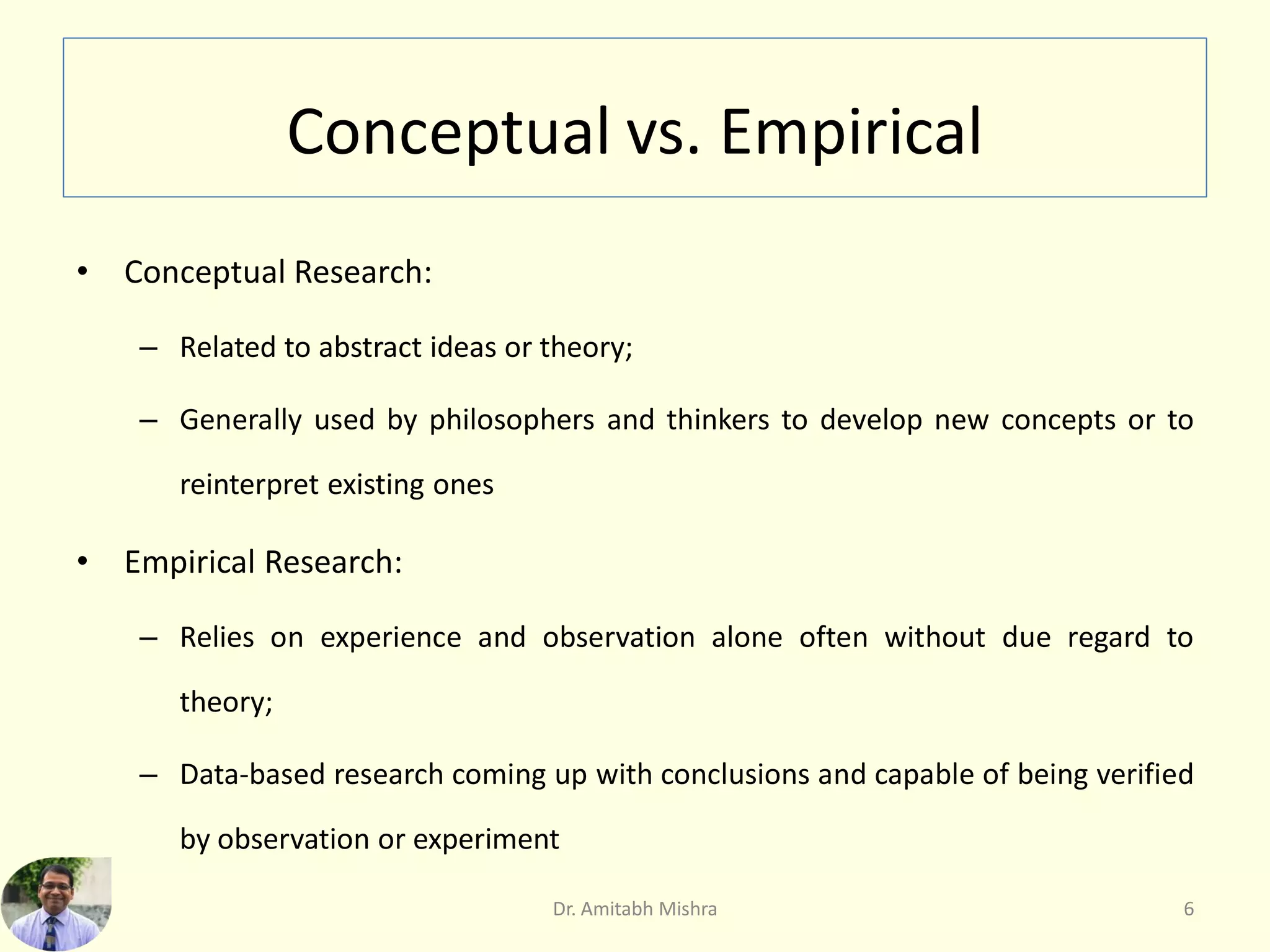
Conceptual vs. Empirical
• Conceptual Research:
– Related to abstract ideas or theory;
– Generally used by philosophers and thinkers to develop new concepts or to
reinterpret existing ones
• Empirical Research:
– Relies on experience and observation alone often without due regard to
theory;
– Data-based research coming up with conclusions and capable of being verified
by observation or experiment
6Dr. Amitabh Mishra
Some other types
• One time research:
– Confined to single time period
• Longitudinal research:
– Research is carried on over several time periods
• Field-setting or Laboratory-setting or Simulation
research:
– Based on the environment in which it is to be carried out
7Dr. Amitabh Mishra
• Clinical or Diagnostic research:
– Usually go deep into causes of things or events that interest us,
using very small samples and very deep probing data gathering
devices
• Exploratory research:
– Objective is development of hypothesis rather than their testing
• Formalized research:
– Research with substantial structure and with specific hypothesis
to be tested
8Dr. Amitabh Mishra
• Historical research:
– Uses historical sources like - documents, remains etc., to study events
or ideas of the past including philosophy of persons or groups at any
remote point of time.
• Obtrusive Research:
– The researcher introduces conditions that influence participants;
manipulates the environment
• Non-Obtrusive Research:
– Researcher avoids influencing subjects in any way and tries to be as
inconspicuous as possible
9Dr. Amitabh Mishra
• Experimental Research:
– An experiment is a research situation where at least one
independent variable, called the experimental variable, is
deliberately manipulated or varied by the researcher
• Correlation Research:
– To find relationships between two or more variable so to:
• Better understand the conditions and events that we encounter (what
goes with what)
• To predict future conditions and events.
– Correlations do not show cause and effect
10Dr. Amitabh Mishra

Types of Business Research

  • 1.
  • 2.
    Types of BusinessResearch 1. Descriptive vs. Analytical 2. Applied vs. Fundamental 3. Quantitative vs. Qualitative 4. Conceptual vs. Empirical 5. Some other types 1. One time Research vs. Longitudinal Research 2. Field setting or Laboratory or Simulation Research 3. Clinical or Diagnostic Research 4. Exploratory vs. Formalized Research 5. Historical Research 6. Conclusion oriented or Decision oriented Dr. Amitabh Mishra 2
  • 3.
    Descriptive vs. Analytical •Descriptive Research (Ex-post facto research): – Description of state of affairs as it exists at present – No control over variables – Can only report what has happened or already happening • Analytical Research : – Researcher has to use facts or information already available and analyze these to make a critical evaluation of the material. 3Dr. Amitabh Mishra
  • 4.
    Applied vs. Fundamental •Applied (Action) Research: – Aims to finding a solution for an immediate problem facing the society or business organization • Fundamental (Basic or Pure) Research: – Concerned with generalizations and formulation of theory; – Directed towards finding information that has broad range of applications and – Adds to already existing organized body of scientific knowledge 4Dr. Amitabh Mishra
  • 5.
    Quantitative vs. Qualitative •Quantitative Research: – Based on measurement of quantity or amount • Qualitative Research: – Concerned with phenomenon relating to or involving quality – Aims at discovering underlying motives and desires 5Dr. Amitabh Mishra
  • 6.
    Conceptual vs. Empirical •Conceptual Research: – Related to abstract ideas or theory; – Generally used by philosophers and thinkers to develop new concepts or to reinterpret existing ones • Empirical Research: – Relies on experience and observation alone often without due regard to theory; – Data-based research coming up with conclusions and capable of being verified by observation or experiment 6Dr. Amitabh Mishra
  • 7.
    Some other types •One time research: – Confined to single time period • Longitudinal research: – Research is carried on over several time periods • Field-setting or Laboratory-setting or Simulation research: – Based on the environment in which it is to be carried out 7Dr. Amitabh Mishra
  • 8.
    • Clinical orDiagnostic research: – Usually go deep into causes of things or events that interest us, using very small samples and very deep probing data gathering devices • Exploratory research: – Objective is development of hypothesis rather than their testing • Formalized research: – Research with substantial structure and with specific hypothesis to be tested 8Dr. Amitabh Mishra
  • 9.
    • Historical research: –Uses historical sources like - documents, remains etc., to study events or ideas of the past including philosophy of persons or groups at any remote point of time. • Obtrusive Research: – The researcher introduces conditions that influence participants; manipulates the environment • Non-Obtrusive Research: – Researcher avoids influencing subjects in any way and tries to be as inconspicuous as possible 9Dr. Amitabh Mishra
  • 10.
    • Experimental Research: –An experiment is a research situation where at least one independent variable, called the experimental variable, is deliberately manipulated or varied by the researcher • Correlation Research: – To find relationships between two or more variable so to: • Better understand the conditions and events that we encounter (what goes with what) • To predict future conditions and events. – Correlations do not show cause and effect 10Dr. Amitabh Mishra