RESEARCH
METHODOLOGY
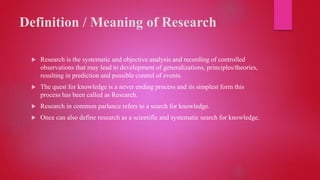
Definition / Meaning of Research
 Research is the systematic and objective analysis and recording of controlled
observations that may lead to development of generalizations, principles/theories,
resulting in prediction and possible control of events.
 The quest for knowledge is a never ending process and its simplest form this
process has been called as Research.
 Research in common parlance refers to a search for knowledge.
 Once can also define research as a scientific and systematic search for knowledge.
 Is the pursuit of truth with the help of study, observations, comparison and
experiment.
 The search for knowledge through objective and systematic method of finding
solution to a problem is research.
 The systematic method consisting of enunciating the problem, formulating a
hypothesis, collecting the facts or data, analyzing the facts.
 In reaching certain conclusion either in the form of solutions towards the
concerned problem or in certain generalizations for some theoretical formulations.
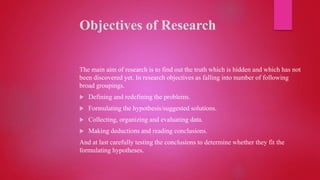
Objectives of Research
The main aim of research is to find out the truth which is hidden and which has not
been discovered yet. In research objectives as falling into number of following
broad groupings.
 Defining and redefining the problems.
 Formulating the hypothesis/suggested solutions.
 Collecting, organizing and evaluating data.
 Making deductions and reading conclusions.
And at last carefully testing the conclusions to determine whether they fit the
formulating hypotheses.
Broad Groupings Name Explanations
Exploratory/Formulative research studies To gain familiarity with a phenomenon or to
achieve new insights into it.
Descriptive research studies To portray accurately the characteristics of a
particular individual, situation or a group.
Diagnostic research studies To determine the frequency with which
something occurs or with which it is
associated with something else.
Hypothesis Testing research studies To test a hypothesis of a casual relationship
between variables.
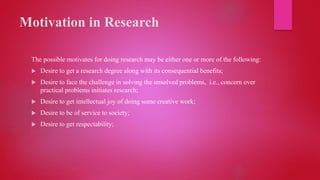
Motivation in Research
The possible motivates for doing research may be either one or more of the following:
 Desire to get a research degree along with its consequential benefits;
 Desire to face the challenge in solving the unsolved problems, i.e., concern over
practical problems initiates research;
 Desire to get intellectual joy of doing some creative work;
 Desire to be of service to society;
 Desire to get respectability;
 However, this is not an exhaustive list of factors motivating people to undertake
research studies.
 Many more factors such as directives of government, employment conditions,
curiosity about new things, desire to understand casual relationships, social
thinking and awakening and the like may as well motivate people to perform
research operations.
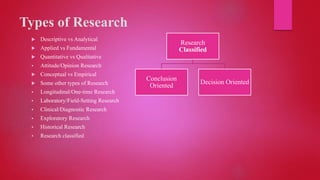
Types of Research
 Descriptive vs Analytical
 Applied vs Fundamental
 Quantitative vs Qualitative
 Attitude/Opinion Research
 Conceptual vs Empirical
 Some other types of Research
 Longitudinal/One-time Research
 Laboratory/Field-Setting Research
 Clinical/Diagnostic Research
 Exploratory Research
 Historical Research
 Research classified
Research
Classified
Conclusion
Oriented
Decision Oriented
Descriptive Research
 It includes surveys and fact finding enquires of different kinds.
 It descriptive of state of affairs as it exits at present.
 The term Ex post-facto research. Social Science and Business Research.
 The main characteristic of has no control over variables.
 Can only report What has happened/What is happening?
 It including comparative and correlation methods.
 Eg: Frequency of shopping.
Analytical Research
 In researcher has to use facts/information already available.
 It analyze these to make critical evaluation of material.
Applied Research
 It aims at finding a solution for an immediate problem like facing a society/an
industrial/business organization/for processing practical problem.
 It aimed at certain conclusions.
 Eg: Marketing Research and Evaluation Research
Fundamental Research
 It mainly concerned with generalizations and with the formulation of theory.
 The research is directed towards finding information.
 Eg: It concerning human behavior carried on with a view to make generalizations
about human behavior.
Quantitative Research
 It is based on measurement of quantity/amount.
 It is applicable to phenomena can be expressed in terms of quantity.
Qualitative Research
 It is concerned with qualitative phenomenon.
 In motivation research is an important type for interested in investigating the
reasons for human behavior.
 To discovering the underlying motivates and desires.
 They should seek guidance from experimental psychologist.
Attitude/Opinion Research
It designed to find out how people feel/what they think about subject.
Conceptual Research
 Related to some abstract ideas/theory.
 It is generally used by philosophers and thinkers to develop new concepts/to
reinterprets existing ones.
 That is verified by empirical research.
Empirical Research
 It relies on experience/observation alone.
 It is data-based research coming up with conclusions.
 That is verified by experiment/observation.
 Then works to get enough facts to prove/disprove hypothesis.
 Evidence gathered by this is most powerful support possible for a given hypotheis.
One-Time Research
Research is confined to a singe time-period.
Longitudinal Research
It is carried out several time-period.
Laboratory Research
Depending upon the environment which it is carried out.
Clinical Research
It follow case study methods.
Diagnostic Research
In depth approaches to reach basic casual relations.
Exploratory Research
It is development of hypothesis rather that their testing.
Historical Research
It utilizes historical sources like documents, remains etc.
Conclusion Oriented Research
 It is free to pick up problems.
 Redesign the enquiry as proceeds.
 It is prepared to conceptualize as wishes.
Decision Oriented Research
 The need of a decision maker.
 The research is not free to embark upon research according to his own inclination.
 Eg: Operation Research

Research methodology

  • 1.
  • 2.
    Definition / Meaningof Research  Research is the systematic and objective analysis and recording of controlled observations that may lead to development of generalizations, principles/theories, resulting in prediction and possible control of events.  The quest for knowledge is a never ending process and its simplest form this process has been called as Research.  Research in common parlance refers to a search for knowledge.  Once can also define research as a scientific and systematic search for knowledge.
  • 3.
     Is thepursuit of truth with the help of study, observations, comparison and experiment.  The search for knowledge through objective and systematic method of finding solution to a problem is research.  The systematic method consisting of enunciating the problem, formulating a hypothesis, collecting the facts or data, analyzing the facts.  In reaching certain conclusion either in the form of solutions towards the concerned problem or in certain generalizations for some theoretical formulations.
  • 4.
    Objectives of Research Themain aim of research is to find out the truth which is hidden and which has not been discovered yet. In research objectives as falling into number of following broad groupings.  Defining and redefining the problems.  Formulating the hypothesis/suggested solutions.  Collecting, organizing and evaluating data.  Making deductions and reading conclusions. And at last carefully testing the conclusions to determine whether they fit the formulating hypotheses.
  • 5.
    Broad Groupings NameExplanations Exploratory/Formulative research studies To gain familiarity with a phenomenon or to achieve new insights into it. Descriptive research studies To portray accurately the characteristics of a particular individual, situation or a group. Diagnostic research studies To determine the frequency with which something occurs or with which it is associated with something else. Hypothesis Testing research studies To test a hypothesis of a casual relationship between variables.
  • 6.
    Motivation in Research Thepossible motivates for doing research may be either one or more of the following:  Desire to get a research degree along with its consequential benefits;  Desire to face the challenge in solving the unsolved problems, i.e., concern over practical problems initiates research;  Desire to get intellectual joy of doing some creative work;  Desire to be of service to society;  Desire to get respectability;
  • 7.
     However, thisis not an exhaustive list of factors motivating people to undertake research studies.  Many more factors such as directives of government, employment conditions, curiosity about new things, desire to understand casual relationships, social thinking and awakening and the like may as well motivate people to perform research operations.
  • 8.
    Types of Research Descriptive vs Analytical  Applied vs Fundamental  Quantitative vs Qualitative  Attitude/Opinion Research  Conceptual vs Empirical  Some other types of Research  Longitudinal/One-time Research  Laboratory/Field-Setting Research  Clinical/Diagnostic Research  Exploratory Research  Historical Research  Research classified Research Classified Conclusion Oriented Decision Oriented
  • 9.
    Descriptive Research  Itincludes surveys and fact finding enquires of different kinds.  It descriptive of state of affairs as it exits at present.  The term Ex post-facto research. Social Science and Business Research.  The main characteristic of has no control over variables.  Can only report What has happened/What is happening?  It including comparative and correlation methods.  Eg: Frequency of shopping.
  • 10.
    Analytical Research  Inresearcher has to use facts/information already available.  It analyze these to make critical evaluation of material.
  • 11.
    Applied Research  Itaims at finding a solution for an immediate problem like facing a society/an industrial/business organization/for processing practical problem.  It aimed at certain conclusions.  Eg: Marketing Research and Evaluation Research
  • 12.
    Fundamental Research  Itmainly concerned with generalizations and with the formulation of theory.  The research is directed towards finding information.  Eg: It concerning human behavior carried on with a view to make generalizations about human behavior.
  • 13.
    Quantitative Research  Itis based on measurement of quantity/amount.  It is applicable to phenomena can be expressed in terms of quantity.
  • 14.
    Qualitative Research  Itis concerned with qualitative phenomenon.  In motivation research is an important type for interested in investigating the reasons for human behavior.  To discovering the underlying motivates and desires.  They should seek guidance from experimental psychologist.
  • 15.
    Attitude/Opinion Research It designedto find out how people feel/what they think about subject.
  • 16.
    Conceptual Research  Relatedto some abstract ideas/theory.  It is generally used by philosophers and thinkers to develop new concepts/to reinterprets existing ones.  That is verified by empirical research.
  • 17.
    Empirical Research  Itrelies on experience/observation alone.  It is data-based research coming up with conclusions.  That is verified by experiment/observation.  Then works to get enough facts to prove/disprove hypothesis.  Evidence gathered by this is most powerful support possible for a given hypotheis.
  • 18.
    One-Time Research Research isconfined to a singe time-period.
  • 19.
    Longitudinal Research It iscarried out several time-period.
  • 20.
    Laboratory Research Depending uponthe environment which it is carried out.
  • 21.
    Clinical Research It followcase study methods.
  • 22.
    Diagnostic Research In depthapproaches to reach basic casual relations.
  • 23.
    Exploratory Research It isdevelopment of hypothesis rather that their testing.
  • 24.
    Historical Research It utilizeshistorical sources like documents, remains etc.
  • 25.
    Conclusion Oriented Research It is free to pick up problems.  Redesign the enquiry as proceeds.  It is prepared to conceptualize as wishes.
  • 26.
    Decision Oriented Research The need of a decision maker.  The research is not free to embark upon research according to his own inclination.  Eg: Operation Research