TYBSC IT SEMVI
PROF. ARTI GAVAS
ANNA LEELACOLLEGE OF COMMERCE AND ECONOMICS,
SHOBHA JAYARAM SHETTY COLLGE FOR BMS, KURLA
 Analytical capabilities of a GIS use spatial and non-spatial (attribute)
data to answer questions about real-world
 It is the spatial analysis functions that distinguishes GIS from other
information systems.
 When use GIS to address real-world problems, you'll come up against
the question that which analysis function you want to use and to
solve the problems.
 This include:
› Spatial Data Functions (Format Transformations, Geometric Transformations
Projection Transformations etc. )
› Attribute Data Functions (Retrieval, Classification, Verification etc.)
› Integrated Analysis (Overlay, Neighborhood Function, Topographic Functions,
Interpolation etc.)
 Classification, retrieval, and measurement functions
 Overlay functions
 Neighbourhood functions
 Connectivity functions
All functions in this category are performed on a single (vector or raster) data layer,
using the associated attribute data
 Classification allows the assignment of features to a class on the basis of
attribute values or attribute ranges
› Classification of different crops like potato and rice
 Retrieval functions allow the selective search of data
› Retrieval all agricultural fields where potato is grown
 Generalization is a function that joins different classes of objects with common
characteristics to a higher level (generalized) class
› Generalization potato and rice fields as food produce fields
 Measurement functions allow the calculation of distances, lengths, or areas.
Allow the combination of two (or more) spatial data layers
comparing them position by position, and treating areas of overlap—
and of non-overlap—in distinct ways
 Intersection
› The potato fields on black soils
 Union
› The fields where potato or rice is the crop
 Difference
› The potato fields not on black soils
 Complement
› The fields that do not have potato as crop
Evaluates the characteristics of an area surrounding a feature’s location; scans the
neighbourhood of the given feature and performs a computation on it
 Search functions
› Allow the retrieval of features that fall within a given search window. This window may be
a rectangle, circle, or polygon
 Buffer zone generation
› Determines a spatial envelope (buffer) around given feature
 Interpolation functions
› Predict unknown values using the known values at nearby locations
 Topographic functions
› Determine characteristics of an area by looking at the immediate neighbourhood
› E.g. Slope calculation
 Works on the basis of networks; represent spatial linkages
between features
 Contiguity functions
› contiguous area of forest of certain size and shape in a satellite
image
 Network analytic functions
› Road network, public transport routes, high voltage lines or other
forms of transportation infrastructure
 Visibility functions
› points visible from a given location (Viewshade mapping)
 Geometric measurement on spatial features includes counting,
distance and area size computations
 Measurements on vector data
 The primitives of vector data sets are point, (poly)line and
polygon.
 Related geometric measurements are location, length, distance
and area size.
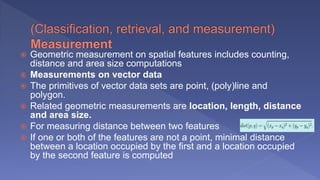
 For measuring distance between two features
 If one or both of the features are not a point, minimal distance
between a location occupied by the first and a location occupied
by the second feature is computed
 Measurements on raster data
 Location is derived from the raster’s anchor point and the
position of the cell in the raster
 The area size is calculated as the number of cells
multiplied by the cell area
 The distance between two raster cells is the standard
distance function applied to the locations of their respective
mid-points
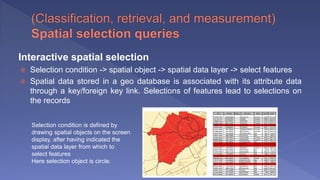
Interactive spatial selection
 Selection condition -> spatial object -> spatial data layer -> select features
 Spatial data stored in a geo database is associated with its attribute data
through a key/foreign key link. Selections of features lead to selections on
the records
Selection condition is defined by
drawing spatial objects on the screen
display, after having indicated the
spatial data layer from which to
select features
Here selection object is circle.
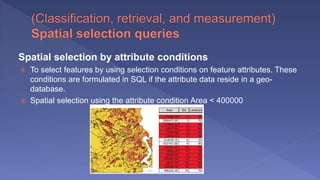
Spatial selection by attribute conditions
 To select features by using selection conditions on feature attributes. These
conditions are formulated in SQL if the attribute data reside in a geo-
database.
 Spatial selection using the attribute condition Area < 400000
Combining attribute conditions
 Atomic conditions use a predicate symbols, < (less than), =
(equals), <= (less than or equal), > (greater than), >= (greater
than or equal) and <> (does not equal). 400000 and 80 are
expressions. Area and LandUSe are attribute names.
 E.g. Area < 400000, and LandUse = 80
 Composite conditions make use of AND, OR, NOT and the
bracket pair ( ).
 E.g. Area < 400000 AND LandUse = 80; Area < 400000 OR
LandUse = 80, NOT (LandUse = 80), (Area < 30000 AND
LandUse = 70) OR (Area < 400000 AND LandUse = 80)
Spatial selection using topological relationship
1. Selecting features that are inside selection objects: containment
relationship
In dark green, some District as the selection objects. In red, all medical clinics
located inside these areas, and thus inside the district.
2. Selecting features that intersect
In dark green some District as the selection objects , and all roads in the district
are selected (in red).
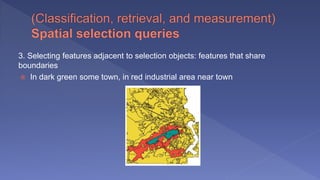
3. Selecting features adjacent to selection objects: features that share
boundaries
 In dark green some town, in red industrial area near town
4. Selecting features based on their distance
In red, roads that are within 200 metres of a medical clinic shown in dark green
 Classification is a technique of purposefully removing
detail from an input data set to reveal important patterns
of spatial distribution.
› User-controlled classification: a user selects the attributes that
will be used as the classification parameters and defines the
classification method
› Automatic classification: a user only specifies the number of
classes in the output data set and the system automatically
determines the class break points
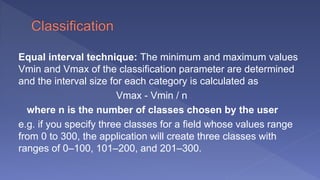
Equal interval technique: The minimum and maximum values
Vmin and Vmax of the classification parameter are determined
and the interval size for each category is calculated as
Vmax - Vmin / n
where n is the number of classes chosen by the user
e.g. if you specify three classes for a field whose values range
from 0 to 300, the application will create three classes with
ranges of 0–100, 101–200, and 201–300.
 Quantile or Equal frequency technique:
Each class contains an equal number of features. Quantile
assigns the same number of data values to each class.
There are no empty classes or classes with too few or too many
values.
•Class 1: 4 – 8 (113
countries have four, five,
six, seven or eight letters)
•Class 2: 8 – 12 (41)
•Class 3: 12 – 16 (12)
•Class 4: 16 – 20 (8)
•Class 5: 20 – 24 (2)
Equal interval:
We generated 5 classes but
the number of classes is
entirely up to you.
Max- min = 24 – 4 = 20
Then, it divides 20 by 5 and
you get an interval (20/5=4).
It takes total of number of features
(176 countries in our case).
Then, it divides the total by the
number of classes to get the
average (176/5=35.2).
Finally, quantile maps counts the
quantity in each group and arranges
them as close to the average as
possible.
•Class 1: 4 – 6 (56 countries have 4,
5 or 6-letter names)
•Class 2: 6 – 7 (38)
•Class 3: 7 – 8 (19)
•Class 4: 9 – 11 (36)
•Class 5: 12 – 24 (27)
Quantile or Equal Frequency:
 Technique of combining two spatial data layers and
producing a third from them
 Flow computations are determined when a phenomenon
does not spread in all directions, but moves or ‘flows’
along a given, least-cost path, determined again by local
terrain characteristics.
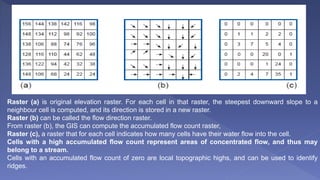
Raster (a) is original elevation raster. For each cell in that raster, the steepest downward slope to a
neighbour cell is computed, and its direction is stored in a new raster.
Raster (b) can be called the flow direction raster.
From raster (b), the GIS can compute the accumulated flow count raster,
Raster (c), a raster that for each cell indicates how many cells have their water flow into the cell.
Cells with a high accumulated flow count represent areas of concentrated flow, and thus may
belong to a stream.
Cells with an accumulated flow count of zero are local topographic highs, and can be used to identify
ridges.
 A network is a connected set of lines, representing some
geographic phenomenon
 Directed networks associate with each line a direction of
transportation; undirected networks do not
 Planar network can be embedded in a two-dimensional plane
 Spatial analysis functions on networks are
› Optimal path finding: least cost-path on a network between a pair of
predefined locations
› Network partitioning: assigns network elements to different locations
using predefined criteria
Turning Cost Table
Ordered & Unordered path finding
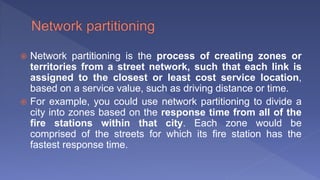
 Network partitioning is the process of creating zones or
territories from a street network, such that each link is
assigned to the closest or least cost service location,
based on a service value, such as driving distance or time.
 For example, you could use network partitioning to divide a
city into zones based on the response time from all of the
fire stations within that city. Each zone would be
comprised of the streets for which its fire station has the
fastest response time.
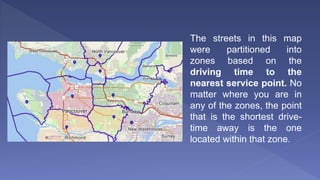
The streets in this map
were partitioned into
zones based on the
driving time to the
nearest service point. No
matter where you are in
any of the zones, the point
that is the shortest drive-
time away is the one
located within that zone.
 Given facilities that provide goods and services and a set of
demand points that consume them, the goal of location-
allocation is to locate the facilities in a way that supplies the
demand points most efficiently. As the name suggests,
location-allocation is a twofold problem that simultaneously
locates facilities and allocates demand points to the facilities.
 Initially, it may appear that all location-allocation analyses solve
the same problem, but the best location is not the same for all
types of facilities. For instance, the best location for an ERS
center is different than the best location for a manufacturing
plant.
 Example 1: Locating an ERS center
When someone calls for an ambulance, we trust it will come to their
aid almost instantly; the emergency response time depends
considerably on the distance between the ambulance and the
patient.
Typically, the goal for determining the best sites for ERS centers is
to make it possible for ambulances to reach the most people within
a defined time frame.
The specific question may be: Where should three ERS
facilities be placed so that the greatest number of people in the
community can be reached within four minutes?
 Example 2: Locating a manufacturing plant
Many retail outlets receive their goods from manufacturing
plants. Whether producing automobiles, appliances, or
packaged food, a manufacturing plant can spend a large
percentage of its budget on transportation.
Location-allocation can answer the following question: Where
should the manufacturing plant be located to minimize
overall transportation costs?
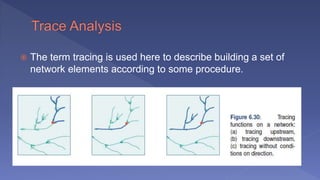
 The term tracing is used here to describe building a set of
network elements according to some procedure.
 Mathematical construct for representing geographic objects
or surfaces as data
 Five characteristics of GIS-based application models:
› The purpose of the model,
› The methodology underlying the model,
› The scale at which the model works,
› Its dimensionality - i.e. whether the model includes spatial, temporal
› Its implementation logic - i.e. the extent to which the model uses
existing knowledge about the implementation context.
 Purpose of the model
 refers to whether the model is descriptive, prescriptive or
predictive in nature.
 Descriptive models attempt to answer the “what is” -
question.
 Prescriptive models usually answer the “what should be”
question
 Predictive models focus upon the “what is likely to be”
questions
 Methodology
 refers to the operational components of the model.
 Stochastic models use statistical or probability functions to
represent random or semi-random of phenomena.
 Deterministic models are based upon a well-defined cause and
effect relationship
 Rule-based models attempt to model processes by using local
(spatial) rules
 Agent-based models (ABM) attempt to model movement and
development of multiple interacting agents
 Scale
 refers to whether the components of the model are individual
or aggregate in nature.
 refers to the ‘level’ at which the model operates.
 Individual-based models are based on individual entities,
such as the agent-based models such as salary of individual
 Aggregate models deal with ‘grouped’ data such as
population census data.
 Dimensionality
 refer to whether a model is static or dynamic,and spatial
or aspatial.
 Spatial model operate in some geographically defined
space.
 Aspatial models have no direct spatial reference.
 Models can also be static, meaning they do not incorporate
a notion of time or change.
 In dynamic models, time is an essential parameter
 Implementation logic
 refers to how the model uses existing theory or
knowledge to create new knowledge.
 Deductive approaches use knowledge of the overall
situation in order to predict outcome conditions.
 This includes models that have some kind of formalized set
of criteria, often with known weightings for the inputs, and
existing algorithms are used to derive outcomes.
 Inductive approaches try to generalize, trial and error
TYBSC IT PGIS Unit IV  Spacial Data Analysis

TYBSC IT PGIS Unit IV Spacial Data Analysis

  • 1.
    TYBSC IT SEMVI PROF.ARTI GAVAS ANNA LEELACOLLEGE OF COMMERCE AND ECONOMICS, SHOBHA JAYARAM SHETTY COLLGE FOR BMS, KURLA
  • 2.
     Analytical capabilitiesof a GIS use spatial and non-spatial (attribute) data to answer questions about real-world  It is the spatial analysis functions that distinguishes GIS from other information systems.  When use GIS to address real-world problems, you'll come up against the question that which analysis function you want to use and to solve the problems.  This include: › Spatial Data Functions (Format Transformations, Geometric Transformations Projection Transformations etc. ) › Attribute Data Functions (Retrieval, Classification, Verification etc.) › Integrated Analysis (Overlay, Neighborhood Function, Topographic Functions, Interpolation etc.)
  • 3.
     Classification, retrieval,and measurement functions  Overlay functions  Neighbourhood functions  Connectivity functions
  • 4.
    All functions inthis category are performed on a single (vector or raster) data layer, using the associated attribute data  Classification allows the assignment of features to a class on the basis of attribute values or attribute ranges › Classification of different crops like potato and rice  Retrieval functions allow the selective search of data › Retrieval all agricultural fields where potato is grown  Generalization is a function that joins different classes of objects with common characteristics to a higher level (generalized) class › Generalization potato and rice fields as food produce fields  Measurement functions allow the calculation of distances, lengths, or areas.
  • 5.
    Allow the combinationof two (or more) spatial data layers comparing them position by position, and treating areas of overlap— and of non-overlap—in distinct ways  Intersection › The potato fields on black soils  Union › The fields where potato or rice is the crop  Difference › The potato fields not on black soils  Complement › The fields that do not have potato as crop
  • 6.
    Evaluates the characteristicsof an area surrounding a feature’s location; scans the neighbourhood of the given feature and performs a computation on it  Search functions › Allow the retrieval of features that fall within a given search window. This window may be a rectangle, circle, or polygon  Buffer zone generation › Determines a spatial envelope (buffer) around given feature  Interpolation functions › Predict unknown values using the known values at nearby locations  Topographic functions › Determine characteristics of an area by looking at the immediate neighbourhood › E.g. Slope calculation
  • 7.
     Works onthe basis of networks; represent spatial linkages between features  Contiguity functions › contiguous area of forest of certain size and shape in a satellite image  Network analytic functions › Road network, public transport routes, high voltage lines or other forms of transportation infrastructure  Visibility functions › points visible from a given location (Viewshade mapping)
  • 8.
     Geometric measurementon spatial features includes counting, distance and area size computations  Measurements on vector data  The primitives of vector data sets are point, (poly)line and polygon.  Related geometric measurements are location, length, distance and area size.  For measuring distance between two features  If one or both of the features are not a point, minimal distance between a location occupied by the first and a location occupied by the second feature is computed
  • 9.
     Measurements onraster data  Location is derived from the raster’s anchor point and the position of the cell in the raster  The area size is calculated as the number of cells multiplied by the cell area  The distance between two raster cells is the standard distance function applied to the locations of their respective mid-points
  • 10.
    Interactive spatial selection Selection condition -> spatial object -> spatial data layer -> select features  Spatial data stored in a geo database is associated with its attribute data through a key/foreign key link. Selections of features lead to selections on the records Selection condition is defined by drawing spatial objects on the screen display, after having indicated the spatial data layer from which to select features Here selection object is circle.
  • 11.
    Spatial selection byattribute conditions  To select features by using selection conditions on feature attributes. These conditions are formulated in SQL if the attribute data reside in a geo- database.  Spatial selection using the attribute condition Area < 400000
  • 12.
    Combining attribute conditions Atomic conditions use a predicate symbols, < (less than), = (equals), <= (less than or equal), > (greater than), >= (greater than or equal) and <> (does not equal). 400000 and 80 are expressions. Area and LandUSe are attribute names.  E.g. Area < 400000, and LandUse = 80  Composite conditions make use of AND, OR, NOT and the bracket pair ( ).  E.g. Area < 400000 AND LandUse = 80; Area < 400000 OR LandUse = 80, NOT (LandUse = 80), (Area < 30000 AND LandUse = 70) OR (Area < 400000 AND LandUse = 80)
  • 13.
    Spatial selection usingtopological relationship 1. Selecting features that are inside selection objects: containment relationship In dark green, some District as the selection objects. In red, all medical clinics located inside these areas, and thus inside the district.
  • 14.
    2. Selecting featuresthat intersect In dark green some District as the selection objects , and all roads in the district are selected (in red).
  • 15.
    3. Selecting featuresadjacent to selection objects: features that share boundaries  In dark green some town, in red industrial area near town
  • 16.
    4. Selecting featuresbased on their distance In red, roads that are within 200 metres of a medical clinic shown in dark green
  • 17.
     Classification isa technique of purposefully removing detail from an input data set to reveal important patterns of spatial distribution. › User-controlled classification: a user selects the attributes that will be used as the classification parameters and defines the classification method › Automatic classification: a user only specifies the number of classes in the output data set and the system automatically determines the class break points
  • 18.
    Equal interval technique:The minimum and maximum values Vmin and Vmax of the classification parameter are determined and the interval size for each category is calculated as Vmax - Vmin / n where n is the number of classes chosen by the user e.g. if you specify three classes for a field whose values range from 0 to 300, the application will create three classes with ranges of 0–100, 101–200, and 201–300.
  • 19.
     Quantile orEqual frequency technique: Each class contains an equal number of features. Quantile assigns the same number of data values to each class. There are no empty classes or classes with too few or too many values.
  • 22.
    •Class 1: 4– 8 (113 countries have four, five, six, seven or eight letters) •Class 2: 8 – 12 (41) •Class 3: 12 – 16 (12) •Class 4: 16 – 20 (8) •Class 5: 20 – 24 (2) Equal interval: We generated 5 classes but the number of classes is entirely up to you. Max- min = 24 – 4 = 20 Then, it divides 20 by 5 and you get an interval (20/5=4).
  • 23.
    It takes totalof number of features (176 countries in our case). Then, it divides the total by the number of classes to get the average (176/5=35.2). Finally, quantile maps counts the quantity in each group and arranges them as close to the average as possible. •Class 1: 4 – 6 (56 countries have 4, 5 or 6-letter names) •Class 2: 6 – 7 (38) •Class 3: 7 – 8 (19) •Class 4: 9 – 11 (36) •Class 5: 12 – 24 (27) Quantile or Equal Frequency:
  • 24.
     Technique ofcombining two spatial data layers and producing a third from them
  • 25.
     Flow computationsare determined when a phenomenon does not spread in all directions, but moves or ‘flows’ along a given, least-cost path, determined again by local terrain characteristics.
  • 26.
    Raster (a) isoriginal elevation raster. For each cell in that raster, the steepest downward slope to a neighbour cell is computed, and its direction is stored in a new raster. Raster (b) can be called the flow direction raster. From raster (b), the GIS can compute the accumulated flow count raster, Raster (c), a raster that for each cell indicates how many cells have their water flow into the cell. Cells with a high accumulated flow count represent areas of concentrated flow, and thus may belong to a stream. Cells with an accumulated flow count of zero are local topographic highs, and can be used to identify ridges.
  • 27.
     A networkis a connected set of lines, representing some geographic phenomenon  Directed networks associate with each line a direction of transportation; undirected networks do not  Planar network can be embedded in a two-dimensional plane  Spatial analysis functions on networks are › Optimal path finding: least cost-path on a network between a pair of predefined locations › Network partitioning: assigns network elements to different locations using predefined criteria
  • 28.
  • 29.
    Ordered & Unorderedpath finding
  • 30.
     Network partitioningis the process of creating zones or territories from a street network, such that each link is assigned to the closest or least cost service location, based on a service value, such as driving distance or time.  For example, you could use network partitioning to divide a city into zones based on the response time from all of the fire stations within that city. Each zone would be comprised of the streets for which its fire station has the fastest response time.
  • 31.
    The streets inthis map were partitioned into zones based on the driving time to the nearest service point. No matter where you are in any of the zones, the point that is the shortest drive- time away is the one located within that zone.
  • 32.
     Given facilitiesthat provide goods and services and a set of demand points that consume them, the goal of location- allocation is to locate the facilities in a way that supplies the demand points most efficiently. As the name suggests, location-allocation is a twofold problem that simultaneously locates facilities and allocates demand points to the facilities.  Initially, it may appear that all location-allocation analyses solve the same problem, but the best location is not the same for all types of facilities. For instance, the best location for an ERS center is different than the best location for a manufacturing plant.
  • 33.
     Example 1:Locating an ERS center When someone calls for an ambulance, we trust it will come to their aid almost instantly; the emergency response time depends considerably on the distance between the ambulance and the patient. Typically, the goal for determining the best sites for ERS centers is to make it possible for ambulances to reach the most people within a defined time frame. The specific question may be: Where should three ERS facilities be placed so that the greatest number of people in the community can be reached within four minutes?
  • 34.
     Example 2:Locating a manufacturing plant Many retail outlets receive their goods from manufacturing plants. Whether producing automobiles, appliances, or packaged food, a manufacturing plant can spend a large percentage of its budget on transportation. Location-allocation can answer the following question: Where should the manufacturing plant be located to minimize overall transportation costs?
  • 35.
     The termtracing is used here to describe building a set of network elements according to some procedure.
  • 36.
     Mathematical constructfor representing geographic objects or surfaces as data  Five characteristics of GIS-based application models: › The purpose of the model, › The methodology underlying the model, › The scale at which the model works, › Its dimensionality - i.e. whether the model includes spatial, temporal › Its implementation logic - i.e. the extent to which the model uses existing knowledge about the implementation context.
  • 37.
     Purpose ofthe model  refers to whether the model is descriptive, prescriptive or predictive in nature.  Descriptive models attempt to answer the “what is” - question.  Prescriptive models usually answer the “what should be” question  Predictive models focus upon the “what is likely to be” questions
  • 38.
     Methodology  refersto the operational components of the model.  Stochastic models use statistical or probability functions to represent random or semi-random of phenomena.  Deterministic models are based upon a well-defined cause and effect relationship  Rule-based models attempt to model processes by using local (spatial) rules  Agent-based models (ABM) attempt to model movement and development of multiple interacting agents
  • 39.
     Scale  refersto whether the components of the model are individual or aggregate in nature.  refers to the ‘level’ at which the model operates.  Individual-based models are based on individual entities, such as the agent-based models such as salary of individual  Aggregate models deal with ‘grouped’ data such as population census data.
  • 40.
     Dimensionality  referto whether a model is static or dynamic,and spatial or aspatial.  Spatial model operate in some geographically defined space.  Aspatial models have no direct spatial reference.  Models can also be static, meaning they do not incorporate a notion of time or change.  In dynamic models, time is an essential parameter
  • 41.
     Implementation logic refers to how the model uses existing theory or knowledge to create new knowledge.  Deductive approaches use knowledge of the overall situation in order to predict outcome conditions.  This includes models that have some kind of formalized set of criteria, often with known weightings for the inputs, and existing algorithms are used to derive outcomes.  Inductive approaches try to generalize, trial and error