Health
Informatics
BCA-2020: Semester-V
Module 5:
Chapter 3
INFORMATION PRIVACY
AND SECURITY
HEALTH INFORMATICS
ETHICS
BIOINFORMATICS
Module
Content
 Information Privacy and Security:TheValue and Importance of
Health Information Privacy, security of health data, potential
technical approaches to health data privacy and security.
 Health Informatics Ethics: Artificial Intelligence, Machine
Learning, and Ethics with respect to Healthcare informatics,
Ethics, Standards and Public Policy.
 Bioinformatics: Bioinformatics, Healthcare Informatics and
Analytics for Improved Healthcare System, Intelligent Monitoring
and Control for Improved Healthcare System.
LearningObjectives
 Define bioinformatics and other bioinformatics-
related terms
 State the importance of bioinformatics in future
medical treatments and prevention
 Describe the Human Genome Project and its
important implications for health care
 Describe the application of bioinformatics in
genetic profiling of individuals and large
populations
Introduction
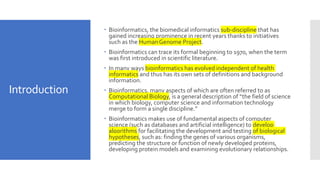
 Bioinformatics, the biomedical informatics sub-discipline that has
gained increasing prominence in recent years thanks to initiatives
such as the Human Genome Project.
 Bioinformatics can trace its formal beginning to 1970, when the term
was first introduced in scientific literature.
 In many ways bioinformatics has evolved independent of health
informatics and thus has its own sets of definitions and background
information.
 Bioinformatics, many aspects of which are often referred to as
Computational Biology, is a general description of “the field of science
in which biology, computer science and information technology
merge to form a single discipline.”
 Bioinformatics makes use of fundamental aspects of computer
science (such as databases and artificial intelligence) to develop
algorithms for facilitating the development and testing of biological
hypotheses, such as: finding the genes of various organisms,
predicting the structure or function of newly developed proteins,
developing protein models and examining evolutionary relationships.
Healthcare
Informatics
andAnalytics
for Improved
Healthcare
System
 Healthcare Informatics focuses on health data, information and
knowledge, including their collection, processing, analysis and
use.
 Bioinformatics employ computational tools and techniques to
study and analyze large biological databases and to absolutely
understand disease and grasp the genetics and proteomics by
relating them with healthcare data.
 The focus is on processing genomic and proteomics data for basic
research in biology, but also medicine, drug discovery, and
related areas.
 Analytics in healthcare came as a result of large healthcare data
that are being gathered electronically. Data analytics is
proficient in terms of healthcare improvement, reduction in
cost and safety of lives.
 Applications of data analytics in healthcare is as a result of the
eruption in data to mine understandings so as to make informed
decisions.
The overlap
among
bioinformatics,
healthcare
informatics
and analytics
 Healthcare Informatics focus is on data and its use in decision-
making. Computer science and information technology only
provide tools in doing so.
 Bioinformatics thus employ computational tools and techniques
to study and analyze large biological databases and to absolutely
understand disease and grasp the genetics and proteomics by
relating them with healthcare data.
 The knowledge of the genetic mechanism of a disease makes it
simple for the physician to diagnose more correctly.
 One of the upcoming prospects is possibility of using genes
instead of medicines to cure specific disease by varying diseased
protein expression.
 This opportunity is enhanced by gene therapy techniques.
Although, the technique is still in the trial stages but there are
positive likelihoods that in the future, the technique will be
recognized.
What is
bioinformatics
?
 Bioinformatics is fundamental to much biological research and
involves biologists who learn programming, or computer
programmers, mathematicians or database managers who learn
the foundations of biology.
 Modern science isn’t simply about publishing one set of results
and hoping other researchers read it. It’s about linking everything
that is out there, to provide new insights that we can only spot if
we can see the big picture. Bioinformatics lets us bring together
the data from lots of experiments in one place, so we can ask
those big questions – and find the answers.
 Bioinformatics enables us to handle the huge amounts of data
involved and make sense of them.
What is
bioinformatics
?
 Bioinformatics involves processing, storing and analysing
biological data.
 This might include:
 Creating databases to store experimental data
 Predicting the way that proteins fold up
 Modelling how all the chemical reactions in a cell interact with each
other
 Bioinformatics is a broad field and needs a diverse range of people
with diverse skill sets.
 Programmers to write the computer programs to analyse all this
data, database administrators to organise storing it all, biological
scientists and statisticians to analyse the data, and web designers
to produce sites and apps that scientists can use to search all this
data.
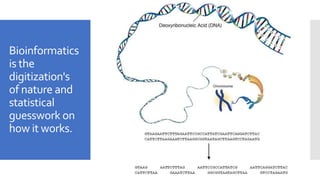
Bioinformatics
is the
digitization's
of nature and
statistical
guesswork on
how it works.
Components
of
Bioinformatics
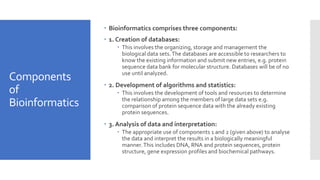
 Bioinformatics comprises three components:
 1. Creation of databases:
 This involves the organizing, storage and management the
biological data sets.The databases are accessible to researchers to
know the existing information and submit new entries, e.g. protein
sequence data bank for molecular structure. Databases will be of no
use until analyzed.
 2. Development of algorithms and statistics:
 This involves the development of tools and resources to determine
the relationship among the members of large data sets e.g.
comparison of protein sequence data with the already existing
protein sequences.
 3. Analysis of data and interpretation:
 The appropriate use of components 1 and 2 (given above) to analyse
the data and interpret the results in a biologically meaningful
manner.This includes DNA, RNA and protein sequences, protein
structure, gene expression profiles and biochemical pathways.
Applications of
Bioinformatics
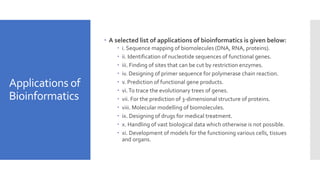
 A selected list of applications of bioinformatics is given below:
 i. Sequence mapping of biomolecules (DNA, RNA, proteins).
 ii. Identification of nucleotide sequences of functional genes.
 iii. Finding of sites that can be cut by restriction enzymes.
 iv. Designing of primer sequence for polymerase chain reaction.
 v. Prediction of functional gene products.
 vi.To trace the evolutionary trees of genes.
 vii. For the prediction of 3-dimensional structure of proteins.
 viii. Molecular modelling of biomolecules.
 ix. Designing of drugs for medical treatment.
 x. Handling of vast biological data which otherwise is not possible.
 xi. Development of models for the functioning various cells, tissues
and organs.
DNASequence
Examples
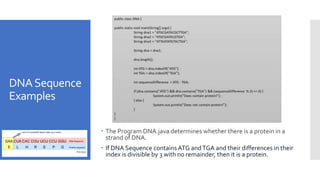
 The Program DNA.java determines whether there is a protein in a
strand of DNA.
 If DNA Sequence containsATG andTGA and their differences in their
index is divisible by 3 with no remainder, then it is a protein.
DNASequence
Alignment
with Dynamic
Programming
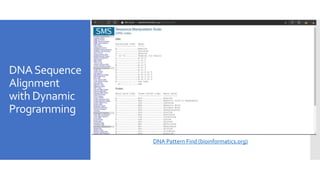
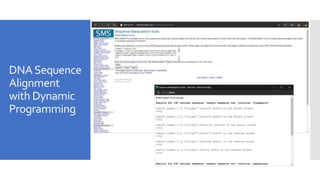
DNA Pattern Find (bioinformatics.org)
DNASequence
Alignment
with Dynamic
Programming
Intelligent
Monitoring
andControl for
Improved
Healthcare
System
 The currently hyped expectation of personalized medicine is often
associated with just achieving the information technology led
integration of biomolecular sequencing, expression and
histopathological bioimaging data with clinical records at the
individual patients’ level as if the significant biomedical
conclusions would be its more or less mandatory result.
 It remains a sad fact that many, if not most biomolecular
mechanisms that translate the human genomic information into
phenotypes are not known and, thus, most of the molecular and
cellular data cannot be interpreted in terms of biomedically
relevant conclusions.
 Whereas the historical trend will certainly be into the general
direction of personalized diagnostics and cures, the temperate
view suggests that biomedical applications that rely either on the
comparison of biomolecular sequences and/or on the already
known biomolecular mechanisms have much greater chances to
enter clinical practice soon.
Intelligent
Monitoring
andControl for
Improved
Healthcare
System
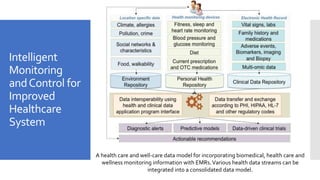
A health care and well-care data model for incorporating biomedical, health care and
wellness monitoring information with EMRs.Various health data streams can be
integrated into a consolidated data model.
ThankYou!

Health Informatics- Module 5-Chapter 3.pptx

  • 1.
  • 2.
    Module 5: Chapter 3 INFORMATIONPRIVACY AND SECURITY HEALTH INFORMATICS ETHICS BIOINFORMATICS
  • 3.
    Module Content  Information Privacyand Security:TheValue and Importance of Health Information Privacy, security of health data, potential technical approaches to health data privacy and security.  Health Informatics Ethics: Artificial Intelligence, Machine Learning, and Ethics with respect to Healthcare informatics, Ethics, Standards and Public Policy.  Bioinformatics: Bioinformatics, Healthcare Informatics and Analytics for Improved Healthcare System, Intelligent Monitoring and Control for Improved Healthcare System.
  • 4.
    LearningObjectives  Define bioinformaticsand other bioinformatics- related terms  State the importance of bioinformatics in future medical treatments and prevention  Describe the Human Genome Project and its important implications for health care  Describe the application of bioinformatics in genetic profiling of individuals and large populations
  • 5.
    Introduction  Bioinformatics, thebiomedical informatics sub-discipline that has gained increasing prominence in recent years thanks to initiatives such as the Human Genome Project.  Bioinformatics can trace its formal beginning to 1970, when the term was first introduced in scientific literature.  In many ways bioinformatics has evolved independent of health informatics and thus has its own sets of definitions and background information.  Bioinformatics, many aspects of which are often referred to as Computational Biology, is a general description of “the field of science in which biology, computer science and information technology merge to form a single discipline.”  Bioinformatics makes use of fundamental aspects of computer science (such as databases and artificial intelligence) to develop algorithms for facilitating the development and testing of biological hypotheses, such as: finding the genes of various organisms, predicting the structure or function of newly developed proteins, developing protein models and examining evolutionary relationships.
  • 6.
    Healthcare Informatics andAnalytics for Improved Healthcare System  HealthcareInformatics focuses on health data, information and knowledge, including their collection, processing, analysis and use.  Bioinformatics employ computational tools and techniques to study and analyze large biological databases and to absolutely understand disease and grasp the genetics and proteomics by relating them with healthcare data.  The focus is on processing genomic and proteomics data for basic research in biology, but also medicine, drug discovery, and related areas.  Analytics in healthcare came as a result of large healthcare data that are being gathered electronically. Data analytics is proficient in terms of healthcare improvement, reduction in cost and safety of lives.  Applications of data analytics in healthcare is as a result of the eruption in data to mine understandings so as to make informed decisions.
  • 7.
    The overlap among bioinformatics, healthcare informatics and analytics Healthcare Informatics focus is on data and its use in decision- making. Computer science and information technology only provide tools in doing so.  Bioinformatics thus employ computational tools and techniques to study and analyze large biological databases and to absolutely understand disease and grasp the genetics and proteomics by relating them with healthcare data.  The knowledge of the genetic mechanism of a disease makes it simple for the physician to diagnose more correctly.  One of the upcoming prospects is possibility of using genes instead of medicines to cure specific disease by varying diseased protein expression.  This opportunity is enhanced by gene therapy techniques. Although, the technique is still in the trial stages but there are positive likelihoods that in the future, the technique will be recognized.
  • 8.
    What is bioinformatics ?  Bioinformaticsis fundamental to much biological research and involves biologists who learn programming, or computer programmers, mathematicians or database managers who learn the foundations of biology.  Modern science isn’t simply about publishing one set of results and hoping other researchers read it. It’s about linking everything that is out there, to provide new insights that we can only spot if we can see the big picture. Bioinformatics lets us bring together the data from lots of experiments in one place, so we can ask those big questions – and find the answers.  Bioinformatics enables us to handle the huge amounts of data involved and make sense of them.
  • 9.
    What is bioinformatics ?  Bioinformaticsinvolves processing, storing and analysing biological data.  This might include:  Creating databases to store experimental data  Predicting the way that proteins fold up  Modelling how all the chemical reactions in a cell interact with each other  Bioinformatics is a broad field and needs a diverse range of people with diverse skill sets.  Programmers to write the computer programs to analyse all this data, database administrators to organise storing it all, biological scientists and statisticians to analyse the data, and web designers to produce sites and apps that scientists can use to search all this data.
  • 10.
    Bioinformatics is the digitization's of natureand statistical guesswork on how it works.
  • 11.
    Components of Bioinformatics  Bioinformatics comprisesthree components:  1. Creation of databases:  This involves the organizing, storage and management the biological data sets.The databases are accessible to researchers to know the existing information and submit new entries, e.g. protein sequence data bank for molecular structure. Databases will be of no use until analyzed.  2. Development of algorithms and statistics:  This involves the development of tools and resources to determine the relationship among the members of large data sets e.g. comparison of protein sequence data with the already existing protein sequences.  3. Analysis of data and interpretation:  The appropriate use of components 1 and 2 (given above) to analyse the data and interpret the results in a biologically meaningful manner.This includes DNA, RNA and protein sequences, protein structure, gene expression profiles and biochemical pathways.
  • 12.
    Applications of Bioinformatics  Aselected list of applications of bioinformatics is given below:  i. Sequence mapping of biomolecules (DNA, RNA, proteins).  ii. Identification of nucleotide sequences of functional genes.  iii. Finding of sites that can be cut by restriction enzymes.  iv. Designing of primer sequence for polymerase chain reaction.  v. Prediction of functional gene products.  vi.To trace the evolutionary trees of genes.  vii. For the prediction of 3-dimensional structure of proteins.  viii. Molecular modelling of biomolecules.  ix. Designing of drugs for medical treatment.  x. Handling of vast biological data which otherwise is not possible.  xi. Development of models for the functioning various cells, tissues and organs.
  • 13.
    DNASequence Examples  The ProgramDNA.java determines whether there is a protein in a strand of DNA.  If DNA Sequence containsATG andTGA and their differences in their index is divisible by 3 with no remainder, then it is a protein.
  • 14.
  • 15.
  • 16.
    Intelligent Monitoring andControl for Improved Healthcare System  Thecurrently hyped expectation of personalized medicine is often associated with just achieving the information technology led integration of biomolecular sequencing, expression and histopathological bioimaging data with clinical records at the individual patients’ level as if the significant biomedical conclusions would be its more or less mandatory result.  It remains a sad fact that many, if not most biomolecular mechanisms that translate the human genomic information into phenotypes are not known and, thus, most of the molecular and cellular data cannot be interpreted in terms of biomedically relevant conclusions.  Whereas the historical trend will certainly be into the general direction of personalized diagnostics and cures, the temperate view suggests that biomedical applications that rely either on the comparison of biomolecular sequences and/or on the already known biomolecular mechanisms have much greater chances to enter clinical practice soon.
  • 17.
    Intelligent Monitoring andControl for Improved Healthcare System A healthcare and well-care data model for incorporating biomedical, health care and wellness monitoring information with EMRs.Various health data streams can be integrated into a consolidated data model.
  • 18.