Health
Informatics
BCA-2020: Semester-V
Module 4:
Chapter 2
DESIGNAND EVALUATION
OF INFORMATION
SYSTEMSAND SERVICES
QUALITY IMPROVEMENT
STRATEGIES
PROTOCOLSAND
EVIDENCE BASED
HEALTHCARE
Module
Content
 Design and Evaluation of Information Systems and Services:
principles of designing information systems, strategies for
Information system evaluation, Information Systems
Effectiveness Measures.
 Quality Improvement Strategies: quality improvement tools,
factors that help to create and sustain Healthcare Informatics as a
new field. quality improvement cycle: PDCA (Plan, Do, Check,Act)
Cycle.
 Protocols and Evidence based Healthcare: information
technology tools to support best practices in health care,
information technology tools that inform and empower patients.
LearningObjectives
 Quality improvement tools
 Factors that help to create and sustain Healthcare
Informatics as a new field
 Quality improvement cycle: PDCA (Plan, Do,
Check, Act) Cycle.
Introduction
 Interestingly, some of the most common words in medicine are
the most difficult to define and “quality” is one of those hard to
describe terms.
 One approach to quality is to say that it is the standard of care for
the society in which the physician practices.
 In other words, poor quality care is care that does not meet the
current standard of care.
 Clearly, this definition relies on our knowing the current standard
of care. One can say that the current standard of care is the
practice of evidence-based medicine and, in the situation where
there is little reliable evidence, the care provided by most
experienced physicians.
Six criteria of
the right
health
care
 Safe: care does not harm patients
 Effective: care prevents disease and complications and minimizes
suffering, disability and death
 Efficient: patients receive care without waste
 Patient centered: care is coordinated and continuous; patients
are informed and educated and involved in decision making
 Timely: patients and staff do not experience unwanted delay
 Equitable: care is equal, regardless of race, language, personal
resources, diagnosis or condition
Quality
Improvement
Roadmap
 Publish quality measurements and information: Use the same
performance measures among all health care organizations and
select those that are the most evidence based
 Pay-for-performance: “quality improvement and reimbursement
methodology aimed at changing current payment structure which
primarily reimburses based on the number of services provided
regardless of outcome. Attempts to introduce market forces and
competition to promote payment for quality, access, efficiency
and successful outcomes.”
 Promote health information technology: Includes the adoption
of electronic health records, e-prescribing and health information
exchanges
 Work through partnerships: Select national, federal, and civilian
quality-oriented partners (e.g. Agency for Healthcare Research
and Quality, NationalQuality Forum, American Health Quality
Association and NationalCommittee on Quality Assurance)
 Improve access to better treatments: Accelerate the availability
and effective use of the best treatments
Factors that
help to create
and sustain
Healthcare
Informatics
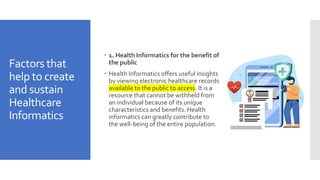
 1. Health Informatics for the benefit of
the public
 Health Informatics offers useful insights
by viewing electronic healthcare records
available to the public to access. It is a
resource that cannot be withheld from
an individual because of its unique
characteristics and benefits. Health
informatics can greatly contribute to
the well-being of the entire population.
Factors that
help to create
and sustain
Healthcare
Informatics
 2.Voice Dictation
 Since healthcare organizations have
incorporated digital technology, health
informatics improves artificial
intelligence voice recognition to
transcribe providers’ notes and medical
orders in real-time.This can reduce the
time spent on data entry and increase
providers’ time interacting directly with
their patients. Innovative health
informatics enables us to find a voice
recognition solution that is accurate and
time-efficient.
Factors that
help to create
and sustain
Healthcare
Informatics
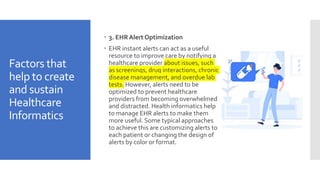
 3. EHR Alert Optimization
 EHR instant alerts can act as a useful
resource to improve care by notifying a
healthcare provider about issues, such
as screenings, drug interactions, chronic
disease management, and overdue lab
tests. However, alerts need to be
optimized to prevent healthcare
providers from becoming overwhelmed
and distracted. Health informatics help
to manage EHR alerts to make them
more useful. Some typical approaches
to achieve this are customizing alerts to
each patient or changing the design of
alerts by color or format.
Factors that
help to create
and sustain
Healthcare
Informatics
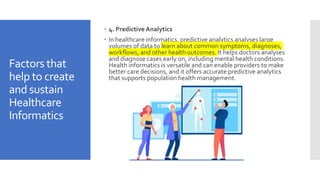
 4. Predictive Analytics
 In healthcare informatics, predictive analytics analyses large
volumes of data to learn about common symptoms, diagnoses,
workflows, and other health outcomes. It helps doctors analyses
and diagnose cases early on, including mental health conditions.
Health informatics is versatile and can enable providers to make
better care decisions, and it offers accurate predictive analytics
that supports population health management.
Factors that
help to create
and sustain
Healthcare
Informatics
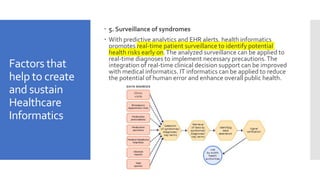
 5. Surveillance of syndromes
 With predictive analytics and EHR alerts, health informatics
promotes real-time patient surveillance to identify potential
health risks early on.The analyzed surveillance can be applied to
real-time diagnoses to implement necessary precautions.The
integration of real-time clinical decision support can be improved
with medical informatics. IT informatics can be applied to reduce
the potential of human error and enhance overall public health.
Factors that
help to create
and sustain
Healthcare
Informatics
 6. Savings
 Healthcare is expensive, where it is estimated that half of all
medical expenditures are spent on repeated procedures, delays in
care, and errors in care or delivery. Health informatics manages
the costs by making everything electronic and connected and
saving time. Lab results reach physicians sooner, patients can
access and download their data quickly, and providers can discuss
integrated care cases soon to arrive at decisions quickly.
Factors that
help to create
and sustain
Healthcare
Informatics
 7. Shared Knowledge
 Clinical informatics offers insights into patients, diseases, and
medicines. Since knowledge is easily passed between providers
and patients, health informatics enhances practice management.
In this way, clinical informatics technology helps everyone within
the care chain, from hospital administrators and physicians to
pharmacists and patients.
Factors that
help to create
and sustain
Healthcare
Informatics
 8. Patient Participation
 Health informatics provides patients access to their electronic health
history and recommendations.This empowers them to participate in
their treatment actively. Patients who can access care portals can
educate themselves better about their diagnoses and manage their
symptoms.These patients can also interact with doctors and nurses
more easily, resulting in better health outcomes. Health informatics
allows patients to feel important in their health treatment.
Factors that
help to create
and sustain
Healthcare
Informatics
 9. Improved Patient Outcomes
 One of the significant ways health informatics transforms healthcare
is improved patient outcomes. Electronic medical records enable
providers to deliver higher quality care and secure care.This is because
health informatics improves predictive analysis that supports better
diagnoses and decreases errors. Clinicians and nurses can increase
performance efficiency with medical informatics technology. In this
way, health informatics frees up physicians’ time with patients by
automating manual operations and improving cost-efficiency.
Factors that
help to create
and sustain
Healthcare
Informatics
 10. Better and more efficient data
storage
 Most medical facilities use traditional
manual methods to store patient records
for a long period. Even now, this is true
for many healthcare institutions dealing
with tons of files and paperwork daily.
This is a major concern in modern
healthcare, and it can be addressed with
health informatics. Healthcare
informatics makes data accessible,
where doctors can get hands-on the
right information quickly.This is time-
consuming and helps to diagnose cases
rapidly.Clinical informatics also manages
the administrative workload and
improves their performance efficiency.
Providers are also notified about
potential health risks through predictive
analysis with health informatics.
Factors that
help to create
and sustain
Healthcare
Informatics
 11. Improved healthcare marketing
 It is important to realize its significance in marketing when learning about
health informatics. Marketing is not just proving that one medical practice is
better than the other. Healthcare marketing is about patient education, and
both marketers and healthcare professionals must understand it.
 With health informatics, private practices and hospitals better introduce their
services to people. For example, hospitals can spread awareness about an
emerging trend in health care. Many practices use social media platforms to
communicate services with health informatics.They use videos, images, and
informative content to promote services to patients and gain better patient
outcomes.
Factors that
help to create
and sustain
Healthcare
Informatics
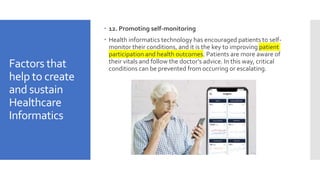
 12. Promoting self-monitoring
 Health informatics technology has encouraged patients to self-
monitor their conditions, and it is the key to improving patient
participation and health outcomes. Patients are more aware of
their vitals and follow the doctor’s advice. In this way, critical
conditions can be prevented from occurring or escalating.
Factors that
help to create
and sustain
Healthcare
Informatics
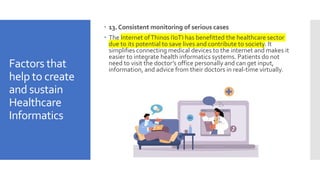
 13. Consistent monitoring of serious cases
 The Internet ofThings (IoT) has benefitted the healthcare sector
due to its potential to save lives and contribute to society. It
simplifies connecting medical devices to the internet and makes it
easier to integrate health informatics systems. Patients do not
need to visit the doctor’s office personally and can get input,
information, and advice from their doctors in real-time virtually.
Factors that
help to create
and sustain
Healthcare
Informatics
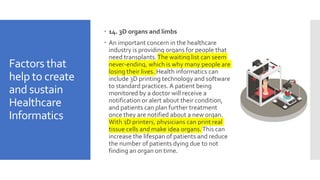
 14. 3D organs and limbs
 An important concern in the healthcare
industry is providing organs for people that
need transplants.The waiting list can seem
never-ending, which is why many people are
losing their lives. Health informatics can
include 3D printing technology and software
to standard practices. A patient being
monitored by a doctor will receive a
notification or alert about their condition,
and patients can plan further treatment
once they are notified about a new organ.
With 3D printers, physicians can print real
tissue cells and make idea organs.This can
increase the lifespan of patients and reduce
the number of patients dying due to not
finding an organ on time.
Factors that
help to create
and sustain
Healthcare
Informatics
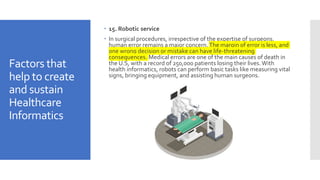
 15. Robotic service
 In surgical procedures, irrespective of the expertise of surgeons,
human error remains a major concern. The margin of error is less, and
one wrong decision or mistake can have life-threatening
consequences. Medical errors are one of the main causes of death in
the U.S, with a record of 250,000 patients losing their lives.With
health informatics, robots can perform basic tasks like measuring vital
signs, bringing equipment, and assisting human surgeons.
Factors that
help to create
and sustain
Healthcare
Informatics
 16. Privacy
 Health informatics is crucial for data confidentiality and patient
privacy. It ensures that no data breaches and issues related to
compromised data are managed. Doctor’s notes and diagnoses
are recorded safely on cloud-based systems. Patients will trust
their physicians and will not hesitate to supply vital information.
Health informatics can support the secure exchange of data from
multiple smart devices.
Quality
improvement
cycle: PDCA
(Plan, Do,
Check,Act)
Cycle.
 What Is PDCA?
 In the 1950s, management consultant DrWilliam Edwards Deming
developed a method of identifying why some products or
processes don't work as hoped. His approach has since become a
popular strategy tool, used by many different types of
organizations. It allows them to formulate theories about what
needs to change, and then test them in a "continuous feedback
loop."
The Four
Phases of the
PDCACycle
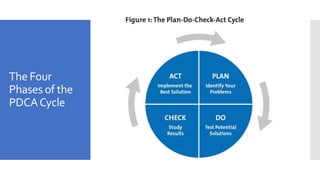
 With the PDCA cycle you can solve problems and implement
solutions in a rigorous, methodical way. Let's look at each of the
four stages in turn:
 1. Plan
 First, identify and understand your problem or opportunity.
Perhaps the standard of a finished product isn't high enough, or an
aspect of your marketing process should be getting better results.
 Explore the information available in full. Generate and screen
ideas, and develop a robust implementation plan.
 Be sure to state your success criteria and make them as
measurable as possible.You'll return to them later in the Check
stage.
The Four
Phases of the
PDCACycle
 2. Do
 Once you've identified a potential solution, test it safely with a small-scale
pilot project.This will show whether your proposed changes achieve the
desired outcome – with minimal disruption to the rest of your operation if
they don't. For example, you could organize a trial within a department, in a
limited geographical area, or with a particular demographic.
 As you run the pilot project, gather data to show whether the change has
worked or not.You'll use this in the next stage.
 3. Check
 Next, analyze your pilot project's results against the criteria that you defined
in Step 1, to assess whether your idea was a success.
 If it wasn't, return to Step 1. If it was, advance to Step 4.
 You may decide to try out more changes, and repeat the Do and Check
phases. But if your original plan definitely isn't working, you'll need to return
to Step 1.
 4. Act
 This is where you implement your solution. But remember that PDCA/PDSA is
a loop, not a process with a beginning and end.Your improved process or
product becomes the new baseline, but you continue to look for ways to make
it even better.
The Four
Phases of the
PDCACycle
When toUse
PDCA
 The PDCA/PDSA framework works well in all types of organizations. It
can be used to improve any process or product, by breaking them
down into smaller steps or development stages, and exploring ways to
improve each one.
 It's particularly helpful for implementingTotal Quality Management
or Six Sigma initiatives, and for improving business processes
generally.
 However, going through the PDCA/PDSA cycle can be much slower
than a straightforward, "gung ho" implementation. So, it might not be
the appropriate approach for dealing with an urgent problem.
 It also requires significant buy-in from team members, and offers
fewer opportunities for radical innovation – which may be what your
organization needs instead.
ThankYou!

Health Informatics- Module 4-Chapter 2.pptx

  • 1.
  • 2.
    Module 4: Chapter 2 DESIGNANDEVALUATION OF INFORMATION SYSTEMSAND SERVICES QUALITY IMPROVEMENT STRATEGIES PROTOCOLSAND EVIDENCE BASED HEALTHCARE
  • 3.
    Module Content  Design andEvaluation of Information Systems and Services: principles of designing information systems, strategies for Information system evaluation, Information Systems Effectiveness Measures.  Quality Improvement Strategies: quality improvement tools, factors that help to create and sustain Healthcare Informatics as a new field. quality improvement cycle: PDCA (Plan, Do, Check,Act) Cycle.  Protocols and Evidence based Healthcare: information technology tools to support best practices in health care, information technology tools that inform and empower patients.
  • 4.
    LearningObjectives  Quality improvementtools  Factors that help to create and sustain Healthcare Informatics as a new field  Quality improvement cycle: PDCA (Plan, Do, Check, Act) Cycle.
  • 5.
    Introduction  Interestingly, someof the most common words in medicine are the most difficult to define and “quality” is one of those hard to describe terms.  One approach to quality is to say that it is the standard of care for the society in which the physician practices.  In other words, poor quality care is care that does not meet the current standard of care.  Clearly, this definition relies on our knowing the current standard of care. One can say that the current standard of care is the practice of evidence-based medicine and, in the situation where there is little reliable evidence, the care provided by most experienced physicians.
  • 6.
    Six criteria of theright health care  Safe: care does not harm patients  Effective: care prevents disease and complications and minimizes suffering, disability and death  Efficient: patients receive care without waste  Patient centered: care is coordinated and continuous; patients are informed and educated and involved in decision making  Timely: patients and staff do not experience unwanted delay  Equitable: care is equal, regardless of race, language, personal resources, diagnosis or condition
  • 7.
    Quality Improvement Roadmap  Publish qualitymeasurements and information: Use the same performance measures among all health care organizations and select those that are the most evidence based  Pay-for-performance: “quality improvement and reimbursement methodology aimed at changing current payment structure which primarily reimburses based on the number of services provided regardless of outcome. Attempts to introduce market forces and competition to promote payment for quality, access, efficiency and successful outcomes.”  Promote health information technology: Includes the adoption of electronic health records, e-prescribing and health information exchanges  Work through partnerships: Select national, federal, and civilian quality-oriented partners (e.g. Agency for Healthcare Research and Quality, NationalQuality Forum, American Health Quality Association and NationalCommittee on Quality Assurance)  Improve access to better treatments: Accelerate the availability and effective use of the best treatments
  • 8.
    Factors that help tocreate and sustain Healthcare Informatics  1. Health Informatics for the benefit of the public  Health Informatics offers useful insights by viewing electronic healthcare records available to the public to access. It is a resource that cannot be withheld from an individual because of its unique characteristics and benefits. Health informatics can greatly contribute to the well-being of the entire population.
  • 9.
    Factors that help tocreate and sustain Healthcare Informatics  2.Voice Dictation  Since healthcare organizations have incorporated digital technology, health informatics improves artificial intelligence voice recognition to transcribe providers’ notes and medical orders in real-time.This can reduce the time spent on data entry and increase providers’ time interacting directly with their patients. Innovative health informatics enables us to find a voice recognition solution that is accurate and time-efficient.
  • 10.
    Factors that help tocreate and sustain Healthcare Informatics  3. EHR Alert Optimization  EHR instant alerts can act as a useful resource to improve care by notifying a healthcare provider about issues, such as screenings, drug interactions, chronic disease management, and overdue lab tests. However, alerts need to be optimized to prevent healthcare providers from becoming overwhelmed and distracted. Health informatics help to manage EHR alerts to make them more useful. Some typical approaches to achieve this are customizing alerts to each patient or changing the design of alerts by color or format.
  • 11.
    Factors that help tocreate and sustain Healthcare Informatics  4. Predictive Analytics  In healthcare informatics, predictive analytics analyses large volumes of data to learn about common symptoms, diagnoses, workflows, and other health outcomes. It helps doctors analyses and diagnose cases early on, including mental health conditions. Health informatics is versatile and can enable providers to make better care decisions, and it offers accurate predictive analytics that supports population health management.
  • 12.
    Factors that help tocreate and sustain Healthcare Informatics  5. Surveillance of syndromes  With predictive analytics and EHR alerts, health informatics promotes real-time patient surveillance to identify potential health risks early on.The analyzed surveillance can be applied to real-time diagnoses to implement necessary precautions.The integration of real-time clinical decision support can be improved with medical informatics. IT informatics can be applied to reduce the potential of human error and enhance overall public health.
  • 13.
    Factors that help tocreate and sustain Healthcare Informatics  6. Savings  Healthcare is expensive, where it is estimated that half of all medical expenditures are spent on repeated procedures, delays in care, and errors in care or delivery. Health informatics manages the costs by making everything electronic and connected and saving time. Lab results reach physicians sooner, patients can access and download their data quickly, and providers can discuss integrated care cases soon to arrive at decisions quickly.
  • 14.
    Factors that help tocreate and sustain Healthcare Informatics  7. Shared Knowledge  Clinical informatics offers insights into patients, diseases, and medicines. Since knowledge is easily passed between providers and patients, health informatics enhances practice management. In this way, clinical informatics technology helps everyone within the care chain, from hospital administrators and physicians to pharmacists and patients.
  • 15.
    Factors that help tocreate and sustain Healthcare Informatics  8. Patient Participation  Health informatics provides patients access to their electronic health history and recommendations.This empowers them to participate in their treatment actively. Patients who can access care portals can educate themselves better about their diagnoses and manage their symptoms.These patients can also interact with doctors and nurses more easily, resulting in better health outcomes. Health informatics allows patients to feel important in their health treatment.
  • 16.
    Factors that help tocreate and sustain Healthcare Informatics  9. Improved Patient Outcomes  One of the significant ways health informatics transforms healthcare is improved patient outcomes. Electronic medical records enable providers to deliver higher quality care and secure care.This is because health informatics improves predictive analysis that supports better diagnoses and decreases errors. Clinicians and nurses can increase performance efficiency with medical informatics technology. In this way, health informatics frees up physicians’ time with patients by automating manual operations and improving cost-efficiency.
  • 17.
    Factors that help tocreate and sustain Healthcare Informatics  10. Better and more efficient data storage  Most medical facilities use traditional manual methods to store patient records for a long period. Even now, this is true for many healthcare institutions dealing with tons of files and paperwork daily. This is a major concern in modern healthcare, and it can be addressed with health informatics. Healthcare informatics makes data accessible, where doctors can get hands-on the right information quickly.This is time- consuming and helps to diagnose cases rapidly.Clinical informatics also manages the administrative workload and improves their performance efficiency. Providers are also notified about potential health risks through predictive analysis with health informatics.
  • 18.
    Factors that help tocreate and sustain Healthcare Informatics  11. Improved healthcare marketing  It is important to realize its significance in marketing when learning about health informatics. Marketing is not just proving that one medical practice is better than the other. Healthcare marketing is about patient education, and both marketers and healthcare professionals must understand it.  With health informatics, private practices and hospitals better introduce their services to people. For example, hospitals can spread awareness about an emerging trend in health care. Many practices use social media platforms to communicate services with health informatics.They use videos, images, and informative content to promote services to patients and gain better patient outcomes.
  • 19.
    Factors that help tocreate and sustain Healthcare Informatics  12. Promoting self-monitoring  Health informatics technology has encouraged patients to self- monitor their conditions, and it is the key to improving patient participation and health outcomes. Patients are more aware of their vitals and follow the doctor’s advice. In this way, critical conditions can be prevented from occurring or escalating.
  • 20.
    Factors that help tocreate and sustain Healthcare Informatics  13. Consistent monitoring of serious cases  The Internet ofThings (IoT) has benefitted the healthcare sector due to its potential to save lives and contribute to society. It simplifies connecting medical devices to the internet and makes it easier to integrate health informatics systems. Patients do not need to visit the doctor’s office personally and can get input, information, and advice from their doctors in real-time virtually.
  • 21.
    Factors that help tocreate and sustain Healthcare Informatics  14. 3D organs and limbs  An important concern in the healthcare industry is providing organs for people that need transplants.The waiting list can seem never-ending, which is why many people are losing their lives. Health informatics can include 3D printing technology and software to standard practices. A patient being monitored by a doctor will receive a notification or alert about their condition, and patients can plan further treatment once they are notified about a new organ. With 3D printers, physicians can print real tissue cells and make idea organs.This can increase the lifespan of patients and reduce the number of patients dying due to not finding an organ on time.
  • 22.
    Factors that help tocreate and sustain Healthcare Informatics  15. Robotic service  In surgical procedures, irrespective of the expertise of surgeons, human error remains a major concern. The margin of error is less, and one wrong decision or mistake can have life-threatening consequences. Medical errors are one of the main causes of death in the U.S, with a record of 250,000 patients losing their lives.With health informatics, robots can perform basic tasks like measuring vital signs, bringing equipment, and assisting human surgeons.
  • 23.
    Factors that help tocreate and sustain Healthcare Informatics  16. Privacy  Health informatics is crucial for data confidentiality and patient privacy. It ensures that no data breaches and issues related to compromised data are managed. Doctor’s notes and diagnoses are recorded safely on cloud-based systems. Patients will trust their physicians and will not hesitate to supply vital information. Health informatics can support the secure exchange of data from multiple smart devices.
  • 24.
    Quality improvement cycle: PDCA (Plan, Do, Check,Act) Cycle. What Is PDCA?  In the 1950s, management consultant DrWilliam Edwards Deming developed a method of identifying why some products or processes don't work as hoped. His approach has since become a popular strategy tool, used by many different types of organizations. It allows them to formulate theories about what needs to change, and then test them in a "continuous feedback loop."
  • 25.
    The Four Phases ofthe PDCACycle  With the PDCA cycle you can solve problems and implement solutions in a rigorous, methodical way. Let's look at each of the four stages in turn:  1. Plan  First, identify and understand your problem or opportunity. Perhaps the standard of a finished product isn't high enough, or an aspect of your marketing process should be getting better results.  Explore the information available in full. Generate and screen ideas, and develop a robust implementation plan.  Be sure to state your success criteria and make them as measurable as possible.You'll return to them later in the Check stage.
  • 26.
    The Four Phases ofthe PDCACycle  2. Do  Once you've identified a potential solution, test it safely with a small-scale pilot project.This will show whether your proposed changes achieve the desired outcome – with minimal disruption to the rest of your operation if they don't. For example, you could organize a trial within a department, in a limited geographical area, or with a particular demographic.  As you run the pilot project, gather data to show whether the change has worked or not.You'll use this in the next stage.  3. Check  Next, analyze your pilot project's results against the criteria that you defined in Step 1, to assess whether your idea was a success.  If it wasn't, return to Step 1. If it was, advance to Step 4.  You may decide to try out more changes, and repeat the Do and Check phases. But if your original plan definitely isn't working, you'll need to return to Step 1.  4. Act  This is where you implement your solution. But remember that PDCA/PDSA is a loop, not a process with a beginning and end.Your improved process or product becomes the new baseline, but you continue to look for ways to make it even better.
  • 27.
    The Four Phases ofthe PDCACycle
  • 28.
    When toUse PDCA  ThePDCA/PDSA framework works well in all types of organizations. It can be used to improve any process or product, by breaking them down into smaller steps or development stages, and exploring ways to improve each one.  It's particularly helpful for implementingTotal Quality Management or Six Sigma initiatives, and for improving business processes generally.  However, going through the PDCA/PDSA cycle can be much slower than a straightforward, "gung ho" implementation. So, it might not be the appropriate approach for dealing with an urgent problem.  It also requires significant buy-in from team members, and offers fewer opportunities for radical innovation – which may be what your organization needs instead.
  • 29.