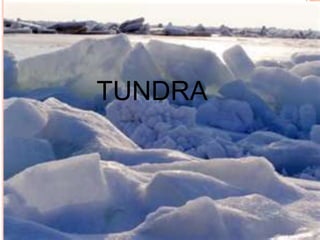
TUNDRA
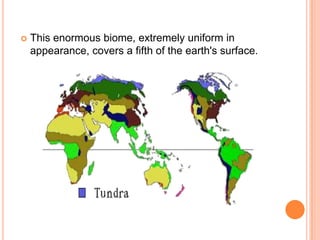
   This enormous biome, extremely uniform in
    appearance, covers a fifth of the earth's surface.
GENERAL CHARACTERISTICS

*Extremely cold climate

* Low biotic diversity

* Simple vegetation structure

* Short season of growth and reproduction

* Energy and nutrients in the form of dead
organic material
ABIOTIC FACTORS
   Sun’s oblique angle – receive little solar energy

   Low Temperatures – 29 degrees celsius to 7
    degrees celsius (winter) and not more than 10
    degrees celsius (summer)

   Short summer days – 6 to 10 weeks. sun shines
    almost 24 hours a day.

   Long winter – 9 months. almost 24 hours night
   Poor soil – reduced decomposition due to cold
    climate

   Strong winds

   Cold and dry climate – precipitation 6 to 10 inches
    of rain per year

   latitude – Arctic tundra or Alpine tundra

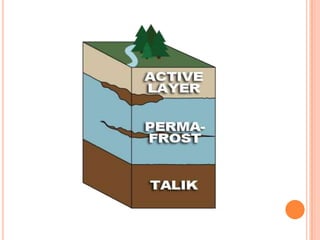
   Permafrost – layer of permanently frozen subsoil
    (600 meters deep)
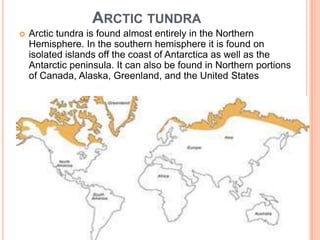
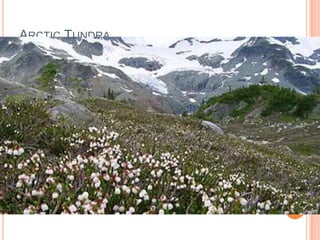
ARCTIC TUNDRA
   Arctic tundra is found almost entirely in the Northern
    Hemisphere. In the southern hemisphere it is found on
    isolated islands off the coast of Antarctica as well as the
    Antarctic peninsula. It can also be found in Northern portions
    of Canada, Alaska, Greenland, and the United States
ARCTIC TUNDRA
 higher latitude
 Short growing season – 50 to 60 days

 permafrost

 vegetation – protects the permafrost through
  shading and insulation
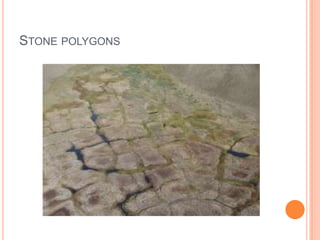
 Freezing and thawing of the upper layer of soil –
  unique, symmetrically patterned landforms. Action
  of frost
 Cryoplanation – molding of the landscape by frost
  action
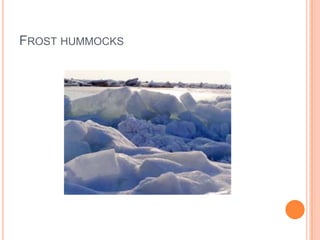
FROST HUMMOCKS
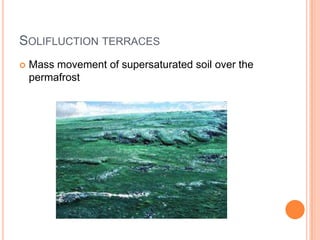
SOLIFLUCTION TERRACES
   Mass movement of supersaturated soil over the
    permafrost
ALPINE TUNDRA
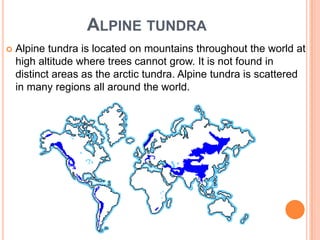
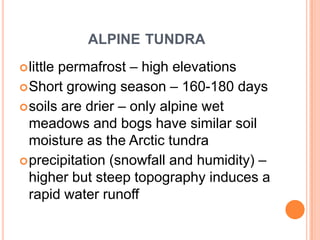
   Alpine tundra is located on mountains throughout the world at
    high altitude where trees cannot grow. It is not found in
    distinct areas as the arctic tundra. Alpine tundra is scattered
    in many regions all around the world.
ALPINE TUNDRA
       permafrost – high elevations
 little
 Short growing season – 160-180 days
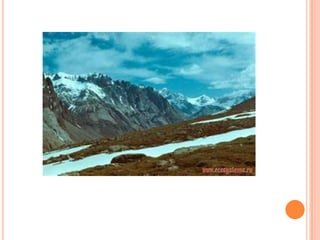
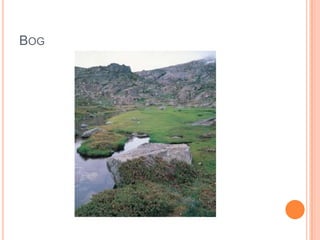
 soils are drier – only alpine wet
  meadows and bogs have similar soil
  moisture as the Arctic tundra
 precipitation (snowfall and humidity) –
  higher but steep topography induces a
  rapid water runoff
BOG
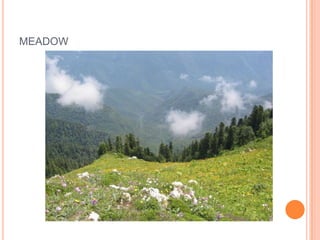
MEADOW
STONE POLYGONS
NUTRIENT CYCLING IN THE TUNDRA
 LowTemperatures and Extreme
 Seasonality Control Tundra
 Productivity and Nutrient Cycling
 Primary  production on the tundra is low, a
 consequence of low temperature and a
 short growing season ranging from 50-60
 days in the high Arctic to 160 days in the
 low-latitude alpine tundra.

 These physical constraints result in a low
 availability of nutrients that further function
 to reduce productivity
 Dead organic matter functions as the
 nutrient pool, but most of it is not directly
 available to plants.

 Because  the tundra soil does not store
 available nutrients in any great quantity,
 plants depend on the release of nutrients
 for decomposition, the uptake of which is
 often aided by mycorrhizae
 Leaching or removal of nutrients is minimal,
 occurring mostly at the beginning of the growing
 season. Melting snow releases nutrients frozen
 over winter in the litter, excreta of animals, and
 microbes.
A rapid upward movement of nutrients early in
 the season at the expense of below-ground
 biomass supports fast shoot growth. *

 Sixweeks into the growing season, plants start
 to send nutrients below-ground.

 As the cold approaches, the above ground
 tissues die, and their dead parts add to the
 accumulation of organic matter.

 Nutrients leached from the dead leaves are
 accumulated by mosses or are frozen into place
 until the following summer’s snowmelt
BIOTIC FACTORS
FLORA
ARCTIC TUNDRA
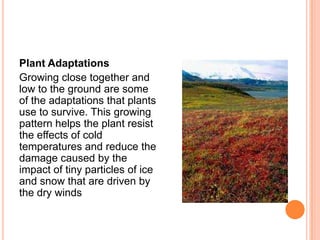
Plant Adaptations
Growing close together and
low to the ground are some
of the adaptations that plants
use to survive. This growing
pattern helps the plant resist
the effects of cold
temperatures and reduce the
damage caused by the
impact of tiny particles of ice
and snow that are driven by
the dry winds
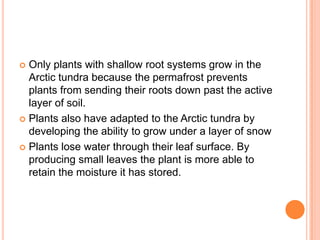
 Only plants with shallow root systems grow in the
  Arctic tundra because the permafrost prevents
  plants from sending their roots down past the active
  layer of soil.
 Plants also have adapted to the Arctic tundra by
  developing the ability to grow under a layer of snow
 Plants lose water through their leaf surface. By
  producing small leaves the plant is more able to
  retain the moisture it has stored.
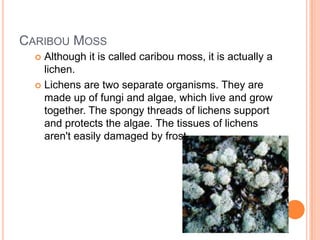
CARIBOU MOSS
   Although it is called caribou moss, it is actually a
    lichen.
   Lichens are two separate organisms. They are
    made up of fungi and algae, which live and grow
    together. The spongy threads of lichens support
    and protects the algae. The tissues of lichens
    aren't easily damaged by frost. .
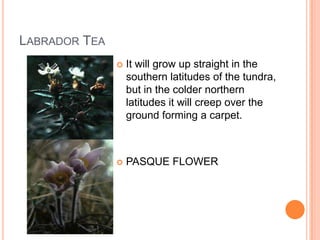
LABRADOR TEA
                  It will grow up straight in the
                   southern latitudes of the tundra,
                   but in the colder northern
                   latitudes it will creep over the
                   ground forming a carpet.


                  PASQUE FLOWER
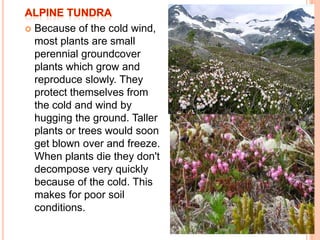
   Because of the cold wind,
    most plants are small
    perennial groundcover
    plants which grow and
    reproduce slowly. They
    protect themselves from
    the cold and wind by
    hugging the ground. Taller
    plants or trees would soon
    get blown over and freeze.
    When plants die they don't
    decompose very quickly
    because of the cold. This
    makes for poor soil
    conditions.
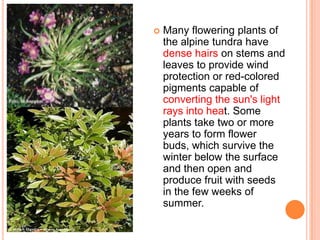
   Many flowering plants of
    the alpine tundra have
    dense hairs on stems and
    leaves to provide wind
    protection or red-colored
    pigments capable of
    converting the sun's light
    rays into heat. Some
    plants take two or more
    years to form flower
    buds, which survive the
    winter below the surface
    and then open and
    produce fruit with seeds
    in the few weeks of
    summer.
WHAT DOES THE SNOW DO TO HELP THE
PLANTS?

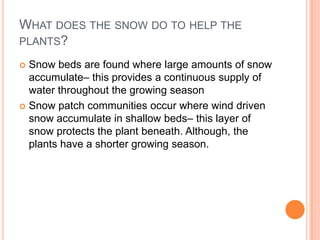
 Snow beds are found where large amounts of snow
  accumulate– this provides a continuous supply of
  water throughout the growing season
 Snow patch communities occur where wind driven
  snow accumulate in shallow beds– this layer of
  snow protects the plant beneath. Although, the
  plants have a shorter growing season.
FAUNA
Low in Diversity
Tundra animals are well Adapted to the Cold
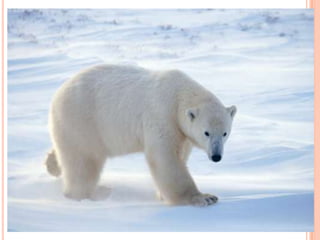
POLAR BEAR
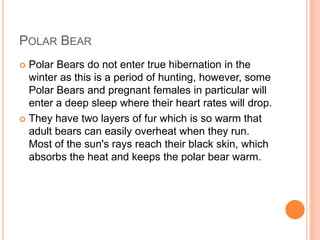
 Polar Bears do not enter true hibernation in the
  winter as this is a period of hunting, however, some
  Polar Bears and pregnant females in particular will
  enter a deep sleep where their heart rates will drop.
 They have two layers of fur which is so warm that
  adult bears can easily overheat when they run.
  Most of the sun's rays reach their black skin, which
  absorbs the heat and keeps the polar bear warm.
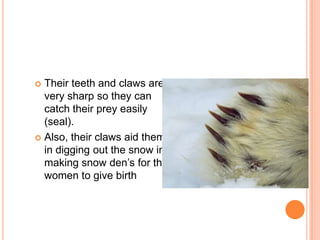
 Their teeth and claws are
  very sharp so they can
  catch their prey easily
  (seal).
 Also, their claws aid them
  in digging out the snow in
  making snow den’s for the
  women to give birth
   Repeated freezing and thawing can destroy living
    tissue. The Alaska blackfish overcomes this
    problem by producing chemicals within its body that
    lowers the freezing temperature of cell fluids. Much
    like the antifreeze we add to the water in our
    vehicles, the "antifreeze" of the Alaska blackfish
    prevents the formation of large ice crystals within its
    cells, even at low temperatures. The Alaska
    blackfish can survive temperatures of-20 degrees C
    (4 F) and the complete freezing of some body parts,
    including their heads, for up to several days.
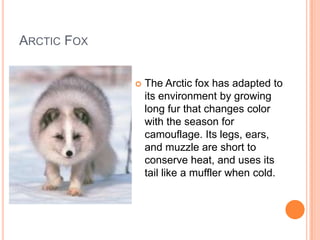
ARCTIC FOX


                The Arctic fox has adapted to
                 its environment by growing
                 long fur that changes color
                 with the season for
                 camouflage. Its legs, ears,
                 and muzzle are short to
                 conserve heat, and uses its
                 tail like a muffler when cold.
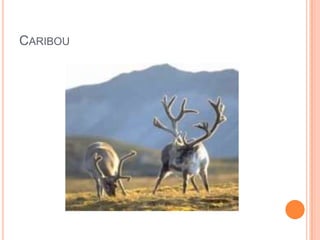
CARIBOU
CARIBOU


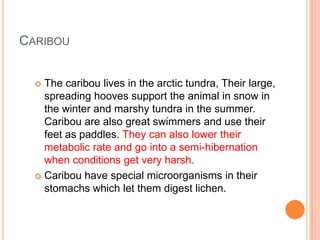
   The caribou lives in the arctic tundra, Their large,
    spreading hooves support the animal in snow in
    the winter and marshy tundra in the summer.
    Caribou are also great swimmers and use their
    feet as paddles. They can also lower their
    metabolic rate and go into a semi-hibernation
    when conditions get very harsh.
   Caribou have special microorganisms in their
    stomachs which let them digest lichen.
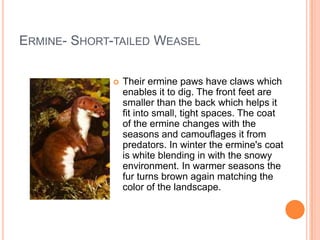
ERMINE- SHORT-TAILED WEASEL

                Their ermine paws have claws which
                 enables it to dig. The front feet are
                 smaller than the back which helps it
                 fit into small, tight spaces. The coat
                 of the ermine changes with the
                 seasons and camouflages it from
                 predators. In winter the ermine's coat
                 is white blending in with the snowy
                 environment. In warmer seasons the
                 fur turns brown again matching the
                 color of the landscape.
SOME COMMON ADAPTATIONS OF RESIDENT
ANIMALS IN THE ARCTIC AND ALPINE TUNDRA:

  - short and stocky arms and legs. 
- thick, insulating
  cover of feathers or fur. 
- color changing feathers or fur:
  brown in summer, and white in winter. 
- thick fat layer
  gained quickly during spring in order to have continual
  energy and warmth during winter months. 
- many tundra
  animals have adapted especially to prevent their bodily
  fluids from freezing solid. 
- resident animals like the
  ptarmigan and the ground squirrel use solar heating to
  stay warm and save energy. Both animals stay out in the
  sun to warm up and during the summer when the weather
  is warm, seek shade to cool off.
HUMAN IMPACT ON TUNDRA BIOME
OVERHUNTING
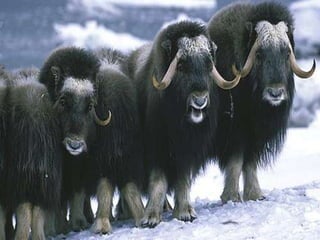
   The overhunting of endangered species in the early
    1900s resulted in the eradication of animals such
    as the musk oxen in the Alaskan tundra, which
    sailors coveted for the food and clothing it offered.
    Eventually, governments began to recognize the
    issue and responded by enacting laws to protect
    the tundra animals. Because of this, musk oxen and
    caribou numbers are slowly rising again in places
    such as Canada where they were once close to
    extinction.
SABER-TOOTHED
             TIGER
   Smilodon became extinct
    at the end of
    the Pleistocene around
    10,000 BC, a time which
    saw the extinction of
    many other large
    herbivorous and
    carnivorous mammals.
   Prehistoric humans, who
    reached North America at
    the same time and are
    known to have hunted
    many of the species that
    disappeared, are often
    viewed as responsible for
    this extinction wave.
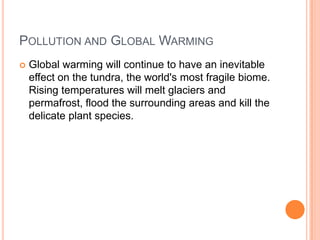
POLLUTION AND GLOBAL WARMING
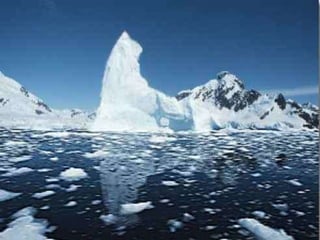
   Global warming will continue to have an inevitable
    effect on the tundra, the world's most fragile biome.
    Rising temperatures will melt glaciers and
    permafrost, flood the surrounding areas and kill the
    delicate plant species.
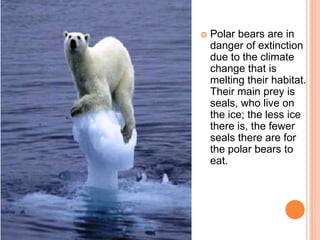
   Polar bears are in
    danger of extinction
    due to the climate
    change that is
    melting their habitat.
    Their main prey is
    seals, who live on
    the ice; the less ice
    there is, the fewer
    seals there are for
    the polar bears to
    eat.
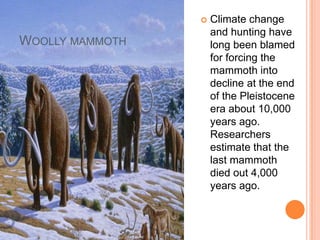
   Climate change
                     and hunting have
WOOLLY MAMMOTH       long been blamed
                     for forcing the
                     mammoth into
                     decline at the end
                     of the Pleistocene
                     era about 10,000
                     years ago.
                     Researchers
                     estimate that the
                     last mammoth
                     died out 4,000
                     years ago.
OIL DRILLING
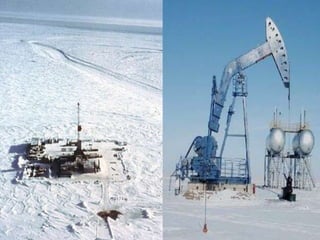
   The Arctic holds the world's largest remaining
    untapped gas reserves and some of its largest
    undeveloped oil reserves. A significant proportion of
    these reserves lie offshore, in the Arctic's shallow
    and biologically productive shelf seas. According to
    the oil industry, the Arctic is the final frontier for
    petroleum development.
   Oil drilling pollutes the water, land and air surrounding the
    tundra. Russia's nickel mines serve as a vivid example of
    the effect that oil drilling can have on the habitat. Many
    plants and animals have either been killed or have
    permanently fled the area after the area became
    contaminated by the harmful gases and materials
    released during drilling.
   On January 3, 1959, Alaska gained statehood along with
    its natural resources. Rich oil deposits was one of the
    many natural resources found in this vast area causing a
    new breed of fortune hunters to come to Alaska. On
    March 24th, 1989, millions of gallons of oil spilled into the
    ocean when Exxon Valdez (an oil tanker) crashed into a
    reef. This spill affected all of the wildlife greatly, tens of
    thousands of seabirds, salmon, herring, and halibut were
    killed from a disaster that wouldn't have happened except
    for the intervention of man. An estimate was made that
    100,000 birds died in the oil spill, something that could
    have been avoided. Even though the bulk of the oil was
    finally cleaned up, some of it still lingers there.
OVERDEVELOPMENT

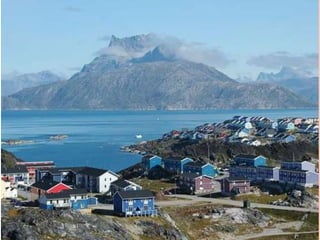
   Building roads and structures in the tundra has
    attracted much more human traffic to an area
    where merely stepping on the fragile plant species
    can kill them. Without plants to contain the soil, the
    earth quickly erodes and threatens to destroy the
    entire biome.
   Footprints and tire tracks can be visible for many
    years after they were made. When the sun hits the
    ruts it causes the permafrost to melt. This causes
    erosion and the ruts get bigger, and eventually the
    ruts turn into gullies. Tracks made during WW II
    have grown so large that some of them are now
    lakes.
Tundra1

Tundra1

  • 1.
  • 2.
    This enormous biome, extremely uniform in appearance, covers a fifth of the earth's surface.
  • 3.
    GENERAL CHARACTERISTICS *Extremely coldclimate * Low biotic diversity * Simple vegetation structure * Short season of growth and reproduction * Energy and nutrients in the form of dead organic material
  • 4.
  • 5.
    Sun’s oblique angle – receive little solar energy  Low Temperatures – 29 degrees celsius to 7 degrees celsius (winter) and not more than 10 degrees celsius (summer)  Short summer days – 6 to 10 weeks. sun shines almost 24 hours a day.  Long winter – 9 months. almost 24 hours night
  • 6.
    Poor soil – reduced decomposition due to cold climate  Strong winds  Cold and dry climate – precipitation 6 to 10 inches of rain per year  latitude – Arctic tundra or Alpine tundra  Permafrost – layer of permanently frozen subsoil (600 meters deep)
  • 7.
    ARCTIC TUNDRA  Arctic tundra is found almost entirely in the Northern Hemisphere. In the southern hemisphere it is found on isolated islands off the coast of Antarctica as well as the Antarctic peninsula. It can also be found in Northern portions of Canada, Alaska, Greenland, and the United States
  • 8.
    ARCTIC TUNDRA  higherlatitude  Short growing season – 50 to 60 days  permafrost  vegetation – protects the permafrost through shading and insulation  Freezing and thawing of the upper layer of soil – unique, symmetrically patterned landforms. Action of frost  Cryoplanation – molding of the landscape by frost action
  • 11.
  • 12.
    SOLIFLUCTION TERRACES  Mass movement of supersaturated soil over the permafrost
  • 13.
    ALPINE TUNDRA  Alpine tundra is located on mountains throughout the world at high altitude where trees cannot grow. It is not found in distinct areas as the arctic tundra. Alpine tundra is scattered in many regions all around the world.
  • 14.
    ALPINE TUNDRA permafrost – high elevations  little  Short growing season – 160-180 days  soils are drier – only alpine wet meadows and bogs have similar soil moisture as the Arctic tundra  precipitation (snowfall and humidity) – higher but steep topography induces a rapid water runoff
  • 16.
  • 17.
  • 18.
  • 19.
  • 20.
     LowTemperatures andExtreme Seasonality Control Tundra Productivity and Nutrient Cycling
  • 21.
     Primary production on the tundra is low, a consequence of low temperature and a short growing season ranging from 50-60 days in the high Arctic to 160 days in the low-latitude alpine tundra.  These physical constraints result in a low availability of nutrients that further function to reduce productivity
  • 22.
     Dead organicmatter functions as the nutrient pool, but most of it is not directly available to plants.  Because the tundra soil does not store available nutrients in any great quantity, plants depend on the release of nutrients for decomposition, the uptake of which is often aided by mycorrhizae
  • 23.
     Leaching orremoval of nutrients is minimal, occurring mostly at the beginning of the growing season. Melting snow releases nutrients frozen over winter in the litter, excreta of animals, and microbes.
  • 24.
    A rapid upwardmovement of nutrients early in the season at the expense of below-ground biomass supports fast shoot growth. *  Sixweeks into the growing season, plants start to send nutrients below-ground.  As the cold approaches, the above ground tissues die, and their dead parts add to the accumulation of organic matter.  Nutrients leached from the dead leaves are accumulated by mosses or are frozen into place until the following summer’s snowmelt
  • 25.
  • 26.
  • 27.
    Plant Adaptations Growing closetogether and low to the ground are some of the adaptations that plants use to survive. This growing pattern helps the plant resist the effects of cold temperatures and reduce the damage caused by the impact of tiny particles of ice and snow that are driven by the dry winds
  • 28.
     Only plantswith shallow root systems grow in the Arctic tundra because the permafrost prevents plants from sending their roots down past the active layer of soil.  Plants also have adapted to the Arctic tundra by developing the ability to grow under a layer of snow  Plants lose water through their leaf surface. By producing small leaves the plant is more able to retain the moisture it has stored.
  • 29.
    CARIBOU MOSS  Although it is called caribou moss, it is actually a lichen.  Lichens are two separate organisms. They are made up of fungi and algae, which live and grow together. The spongy threads of lichens support and protects the algae. The tissues of lichens aren't easily damaged by frost. .
  • 30.
    LABRADOR TEA  It will grow up straight in the southern latitudes of the tundra, but in the colder northern latitudes it will creep over the ground forming a carpet.  PASQUE FLOWER
  • 31.
    Because of the cold wind, most plants are small perennial groundcover plants which grow and reproduce slowly. They protect themselves from the cold and wind by hugging the ground. Taller plants or trees would soon get blown over and freeze. When plants die they don't decompose very quickly because of the cold. This makes for poor soil conditions.
  • 32.
    Many flowering plants of the alpine tundra have dense hairs on stems and leaves to provide wind protection or red-colored pigments capable of converting the sun's light rays into heat. Some plants take two or more years to form flower buds, which survive the winter below the surface and then open and produce fruit with seeds in the few weeks of summer.
  • 33.
    WHAT DOES THESNOW DO TO HELP THE PLANTS?  Snow beds are found where large amounts of snow accumulate– this provides a continuous supply of water throughout the growing season  Snow patch communities occur where wind driven snow accumulate in shallow beds– this layer of snow protects the plant beneath. Although, the plants have a shorter growing season.
  • 34.
    FAUNA Low in Diversity Tundraanimals are well Adapted to the Cold
  • 36.
    POLAR BEAR  PolarBears do not enter true hibernation in the winter as this is a period of hunting, however, some Polar Bears and pregnant females in particular will enter a deep sleep where their heart rates will drop.  They have two layers of fur which is so warm that adult bears can easily overheat when they run. Most of the sun's rays reach their black skin, which absorbs the heat and keeps the polar bear warm.
  • 37.
     Their teethand claws are very sharp so they can catch their prey easily (seal).  Also, their claws aid them in digging out the snow in making snow den’s for the women to give birth
  • 38.
    Repeated freezing and thawing can destroy living tissue. The Alaska blackfish overcomes this problem by producing chemicals within its body that lowers the freezing temperature of cell fluids. Much like the antifreeze we add to the water in our vehicles, the "antifreeze" of the Alaska blackfish prevents the formation of large ice crystals within its cells, even at low temperatures. The Alaska blackfish can survive temperatures of-20 degrees C (4 F) and the complete freezing of some body parts, including their heads, for up to several days.
  • 39.
    ARCTIC FOX  The Arctic fox has adapted to its environment by growing long fur that changes color with the season for camouflage. Its legs, ears, and muzzle are short to conserve heat, and uses its tail like a muffler when cold.
  • 40.
  • 41.
    CARIBOU The caribou lives in the arctic tundra, Their large, spreading hooves support the animal in snow in the winter and marshy tundra in the summer. Caribou are also great swimmers and use their feet as paddles. They can also lower their metabolic rate and go into a semi-hibernation when conditions get very harsh.  Caribou have special microorganisms in their stomachs which let them digest lichen.
  • 42.
    ERMINE- SHORT-TAILED WEASEL  Their ermine paws have claws which enables it to dig. The front feet are smaller than the back which helps it fit into small, tight spaces. The coat of the ermine changes with the seasons and camouflages it from predators. In winter the ermine's coat is white blending in with the snowy environment. In warmer seasons the fur turns brown again matching the color of the landscape.
  • 43.
    SOME COMMON ADAPTATIONSOF RESIDENT ANIMALS IN THE ARCTIC AND ALPINE TUNDRA: - short and stocky arms and legs. 
- thick, insulating cover of feathers or fur. 
- color changing feathers or fur: brown in summer, and white in winter. 
- thick fat layer gained quickly during spring in order to have continual energy and warmth during winter months. 
- many tundra animals have adapted especially to prevent their bodily fluids from freezing solid. 
- resident animals like the ptarmigan and the ground squirrel use solar heating to stay warm and save energy. Both animals stay out in the sun to warm up and during the summer when the weather is warm, seek shade to cool off.
  • 44.
    HUMAN IMPACT ONTUNDRA BIOME
  • 45.
    OVERHUNTING  The overhunting of endangered species in the early 1900s resulted in the eradication of animals such as the musk oxen in the Alaskan tundra, which sailors coveted for the food and clothing it offered. Eventually, governments began to recognize the issue and responded by enacting laws to protect the tundra animals. Because of this, musk oxen and caribou numbers are slowly rising again in places such as Canada where they were once close to extinction.
  • 47.
    SABER-TOOTHED TIGER  Smilodon became extinct at the end of the Pleistocene around 10,000 BC, a time which saw the extinction of many other large herbivorous and carnivorous mammals.  Prehistoric humans, who reached North America at the same time and are known to have hunted many of the species that disappeared, are often viewed as responsible for this extinction wave.
  • 48.
    POLLUTION AND GLOBALWARMING  Global warming will continue to have an inevitable effect on the tundra, the world's most fragile biome. Rising temperatures will melt glaciers and permafrost, flood the surrounding areas and kill the delicate plant species.
  • 49.
    Polar bears are in danger of extinction due to the climate change that is melting their habitat. Their main prey is seals, who live on the ice; the less ice there is, the fewer seals there are for the polar bears to eat.
  • 51.
    Climate change and hunting have WOOLLY MAMMOTH long been blamed for forcing the mammoth into decline at the end of the Pleistocene era about 10,000 years ago. Researchers estimate that the last mammoth died out 4,000 years ago.
  • 52.
    OIL DRILLING  The Arctic holds the world's largest remaining untapped gas reserves and some of its largest undeveloped oil reserves. A significant proportion of these reserves lie offshore, in the Arctic's shallow and biologically productive shelf seas. According to the oil industry, the Arctic is the final frontier for petroleum development.
  • 53.
    Oil drilling pollutes the water, land and air surrounding the tundra. Russia's nickel mines serve as a vivid example of the effect that oil drilling can have on the habitat. Many plants and animals have either been killed or have permanently fled the area after the area became contaminated by the harmful gases and materials released during drilling.
  • 54.
    On January 3, 1959, Alaska gained statehood along with its natural resources. Rich oil deposits was one of the many natural resources found in this vast area causing a new breed of fortune hunters to come to Alaska. On March 24th, 1989, millions of gallons of oil spilled into the ocean when Exxon Valdez (an oil tanker) crashed into a reef. This spill affected all of the wildlife greatly, tens of thousands of seabirds, salmon, herring, and halibut were killed from a disaster that wouldn't have happened except for the intervention of man. An estimate was made that 100,000 birds died in the oil spill, something that could have been avoided. Even though the bulk of the oil was finally cleaned up, some of it still lingers there.
  • 56.
    OVERDEVELOPMENT  Building roads and structures in the tundra has attracted much more human traffic to an area where merely stepping on the fragile plant species can kill them. Without plants to contain the soil, the earth quickly erodes and threatens to destroy the entire biome.
  • 57.
    Footprints and tire tracks can be visible for many years after they were made. When the sun hits the ruts it causes the permafrost to melt. This causes erosion and the ruts get bigger, and eventually the ruts turn into gullies. Tracks made during WW II have grown so large that some of them are now lakes.

Editor's Notes

  • #29 To carry out photosynthesis in extremely cold conditions and for flowering plants to bear flowers
  • #30 The algae haschlorophyll which can make food. This is called a symbiotic relationship. Lichen can make food when the temperature gets very low and there is little light.
  • #37 They have two layers of fur which is so warm that adult bears can easily overheat when they run.Most of the sun's rays reach their black skin, which absorbs the heat and keeps the polar bear warm.