DESERT BIOME   By: Tori Ahr, Amanda Dirr, Kelli James,  Romisha Law, Sarah Mossman and Sara Moster NORTH AMERICAN:
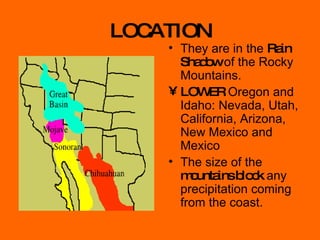
LOCATION They are in the  Rain Shadow  of the Rocky Mountains. LOWER  Oregon and Idaho: Nevada, Utah, California, Arizona, New Mexico and Mexico The size of the  mountains block  any precipitation coming from the coast.
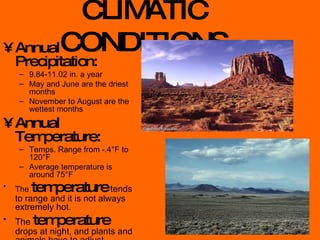
CLIMATIC CONDITIONS Annual Precipitation: 9.84-11.02 in. a year May and June are the driest months November to August are the wettest months Annual Temperature: Temps. Range from -.4°F to 120°F Average temperature is around 75°F The   temperature  tends to range and it is not always extremely hot. The  temperature  drops at night, and plants and animals have to adjust.
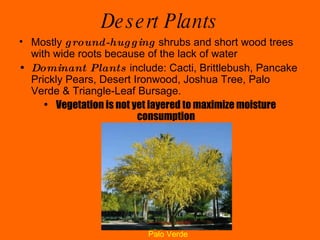
Desert Plants Mostly  ground-hugging  shrubs and short wood trees with wide roots because of the lack of water  Dominant Plants  include: Cacti, Brittlebush, Pancake Prickly Pears, Desert Ironwood, Joshua Tree, Palo Verde & Triangle-Leaf Bursage. Vegetation is not yet layered to maximize moisture consumption Palo Verde
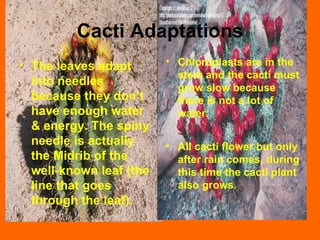
Cacti Adaptations The leaves adapt into needles because they don’t have enough water & energy. The spiny needle is actually the Midrib of the well-known leaf (the line that goes through the leaf). Chloroplasts are in the stem and the cacti must grow slow because there is not a lot of water. All cacti flower but only after rain comes, during this time the cacti plant also grows.
more plant adaptations… The pores (in plants) during the day close to prevent water loss Complicated root systems extend many miles and may be located towards the top of the surface to directly collect rain Silver and glossy leaves reflect more energy that is radiant and affects the taste
SOiL Dry and poor Thin With little nutrients Composed of Sand and Gravel Does not hold water
ANiMALS Fossorial-which means ‘to borrow’ which they do to escape the heat Rabbits Skunks Burrowing Owls They take over burrows because they are not able to dig their own. They escape predation and they make noises similar to rattle snakes to scare off predators.
More animals… Nocturnal Animals come out during the night to escape the heat Crepuscular They come out at dusk and dawn; to escape the heat
Animal Adaptations Their bodies are equip to store amounts of water and cope with food shortages Most animals are small and only get water from the food that they eat
Other Biome.. Phoenix Tusan Las Vegas Many people are flooding into these places.

Desert Project[1]

  • 1.
    DESERT BIOME  By: Tori Ahr, Amanda Dirr, Kelli James, Romisha Law, Sarah Mossman and Sara Moster NORTH AMERICAN:
  • 2.
    LOCATION They arein the Rain Shadow of the Rocky Mountains. LOWER Oregon and Idaho: Nevada, Utah, California, Arizona, New Mexico and Mexico The size of the mountains block any precipitation coming from the coast.
  • 3.
    CLIMATIC CONDITIONS AnnualPrecipitation: 9.84-11.02 in. a year May and June are the driest months November to August are the wettest months Annual Temperature: Temps. Range from -.4°F to 120°F Average temperature is around 75°F The temperature tends to range and it is not always extremely hot. The temperature drops at night, and plants and animals have to adjust.
  • 4.
    Desert Plants Mostly ground-hugging shrubs and short wood trees with wide roots because of the lack of water Dominant Plants include: Cacti, Brittlebush, Pancake Prickly Pears, Desert Ironwood, Joshua Tree, Palo Verde & Triangle-Leaf Bursage. Vegetation is not yet layered to maximize moisture consumption Palo Verde
  • 5.
    Cacti Adaptations Theleaves adapt into needles because they don’t have enough water & energy. The spiny needle is actually the Midrib of the well-known leaf (the line that goes through the leaf). Chloroplasts are in the stem and the cacti must grow slow because there is not a lot of water. All cacti flower but only after rain comes, during this time the cacti plant also grows.
  • 6.
    more plant adaptations…The pores (in plants) during the day close to prevent water loss Complicated root systems extend many miles and may be located towards the top of the surface to directly collect rain Silver and glossy leaves reflect more energy that is radiant and affects the taste
  • 7.
    SOiL Dry andpoor Thin With little nutrients Composed of Sand and Gravel Does not hold water
  • 8.
    ANiMALS Fossorial-which means‘to borrow’ which they do to escape the heat Rabbits Skunks Burrowing Owls They take over burrows because they are not able to dig their own. They escape predation and they make noises similar to rattle snakes to scare off predators.
  • 9.
    More animals… NocturnalAnimals come out during the night to escape the heat Crepuscular They come out at dusk and dawn; to escape the heat
  • 10.
    Animal Adaptations Theirbodies are equip to store amounts of water and cope with food shortages Most animals are small and only get water from the food that they eat
  • 11.
    Other Biome.. PhoenixTusan Las Vegas Many people are flooding into these places.