BY-Kaavya, Yana, Yashika
Natural Vegetation
and Wildlife
Happier
Always be happy Be polite to everyone
People who love you will
always want you to be happy
Love and appreciate the
things you have because
soon they'll be gone
ELO's
-Identify and list the characteristics of shrubs
-Identify Tundra Desert
-Define Tundra vegetation and wildlife and list its characteristics
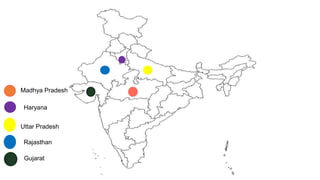
-List the places in which shrubs are mainly located
-list the usual places of tundra desert
-Mark Tundra deserts on world map
-mark the places where shrubs are located on both world and Indian map
-Attempt a quiz to test your knowledge about Tundra Deserts and Shrubs
Shrubs
• a woody plant which is
smaller than a tree and has
several main stems arising at
or near the ground.
• Although stems are tough, they are
flexible but not delicate. Such
plants have a long life span.
Examples: Jasmine, rose, lemon,
henna and tulsi.
● Lack of a trunk: They branch near the
ground, hence do not have a well-defined
trunk and rather have many stems.
● Broad leave plants: Shrubs are usually as
such.
● Hardy plants: They grow in all types of
soil and are hardy.
● Shrubs are seasonal since they generally
thrive in a sunny environment.
● Also, they are smaller than trees.
Characteristics
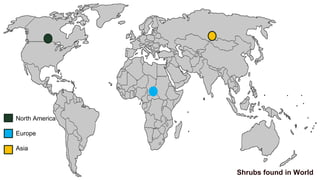
Shrubs found in World
North America
Europe
Asia
Madhya Pradesh
Haryana
Uttar Pradesh
Rajasthan
Gujarat
Let's do some Question-
Q1- How are the stems of shrubs?
Q2- What are the two Characteristics of
Shrubs?
Tundra Desert
• The tundra is a treeless polar desert found in the high
latitudes in the polar regions
• Primarily in Alaska, Canada, Russia, Greenland, Iceland,
and Scandinavia, as well as sub-Antarctic islands.
• The region's long, dry winters feature months of total
darkness and extremely frigid temperatures.
• Tundra is a treeless expanse that supports communities of
sedges and heaths as well as dwarf shrubs
• Vegetation is generally scattered, although it can be patchy
reflecting changes in soil and moisture gradients.
Characteristics
• Extremely cold climate
• Low biotic diversity
• Simple vegetation structure
• Limitation of drainage
• Short season of growth and reproduction
• Energy and nutrients in the form of dead organic
material
• Large population oscillations
• Precipitation in the tundra totals 150 to 250 mm
a year
• primarily in Alaska, Canada, Russia, Greenland,
Iceland, and Scandinavia, as well as sub-
Antarctic islands.
• very low mean annual temperature
• In mid-winter temperatures are as low as -40
to -50 °C
• Summers are relatively warmer
Characteristics
Plants in Tundra Region
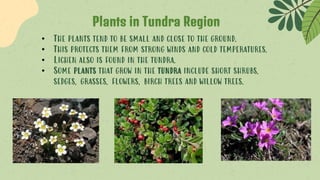
• The plants tend to be small and close to the ground.
• This protects them from strong winds and cold temperatures.
• Lichen also is found in the tundra.
• Some plants that grow in the tundra include short shrubs,
sedges, grasses, flowers, birch trees and willow trees.
Arctic Moss
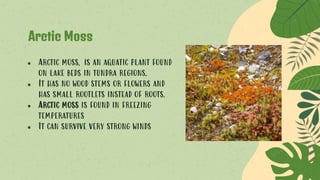
● Arctic moss, is an aquatic plant found
on lake beds in tundra regions.
● It has no wood stems or flowers and
has small rootlets instead of roots.
● Arctic moss is found in freezing
temperatures
● It can survive very strong winds
Pasque
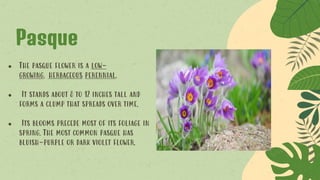
● The pasque flower is a low-
growing, herbaceous perennial.
● It stands about 8 to 12 inches tall and
forms a clump that spreads over time.
● Its blooms precede most of its foliage in
spring. The most common pasque has
bluish-purple or dark violet flower.
1-min break
1. Pick a point on a floor/wall.
2. Draw and eight using your
eyes.
3. Keep tracing for 30 seconds, then switch
directions.
Wildlife in Tundra
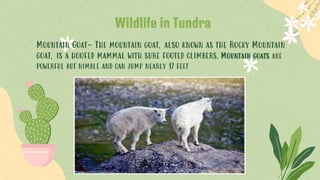
Mountain Goat- The mountain goat, also known as the Rocky Mountain
goat, is a hoofed mammal with sure footed climbers. Mountain goats are
powerful but nimble and can jump nearly 12 feet
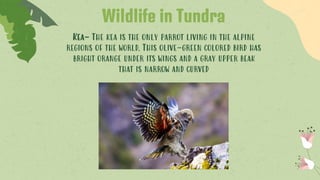
Kea- The kea is the only parrot living in the alpine
regions of the world. This olive-green colored bird has
bright orange under its wings and a gray upper beak
that is narrow and curved
Wildlife in Tundra
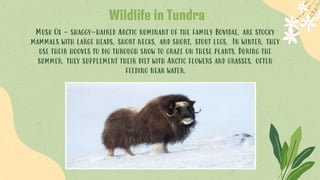
Musk Ox - shaggy-haired Arctic ruminant of the family Bovidae, are stocky
mammals with large heads, short necks, and short, stout legs. In winter, they
use their hooves to dig through snow to graze on these plants. During the
summer, they supplement their diet with Arctic flowers and grasses, often
feeding near water.
Wildlife in Tundra
Wildlife in Tundra
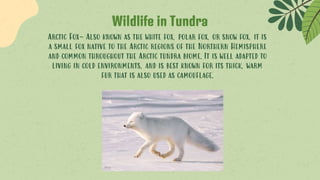
Arctic Fox- Also known as the white fox, polar fox, or snow fox, it is
a small fox native to the Arctic regions of the Northern Hemisphere
and common throughout the Arctic tundra biome. It is well adapted to
living in cold environments, and is best known for its thick, warm
fur that is also used as camouflage.
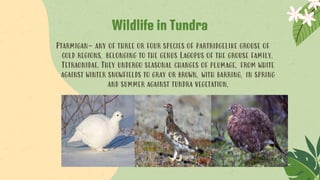
Ptarmigan- any of three or four species of partridgelike grouse of
cold regions, belonging to the genus Lagopus of the grouse family,
Tetraonidae. They undergo seasonal changes of plumage, from white
against winter snowfields to gray or brown, with barring, in spring
and summer against tundra vegetation.
Wildlife in Tundra
Wildlife in Tundra
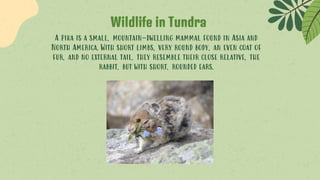
A pika is a small, mountain-dwelling mammal found in Asia and
North America. With short limbs, very round body, an even coat of
fur, and no external tail, they resemble their close relative, the
rabbit, but with short, rounded ears.
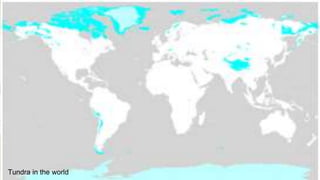
Tundra in the world
Questions
1. What are the
adaptations of the Arctic
Fox?
2. What is the average
height of Pasque plant?
Quiz Time
https://nearpod.com/
CREDITS: This presentation template was created by Slidesgo,
including icons by Flaticon, and infographics & images by Freepik
Thank
You!

SHRUBS-TUNDRA DESERT VEGETATION.pptx

  • 1.
    BY-Kaavya, Yana, Yashika NaturalVegetation and Wildlife
  • 2.
  • 3.
    Always be happyBe polite to everyone People who love you will always want you to be happy Love and appreciate the things you have because soon they'll be gone
  • 4.
    ELO's -Identify and listthe characteristics of shrubs -Identify Tundra Desert -Define Tundra vegetation and wildlife and list its characteristics -List the places in which shrubs are mainly located -list the usual places of tundra desert -Mark Tundra deserts on world map -mark the places where shrubs are located on both world and Indian map -Attempt a quiz to test your knowledge about Tundra Deserts and Shrubs
  • 5.
    Shrubs • a woodyplant which is smaller than a tree and has several main stems arising at or near the ground. • Although stems are tough, they are flexible but not delicate. Such plants have a long life span. Examples: Jasmine, rose, lemon, henna and tulsi.
  • 6.
    ● Lack ofa trunk: They branch near the ground, hence do not have a well-defined trunk and rather have many stems. ● Broad leave plants: Shrubs are usually as such. ● Hardy plants: They grow in all types of soil and are hardy. ● Shrubs are seasonal since they generally thrive in a sunny environment. ● Also, they are smaller than trees. Characteristics
  • 7.
    Shrubs found inWorld North America Europe Asia
  • 8.
  • 9.
    Let's do someQuestion- Q1- How are the stems of shrubs? Q2- What are the two Characteristics of Shrubs?
  • 10.
    Tundra Desert • Thetundra is a treeless polar desert found in the high latitudes in the polar regions • Primarily in Alaska, Canada, Russia, Greenland, Iceland, and Scandinavia, as well as sub-Antarctic islands. • The region's long, dry winters feature months of total darkness and extremely frigid temperatures. • Tundra is a treeless expanse that supports communities of sedges and heaths as well as dwarf shrubs • Vegetation is generally scattered, although it can be patchy reflecting changes in soil and moisture gradients.
  • 11.
    Characteristics • Extremely coldclimate • Low biotic diversity • Simple vegetation structure • Limitation of drainage • Short season of growth and reproduction • Energy and nutrients in the form of dead organic material
  • 12.
    • Large populationoscillations • Precipitation in the tundra totals 150 to 250 mm a year • primarily in Alaska, Canada, Russia, Greenland, Iceland, and Scandinavia, as well as sub- Antarctic islands. • very low mean annual temperature • In mid-winter temperatures are as low as -40 to -50 °C • Summers are relatively warmer Characteristics
  • 13.
    Plants in TundraRegion • The plants tend to be small and close to the ground. • This protects them from strong winds and cold temperatures. • Lichen also is found in the tundra. • Some plants that grow in the tundra include short shrubs, sedges, grasses, flowers, birch trees and willow trees.
  • 14.
    Arctic Moss ● Arcticmoss, is an aquatic plant found on lake beds in tundra regions. ● It has no wood stems or flowers and has small rootlets instead of roots. ● Arctic moss is found in freezing temperatures ● It can survive very strong winds
  • 15.
    Pasque ● The pasqueflower is a low- growing, herbaceous perennial. ● It stands about 8 to 12 inches tall and forms a clump that spreads over time. ● Its blooms precede most of its foliage in spring. The most common pasque has bluish-purple or dark violet flower.
  • 16.
    1-min break 1. Picka point on a floor/wall. 2. Draw and eight using your eyes. 3. Keep tracing for 30 seconds, then switch directions.
  • 17.
    Wildlife in Tundra MountainGoat- The mountain goat, also known as the Rocky Mountain goat, is a hoofed mammal with sure footed climbers. Mountain goats are powerful but nimble and can jump nearly 12 feet
  • 18.
    Kea- The keais the only parrot living in the alpine regions of the world. This olive-green colored bird has bright orange under its wings and a gray upper beak that is narrow and curved Wildlife in Tundra
  • 19.
    Musk Ox -shaggy-haired Arctic ruminant of the family Bovidae, are stocky mammals with large heads, short necks, and short, stout legs. In winter, they use their hooves to dig through snow to graze on these plants. During the summer, they supplement their diet with Arctic flowers and grasses, often feeding near water. Wildlife in Tundra
  • 20.
    Wildlife in Tundra ArcticFox- Also known as the white fox, polar fox, or snow fox, it is a small fox native to the Arctic regions of the Northern Hemisphere and common throughout the Arctic tundra biome. It is well adapted to living in cold environments, and is best known for its thick, warm fur that is also used as camouflage.
  • 21.
    Ptarmigan- any ofthree or four species of partridgelike grouse of cold regions, belonging to the genus Lagopus of the grouse family, Tetraonidae. They undergo seasonal changes of plumage, from white against winter snowfields to gray or brown, with barring, in spring and summer against tundra vegetation. Wildlife in Tundra
  • 22.
    Wildlife in Tundra Apika is a small, mountain-dwelling mammal found in Asia and North America. With short limbs, very round body, an even coat of fur, and no external tail, they resemble their close relative, the rabbit, but with short, rounded ears.
  • 23.
  • 24.
    Questions 1. What arethe adaptations of the Arctic Fox? 2. What is the average height of Pasque plant?
  • 25.
  • 26.
    CREDITS: This presentationtemplate was created by Slidesgo, including icons by Flaticon, and infographics & images by Freepik Thank You!