CASE STUDY ON TSUNAMI Case study on Tsunami which struck India on 26 Dec 2004
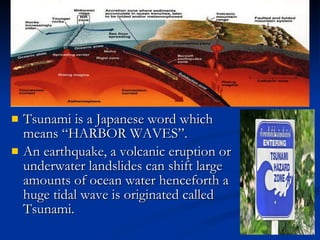
Tsunami is a Japanese word which means “HARBOR WAVES”. An earthquake, a volcanic eruption or underwater landslides can shift large amounts of ocean water henceforth a huge tidal wave is originated called Tsunami.
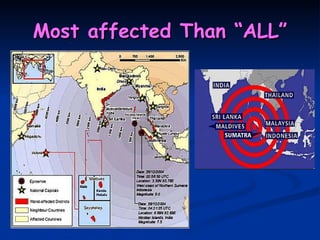
Tsunami struck in the Indian ocean on 26dec 2004. These huge waves were a result of the earthquake that had its epicenter close to the western boundary of Sumatra  The magnitude of this earthquake was measured 9.0 on the Richter scale.
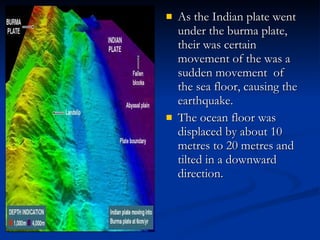
As the Indian plate went under the burma plate, their was certain movement of the was a sudden movement  of the sea floor, causing the earthquake. The ocean floor was displaced by about 10 metres to 20 metres and tilted in a downward direction.
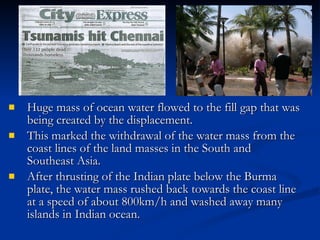
Huge mass of ocean water flowed to the fill gap that was being created by the displacement. This marked the withdrawal of the water mass from the coast lines of the land masses in the South and Southeast Asia. After thrusting of the Indian plate below the Burma plate, the water mass rushed back towards the coast line at a speed of about 800km/h and washed away many islands in Indian ocean.
 
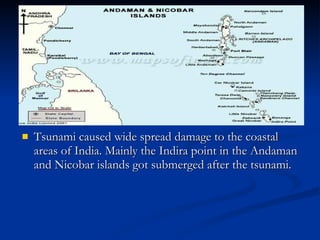
Tsunami caused wide spread damage to the coastal areas of India. Mainly the Indira point in the Andaman and Nicobar islands got submerged after the tsunami.
Most affected Than “ALL”
 
Indian effected areas
I. Conclude I, conclude that I shall help the Tsunami victims to ensure my country to grow

case study on the 26dec tsunami

  • 1.
    CASE STUDY ONTSUNAMI Case study on Tsunami which struck India on 26 Dec 2004
  • 2.
    Tsunami is aJapanese word which means “HARBOR WAVES”. An earthquake, a volcanic eruption or underwater landslides can shift large amounts of ocean water henceforth a huge tidal wave is originated called Tsunami.
  • 3.
    Tsunami struck inthe Indian ocean on 26dec 2004. These huge waves were a result of the earthquake that had its epicenter close to the western boundary of Sumatra The magnitude of this earthquake was measured 9.0 on the Richter scale.
  • 4.
    As the Indianplate went under the burma plate, their was certain movement of the was a sudden movement of the sea floor, causing the earthquake. The ocean floor was displaced by about 10 metres to 20 metres and tilted in a downward direction.
  • 5.
    Huge mass ofocean water flowed to the fill gap that was being created by the displacement. This marked the withdrawal of the water mass from the coast lines of the land masses in the South and Southeast Asia. After thrusting of the Indian plate below the Burma plate, the water mass rushed back towards the coast line at a speed of about 800km/h and washed away many islands in Indian ocean.
  • 6.
  • 7.
    Tsunami caused widespread damage to the coastal areas of India. Mainly the Indira point in the Andaman and Nicobar islands got submerged after the tsunami.
  • 8.
  • 9.
  • 10.
  • 11.
    I. Conclude I,conclude that I shall help the Tsunami victims to ensure my country to grow