A
SEMINAR PRESENTATION
ON
“Tsunami warning system”
2015-2016
SUBMITED BY:
Girish.N.Pandrangi
M.Sc. -I Year,
Semester – I
DEPARTMENT OF COMPUTER SCIENCE
SHRI SHIVAJI SCIENCE COLLEGE, NAGPUR.
CONTENTS
 Tsunami
 Tsunami Warning System
 Detecting Tsunami
 Seismometers
 Tidal Gauge
 DART Buoys
 DART I & II System
 Advantages & Disadvantages
 Future Scope
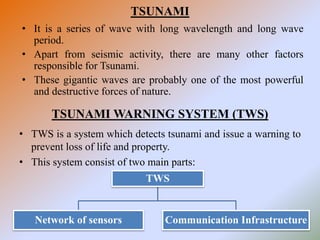
TSUNAMI
• It is a series of wave with long wavelength and long wave
period.
• Apart from seismic activity, there are many other factors
responsible for Tsunami.
• These gigantic waves are probably one of the most powerful
and destructive forces of nature.
TSUNAMI WARNING SYSTEM (TWS)
• TWS is a system which detects tsunami and issue a warning to
prevent loss of life and property.
• This system consist of two main parts:
TWS
Network of sensors Communication Infrastructure
WORKING OF TSUNAMI WORKING SYSTEM (TWS)
• Network of seismic monitoring station at sea floor detects
presence of earthquake.
• Seismic monitoring station determines location and depth of
earthquake having potential to cause tsunami.
• Any resulting tsunami are verified by sea level monitoring
station such as DART buoys, tidal gauge.
TYPES OF TSUNAMI WARNING SYSTEM (TWS)
• There are two distinct types of TWS:
TWS
International Warning System National Warning System
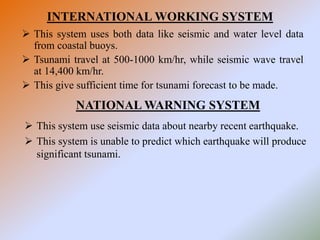
INTERNATIONAL WORKING SYSTEM
 This system uses both data like seismic and water level data
from coastal buoys.
 Tsunami travel at 500-1000 km/hr, while seismic wave travel
at 14,400 km/hr.
 This give sufficient time for tsunami forecast to be made.
NATIONAL WARNING SYSTEM
 This system use seismic data about nearby recent earthquake.
 This system is unable to predict which earthquake will produce
significant tsunami.
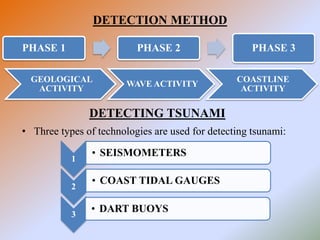
DETECTION METHOD
PHASE 1 PHASE 2 PHASE 3
GEOLOGICAL
ACTIVITY
WAVE ACTIVITY
COASTLINE
ACTIVITY
DETECTING TSUNAMI
• Three types of technologies are used for detecting tsunami:
1
• SEISMOMETERS
2
• COAST TIDAL GAUGES
3
• DART BUOYS
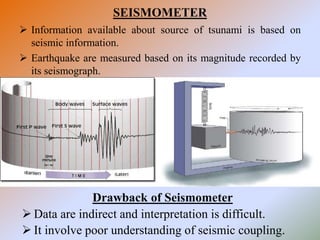
SEISMOMETER
 Information available about source of tsunami is based on
seismic information.
 Earthquake are measured based on its magnitude recorded by
its seismograph.
Drawback of Seismometer
 Data are indirect and interpretation is difficult.
 It involve poor understanding of seismic coupling.
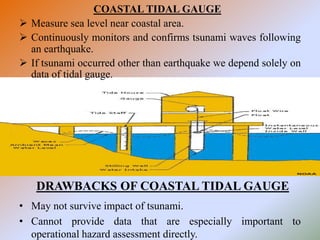
COASTAL TIDAL GAUGE
 Measure sea level near coastal area.
 Continuously monitors and confirms tsunami waves following
an earthquake.
 If tsunami occurred other than earthquake we depend solely on
data of tidal gauge.
• May not survive impact of tsunami.
• Cannot provide data that are especially important to
operational hazard assessment directly.
DRAWBACKS OF COASTAL TIDAL GAUGE
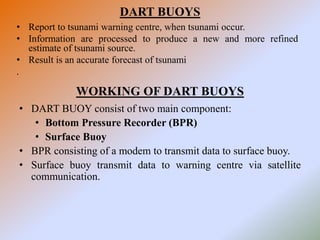
DART BUOYS
• Report to tsunami warning centre, when tsunami occur.
• Information are processed to produce a new and more refined
estimate of tsunami source.
• Result is an accurate forecast of tsunami
.
WORKING OF DART BUOYS
• DART BUOY consist of two main component:
• Bottom Pressure Recorder (BPR)
• Surface Buoy
• BPR consisting of a modem to transmit data to surface buoy.
• Surface buoy transmit data to warning centre via satellite
communication.
MODES OF OPERATION
• DART buoy has two modes of operation:
Modes
Standard Modes Event Modes
STANDARD MODE:
• System generally operates in standard mode.
• DART transmits data every six hours with recording period of
15 minutes.
EVENT MODE:
• When tsunami wave occur standard mode trigger to event
mode.
• Transmit data every 15 seconds at an average of 1 minute for
three hours.
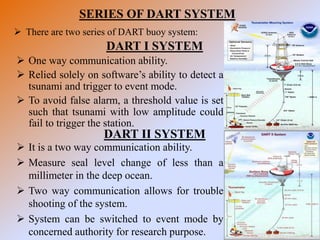
SERIES OF DART SYSTEM
 There are two series of DART buoy system:
DART I SYSTEM
 One way communication ability.
 Relied solely on software’s ability to detect a
tsunami and trigger to event mode.
 To avoid false alarm, a threshold value is set
such that tsunami with low amplitude could
fail to trigger the station.
DART II SYSTEM
 It is a two way communication ability.
 Measure seal level change of less than a
millimeter in the deep ocean.
 Two way communication allows for trouble
shooting of the system.
 System can be switched to event mode by
concerned authority for research purpose.
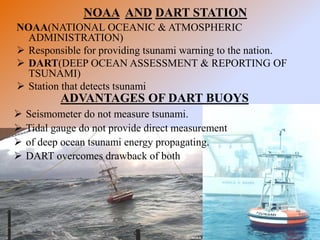
NOAA(NATIONAL OCEANIC & ATMOSPHERIC
ADMINISTRATION)
 Responsible for providing tsunami warning to the nation.
 DART(DEEP OCEAN ASSESSMENT & REPORTING OF
TSUNAMI)
 Station that detects tsunami.
NOAA AND DART STATION
ADVANTAGES OF DART BUOYS
 Seismometer do not measure tsunami.
 Tidal gauge do not provide direct measurement
 of deep ocean tsunami energy propagating.
 DART overcomes drawback of both
ADVANTAGES OF TSUNAMI WARNING SYSTEM
 Deep water pressure produce low false reading.
 Multiple sensor can detect wave propagation.
 Good advance warning system.
DISADVANTAGES OF TSUNAMI WARNING SYSTEM
 Expensive equipments.
 High maintenance cost.
 Require multiple communication link:
 SONAR.
 Satellite Uplink.
 Satellite Downlink.
 Notification to authorities.
 Authorities notifies coastal dwellers.
FUTURE SCOPE
In future Tsunami occurrence can be decided and alarm can be
raised only after checking many criteria. Four criteria to be
checked out are as follows:
 Pressure inside the sea bed.
 Tide level.
 Biological changes in the marine living organisms.
 Sea shore level.
If all these four criteria get detected then it can be concluded that
there is some occurrence of natural disaster (Tsunami).
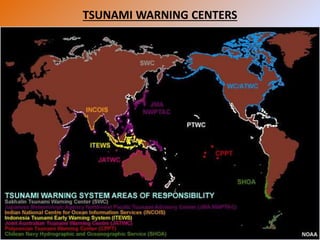
TSUNAMI WARNING CENTERS
Tsunami Warning System

Tsunami Warning System

  • 1.
    A SEMINAR PRESENTATION ON “Tsunami warningsystem” 2015-2016 SUBMITED BY: Girish.N.Pandrangi M.Sc. -I Year, Semester – I DEPARTMENT OF COMPUTER SCIENCE SHRI SHIVAJI SCIENCE COLLEGE, NAGPUR.
  • 2.
    CONTENTS  Tsunami  TsunamiWarning System  Detecting Tsunami  Seismometers  Tidal Gauge  DART Buoys  DART I & II System  Advantages & Disadvantages  Future Scope
  • 3.
    TSUNAMI • It isa series of wave with long wavelength and long wave period. • Apart from seismic activity, there are many other factors responsible for Tsunami. • These gigantic waves are probably one of the most powerful and destructive forces of nature. TSUNAMI WARNING SYSTEM (TWS) • TWS is a system which detects tsunami and issue a warning to prevent loss of life and property. • This system consist of two main parts: TWS Network of sensors Communication Infrastructure
  • 4.
    WORKING OF TSUNAMIWORKING SYSTEM (TWS) • Network of seismic monitoring station at sea floor detects presence of earthquake. • Seismic monitoring station determines location and depth of earthquake having potential to cause tsunami. • Any resulting tsunami are verified by sea level monitoring station such as DART buoys, tidal gauge. TYPES OF TSUNAMI WARNING SYSTEM (TWS) • There are two distinct types of TWS: TWS International Warning System National Warning System
  • 5.
    INTERNATIONAL WORKING SYSTEM This system uses both data like seismic and water level data from coastal buoys.  Tsunami travel at 500-1000 km/hr, while seismic wave travel at 14,400 km/hr.  This give sufficient time for tsunami forecast to be made. NATIONAL WARNING SYSTEM  This system use seismic data about nearby recent earthquake.  This system is unable to predict which earthquake will produce significant tsunami.
  • 6.
    DETECTION METHOD PHASE 1PHASE 2 PHASE 3 GEOLOGICAL ACTIVITY WAVE ACTIVITY COASTLINE ACTIVITY DETECTING TSUNAMI • Three types of technologies are used for detecting tsunami: 1 • SEISMOMETERS 2 • COAST TIDAL GAUGES 3 • DART BUOYS
  • 7.
    SEISMOMETER  Information availableabout source of tsunami is based on seismic information.  Earthquake are measured based on its magnitude recorded by its seismograph. Drawback of Seismometer  Data are indirect and interpretation is difficult.  It involve poor understanding of seismic coupling.
  • 8.
    COASTAL TIDAL GAUGE Measure sea level near coastal area.  Continuously monitors and confirms tsunami waves following an earthquake.  If tsunami occurred other than earthquake we depend solely on data of tidal gauge. • May not survive impact of tsunami. • Cannot provide data that are especially important to operational hazard assessment directly. DRAWBACKS OF COASTAL TIDAL GAUGE
  • 9.
    DART BUOYS • Reportto tsunami warning centre, when tsunami occur. • Information are processed to produce a new and more refined estimate of tsunami source. • Result is an accurate forecast of tsunami . WORKING OF DART BUOYS • DART BUOY consist of two main component: • Bottom Pressure Recorder (BPR) • Surface Buoy • BPR consisting of a modem to transmit data to surface buoy. • Surface buoy transmit data to warning centre via satellite communication.
  • 10.
    MODES OF OPERATION •DART buoy has two modes of operation: Modes Standard Modes Event Modes STANDARD MODE: • System generally operates in standard mode. • DART transmits data every six hours with recording period of 15 minutes. EVENT MODE: • When tsunami wave occur standard mode trigger to event mode. • Transmit data every 15 seconds at an average of 1 minute for three hours.
  • 11.
    SERIES OF DARTSYSTEM  There are two series of DART buoy system: DART I SYSTEM  One way communication ability.  Relied solely on software’s ability to detect a tsunami and trigger to event mode.  To avoid false alarm, a threshold value is set such that tsunami with low amplitude could fail to trigger the station. DART II SYSTEM  It is a two way communication ability.  Measure seal level change of less than a millimeter in the deep ocean.  Two way communication allows for trouble shooting of the system.  System can be switched to event mode by concerned authority for research purpose.
  • 12.
    NOAA(NATIONAL OCEANIC &ATMOSPHERIC ADMINISTRATION)  Responsible for providing tsunami warning to the nation.  DART(DEEP OCEAN ASSESSMENT & REPORTING OF TSUNAMI)  Station that detects tsunami. NOAA AND DART STATION ADVANTAGES OF DART BUOYS  Seismometer do not measure tsunami.  Tidal gauge do not provide direct measurement  of deep ocean tsunami energy propagating.  DART overcomes drawback of both
  • 13.
    ADVANTAGES OF TSUNAMIWARNING SYSTEM  Deep water pressure produce low false reading.  Multiple sensor can detect wave propagation.  Good advance warning system. DISADVANTAGES OF TSUNAMI WARNING SYSTEM  Expensive equipments.  High maintenance cost.  Require multiple communication link:  SONAR.  Satellite Uplink.  Satellite Downlink.  Notification to authorities.  Authorities notifies coastal dwellers.
  • 14.
    FUTURE SCOPE In futureTsunami occurrence can be decided and alarm can be raised only after checking many criteria. Four criteria to be checked out are as follows:  Pressure inside the sea bed.  Tide level.  Biological changes in the marine living organisms.  Sea shore level. If all these four criteria get detected then it can be concluded that there is some occurrence of natural disaster (Tsunami).
  • 15.