The 5g wireless
TeChNOlOgY
By: Mansi Gupta & Priyanka Saxena
CONTENTS OVERVIEW
 ABSTRACT
 INTRODUCTION TO 5G WIRELESS TECHNOLOGY
o DEFINITION
o OBJECTIVES OF 5G
 EVOLUTION FROM 1G TO 5G
 CONCLUSION AND FUTURE PROSPECTS
ABSTRACT
 5G is a name used in some research papers and projects to denote the next
major phase of mobile telecommunications standards beyond the upcoming 4G
standards.
 5G technology has changed the means to use cell phones within very high
bandwidth. The 5G technologies include all type of advanced features which
makes this technology most powerful and in huge demand in near future. With
5G people will experience a level of call volume and data transmission never
experienced before.
 As a subscriber becomes more aware of the mobile phone technology, he/she will
seek for an appropriate package all together, including all the advanced features of a
cellular phone can have. Hence, the search for new technology is always the main
intention of the prime cell phone giants to out innovate their competitors.
 In addition, the main purpose of the 5th generation wireless networks will be to
design the best wireless world that is free from limitations and hindrance of the
previous generations. The 5G design is to be based on user centric mobile
environment with many wireless and mobile technologies on the ground.
INTRODUCTION TO 5G TECHNOLOGY
 Today everyone possesses a mobile phone that works 24X7. Our
handsets keep us connected with the world along with serving the
purpose of entertainment gadget. From 1G – 2.5G and from 3G and
above, this world of telecommunications has seen a number of
improvements along with improved performance with every passing
day.
 5G is visualized to be a complete network for wireless mobile
internet, which has the capability to offer services for accommodating
the application potential requirements without suffering the quality.
 A new revolution is about to begin as the global cell phones are just
round the corner. The utilization of this gadget will surely move a step
ahead with improved and accessible connectivity around the world.
 5G technology has a bright future as it can handle best technologies
and offer priceless handset to their customers. It has an extraordinary
capability to support Software and Consultancy. In upcoming days, 5G
technology is predicted to take over the world market.
1. Definition
5G Wireless System is a complete wireless communication
with almost no limitation; somehow people called it REAL
wireless world. But till present day, this concept is only
theory and not real.
It basically denotes the next major phase of mobile
telecommunication standards beyond 4G, whose releases
are in progress by standardization bodies but are not at
this time considered as new mobile generations but under
the 4G umbrella.
The implementation of standards under a 5G umbrella
would likely be around 2020.
2. Objectives of 5G
Superior Service Quality & User Experience: The focus is
shifting towards managing the delivery of high-quality services
i.e. support service center and user-centric management.
Reliable Connectivity Experience: An instant immediacy in
mobile services will lay the foundation for a whole new set of
mobile apps to proliferate and push the capabilities of
communications beyond what is currently possible.
Ability to handle Upsetting growth in Network Capacity:
Server workloads are growing by 10% a year. Network
bandwidth demand is growing by 35%. Storage capacity is
growing by 50%. Power costs growth is 20%. Throwing more
capacity at demand is not a solution; there is a need to optimize
capacity in new ways.
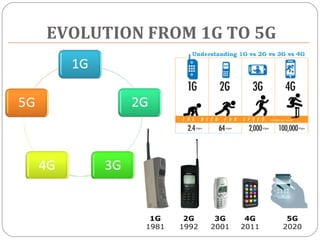
EVOLUTION FROM 1G TO 5G
1. 1st
Generation
Drawbacks:
 Poor Voice Quality
 Poor Battery Life
 Large Phone Size
 No Security
 Limited Capacity
 Poor Handset Reliability
Features:
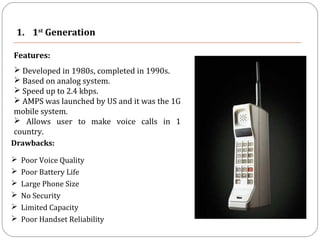
 Developed in 1980s, completed in 1990s.
 Based on analog system.
 Speed up to 2.4 kbps.
 AMPS was launched by US and it was the 1G
mobile system.
 Allows user to make voice calls in 1
country.
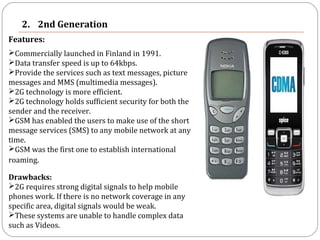
2. 2nd Generation
Features:
Commercially launched in Finland in 1991.
Data transfer speed is up to 64kbps.
Provide the services such as text messages, picture
messages and MMS (multimedia messages).
2G technology is more efficient.
2G technology holds sufficient security for both the
sender and the receiver.
GSM has enabled the users to make use of the short
message services (SMS) to any mobile network at any
time.
GSM was the first one to establish international
roaming. 
Drawbacks:
2G requires strong digital signals to help mobile
phones work. If there is no network coverage in any
specific area, digital signals would be weak.
These systems are unable to handle complex data
such as Videos.
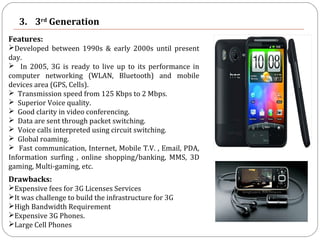
3. 3rd
Generation
Features:
Developed between 1990s & early 2000s until present
day.
 In 2005, 3G is ready to live up to its performance in
computer networking (WLAN, Bluetooth) and mobile
devices area (GPS, Cells).
 Transmission speed from 125 Kbps to 2 Mbps.
 Superior Voice quality.
 Good clarity in video conferencing.
 Data are sent through packet switching.
 Voice calls interpreted using circuit switching.
 Global roaming.
 Fast communication, Internet, Mobile T.V. , Email, PDA,
Information surfing , online shopping/banking, MMS, 3D
gaming, Multi-gaming, etc.
Drawbacks:
Expensive fees for 3G Licenses Services
It was challenge to build the infrastructure for 3G
High Bandwidth Requirement
Expensive 3G Phones.
Large Cell Phones
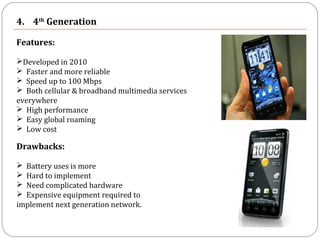
4. 4th
Generation
Features:
Developed in 2010
 Faster and more reliable
 Speed up to 100 Mbps
 Both cellular & broadband multimedia services
everywhere
 High performance
 Easy global roaming
 Low cost
Drawbacks:
 Battery uses is more
 Hard to implement
 Need complicated hardware
 Expensive equipment required to
implement next generation network.
 
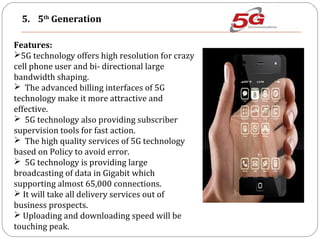
5. 5th
Generation
Features:
5G technology offers high resolution for crazy
cell phone user and bi- directional large
bandwidth shaping.
 The advanced billing interfaces of 5G
technology make it more attractive and
effective.
 5G technology also providing subscriber
supervision tools for fast action.
 The high quality services of 5G technology
based on Policy to avoid error.
 5G technology is providing large
broadcasting of data in Gigabit which
supporting almost 65,000 connections.
 It will take all delivery services out of
business prospects.
 Uploading and downloading speed will be
touching peak.
5. 5th
Generation
Features:
 The traffic statistics by 5G technology makes it more accurate.
 Through remote management offered by 5G technology a user can get a
better and faster solution.
 The remote diagnostics also a great feature of 5G technology.
 The 5G technology is providing up to 25 Mbps connectivity speed &
1Gbps data rate.
 Not harmful for human health
 Less battery consumption
CONCLUSION AND FUTURE PROSPECT
5G technology is the future of technology that will change the face
of the world market entirely.
The new concept, the new innovation and the new spectrum are all
what will give rise to a technological revolution in the world.
By 2020, the first 5G technology mobile overtaking will be brought
in the market.
Keep your eyes focused on the future prospect of the world and be
a part of something life altering.
Thank you…………………….
Detailed explanation of 5G in subsequent presentations.

5G technology part 1

  • 1.
    The 5g wireless TeChNOlOgY By:Mansi Gupta & Priyanka Saxena
  • 2.
    CONTENTS OVERVIEW  ABSTRACT INTRODUCTION TO 5G WIRELESS TECHNOLOGY o DEFINITION o OBJECTIVES OF 5G  EVOLUTION FROM 1G TO 5G  CONCLUSION AND FUTURE PROSPECTS
  • 3.
    ABSTRACT  5G isa name used in some research papers and projects to denote the next major phase of mobile telecommunications standards beyond the upcoming 4G standards.  5G technology has changed the means to use cell phones within very high bandwidth. The 5G technologies include all type of advanced features which makes this technology most powerful and in huge demand in near future. With 5G people will experience a level of call volume and data transmission never experienced before.  As a subscriber becomes more aware of the mobile phone technology, he/she will seek for an appropriate package all together, including all the advanced features of a cellular phone can have. Hence, the search for new technology is always the main intention of the prime cell phone giants to out innovate their competitors.  In addition, the main purpose of the 5th generation wireless networks will be to design the best wireless world that is free from limitations and hindrance of the previous generations. The 5G design is to be based on user centric mobile environment with many wireless and mobile technologies on the ground.
  • 4.
    INTRODUCTION TO 5GTECHNOLOGY  Today everyone possesses a mobile phone that works 24X7. Our handsets keep us connected with the world along with serving the purpose of entertainment gadget. From 1G – 2.5G and from 3G and above, this world of telecommunications has seen a number of improvements along with improved performance with every passing day.  5G is visualized to be a complete network for wireless mobile internet, which has the capability to offer services for accommodating the application potential requirements without suffering the quality.  A new revolution is about to begin as the global cell phones are just round the corner. The utilization of this gadget will surely move a step ahead with improved and accessible connectivity around the world.  5G technology has a bright future as it can handle best technologies and offer priceless handset to their customers. It has an extraordinary capability to support Software and Consultancy. In upcoming days, 5G technology is predicted to take over the world market.
  • 5.
    1. Definition 5G WirelessSystem is a complete wireless communication with almost no limitation; somehow people called it REAL wireless world. But till present day, this concept is only theory and not real. It basically denotes the next major phase of mobile telecommunication standards beyond 4G, whose releases are in progress by standardization bodies but are not at this time considered as new mobile generations but under the 4G umbrella. The implementation of standards under a 5G umbrella would likely be around 2020.
  • 6.
    2. Objectives of5G Superior Service Quality & User Experience: The focus is shifting towards managing the delivery of high-quality services i.e. support service center and user-centric management. Reliable Connectivity Experience: An instant immediacy in mobile services will lay the foundation for a whole new set of mobile apps to proliferate and push the capabilities of communications beyond what is currently possible. Ability to handle Upsetting growth in Network Capacity: Server workloads are growing by 10% a year. Network bandwidth demand is growing by 35%. Storage capacity is growing by 50%. Power costs growth is 20%. Throwing more capacity at demand is not a solution; there is a need to optimize capacity in new ways.
  • 7.
  • 8.
    1. 1st Generation Drawbacks:  PoorVoice Quality  Poor Battery Life  Large Phone Size  No Security  Limited Capacity  Poor Handset Reliability Features:  Developed in 1980s, completed in 1990s.  Based on analog system.  Speed up to 2.4 kbps.  AMPS was launched by US and it was the 1G mobile system.  Allows user to make voice calls in 1 country.
  • 9.
    2. 2nd Generation Features: Commerciallylaunched in Finland in 1991. Data transfer speed is up to 64kbps. Provide the services such as text messages, picture messages and MMS (multimedia messages). 2G technology is more efficient. 2G technology holds sufficient security for both the sender and the receiver. GSM has enabled the users to make use of the short message services (SMS) to any mobile network at any time. GSM was the first one to establish international roaming.  Drawbacks: 2G requires strong digital signals to help mobile phones work. If there is no network coverage in any specific area, digital signals would be weak. These systems are unable to handle complex data such as Videos.
  • 10.
    3. 3rd Generation Features: Developed between1990s & early 2000s until present day.  In 2005, 3G is ready to live up to its performance in computer networking (WLAN, Bluetooth) and mobile devices area (GPS, Cells).  Transmission speed from 125 Kbps to 2 Mbps.  Superior Voice quality.  Good clarity in video conferencing.  Data are sent through packet switching.  Voice calls interpreted using circuit switching.  Global roaming.  Fast communication, Internet, Mobile T.V. , Email, PDA, Information surfing , online shopping/banking, MMS, 3D gaming, Multi-gaming, etc. Drawbacks: Expensive fees for 3G Licenses Services It was challenge to build the infrastructure for 3G High Bandwidth Requirement Expensive 3G Phones. Large Cell Phones
  • 11.
    4. 4th Generation Features: Developed in2010  Faster and more reliable  Speed up to 100 Mbps  Both cellular & broadband multimedia services everywhere  High performance  Easy global roaming  Low cost Drawbacks:  Battery uses is more  Hard to implement  Need complicated hardware  Expensive equipment required to implement next generation network.  
  • 12.
    5. 5th Generation Features: 5G technologyoffers high resolution for crazy cell phone user and bi- directional large bandwidth shaping.  The advanced billing interfaces of 5G technology make it more attractive and effective.  5G technology also providing subscriber supervision tools for fast action.  The high quality services of 5G technology based on Policy to avoid error.  5G technology is providing large broadcasting of data in Gigabit which supporting almost 65,000 connections.  It will take all delivery services out of business prospects.  Uploading and downloading speed will be touching peak.
  • 13.
    5. 5th Generation Features:  Thetraffic statistics by 5G technology makes it more accurate.  Through remote management offered by 5G technology a user can get a better and faster solution.  The remote diagnostics also a great feature of 5G technology.  The 5G technology is providing up to 25 Mbps connectivity speed & 1Gbps data rate.  Not harmful for human health  Less battery consumption
  • 14.
    CONCLUSION AND FUTUREPROSPECT 5G technology is the future of technology that will change the face of the world market entirely. The new concept, the new innovation and the new spectrum are all what will give rise to a technological revolution in the world. By 2020, the first 5G technology mobile overtaking will be brought in the market. Keep your eyes focused on the future prospect of the world and be a part of something life altering. Thank you……………………. Detailed explanation of 5G in subsequent presentations.