SEMINAR PRESENTATION
ON
A Survey of 5G Network: Architecture and
Emerging Technologies
Presented by :
SANJEET KUMAR
USN: 1JS12EC096
DEPT. OF ELECTRONICS & COMMUNICATION
JSS ACADEMY OF TECHNICAL EDUCATION, BANGALORE
JSS Campus, Uttarahalli-Kengeri Road, Bangalore-560060
INTRODUCTION
 An exponential increase in demand of user.
► Mobile and wireless traffic volume will
increase a thousand times over the next
decade. It is expected that 50 billion devices
will connect to the cloud by 2020.
► It’ll be a complete wireless communication
with almost no limitation.
► Has incredible transmission speed.
2
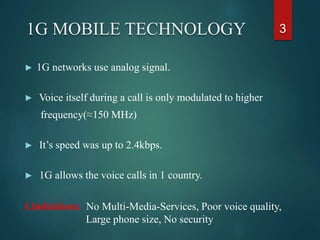
► 1G networks use analog signal.
► Voice itself during a call is only modulated to higher
frequency(≈150 MHz)
► It’s speed was up to 2.4kbps.
► 1G allows the voice calls in 1 country.
Limitations: No Multi-Media-Services, Poor voice quality,
Large phone size, No security
31G MOBILE TECHNOLOGY
Evolution From 1G to 5G Networks
► 1G, 2G, 3G & 4G are the generations
of wireless telecom connectivity.
► 1G : initial wireless telecom network
system
► “Brick phones” and “Bag phones” are
under 1G technology
► Analog signals are used in 1G.
4
2G MOBILE TECHNOLOGY
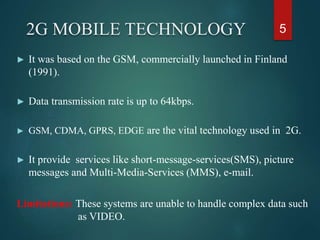
► It was based on the GSM, commercially launched in Finland
(1991).
► Data transmission rate is up to 64kbps.
► GSM, CDMA, GPRS, EDGE are the vital technology used in 2G.
► It provide services like short-message-services(SMS), picture
messages and Multi-Media-Services (MMS), e-mail.
Limitations: These systems are unable to handle complex data such
as VIDEO.
5
3G MOBILE TECHNOLOGY
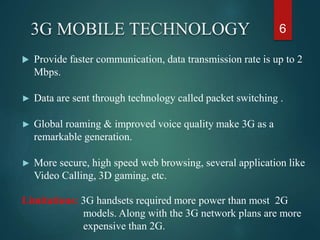
 Provide faster communication, data transmission rate is up to 2
Mbps.
► Data are sent through technology called packet switching .
► Global roaming & improved voice quality make 3G as a
remarkable generation.
► More secure, high speed web browsing, several application like
Video Calling, 3D gaming, etc.
Limitations: 3G handsets required more power than most 2G
models. Along with the 3G network plans are more
expensive than 2G.
6
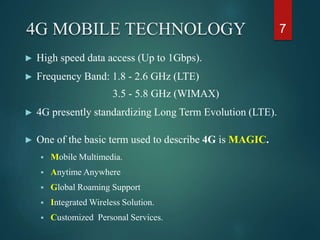
4G MOBILE TECHNOLOGY
► High speed data access (Up to 1Gbps).
► Frequency Band: 1.8 - 2.6 GHz (LTE)
3.5 - 5.8 GHz (WIMAX)
► 4G presently standardizing Long Term Evolution (LTE).
► One of the basic term used to describe 4G is MAGIC.
 Mobile Multimedia.
 Anytime Anywhere
 Global Roaming Support
 Integrated Wireless Solution.
 Customized Personal Services.
7
8
 It is combination of Wi-Fi and WIMAX (Worldwide
Interoperability for Microwave Access).
 4G Promises higher data rate and expended Multi-Media-
Services, high quality streaming video.
 Application: Online gaming, High Definition TV.
Limitations: Battery uses is more, 4G is currently available in
certain cities.
5G MOBILE TECHNOLOGY
 BDMA , non orthogonal & quasi-
orthogonal multiple access is used.
 Expected data transmission rate is
10-50Gbps.
 Bandwidth: 60GHz
 Capable of supporting World Wide
Wireless Web (WWWW).
9
WHY NEED OF 5G?
 3.4 billion people have broadband in
2014, about 80% were mobile
broadband user – and majority was
served by High Speed Packet Access
(HSPA) or Long Term Evolution
(LTE).
 As per estimation, 4G network will no
longer able to control the traffic in
upcoming years.
 Within 2020 WWWW will become the
latest trend for wireless communication.
10
FEATURES OF 5G
5G
HIGHER
DATA
RATE
LESS
TRAFFIC
REDUCED
COST
CONSISTANT
QUALITY OF
EXPERIENCE
MASSIVE
DEVICE
CONNECTIV
ITY
11
 Higher number of simultaneously connected devices.
 Higher system spectral efficiency (data volume per unit area).
 Lower battery consumption.
 Better coverage.
 High bit rates in large portions of coverage area.
 Lower cost than previous generations
12ADVANTAGES
Disadvantages
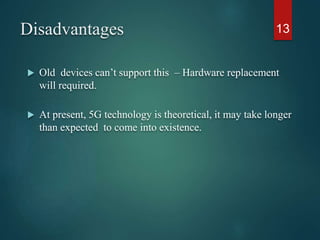
 Old devices can’t support this – Hardware replacement
will required.
 At present, 5G technology is theoretical, it may take longer
than expected to come into existence.
13
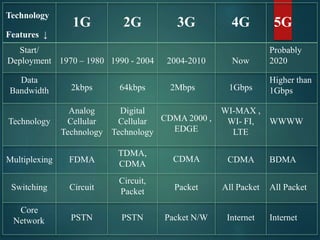
Technology
Features ↓
1G 2G 3G 4G 5G
Start/
Deployment 1970 – 1980 1990 - 2004 2004-2010 Now
Probably
2020
Data
Bandwidth 2kbps 64kbps 2Mbps 1Gbps
Higher than
1Gbps
Technology
Analog
Cellular
Technology
Digital
Cellular
Technology
CDMA 2000 ,
EDGE
WI-MAX ,
WI- FI,
LTE
WWWW
Multiplexing FDMA
TDMA,
CDMA
CDMA CDMA BDMA
Switching Circuit
Circuit,
Packet Packet All Packet All Packet
Core
Network PSTN PSTN Packet N/W Internet Internet
CONCLUSION
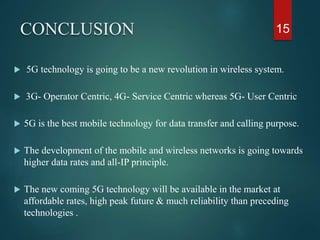
 5G technology is going to be a new revolution in wireless system.
 3G- Operator Centric, 4G- Service Centric whereas 5G- User Centric
 5G is the best mobile technology for data transfer and calling purpose.
 The development of the mobile and wireless networks is going towards
higher data rates and all-IP principle.
 The new coming 5G technology will be available in the market at
affordable rates, high peak future & much reliability than preceding
technologies .
15
REFERENCES
[1] “A Survey of 5G network: Architecture and Emerging Technologies” by Akhil Gupta and Rakesh
Kumar Jha, IEEE, Digital Object Identifier 10.1109/ACCESS.2015.2461602, August 7, 2015,
[2] R. Baldemair et al., ``Evolving wireless communications: Addressing the challenges and
expectations of the future,'' IEEE Veh. Technol. Mag.,vol. 8, no. 1, pp. 2430, Mar. 2013.
[3] http://www.teknocrat.com/1g-vs-2g-vs-3g-vs-4g-vs-5g-comparison-differences-and-
analysis.html.
[4] “5G Technology – Redefining wireless Communication in upcoming years” by Akhilesh Kumar
Pachauri 1 and Ompal Singh published in International Journal of Computer Science and
Management Research Vol 1 Issue 1 Aug 2012 ISSN 2278 – 733X
[5] http://www.ijcaonline.org/volume5/number4/pxc3871282.pdf.
[6] “Prospective of Fifth Generation Mobile Communications” by Dr. Anwar M. Mousa University of
Palestine,Gaza- Palestine published in International Journal of Next-Generation Networks (IJNGN)
Vol.4, No.3,September 2012
[5] International Journal of Computer Science and Management Research Vol 1 Issue 1 Aug 2012
[7] “5G Mobile Phone Technology” from www.pediain.com
[8] http://freewimaxinfo.com/5g-technology.html.
16
17

5G TECHNOLOGY

  • 1.
    SEMINAR PRESENTATION ON A Surveyof 5G Network: Architecture and Emerging Technologies Presented by : SANJEET KUMAR USN: 1JS12EC096 DEPT. OF ELECTRONICS & COMMUNICATION JSS ACADEMY OF TECHNICAL EDUCATION, BANGALORE JSS Campus, Uttarahalli-Kengeri Road, Bangalore-560060
  • 2.
    INTRODUCTION  An exponentialincrease in demand of user. ► Mobile and wireless traffic volume will increase a thousand times over the next decade. It is expected that 50 billion devices will connect to the cloud by 2020. ► It’ll be a complete wireless communication with almost no limitation. ► Has incredible transmission speed. 2
  • 3.
    ► 1G networksuse analog signal. ► Voice itself during a call is only modulated to higher frequency(≈150 MHz) ► It’s speed was up to 2.4kbps. ► 1G allows the voice calls in 1 country. Limitations: No Multi-Media-Services, Poor voice quality, Large phone size, No security 31G MOBILE TECHNOLOGY
  • 4.
    Evolution From 1Gto 5G Networks ► 1G, 2G, 3G & 4G are the generations of wireless telecom connectivity. ► 1G : initial wireless telecom network system ► “Brick phones” and “Bag phones” are under 1G technology ► Analog signals are used in 1G. 4
  • 5.
    2G MOBILE TECHNOLOGY ►It was based on the GSM, commercially launched in Finland (1991). ► Data transmission rate is up to 64kbps. ► GSM, CDMA, GPRS, EDGE are the vital technology used in 2G. ► It provide services like short-message-services(SMS), picture messages and Multi-Media-Services (MMS), e-mail. Limitations: These systems are unable to handle complex data such as VIDEO. 5
  • 6.
    3G MOBILE TECHNOLOGY Provide faster communication, data transmission rate is up to 2 Mbps. ► Data are sent through technology called packet switching . ► Global roaming & improved voice quality make 3G as a remarkable generation. ► More secure, high speed web browsing, several application like Video Calling, 3D gaming, etc. Limitations: 3G handsets required more power than most 2G models. Along with the 3G network plans are more expensive than 2G. 6
  • 7.
    4G MOBILE TECHNOLOGY ►High speed data access (Up to 1Gbps). ► Frequency Band: 1.8 - 2.6 GHz (LTE) 3.5 - 5.8 GHz (WIMAX) ► 4G presently standardizing Long Term Evolution (LTE). ► One of the basic term used to describe 4G is MAGIC.  Mobile Multimedia.  Anytime Anywhere  Global Roaming Support  Integrated Wireless Solution.  Customized Personal Services. 7
  • 8.
    8  It iscombination of Wi-Fi and WIMAX (Worldwide Interoperability for Microwave Access).  4G Promises higher data rate and expended Multi-Media- Services, high quality streaming video.  Application: Online gaming, High Definition TV. Limitations: Battery uses is more, 4G is currently available in certain cities.
  • 9.
    5G MOBILE TECHNOLOGY BDMA , non orthogonal & quasi- orthogonal multiple access is used.  Expected data transmission rate is 10-50Gbps.  Bandwidth: 60GHz  Capable of supporting World Wide Wireless Web (WWWW). 9
  • 10.
    WHY NEED OF5G?  3.4 billion people have broadband in 2014, about 80% were mobile broadband user – and majority was served by High Speed Packet Access (HSPA) or Long Term Evolution (LTE).  As per estimation, 4G network will no longer able to control the traffic in upcoming years.  Within 2020 WWWW will become the latest trend for wireless communication. 10
  • 11.
  • 12.
     Higher numberof simultaneously connected devices.  Higher system spectral efficiency (data volume per unit area).  Lower battery consumption.  Better coverage.  High bit rates in large portions of coverage area.  Lower cost than previous generations 12ADVANTAGES
  • 13.
    Disadvantages  Old devicescan’t support this – Hardware replacement will required.  At present, 5G technology is theoretical, it may take longer than expected to come into existence. 13
  • 14.
    Technology Features ↓ 1G 2G3G 4G 5G Start/ Deployment 1970 – 1980 1990 - 2004 2004-2010 Now Probably 2020 Data Bandwidth 2kbps 64kbps 2Mbps 1Gbps Higher than 1Gbps Technology Analog Cellular Technology Digital Cellular Technology CDMA 2000 , EDGE WI-MAX , WI- FI, LTE WWWW Multiplexing FDMA TDMA, CDMA CDMA CDMA BDMA Switching Circuit Circuit, Packet Packet All Packet All Packet Core Network PSTN PSTN Packet N/W Internet Internet
  • 15.
    CONCLUSION  5G technologyis going to be a new revolution in wireless system.  3G- Operator Centric, 4G- Service Centric whereas 5G- User Centric  5G is the best mobile technology for data transfer and calling purpose.  The development of the mobile and wireless networks is going towards higher data rates and all-IP principle.  The new coming 5G technology will be available in the market at affordable rates, high peak future & much reliability than preceding technologies . 15
  • 16.
    REFERENCES [1] “A Surveyof 5G network: Architecture and Emerging Technologies” by Akhil Gupta and Rakesh Kumar Jha, IEEE, Digital Object Identifier 10.1109/ACCESS.2015.2461602, August 7, 2015, [2] R. Baldemair et al., ``Evolving wireless communications: Addressing the challenges and expectations of the future,'' IEEE Veh. Technol. Mag.,vol. 8, no. 1, pp. 2430, Mar. 2013. [3] http://www.teknocrat.com/1g-vs-2g-vs-3g-vs-4g-vs-5g-comparison-differences-and- analysis.html. [4] “5G Technology – Redefining wireless Communication in upcoming years” by Akhilesh Kumar Pachauri 1 and Ompal Singh published in International Journal of Computer Science and Management Research Vol 1 Issue 1 Aug 2012 ISSN 2278 – 733X [5] http://www.ijcaonline.org/volume5/number4/pxc3871282.pdf. [6] “Prospective of Fifth Generation Mobile Communications” by Dr. Anwar M. Mousa University of Palestine,Gaza- Palestine published in International Journal of Next-Generation Networks (IJNGN) Vol.4, No.3,September 2012 [5] International Journal of Computer Science and Management Research Vol 1 Issue 1 Aug 2012 [7] “5G Mobile Phone Technology” from www.pediain.com [8] http://freewimaxinfo.com/5g-technology.html. 16
  • 17.