AN INDUSTRIAL REPORT
ON
5G TECHNOLOGY at VIVO INDIA,G.NOIDA
submitted in partial fulfillment of the requirements for the degree of
Masters of Technology(Electronics & Communication Engineering)
in The NorthCap University,Gurugram
by
ATUL
16ECP001
Submitted to
DR. SHARDA VASHISTH
SCHOOL OF ENGINEERING & TECHNOLOGY
Department of Electrical, Electronics and Communication Engineering
Gurugram, Haryana
2017-2018
Acknowledgement
It is my pleasure to be indebted to various people, who directly or indirectly contributed
in the development of this work and who influenced my thinking, behavior, and acts
during the course of study I am thankful to Mr Vijay Kumar Ahlawat (senior firmware
engineer) at Vivo mobile india private limited for his support,cooperation and
motivation provided to me during the training for constant inspiration, presence and
blessings.
I am also grateful to the management of Vivo mobile india private limited ,Greater
Noida for permitting me to have training during 22nd may to 5th july ,2017
Lastly, I would like to thank the almighty and my parents for their moral support and my
friends with whom I shared my day-to-day experience and received lots of suggestions
that improved my quality of work.
Abstract
5G technologies will change the way most high-bandwidth users access their phones.With 5G
people will experience a level of call volume and data transmission never experienced
before.5G Technology is offering the services in different fields like Documentation,
supporting electronic transactions (e- Payments, e-transactions) etc. As the cus-tomer
becomes more and more aware of the mobile phone technology, he or she will look for a
decent package all together, including all the advanced features a cellular phone can have.
Hence the search for new technology is always the main motive of the leading cell phone
giants to out innovate their competitors. The 5g design is based on user- centric mobile
environment with many wireless and mobile technologies on the ground.In 5G, researches are
related to the development of World Wide Wireless Web (WWWW), Dynamic Adhoc
Wireless Networks (DAWN) and Real Wireless Communication. The most important tech-
nologies for 5G technologies are 802.11 Wireless Local Area Networks (WLAN) and 802.16
Wireless Metropolitan Area Networks (WMAN), Ad-hoc Wireless Personal Area Network
(WPAN) and Wireless net-works for digital communication.
CHAPTER 1
INTRODUCTION
The world has seen a lot of changes in the realm of communication. Today we no
more use landlines. Everyone possesses a mobile phone that functions 24X7. Our handsets
not only keep us connected with the world at large but also serve the purpose of
entertainment gadget. From 1G to 2.5G and from 3G to 5G this world of telecommunications
has seen a number of improvements along with improved performance with every passing
day.The 5th generation is envisaged to be a complete network for wireless mobile internet,
which has the capability to offer services for accom-modating the application potential
requirements without suffering the quality. The ultimate goal of 5G is to design a real
wireless world, that is free from obstacles of the earlier generations.5G technology will
change the manner in which cellular plans are of-fered worldwide. A new revolution is about
to begin. The global cell phone is around the corner. The global mobile phone will hit the
local-ities who can call and access from one country to anothers local phone with this new
technology. The way in which people are communicat-ing will altogether upgrade. The
utilization of this gadget will surely move a step ahead with improved and accessible
connectivity around the world. Your office will shrink into your handset with this cell phone
that is going to resemble PDA (personal digital assistant) of twenty first century.
5G technology has a bright future because it can handle best technolo-gies and offer priceless
handset to their customers. May be in coming days 5G technology takes over the world
market. 5G Technologies have an extraordinary capability to support Software and
Consultancy. The Router and switch technology used in 5G network providing high
connectivity. The 5G technology distributes internet access to nodes within the building and
can be deployed with union of wired or wire-less network connections. The current trend of
5G technology has a glowing future.
1
1.1 Definition
5G Wireless System is a complete wireless communication with almost no limitation;
somehow people called it REAL wireless world. But till present day 5G wireless system
concept is only theory and not real, so it is not applicable for use.5G (5th generation mobile
networks or 5th generation wireless systems) is a technology used in research papers and
projects to denote the next major phase of mobile telecommunication standards beyond 4G.
5G is not officially used for any specification or official document yet made public by
telecommunication companies or standardization bodies. New standard releases beyond 4G
are in progress by standard-ization bodies, but are at this time not considered as new mobile
gen-erations but under the 4G umbrella. The implementation of standards under a 5G
umbrella would likely be around the year of 2020.
1.2 Properties of 5G
Worldwide cellular phone : Phone calls in any country can be done easily like a local phone
call.Extraordinary data capabilities : Data capabilities of the 5G system is much more higher
than other generation so you can store more number of data with less problem in storing
them.High connectivity : Connectivity speed of 5G is unimaginable.More power and features
in hand held phones : You’ll have all features of PDA and laptops in your mobile phone,
which makes it more powerful.Large phone memory, more dialing speed, more clarity in
audio & video.
2
Chapter 2
Literature Survey
2.1 Wireless Technology
Wireless communications is the transfer of information between two or more points that are
not physically connected. Distances can be short, such as a few meters for television remote
control, or as far as thousands or even millions of kilometers for deep-space radio commu-
nications. It encompasses various types of fixed, mobile, and portable two-way radios,
cellular telephones, personal digital assistants (PDAs), and wireless networking. Other
examples of wireless technology in-clude GPS units, Garage door openers or garage doors,
wireless com-puter mice, keyboards and Headset(telephone/computer),headphones, radio
receivers, satellite television, broadcast television and cordless telephones.
2.1.1 Types of Wireless Communication Networks
Cellular Networks
A cellular network is a radio network distributed over land areas called cells, each served by
at least one fixed-location transceiver known as a cell site or base station. When joined
together these cells provide radio coverage over a wide geographic area. This enables a large
number of portable transceivers (e.g., mobile phones, pagers, etc.) to commu-nicate with
each other and with fixed transceivers and telephones any-where in the network, via base
stations, even if some of the transceivers are moving through more than one cell during
transmission.
Wireless Local Area Network
A wireless local area network (WLAN) links two or more devices us-ing some wireless
distribution method (typically spread-spectrum or OFDM radio), and usually providing a
connection through an access point to the wider internet.
3
This gives users the mobility to move around within a local coverage area and still be
connected to the net-work. Most modern WLANs are based on IEEE 802.11 standards, mar-
keted underthe Wi-Fi brand name. Wireless LANs have become popu-lar in the home due to
ease of installation, and incommercial complexes offering wireless access to their customers;
often for free. Large wire-less network projects are being put up in many major cities: New
York City, for instance, has begun a pilot program to provide city workers in all five
boroughs of the city with wireless Internet access.
2.2 Evolution from 1G to 5G
In 1895, Guglielmo Marconi opened the way for modern wireless com-munications by
transmitting the three- dot Morse code for the letter ’S’ over a distance of three kilometers
using electromagnetic waves. From this beginning, wireless communications has developed
into a key el-ement of modern society. From satellite transmission, radio and tele-vision
broadcasting to the now ubiquitous mobile telephone, wireless communications has
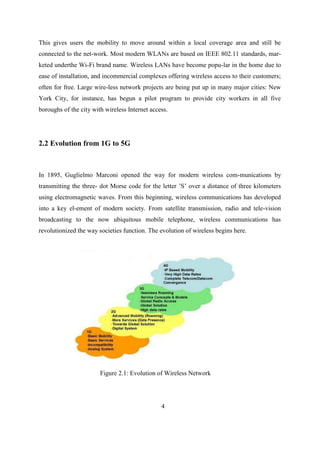
revolutionized the way societies function. The evolution of wireless begins here.
Figure 2.1: Evolution of Wireless Network
4
2.2.1 1st GENERATION
First Generation wireless technology (1G) is the original analog (An analog or analogue
signal is any continuous signal for which the time varying feature (variable) of the signal is a
representation of some other time varying quantity), voice-only cellular telephone standard,
devel-oped in the 1980s. The prominent ones among 1G system were ad-vanced mobile
phone system (AMPS), Nordic mobile telephone (NMT), and total access communication
system (TACS).
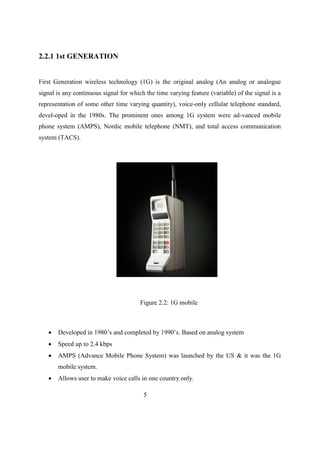
Figure 2.2: 1G mobile
 Developed in 1980’s and completed by 1990’s. Based on analog system
 Speed up to 2.4 kbps
 AMPS (Advance Mobile Phone System) was launched by the US & it was the 1G
mobile system.
 Allows user to make voice calls in one country only.
5
2.2.2 2nd GENERATION
2G (or 2-G) is short for second-generation wireless telephone technol-ogy. Second
generation 2G cellular telecom networks were commer-cially launched on the GSM standard
in Finland in 1991. 2G network allows for much greater penetration intensity. 2G
technologies enabled the various mobile phone networks to provide the services such as text
messages, picture messages and MMS (Multi Media Messages). 2G technology is more
efficient. 2G technology holds sufficient security for both the sender and the receiver. All
text messages are digitally en-crypted. This digital encryption allows for the transfer of data
in such a way that only the intended receiver can receive and read it.
Second generation technologies are either time division multiple access (TDMA) or code
division multiple access (CDMA). TDMA allows for the division of signal into time slots.
CDMA allocates each user a spe-cial code to communicate over a multiplex physical
channel. Different TDMA technologies are GSM, PDC, iDEN, IS-136. CDMA technol-ogy
is IS-95. GSM (Global system for mobile communication) is the most admired standard of all
the mobile technologies. GSM technology was the first one to help establish international
roaming. This enabled the mobile subscribers to use their mobile phone connections in many
different countries of the worlds is based on digital signals ,unlike 1G technologies which
were used to transfer analogue signals. GSM has enabled the users to make use of the short
message services (SMS) to any mobile network at any time. SMS is a cheap and easy way to
send a message to anyone, other than the voice call or conference. This technology is
beneficial to both the network operators and the ultimate users at the same time. In
comparison to 1G’s analog signals, 2G’s digital signals are very re-liant on location and
proximity. If a 2G handset made a call far away from a cell tower, the digital signal may not
be enough to reach it. While a call made from a 1G handset had generally poor quality than
that of a 2G handset, it survived longer distances This is due to the analog signal having a
smooth curve compared to the digital signal, which had a jagged, angular curve. As
conditions worsen, the quality of a call made from a 1G handset would gradually worsen, but
a call made from a 2G handset would fail completely.
6
2.5G networks, such as General Packet Radio Service (GPRS), are an extension of 2G
networks, in that they use circuit switching for voice and packet switching for data
transmission resulting in its popularity since packet switching utilizes bandwidth much more
efficiently. In this system, each users packets compete for available bandwidth, and users are
billed only for the amount of data transmitted.
Figure 2.3: 2G mobile
 Developed in late 1980s & completed in late 1990s Based on digital system
 Speed up to 64 kbps
 Services such are digital voice & SMS with more clarity Semi global facility
 2G are the handsets we are using today, with 2.5G having more capabilities
2.2.3 3rd GENERATION
International Mobile Telecommunications-2000 (IMT–2000), better known as 3G or 3rd
Generation, is a generation of standards for mobile phones and mobile telecommunications
services fulfilling specifications by the International Telecommunication Union. The use of
3G technology is also able to transmit packet switch data efficiently at better and in-creased
bandwidth
7
3G mobile technologies proffers more advanced services to mobile users. The spectral
efficiency of 3G technology is better than 2G technologies. Spectral efficiency is the
measurement of rate of information transfer over any communication system. 3G is also
known as IMT-2000.
Figure 2.4: 3G mobile
 Developed between late 1990s & early 2000s until present day
 In 2005, 3G is ready to live up to its performance in computer networking
(WCDMA, WLAN and Bluetooth) and mobile de-vices area (cell phone
and GPS)
 Transmission speed from 125 kbps to 2 Mbps Superior voice quality
 Good clarity in video conference
 Data are sent through technology called packet switching Voice calls are interpreted
using circuit switching
 Fast Communication, Internet, Mobile T.V, E-mail, PDA, infor-mation surfing, on-
line shopping/ banking, Multi Media Messag-ing Service (MMS), 3D gaming, Multi-
Gaming etc.
 Global roaming
8
2.2.4 4th GENERATION
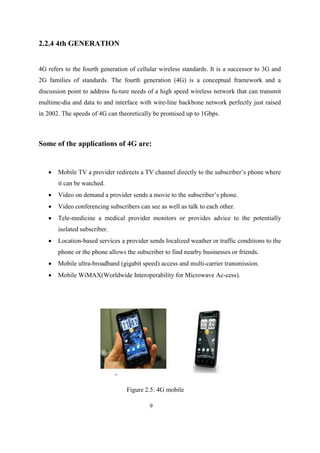
4G refers to the fourth generation of cellular wireless standards. It is a successor to 3G and
2G families of standards. The fourth generation (4G) is a conceptual framework and a
discussion point to address fu-ture needs of a high speed wireless network that can transmit
multime-dia and data to and interface with wire-line backbone network perfectly just raised
in 2002. The speeds of 4G can theoretically be promised up to 1Gbps.
Some of the applications of 4G are:
 Mobile TV a provider redirects a TV channel directly to the subscriber’s phone where
it can be watched.
 Video on demand a provider sends a movie to the subscriber’s phone.
 Video conferencing subscribers can see as well as talk to each other.
 Tele-medicine a medical provider monitors or provides advice to the potentially
isolated subscriber.
 Location-based services a provider sends localized weather or traffic conditions to the
phone or the phone allows the subscriber to find nearby businesses or friends.
 Mobile ultra-broadband (gigabit speed) access and multi-carrier transmission.
 Mobile WiMAX(Worldwide Interoperability for Microwave Ac-cess).
Figure 2.5: 4G mobile
9
 Developed in 2010
 Faster & more reliable Speed up to 100 Mbps
 Both cellular and broadband multimedia services everywhere
 High performance
 Easy global roaming
 Low cost
2.2.5 5th GENERATION
5G Technology stands for 5th Generation Mobile technology. 5G tech-nology has changed
the means to use cell phones within very high bandwidth. User never experienced ever before
such a high value tech-nology. The 5G technologies include all type of advanced features
which makes 5G technology most powerful and in huge demand in near future.
The gigantic array of innovative technology being built into new cell phones is stunning. 5G
technologies which are on hand held phone offering more power and features than at least
1000 lunar modules. A user can also hook their 5G technology cell phone with their Lap-top
to get broadband internet access. 5G technology including camera, MP3 recording, video
player, large phone memory, dialling speed, au-dio player and much more you can never
imagine.
Figure 2.6: 5G mobile
10
 Next major phase of mobile telecommunication & wireless sys-tem
 10 times more capacity than others
 Expected speed up to 1 Gbps
 More faster & reliable than 4G
 Lower cost than previous generations
2.3 Comparison of all generations
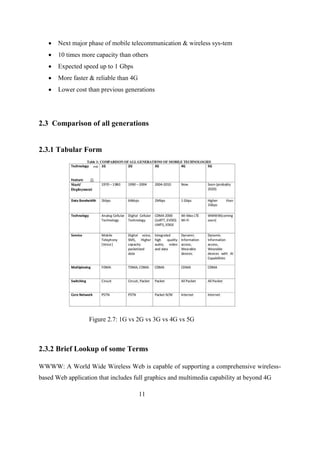
2.3.1 Tabular Form
Figure 2.7: 1G vs 2G vs 3G vs 4G vs 5G
2.3.2 Brief Lookup of some Terms
WWWW: A World Wide Wireless Web is capable of supporting a comprehensive wireless-
based Web application that includes full graphics and multimedia capability at beyond 4G
11
WDM: Wavelength Division Multiplexing allows many indepen-dent signals to be
transmitted simultaneously on one fiber with each signal located at a different wavelength.
Routing and detec-tion of these signals require devices that are wavelength selec-tive,
allowing for the transmission, recovery, or routing of spe-cific wavelengths in photonic
networks.WCDMA: Wideband CDMA is a technology for wideband dig-ital radio
communications of multimedia and other capacity de-manding applications.PSTN: Public
Switched Telephone Network is a regular voice telephone network.Spread Spectrum: It is a
form of wireless communication in which the frequency of the transmitted signal is
deliberately var-ied over a wide range. This results in a higher bandwidth of the signal than
the one without varied frequency.TDMA: Time Division Multiple Access is a technology for
shar-ing a medium by several users by dividing into different time slots transmitting at the
same frequency.UMTS: Universal Mobile Telecommunications System is the third
generation mobile telephone standard in Europe.WAP: Wireless Application Protocol defines
the use of TCP/IP and Web browsing for mobile systems.DAWN: Advanced technologies
including smart antenna and flex-ible modulation are keys to optimize this wireless version
of reconfigurable adhoc networks
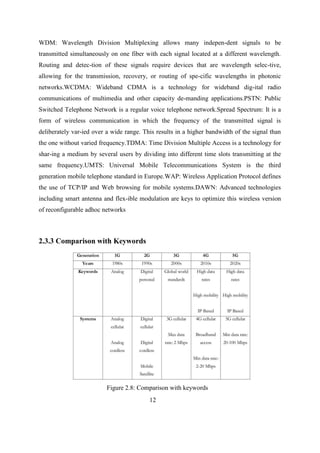
2.3.3 Comparison with Keywords
Figure 2.8: Comparison with keywords
12
Chapter 3
5G Technology
3.1 What is 5G technology
5G (5th generation mobile networks or 5th generation wireless sys-tems) is a term used in
some research papers and projects to denote the next major phase of mobile
telecommunications standards beyond the current 4G/IMT-Advanced standards. 5G is also
referred to as be-yond 2020 mobile communications technologies. 5G does not describe any
particular specification in any official document published by any telecommunication
standardization body.
A new mobile generation has appeared approximately every 10th year since the first 1G
system, Nordic Mobile Telephone, was intro-duced in 1981. The first 2G system started to
roll out in 1992, the first 3G system first appeared in 2001 and 4G systems fully compliant
with IMT Advanced were standardised in 2012. The development of the 2G (GSM) and 3G
(IMT-2000 and UMTS) standards took about 10 years from the official start of the R&D
projects, and development of 4G systems started in 2001 or 2002. Predecessor technologies
have occurred on the market a few years before the new mobile generation, for example the
pre-3G system CdmaOne/IS95 in the US in 1995, and the pre-4G systems Mobile WiMAX in
South-Korea 2006, and first release-LTE in Scandinavia 2009.
Mobile generations typically refer to nonbackwards-compatible cel-lular standards following
requirements stated by ITU-R, such as IMT-2000 for 3G and IMT-Advanced for 4G. In
parallel with the develop-ment of the ITU-R mobile generations, IEEE and other standardisa-
tion bodies also develop wireless communication technologies, often for higher data rates and
higher frequencies but shorter transmission ranges. The first gigabit IEEE standard was wigig
or IEEE 802.11ac, commercially available since 2013, soon to be followed by the multi
gigabit standard IEEE 802.11ad.If 5G appears, and reflects these prognoses, the major
difference from a user point of view between 4G and 5G techniques must be something else
than increased peak bit rate.
13
for example higher number of simultaneously connected devices, higher system spectral
efficiency (data volume per area unit), lower battery consumption, lower outage probability
(better coverage), high bit rates in larger portions of the coverage area, lower latencies,
higher number of supported devices lower infrastructure deployment costs, higher versatility
and scalabil-ity or higher reliability of communications. Those are the objectives in several of
the research papers and projects below.
3.2 Research Work
Key concepts suggested in scientific papers discussing 5G and beyond 4G wireless
communications are:
Massive Dense Networks also known as Massive Distributed MIMO providing green flexible
small cells 5G Green Dense Small Cells. A transmission point equipped with a very large
number of an-tennas that simultaneously serve multiple users. With massive MIMO multiple
messages for several terminals can be transmit-ted on the same time-frequency resource,
maximising beamform-ing gain while minimising interference.
Advanced interference and mobility management, achieved with the cooperation of different
transmission points with overlapped coverage, and encompassing the option of a flexible
usage of re-sources for uplink and downlink transmission in each cell, the option of direct
device-to-device transmission and advanced in-terference cancellation techniques.
Efficient support of machine-type devices to enable the Internet of Things with potentially
higher numbers of connected devices as well as novel applications such as mission critical
control or traffic safety, requiring reduced latency and enhanced reliability.
Group cooperative relay: A major issue in beyond 4G systems is to make the high bit rates
available in a larger portion of the cell, especially to users in an exposed position in between
several base stations. In current research, this issue is addressed by cellular repeaters and
macro-diversity techniques, also known as group cooperative relay, as well as by beam
division multiple access (BDMA).
14
The usage of millimetre wave frequencies (e.g. up to 90 GHz) for wireless backhaul and/or
access (IEEE rather than ITU gen-erations).
Pervasive networks providing Internet of things, wireless sensor networks and ubiquitous
computing: The user can simultane-ously be connected to several wireless access
technologies and seamlessly move between them. These access technologies can be 2.5G,
3G, 4G, or 5G mobile networks, Wi-Fi, WPAN, or any other future access technology. In
5G, the concept may be further developed into multiple concurrent data transfer paths.
Multi-hop networks: A major issue in beyond 4G systems is to make the high bit rates
available in a larger portion of the cell, es-pecially to users in an exposed position in between
several base stations. In current research, this issue is addressed by cellular repeaters and
macro-diversity techniques, also known as group cooperative relay, where also users could be
potential cooper ative nodes thanks to the use of direct device-to-device (D2D)
communications.
Cognitive radio technology, also known as smart-radio: allow-ing different radio
technologies to share the same spectrum effi-ciently by adaptively finding unused spectrum
and adapting the transmission scheme to the requirements of the technologies cur-rently
sharing the spectrum. This dynamic radio resource man-agement is achieved in a distributed
fashion, and relies on software-defined radio.
Dynamic Adhoc Wireless Networks (DAWN), essentially identi-cal to Mobile ad hoc
network (MANET), Wireless mesh network (WMN) or wireless grids, combined with smart
antennas, coop-erative diversity and flexible modulation.
Vandermonde-subspace frequency division multiplexing (VFDM): a modulation scheme to
allow the co-existence of macro-cells and cognitive radio small-cells in a two-tiered LTE/4G
network.IPv6, where a visiting care-of mobile IP address is assigned ac-cording to location
and connected network.Wearable devices with AI capabilities such as smartwatches and
optical head-mounted displays for augmented reality.One unified global standard.Real
wireless world with no more limitation with access and zone issues.
15
User centric (or cell phone developer initiated) network concept instead of operator-initiated
(as in 1G) or system developer initi-ated (as in 2G, 3G and 4G) standards.
Li-Fi, or light fidelity, is a massive MIMO visible light commu-nication network to advance
5G. Li-Fi uses light-emitting diodes to transmit data, rather than radio waves like Wi-Fi.
World wide wireless web (WWWW), i.e. comprehensive wireless-based web applications
that include full multimedia capability beyond 4G speeds.
3.3 Architecture of 5G
Figure 3.1: Mobile Terminal Design of 5G
Above figure shows 5G mobile phone design. 5G is being developed to accommodate the
QoS and rate requirements set by forthcoming appli-cations like wireless broadband access,
Multimedia Messaging Service (MMS), video chat, mobile TV, HDTV content, Digital
Video Broad-casting (DVB), minimal services like voice and data, and other services that
utilize bandwidth.
16
The definition of 5G is to provide adequate RF coverage, more bits/Hz and to interconnect all
wireless heteroge-neous networks to provide seamless, consistent telecom experience to the
user.
3.4 Protocol Stack of 5G
3.4.1 Comparison with OSI Model
Figure 3.2: Comparison with OSI Model
3.4.2 Open Wireless Architecture (OWA)
Physical layer + Data link layer = OWA
 OSI layer 1, i.e. Physical layer & OSI layer 2, i.e. Data link layer define the wireless
technology.
 For these two layers the 5G mobile network is likely to be based on Open Wireless
Architecture (OWA).
17
3.4.3 Network Layer
 All mobile networks will use mobile IP.
 Each mobile terminal will be FA (Foreign Agent).
 A mobile can be attached to several mobiles or wireless networks at the same time.
 The fixed IPv6 will be implemented in the mobile phones. Separation of network
layer into two sub-layers:
1.Lower network layer (for each interface)
2.Upper network layer (for the mobile terminal)
Figure 3.3: Network Layer in 5G
3.4.4 Open Transport Protocol (OTP)
Transport layer + Session layer = OTP
 Wireless network differs from wired network regarding the trans-port layer.
 In all TCP versions the assumption is that lost segments are due to network
congestion.
 In wireless, the loss is due to higher bit error ratio in the radio interface.
 5G mobile terminals have transport layer that is possible to be downloaded &
installed which is based on Open Transport Pro-tocol.
18
3.4.5 Application Layer
Presentation layer + Application layer = Application layer (5G)
 Provides intelligent QoS (Quality of Service) management over variety of networks.
 Provides possibility for service quality testing & storage of mea-surement information
in information database in the mobile ter-minal.
 Select the best wireless connection for given services.
 QoS parameters, such as, delay, losses, BW, reliability, will be stored in DB
(Database) of 5G mobile.
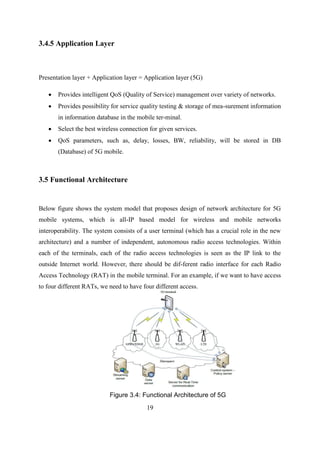
3.5 Functional Architecture
Below figure shows the system model that proposes design of network architecture for 5G
mobile systems, which is all-IP based model for wireless and mobile networks
interoperability. The system consists of a user terminal (which has a crucial role in the new
architecture) and a number of independent, autonomous radio access technologies. Within
each of the terminals, each of the radio access technologies is seen as the IP link to the
outside Internet world. However, there should be dif-ferent radio interface for each Radio
Access Technology (RAT) in the mobile terminal. For an example, if we want to have access
to four different RATs, we need to have four different access.
Figure 3.4: Functional Architecture of 5G
19
Application connections are realized between clients and servers in the Internet via sockets.
Internet sockets are endpoints for data commu-nication flows. Each socket of the web is a
unified and unique combina-tion of local IP address and appropriate local transport
communications port, target IP address and target appropriate communication port, and type
of transport protocol. Considering that, the establishment of com-munication from end-to-end
between the client and server using the Internet protocol is necessary to raise the appropriate
Internet socket uniquely determined by the application of the client and the server. This
means that in case of interoperability between heterogeneous networks and for the vertical
handover between the respective radio technologies, the local IP address and destination IP
address should be fixed and un-changed. Fixing of these two parameters should ensure
handover trans-parency to the Internet connection end-to-end, when there is a mobile user at
least on one end of such connection. In order to preserve the proper layout of the packets and
to reduce or prevent packets losses, routing to the target destination and vice versa should be
uniquely and using the same path.
Figure 3.5: Protocol layout
Each radio access technology that is available to the user in achiev-ing connectivity with the
relevant radio access is presented with appro-priate IP interface. Each IP interface in the
terminal is characterized by its IP address and net mask and parameters associated with the
rout-ing of IP packets across the network.
20
In regular inter-system handover the change of access technology (i.e., vertical handover)
would mean changing the local IP address. Then, change of any of the parameters of the
socket means and change of the socket, that is, closing the socket and opening a new one.
This means, ending the connection and start-ing e new one. This approach is not-flexible, and
it is based on todays Internet communication. In order to solve this deficiency we propose a
new level that will take care of the abstraction levels of network ac-cess technologies to
higher layers of the protocol stack. This layer is crucial in the new architecture. To enable the
functions of the applied transparency and control or direct routing of packets through the
most appropriate radio access technology, in the proposed architecture we in-troduce a
control system in the functional architecture of the networks, which works in complete
coordination with the user terminal and pro-vides a network abstraction functions and routing
of packets based on defined policies. At the same time this control system is an essential
element through which it can determine the quality of service for each transmission
technology. He is on the Internet side of the proposed ar-chitecture, and as such represents an
ideal system to test the qualitative characteristics of the access technologies, as well as to
obtain a realis-tic picture regarding the quality that can be expected from applications of the
user towards a given server in Internet (or peer). Protocol setup of the new levels within the
existing protocol stack, which form the proposed architecture, is presented in Figure
(Protocol Layout for the Elements of the Proposed Architecture). The network abstraction
level would be provided by creating IP tunnels over IP interfaces obtained by connection to
the terminal via the access technologies available to the terminal (i.e., mobile user). In fact,
the tunnels would be estab-lished between the user terminal and control system named here
as Policy Router, which performs routing based on given policies. In this way the client side
will create an appropriate number of tunnels con-nected to the number of radio access
technologies, and the client will only set a local IP address which will be formed with sockets
Internet communication of client applications with Internet servers. The way IP packets are
routed through tunnels, or choosing the right tunnel, would be served by policies whose rules
will be exchanged via the virtual network layer protocol. This way we achieve the required
abstraction of the network to the client applications at the mobile terminal. The process of
establishing a tunnel to the Policy Router, for routing based on the policies, are carried out
immediately after the establishment of IP connectivity across the radio access technology,
and it is initiated from the mobile terminal Virtual Network-level Protocol.
21
3.6 Features of 5G
 5G technology offer high resolution for crazy cell phone user and bi- directional large
bandwidth shaping.
 The advanced billing interfaces of 5G technology makes it more attractive and
effective.
 5G technology also providing subscriber supervision tools for fast action.
 The high quality services of 5G technology based on Policy to avoid error.
 5G technology is providing large broadcasting of data in Gigabit which supporting
almost 65,000 connections.
 5G technology offer transporter class gateway with unparalleled consistency.
 The traffic statistics by 5G technology makes it more accurate.
 Through remote management offered by 5G technology a user can get better and fast
solution.
 The remote diagnostics also a great feature of 5G technology.
 The 5G technology is providing up to 25 Mbps connectivity speed. The 5G
technology also support virtual private network.
 The new 5G technology will take all delivery service out of busi-ness prospect.
 The uploading and downloading speed of 5G technology touch-ing the peak.
 The 5G technology network offering enhanced and available con-nectivity just about
the world.
3.6.1 Advantages
 5G provides data bandwidth of 1 Gbps or higher. 5G is globally accessible.
 5G provides dynamic information access beneficial to domestic user.
 5G is available at low cost.
22
3.6.2 Applications
 Wearable device with AI capabilities.
 Pervasive (Global) networks. Media independent handover. Radio resource
management.
 High Altitude Stratospheric Platform Station (HAPS) systems. VoIP (Voice over IP)
enabled device.With 6th sense technology.
23
Chapter 4
Conclusion
Mobile Wireless Communication Technology is going to be a new rev-olution in mobile
market. With the coming out of cell phone alike to personal data assistant (PDA) now our
whole office is in our finger tips or in our phone. The 5G technology is designed as an open
platform on different layers, from the physical layer up to the application. Presently, the
current work is in the modules that shall offer the best Operating System and lowest cost for
a specified service using one or more than one wireless technology at the same time from the
5G mobile. 5G technology has a bright future because it can handle best technologies and
offer priceless handset to their customers. 4G and 5G techniques provide efficient user
services with lower battery consumption, lower outage probability (better coverage), high bit
rates in larger portions of the coverage area, cheaper or no traffic fees due to low
infrastructure deployment costs, or higher aggregate capacity for many simultaneous users.
24
Chapter 5
Future Scope
The future enhancement of 5G Technology and its beyond(6G) will be incredible as it
combines with artificial intelligent (AI).One can able to control his intelligent Robot using
his mobile phone.Human life will be surrounded by artificial sensors which could be
communicating with your mobile phones.Mobiles can automatically type the message what
your brain thinks.
Possibility of communicating between planets(i.e, a person on Earth can communicate with
astronaut on some other planet by using his mobile) without any delay.
25
References
[1] IEEE-2013-5G Technology of Mobile Communication: A Survey
[2] IEEE-2013-5G Key Technologies: Identifying Innovation Oppor-
tunity
[3] September 2013 — IEEE vehicular technology magazine-5G on
the Horizon
[4] IEEE-2009-The Future of Mobile Wireless Communication Net-
works
[5] en.wikipedia.org/wiki/5G
26
Contents
1 Introduction 1
1.1 Definition ……………….......................................................... 2
1.2 Properties of 5G………………………………………………... 2
2 Literature Survey 3
2.1 Wireless Technology…………………………………………….. 3
2.1.1 Types of Wireless Communication Networks…………………3 .
2.2 Evolution from 1G to 5G………………………………………...4
2.2.1 1st generation………………………………….................5
2.2.2 2nd generation……………………………………………6
2.2.3 3rd
generation…………………………………………….7
2.2.4 4th generation……………………………………………9
2.2.5 5th generation……………………………………………10
2.3 Comparison of all generations……………………………………11
2.3.1 Tabular Form…………………………………………….11
2.3.2 Brief Lookup of some Terms…………………………….11
2.3.3 Comparison with Keywords…………………………… 12
3 5G Technology 13
3.1 What is 5G technology…………………………………………...13
3.2 Research Work…………………………………………………………….14
3.3 Architecture of 5G…………………………………………………...........16
3.4 Protocol Stack of 5G………………………………………………………17
3.4.1 Comparison with OSI Model………………………………………...17
3.4.2 Open wireless Architecture(OWA)…………………………………...17
3.4.3 Network Layer………………………………………………………...18
3.4.4 Open Transport Procotol(OTP)………………………………………..18
3.4.5 Application Layer……………………………………………………..19
3.5 Functional Architecture……………………………………………………..19
3.6 Features of 5G………………………………………………………………22
3.6.1 Advantages…………………………………………………………...22
3.6.2 Applications…………………………………………………………..23
4 Conclusions 24
5 Future scope 25
6 References 26
List of figures
2.1 Evolution of Wireless Network…………………………………………..4
2.2 1G mobile………………………………………………………………...5
2.3 2G mobile………………………………………………………………..7
2.4 3G mobile………………………………………………………………..8
2.5 4G mobile………………………………………………………………..9
2.6 5G mobile……………………………………………………………….10
2.7 1G vs 2G vs 3G vs 4G vs 5G……………………………………………11
2.8 Comparison with keywords……………………………………………..12
3.1 Mobile Terminal Design of 5G………………………………………….16
3.2 Comparison with OSI Model…………………………………………...17
3.3 Network Layer in5G……………………………………………………18
3.4 Fundamental Architecture of 5G……………………………………….19
3.5 Protocol layout for the elements of the proposed architecture of 5G….20
Report on 5 g technology

Report on 5 g technology

  • 1.
    AN INDUSTRIAL REPORT ON 5GTECHNOLOGY at VIVO INDIA,G.NOIDA submitted in partial fulfillment of the requirements for the degree of Masters of Technology(Electronics & Communication Engineering) in The NorthCap University,Gurugram by ATUL 16ECP001 Submitted to DR. SHARDA VASHISTH SCHOOL OF ENGINEERING & TECHNOLOGY Department of Electrical, Electronics and Communication Engineering Gurugram, Haryana 2017-2018
  • 2.
    Acknowledgement It is mypleasure to be indebted to various people, who directly or indirectly contributed in the development of this work and who influenced my thinking, behavior, and acts during the course of study I am thankful to Mr Vijay Kumar Ahlawat (senior firmware engineer) at Vivo mobile india private limited for his support,cooperation and motivation provided to me during the training for constant inspiration, presence and blessings. I am also grateful to the management of Vivo mobile india private limited ,Greater Noida for permitting me to have training during 22nd may to 5th july ,2017 Lastly, I would like to thank the almighty and my parents for their moral support and my friends with whom I shared my day-to-day experience and received lots of suggestions that improved my quality of work.
  • 3.
    Abstract 5G technologies willchange the way most high-bandwidth users access their phones.With 5G people will experience a level of call volume and data transmission never experienced before.5G Technology is offering the services in different fields like Documentation, supporting electronic transactions (e- Payments, e-transactions) etc. As the cus-tomer becomes more and more aware of the mobile phone technology, he or she will look for a decent package all together, including all the advanced features a cellular phone can have. Hence the search for new technology is always the main motive of the leading cell phone giants to out innovate their competitors. The 5g design is based on user- centric mobile environment with many wireless and mobile technologies on the ground.In 5G, researches are related to the development of World Wide Wireless Web (WWWW), Dynamic Adhoc Wireless Networks (DAWN) and Real Wireless Communication. The most important tech- nologies for 5G technologies are 802.11 Wireless Local Area Networks (WLAN) and 802.16 Wireless Metropolitan Area Networks (WMAN), Ad-hoc Wireless Personal Area Network (WPAN) and Wireless net-works for digital communication.
  • 4.
    CHAPTER 1 INTRODUCTION The worldhas seen a lot of changes in the realm of communication. Today we no more use landlines. Everyone possesses a mobile phone that functions 24X7. Our handsets not only keep us connected with the world at large but also serve the purpose of entertainment gadget. From 1G to 2.5G and from 3G to 5G this world of telecommunications has seen a number of improvements along with improved performance with every passing day.The 5th generation is envisaged to be a complete network for wireless mobile internet, which has the capability to offer services for accom-modating the application potential requirements without suffering the quality. The ultimate goal of 5G is to design a real wireless world, that is free from obstacles of the earlier generations.5G technology will change the manner in which cellular plans are of-fered worldwide. A new revolution is about to begin. The global cell phone is around the corner. The global mobile phone will hit the local-ities who can call and access from one country to anothers local phone with this new technology. The way in which people are communicat-ing will altogether upgrade. The utilization of this gadget will surely move a step ahead with improved and accessible connectivity around the world. Your office will shrink into your handset with this cell phone that is going to resemble PDA (personal digital assistant) of twenty first century. 5G technology has a bright future because it can handle best technolo-gies and offer priceless handset to their customers. May be in coming days 5G technology takes over the world market. 5G Technologies have an extraordinary capability to support Software and Consultancy. The Router and switch technology used in 5G network providing high connectivity. The 5G technology distributes internet access to nodes within the building and can be deployed with union of wired or wire-less network connections. The current trend of 5G technology has a glowing future. 1
  • 5.
    1.1 Definition 5G WirelessSystem is a complete wireless communication with almost no limitation; somehow people called it REAL wireless world. But till present day 5G wireless system concept is only theory and not real, so it is not applicable for use.5G (5th generation mobile networks or 5th generation wireless systems) is a technology used in research papers and projects to denote the next major phase of mobile telecommunication standards beyond 4G. 5G is not officially used for any specification or official document yet made public by telecommunication companies or standardization bodies. New standard releases beyond 4G are in progress by standard-ization bodies, but are at this time not considered as new mobile gen-erations but under the 4G umbrella. The implementation of standards under a 5G umbrella would likely be around the year of 2020. 1.2 Properties of 5G Worldwide cellular phone : Phone calls in any country can be done easily like a local phone call.Extraordinary data capabilities : Data capabilities of the 5G system is much more higher than other generation so you can store more number of data with less problem in storing them.High connectivity : Connectivity speed of 5G is unimaginable.More power and features in hand held phones : You’ll have all features of PDA and laptops in your mobile phone, which makes it more powerful.Large phone memory, more dialing speed, more clarity in audio & video. 2
  • 6.
    Chapter 2 Literature Survey 2.1Wireless Technology Wireless communications is the transfer of information between two or more points that are not physically connected. Distances can be short, such as a few meters for television remote control, or as far as thousands or even millions of kilometers for deep-space radio commu- nications. It encompasses various types of fixed, mobile, and portable two-way radios, cellular telephones, personal digital assistants (PDAs), and wireless networking. Other examples of wireless technology in-clude GPS units, Garage door openers or garage doors, wireless com-puter mice, keyboards and Headset(telephone/computer),headphones, radio receivers, satellite television, broadcast television and cordless telephones. 2.1.1 Types of Wireless Communication Networks Cellular Networks A cellular network is a radio network distributed over land areas called cells, each served by at least one fixed-location transceiver known as a cell site or base station. When joined together these cells provide radio coverage over a wide geographic area. This enables a large number of portable transceivers (e.g., mobile phones, pagers, etc.) to commu-nicate with each other and with fixed transceivers and telephones any-where in the network, via base stations, even if some of the transceivers are moving through more than one cell during transmission. Wireless Local Area Network A wireless local area network (WLAN) links two or more devices us-ing some wireless distribution method (typically spread-spectrum or OFDM radio), and usually providing a connection through an access point to the wider internet. 3
  • 7.
    This gives usersthe mobility to move around within a local coverage area and still be connected to the net-work. Most modern WLANs are based on IEEE 802.11 standards, mar- keted underthe Wi-Fi brand name. Wireless LANs have become popu-lar in the home due to ease of installation, and incommercial complexes offering wireless access to their customers; often for free. Large wire-less network projects are being put up in many major cities: New York City, for instance, has begun a pilot program to provide city workers in all five boroughs of the city with wireless Internet access. 2.2 Evolution from 1G to 5G In 1895, Guglielmo Marconi opened the way for modern wireless com-munications by transmitting the three- dot Morse code for the letter ’S’ over a distance of three kilometers using electromagnetic waves. From this beginning, wireless communications has developed into a key el-ement of modern society. From satellite transmission, radio and tele-vision broadcasting to the now ubiquitous mobile telephone, wireless communications has revolutionized the way societies function. The evolution of wireless begins here. Figure 2.1: Evolution of Wireless Network 4
  • 8.
    2.2.1 1st GENERATION FirstGeneration wireless technology (1G) is the original analog (An analog or analogue signal is any continuous signal for which the time varying feature (variable) of the signal is a representation of some other time varying quantity), voice-only cellular telephone standard, devel-oped in the 1980s. The prominent ones among 1G system were ad-vanced mobile phone system (AMPS), Nordic mobile telephone (NMT), and total access communication system (TACS). Figure 2.2: 1G mobile  Developed in 1980’s and completed by 1990’s. Based on analog system  Speed up to 2.4 kbps  AMPS (Advance Mobile Phone System) was launched by the US & it was the 1G mobile system.  Allows user to make voice calls in one country only. 5
  • 9.
    2.2.2 2nd GENERATION 2G(or 2-G) is short for second-generation wireless telephone technol-ogy. Second generation 2G cellular telecom networks were commer-cially launched on the GSM standard in Finland in 1991. 2G network allows for much greater penetration intensity. 2G technologies enabled the various mobile phone networks to provide the services such as text messages, picture messages and MMS (Multi Media Messages). 2G technology is more efficient. 2G technology holds sufficient security for both the sender and the receiver. All text messages are digitally en-crypted. This digital encryption allows for the transfer of data in such a way that only the intended receiver can receive and read it. Second generation technologies are either time division multiple access (TDMA) or code division multiple access (CDMA). TDMA allows for the division of signal into time slots. CDMA allocates each user a spe-cial code to communicate over a multiplex physical channel. Different TDMA technologies are GSM, PDC, iDEN, IS-136. CDMA technol-ogy is IS-95. GSM (Global system for mobile communication) is the most admired standard of all the mobile technologies. GSM technology was the first one to help establish international roaming. This enabled the mobile subscribers to use their mobile phone connections in many different countries of the worlds is based on digital signals ,unlike 1G technologies which were used to transfer analogue signals. GSM has enabled the users to make use of the short message services (SMS) to any mobile network at any time. SMS is a cheap and easy way to send a message to anyone, other than the voice call or conference. This technology is beneficial to both the network operators and the ultimate users at the same time. In comparison to 1G’s analog signals, 2G’s digital signals are very re-liant on location and proximity. If a 2G handset made a call far away from a cell tower, the digital signal may not be enough to reach it. While a call made from a 1G handset had generally poor quality than that of a 2G handset, it survived longer distances This is due to the analog signal having a smooth curve compared to the digital signal, which had a jagged, angular curve. As conditions worsen, the quality of a call made from a 1G handset would gradually worsen, but a call made from a 2G handset would fail completely. 6
  • 10.
    2.5G networks, suchas General Packet Radio Service (GPRS), are an extension of 2G networks, in that they use circuit switching for voice and packet switching for data transmission resulting in its popularity since packet switching utilizes bandwidth much more efficiently. In this system, each users packets compete for available bandwidth, and users are billed only for the amount of data transmitted. Figure 2.3: 2G mobile  Developed in late 1980s & completed in late 1990s Based on digital system  Speed up to 64 kbps  Services such are digital voice & SMS with more clarity Semi global facility  2G are the handsets we are using today, with 2.5G having more capabilities 2.2.3 3rd GENERATION International Mobile Telecommunications-2000 (IMT–2000), better known as 3G or 3rd Generation, is a generation of standards for mobile phones and mobile telecommunications services fulfilling specifications by the International Telecommunication Union. The use of 3G technology is also able to transmit packet switch data efficiently at better and in-creased bandwidth 7
  • 11.
    3G mobile technologiesproffers more advanced services to mobile users. The spectral efficiency of 3G technology is better than 2G technologies. Spectral efficiency is the measurement of rate of information transfer over any communication system. 3G is also known as IMT-2000. Figure 2.4: 3G mobile  Developed between late 1990s & early 2000s until present day  In 2005, 3G is ready to live up to its performance in computer networking (WCDMA, WLAN and Bluetooth) and mobile de-vices area (cell phone and GPS)  Transmission speed from 125 kbps to 2 Mbps Superior voice quality  Good clarity in video conference  Data are sent through technology called packet switching Voice calls are interpreted using circuit switching  Fast Communication, Internet, Mobile T.V, E-mail, PDA, infor-mation surfing, on- line shopping/ banking, Multi Media Messag-ing Service (MMS), 3D gaming, Multi- Gaming etc.  Global roaming 8
  • 12.
    2.2.4 4th GENERATION 4Grefers to the fourth generation of cellular wireless standards. It is a successor to 3G and 2G families of standards. The fourth generation (4G) is a conceptual framework and a discussion point to address fu-ture needs of a high speed wireless network that can transmit multime-dia and data to and interface with wire-line backbone network perfectly just raised in 2002. The speeds of 4G can theoretically be promised up to 1Gbps. Some of the applications of 4G are:  Mobile TV a provider redirects a TV channel directly to the subscriber’s phone where it can be watched.  Video on demand a provider sends a movie to the subscriber’s phone.  Video conferencing subscribers can see as well as talk to each other.  Tele-medicine a medical provider monitors or provides advice to the potentially isolated subscriber.  Location-based services a provider sends localized weather or traffic conditions to the phone or the phone allows the subscriber to find nearby businesses or friends.  Mobile ultra-broadband (gigabit speed) access and multi-carrier transmission.  Mobile WiMAX(Worldwide Interoperability for Microwave Ac-cess). Figure 2.5: 4G mobile 9
  • 13.
     Developed in2010  Faster & more reliable Speed up to 100 Mbps  Both cellular and broadband multimedia services everywhere  High performance  Easy global roaming  Low cost 2.2.5 5th GENERATION 5G Technology stands for 5th Generation Mobile technology. 5G tech-nology has changed the means to use cell phones within very high bandwidth. User never experienced ever before such a high value tech-nology. The 5G technologies include all type of advanced features which makes 5G technology most powerful and in huge demand in near future. The gigantic array of innovative technology being built into new cell phones is stunning. 5G technologies which are on hand held phone offering more power and features than at least 1000 lunar modules. A user can also hook their 5G technology cell phone with their Lap-top to get broadband internet access. 5G technology including camera, MP3 recording, video player, large phone memory, dialling speed, au-dio player and much more you can never imagine. Figure 2.6: 5G mobile 10
  • 14.
     Next majorphase of mobile telecommunication & wireless sys-tem  10 times more capacity than others  Expected speed up to 1 Gbps  More faster & reliable than 4G  Lower cost than previous generations 2.3 Comparison of all generations 2.3.1 Tabular Form Figure 2.7: 1G vs 2G vs 3G vs 4G vs 5G 2.3.2 Brief Lookup of some Terms WWWW: A World Wide Wireless Web is capable of supporting a comprehensive wireless- based Web application that includes full graphics and multimedia capability at beyond 4G 11
  • 15.
    WDM: Wavelength DivisionMultiplexing allows many indepen-dent signals to be transmitted simultaneously on one fiber with each signal located at a different wavelength. Routing and detec-tion of these signals require devices that are wavelength selec-tive, allowing for the transmission, recovery, or routing of spe-cific wavelengths in photonic networks.WCDMA: Wideband CDMA is a technology for wideband dig-ital radio communications of multimedia and other capacity de-manding applications.PSTN: Public Switched Telephone Network is a regular voice telephone network.Spread Spectrum: It is a form of wireless communication in which the frequency of the transmitted signal is deliberately var-ied over a wide range. This results in a higher bandwidth of the signal than the one without varied frequency.TDMA: Time Division Multiple Access is a technology for shar-ing a medium by several users by dividing into different time slots transmitting at the same frequency.UMTS: Universal Mobile Telecommunications System is the third generation mobile telephone standard in Europe.WAP: Wireless Application Protocol defines the use of TCP/IP and Web browsing for mobile systems.DAWN: Advanced technologies including smart antenna and flex-ible modulation are keys to optimize this wireless version of reconfigurable adhoc networks 2.3.3 Comparison with Keywords Figure 2.8: Comparison with keywords 12
  • 16.
    Chapter 3 5G Technology 3.1What is 5G technology 5G (5th generation mobile networks or 5th generation wireless sys-tems) is a term used in some research papers and projects to denote the next major phase of mobile telecommunications standards beyond the current 4G/IMT-Advanced standards. 5G is also referred to as be-yond 2020 mobile communications technologies. 5G does not describe any particular specification in any official document published by any telecommunication standardization body. A new mobile generation has appeared approximately every 10th year since the first 1G system, Nordic Mobile Telephone, was intro-duced in 1981. The first 2G system started to roll out in 1992, the first 3G system first appeared in 2001 and 4G systems fully compliant with IMT Advanced were standardised in 2012. The development of the 2G (GSM) and 3G (IMT-2000 and UMTS) standards took about 10 years from the official start of the R&D projects, and development of 4G systems started in 2001 or 2002. Predecessor technologies have occurred on the market a few years before the new mobile generation, for example the pre-3G system CdmaOne/IS95 in the US in 1995, and the pre-4G systems Mobile WiMAX in South-Korea 2006, and first release-LTE in Scandinavia 2009. Mobile generations typically refer to nonbackwards-compatible cel-lular standards following requirements stated by ITU-R, such as IMT-2000 for 3G and IMT-Advanced for 4G. In parallel with the develop-ment of the ITU-R mobile generations, IEEE and other standardisa- tion bodies also develop wireless communication technologies, often for higher data rates and higher frequencies but shorter transmission ranges. The first gigabit IEEE standard was wigig or IEEE 802.11ac, commercially available since 2013, soon to be followed by the multi gigabit standard IEEE 802.11ad.If 5G appears, and reflects these prognoses, the major difference from a user point of view between 4G and 5G techniques must be something else than increased peak bit rate. 13
  • 17.
    for example highernumber of simultaneously connected devices, higher system spectral efficiency (data volume per area unit), lower battery consumption, lower outage probability (better coverage), high bit rates in larger portions of the coverage area, lower latencies, higher number of supported devices lower infrastructure deployment costs, higher versatility and scalabil-ity or higher reliability of communications. Those are the objectives in several of the research papers and projects below. 3.2 Research Work Key concepts suggested in scientific papers discussing 5G and beyond 4G wireless communications are: Massive Dense Networks also known as Massive Distributed MIMO providing green flexible small cells 5G Green Dense Small Cells. A transmission point equipped with a very large number of an-tennas that simultaneously serve multiple users. With massive MIMO multiple messages for several terminals can be transmit-ted on the same time-frequency resource, maximising beamform-ing gain while minimising interference. Advanced interference and mobility management, achieved with the cooperation of different transmission points with overlapped coverage, and encompassing the option of a flexible usage of re-sources for uplink and downlink transmission in each cell, the option of direct device-to-device transmission and advanced in-terference cancellation techniques. Efficient support of machine-type devices to enable the Internet of Things with potentially higher numbers of connected devices as well as novel applications such as mission critical control or traffic safety, requiring reduced latency and enhanced reliability. Group cooperative relay: A major issue in beyond 4G systems is to make the high bit rates available in a larger portion of the cell, especially to users in an exposed position in between several base stations. In current research, this issue is addressed by cellular repeaters and macro-diversity techniques, also known as group cooperative relay, as well as by beam division multiple access (BDMA). 14
  • 18.
    The usage ofmillimetre wave frequencies (e.g. up to 90 GHz) for wireless backhaul and/or access (IEEE rather than ITU gen-erations). Pervasive networks providing Internet of things, wireless sensor networks and ubiquitous computing: The user can simultane-ously be connected to several wireless access technologies and seamlessly move between them. These access technologies can be 2.5G, 3G, 4G, or 5G mobile networks, Wi-Fi, WPAN, or any other future access technology. In 5G, the concept may be further developed into multiple concurrent data transfer paths. Multi-hop networks: A major issue in beyond 4G systems is to make the high bit rates available in a larger portion of the cell, es-pecially to users in an exposed position in between several base stations. In current research, this issue is addressed by cellular repeaters and macro-diversity techniques, also known as group cooperative relay, where also users could be potential cooper ative nodes thanks to the use of direct device-to-device (D2D) communications. Cognitive radio technology, also known as smart-radio: allow-ing different radio technologies to share the same spectrum effi-ciently by adaptively finding unused spectrum and adapting the transmission scheme to the requirements of the technologies cur-rently sharing the spectrum. This dynamic radio resource man-agement is achieved in a distributed fashion, and relies on software-defined radio. Dynamic Adhoc Wireless Networks (DAWN), essentially identi-cal to Mobile ad hoc network (MANET), Wireless mesh network (WMN) or wireless grids, combined with smart antennas, coop-erative diversity and flexible modulation. Vandermonde-subspace frequency division multiplexing (VFDM): a modulation scheme to allow the co-existence of macro-cells and cognitive radio small-cells in a two-tiered LTE/4G network.IPv6, where a visiting care-of mobile IP address is assigned ac-cording to location and connected network.Wearable devices with AI capabilities such as smartwatches and optical head-mounted displays for augmented reality.One unified global standard.Real wireless world with no more limitation with access and zone issues. 15
  • 19.
    User centric (orcell phone developer initiated) network concept instead of operator-initiated (as in 1G) or system developer initi-ated (as in 2G, 3G and 4G) standards. Li-Fi, or light fidelity, is a massive MIMO visible light commu-nication network to advance 5G. Li-Fi uses light-emitting diodes to transmit data, rather than radio waves like Wi-Fi. World wide wireless web (WWWW), i.e. comprehensive wireless-based web applications that include full multimedia capability beyond 4G speeds. 3.3 Architecture of 5G Figure 3.1: Mobile Terminal Design of 5G Above figure shows 5G mobile phone design. 5G is being developed to accommodate the QoS and rate requirements set by forthcoming appli-cations like wireless broadband access, Multimedia Messaging Service (MMS), video chat, mobile TV, HDTV content, Digital Video Broad-casting (DVB), minimal services like voice and data, and other services that utilize bandwidth. 16
  • 20.
    The definition of5G is to provide adequate RF coverage, more bits/Hz and to interconnect all wireless heteroge-neous networks to provide seamless, consistent telecom experience to the user. 3.4 Protocol Stack of 5G 3.4.1 Comparison with OSI Model Figure 3.2: Comparison with OSI Model 3.4.2 Open Wireless Architecture (OWA) Physical layer + Data link layer = OWA  OSI layer 1, i.e. Physical layer & OSI layer 2, i.e. Data link layer define the wireless technology.  For these two layers the 5G mobile network is likely to be based on Open Wireless Architecture (OWA). 17
  • 21.
    3.4.3 Network Layer All mobile networks will use mobile IP.  Each mobile terminal will be FA (Foreign Agent).  A mobile can be attached to several mobiles or wireless networks at the same time.  The fixed IPv6 will be implemented in the mobile phones. Separation of network layer into two sub-layers: 1.Lower network layer (for each interface) 2.Upper network layer (for the mobile terminal) Figure 3.3: Network Layer in 5G 3.4.4 Open Transport Protocol (OTP) Transport layer + Session layer = OTP  Wireless network differs from wired network regarding the trans-port layer.  In all TCP versions the assumption is that lost segments are due to network congestion.  In wireless, the loss is due to higher bit error ratio in the radio interface.  5G mobile terminals have transport layer that is possible to be downloaded & installed which is based on Open Transport Pro-tocol. 18
  • 22.
    3.4.5 Application Layer Presentationlayer + Application layer = Application layer (5G)  Provides intelligent QoS (Quality of Service) management over variety of networks.  Provides possibility for service quality testing & storage of mea-surement information in information database in the mobile ter-minal.  Select the best wireless connection for given services.  QoS parameters, such as, delay, losses, BW, reliability, will be stored in DB (Database) of 5G mobile. 3.5 Functional Architecture Below figure shows the system model that proposes design of network architecture for 5G mobile systems, which is all-IP based model for wireless and mobile networks interoperability. The system consists of a user terminal (which has a crucial role in the new architecture) and a number of independent, autonomous radio access technologies. Within each of the terminals, each of the radio access technologies is seen as the IP link to the outside Internet world. However, there should be dif-ferent radio interface for each Radio Access Technology (RAT) in the mobile terminal. For an example, if we want to have access to four different RATs, we need to have four different access. Figure 3.4: Functional Architecture of 5G 19
  • 23.
    Application connections arerealized between clients and servers in the Internet via sockets. Internet sockets are endpoints for data commu-nication flows. Each socket of the web is a unified and unique combina-tion of local IP address and appropriate local transport communications port, target IP address and target appropriate communication port, and type of transport protocol. Considering that, the establishment of com-munication from end-to-end between the client and server using the Internet protocol is necessary to raise the appropriate Internet socket uniquely determined by the application of the client and the server. This means that in case of interoperability between heterogeneous networks and for the vertical handover between the respective radio technologies, the local IP address and destination IP address should be fixed and un-changed. Fixing of these two parameters should ensure handover trans-parency to the Internet connection end-to-end, when there is a mobile user at least on one end of such connection. In order to preserve the proper layout of the packets and to reduce or prevent packets losses, routing to the target destination and vice versa should be uniquely and using the same path. Figure 3.5: Protocol layout Each radio access technology that is available to the user in achiev-ing connectivity with the relevant radio access is presented with appro-priate IP interface. Each IP interface in the terminal is characterized by its IP address and net mask and parameters associated with the rout-ing of IP packets across the network. 20
  • 24.
    In regular inter-systemhandover the change of access technology (i.e., vertical handover) would mean changing the local IP address. Then, change of any of the parameters of the socket means and change of the socket, that is, closing the socket and opening a new one. This means, ending the connection and start-ing e new one. This approach is not-flexible, and it is based on todays Internet communication. In order to solve this deficiency we propose a new level that will take care of the abstraction levels of network ac-cess technologies to higher layers of the protocol stack. This layer is crucial in the new architecture. To enable the functions of the applied transparency and control or direct routing of packets through the most appropriate radio access technology, in the proposed architecture we in-troduce a control system in the functional architecture of the networks, which works in complete coordination with the user terminal and pro-vides a network abstraction functions and routing of packets based on defined policies. At the same time this control system is an essential element through which it can determine the quality of service for each transmission technology. He is on the Internet side of the proposed ar-chitecture, and as such represents an ideal system to test the qualitative characteristics of the access technologies, as well as to obtain a realis-tic picture regarding the quality that can be expected from applications of the user towards a given server in Internet (or peer). Protocol setup of the new levels within the existing protocol stack, which form the proposed architecture, is presented in Figure (Protocol Layout for the Elements of the Proposed Architecture). The network abstraction level would be provided by creating IP tunnels over IP interfaces obtained by connection to the terminal via the access technologies available to the terminal (i.e., mobile user). In fact, the tunnels would be estab-lished between the user terminal and control system named here as Policy Router, which performs routing based on given policies. In this way the client side will create an appropriate number of tunnels con-nected to the number of radio access technologies, and the client will only set a local IP address which will be formed with sockets Internet communication of client applications with Internet servers. The way IP packets are routed through tunnels, or choosing the right tunnel, would be served by policies whose rules will be exchanged via the virtual network layer protocol. This way we achieve the required abstraction of the network to the client applications at the mobile terminal. The process of establishing a tunnel to the Policy Router, for routing based on the policies, are carried out immediately after the establishment of IP connectivity across the radio access technology, and it is initiated from the mobile terminal Virtual Network-level Protocol. 21
  • 25.
    3.6 Features of5G  5G technology offer high resolution for crazy cell phone user and bi- directional large bandwidth shaping.  The advanced billing interfaces of 5G technology makes it more attractive and effective.  5G technology also providing subscriber supervision tools for fast action.  The high quality services of 5G technology based on Policy to avoid error.  5G technology is providing large broadcasting of data in Gigabit which supporting almost 65,000 connections.  5G technology offer transporter class gateway with unparalleled consistency.  The traffic statistics by 5G technology makes it more accurate.  Through remote management offered by 5G technology a user can get better and fast solution.  The remote diagnostics also a great feature of 5G technology.  The 5G technology is providing up to 25 Mbps connectivity speed. The 5G technology also support virtual private network.  The new 5G technology will take all delivery service out of busi-ness prospect.  The uploading and downloading speed of 5G technology touch-ing the peak.  The 5G technology network offering enhanced and available con-nectivity just about the world. 3.6.1 Advantages  5G provides data bandwidth of 1 Gbps or higher. 5G is globally accessible.  5G provides dynamic information access beneficial to domestic user.  5G is available at low cost. 22
  • 26.
    3.6.2 Applications  Wearabledevice with AI capabilities.  Pervasive (Global) networks. Media independent handover. Radio resource management.  High Altitude Stratospheric Platform Station (HAPS) systems. VoIP (Voice over IP) enabled device.With 6th sense technology. 23
  • 27.
    Chapter 4 Conclusion Mobile WirelessCommunication Technology is going to be a new rev-olution in mobile market. With the coming out of cell phone alike to personal data assistant (PDA) now our whole office is in our finger tips or in our phone. The 5G technology is designed as an open platform on different layers, from the physical layer up to the application. Presently, the current work is in the modules that shall offer the best Operating System and lowest cost for a specified service using one or more than one wireless technology at the same time from the 5G mobile. 5G technology has a bright future because it can handle best technologies and offer priceless handset to their customers. 4G and 5G techniques provide efficient user services with lower battery consumption, lower outage probability (better coverage), high bit rates in larger portions of the coverage area, cheaper or no traffic fees due to low infrastructure deployment costs, or higher aggregate capacity for many simultaneous users. 24
  • 28.
    Chapter 5 Future Scope Thefuture enhancement of 5G Technology and its beyond(6G) will be incredible as it combines with artificial intelligent (AI).One can able to control his intelligent Robot using his mobile phone.Human life will be surrounded by artificial sensors which could be communicating with your mobile phones.Mobiles can automatically type the message what your brain thinks. Possibility of communicating between planets(i.e, a person on Earth can communicate with astronaut on some other planet by using his mobile) without any delay. 25
  • 30.
    References [1] IEEE-2013-5G Technologyof Mobile Communication: A Survey [2] IEEE-2013-5G Key Technologies: Identifying Innovation Oppor- tunity [3] September 2013 — IEEE vehicular technology magazine-5G on the Horizon [4] IEEE-2009-The Future of Mobile Wireless Communication Net- works [5] en.wikipedia.org/wiki/5G 26
  • 31.
    Contents 1 Introduction 1 1.1Definition ……………….......................................................... 2 1.2 Properties of 5G………………………………………………... 2 2 Literature Survey 3 2.1 Wireless Technology…………………………………………….. 3 2.1.1 Types of Wireless Communication Networks…………………3 . 2.2 Evolution from 1G to 5G………………………………………...4 2.2.1 1st generation………………………………….................5 2.2.2 2nd generation……………………………………………6 2.2.3 3rd generation…………………………………………….7 2.2.4 4th generation……………………………………………9 2.2.5 5th generation……………………………………………10 2.3 Comparison of all generations……………………………………11 2.3.1 Tabular Form…………………………………………….11 2.3.2 Brief Lookup of some Terms…………………………….11 2.3.3 Comparison with Keywords…………………………… 12 3 5G Technology 13 3.1 What is 5G technology…………………………………………...13
  • 33.
    3.2 Research Work…………………………………………………………….14 3.3Architecture of 5G…………………………………………………...........16 3.4 Protocol Stack of 5G………………………………………………………17 3.4.1 Comparison with OSI Model………………………………………...17 3.4.2 Open wireless Architecture(OWA)…………………………………...17 3.4.3 Network Layer………………………………………………………...18 3.4.4 Open Transport Procotol(OTP)………………………………………..18 3.4.5 Application Layer……………………………………………………..19 3.5 Functional Architecture……………………………………………………..19 3.6 Features of 5G………………………………………………………………22 3.6.1 Advantages…………………………………………………………...22 3.6.2 Applications…………………………………………………………..23 4 Conclusions 24 5 Future scope 25 6 References 26
  • 38.
    List of figures 2.1Evolution of Wireless Network…………………………………………..4 2.2 1G mobile………………………………………………………………...5 2.3 2G mobile………………………………………………………………..7 2.4 3G mobile………………………………………………………………..8 2.5 4G mobile………………………………………………………………..9 2.6 5G mobile……………………………………………………………….10 2.7 1G vs 2G vs 3G vs 4G vs 5G……………………………………………11 2.8 Comparison with keywords……………………………………………..12 3.1 Mobile Terminal Design of 5G………………………………………….16 3.2 Comparison with OSI Model…………………………………………...17 3.3 Network Layer in5G……………………………………………………18 3.4 Fundamental Architecture of 5G……………………………………….19 3.5 Protocol layout for the elements of the proposed architecture of 5G….20