TECHNOLOGY LIFE
CYCLE
Submitted By:Anuradha
Nitesh Rai
Rahul Kumar
Shilpa Aggarwal
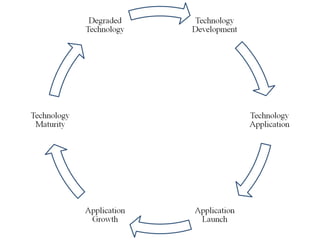
Technology Life Cycle
• The technology life cycle describes the commercial gain of
product through the expense of research and development
phase and financial return during its vital life.
• It is concerned with the time and cost of developing the
technology.
Application of TLC
in Cellular(Mobile) Industry
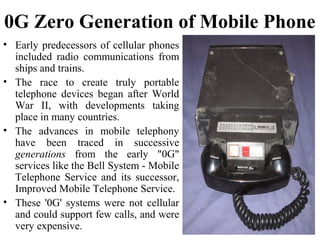
0G Zero Generation of Mobile Phone
• Early predecessors of cellular phones
included radio communications from
ships and trains.
• The race to create truly portable
telephone devices began after World
War II, with developments taking
place in many countries.
• The advances in mobile telephony
have been traced in successive
generations from the early "0G"
services like the Bell System - Mobile
Telephone Service and its successor,
Improved Mobile Telephone Service.
• These '0G' systems were not cellular
and could support few calls, and were
very expensive.
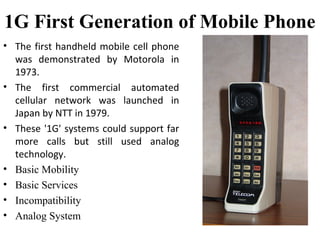
1G First Generation of Mobile Phone
• The first handheld mobile cell phone
was demonstrated by Motorola in
1973.
• The first commercial automated
cellular network was launched in
Japan by NTT in 1979.
• These '1G' systems could support far
more calls but still used analog
technology.
• Basic Mobility
• Basic Services
• Incompatibility
• Analog System
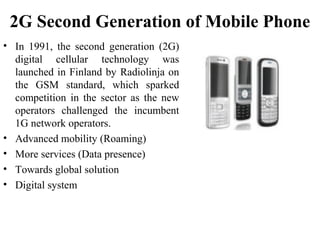
2G Second Generation of Mobile Phone
• In 1991, the second generation (2G)
digital cellular technology was
launched in Finland by Radiolinja on
the GSM standard, which sparked
competition in the sector as the new
operators challenged the incumbent
1G network operators.
• Advanced mobility (Roaming)
• More services (Data presence)
• Towards global solution
• Digital system
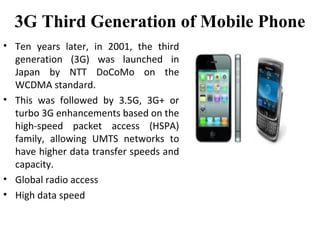
3G Third Generation of Mobile Phone
• Ten years later, in 2001, the third
generation (3G) was launched in
Japan by NTT DoCoMo on the
WCDMA standard.
• This was followed by 3.5G, 3G+ or
turbo 3G enhancements based on the
high-speed packet access (HSPA)
family, allowing UMTS networks to
have higher data transfer speeds and
capacity.
• Global radio access
• High data speed
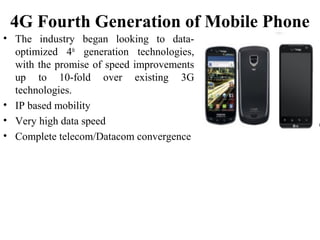
4G Fourth Generation of Mobile Phone
• The industry began looking to dataoptimized 4th generation technologies,
with the promise of speed improvements
up to 10-fold over existing 3G
technologies.
• IP based mobility
• Very high data speed
• Complete telecom/Datacom convergence
5G Fifth Generation of Mobile Phone
• 5G (5th generation mobile networks or 5th generation wireless
systems) is a term used in some research papers and projects to denote
the next major phase of mobile telecommunications standards beyond
the current 4G standards.
• 5G is also referred to as beyond 2020 mobile communications
technologies. 5G does not describe any particular specification in any
official document published by any telecommunication
standardisation body.
• Although updated standards that define capabilities beyond those
defined in the current 4G standards are under consideration, those
new capabilities are still being grouped under the current 4G
standards.
• Li-Fi, or light fidelity, is a 5th generation visible light communication
network. Li-Fi uses light-emitting diodes to transmit data, rather than
radio waves like Wi-Fi.
THANK YOU

Technology Life Cycle With Mobile Generation Example

  • 1.
  • 2.
    Technology Life Cycle •The technology life cycle describes the commercial gain of product through the expense of research and development phase and financial return during its vital life. • It is concerned with the time and cost of developing the technology.
  • 4.
    Application of TLC inCellular(Mobile) Industry
  • 5.
    0G Zero Generationof Mobile Phone • Early predecessors of cellular phones included radio communications from ships and trains. • The race to create truly portable telephone devices began after World War II, with developments taking place in many countries. • The advances in mobile telephony have been traced in successive generations from the early "0G" services like the Bell System - Mobile Telephone Service and its successor, Improved Mobile Telephone Service. • These '0G' systems were not cellular and could support few calls, and were very expensive.
  • 6.
    1G First Generationof Mobile Phone • The first handheld mobile cell phone was demonstrated by Motorola in 1973. • The first commercial automated cellular network was launched in Japan by NTT in 1979. • These '1G' systems could support far more calls but still used analog technology. • Basic Mobility • Basic Services • Incompatibility • Analog System
  • 7.
    2G Second Generationof Mobile Phone • In 1991, the second generation (2G) digital cellular technology was launched in Finland by Radiolinja on the GSM standard, which sparked competition in the sector as the new operators challenged the incumbent 1G network operators. • Advanced mobility (Roaming) • More services (Data presence) • Towards global solution • Digital system
  • 8.
    3G Third Generationof Mobile Phone • Ten years later, in 2001, the third generation (3G) was launched in Japan by NTT DoCoMo on the WCDMA standard. • This was followed by 3.5G, 3G+ or turbo 3G enhancements based on the high-speed packet access (HSPA) family, allowing UMTS networks to have higher data transfer speeds and capacity. • Global radio access • High data speed
  • 9.
    4G Fourth Generationof Mobile Phone • The industry began looking to dataoptimized 4th generation technologies, with the promise of speed improvements up to 10-fold over existing 3G technologies. • IP based mobility • Very high data speed • Complete telecom/Datacom convergence
  • 10.
    5G Fifth Generationof Mobile Phone • 5G (5th generation mobile networks or 5th generation wireless systems) is a term used in some research papers and projects to denote the next major phase of mobile telecommunications standards beyond the current 4G standards. • 5G is also referred to as beyond 2020 mobile communications technologies. 5G does not describe any particular specification in any official document published by any telecommunication standardisation body. • Although updated standards that define capabilities beyond those defined in the current 4G standards are under consideration, those new capabilities are still being grouped under the current 4G standards. • Li-Fi, or light fidelity, is a 5th generation visible light communication network. Li-Fi uses light-emitting diodes to transmit data, rather than radio waves like Wi-Fi.
  • 11.