VISVESVARAYA TECHNOLOGICAL UNIVERSITY, BELAGAVI
BHEEMANNA KHANDRE INSTITUTE OF TECHNOLOGY, BHALKI
DEPARTMENT OF ELECTRONICS AND COMMUNICATION
A SEMINAR PRESENTATION ON
5G Wireless Technology
PRESENTED BY :
KARAN. (3RB19EC028)
UNDER THE GUIDANCE
Prof. Dhiraj Despande
Contents
 Introduction to 5G
Evolution from 1G to 5G
Comparison of 1G to 5G Technologies
Key Concepts
Architecture
Hardware & Software of 5G
Features
Advantages
Applications
Conclusion
Reference
Introduction
 In 2015, the 3rd Generation Partnership Project (3GPP), a collaboration between
telecommunications standards organizations, began working on the technical
specifications for 5G.
 Since then, 5G networks have been deployed in various parts of the world, with major
mobile network operators in countries such as the United States, China, South
Korea, and Japan investing heavily in the technology. In addition to providing faster
mobile broadband services, 5G is also expected to enable new applications and use
cases, such as autonomous vehicles, smart cities, and industrial automation, by
providing high-speed, low-latency connectivity to a wide range of devices and
sensors.
 The development of 5G wireless technology began in the early 2010s, as a
response to the growing demand for faster mobile networks and
greater capacity to support the increasing number of connected devices. The
International Telecommunication Union (ITU) initiated the process of defining
the technical specifications for 5G in 2012, with the goal of achieving higher data
rates, lower latency, and improved energy efficiency compared to existing wireless
technologies.
What is 5G ?
5G is the fifth generation of wireless network technology,
designed to provide faster data transfer rates, higher bandwidth,
and lower latency than previous generations of mobile networks.
5G networks use advanced wireless technologies, including
millimeter-wave frequencies, massive MIMO (Multiple Input
Multiple Output), beamforming, and advanced signal processing
algorithms, to deliver faster and more reliable connections. The
increased speed and responsiveness of 5G networks will enable
a range of new applications and services, including autonomous
vehicles, remote surgery, and virtual reality experiences.
Evolution from 1G to 5G
 1G
 2G
 3G
 4G
 5G
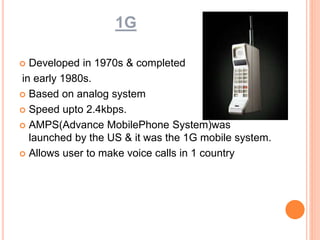
1G
 Developed in 1970s & completed
in early 1980s.
 Based on analog system
 Speed upto 2.4kbps.
 AMPS(Advance MobilePhone System)was
launched by the US & it was the 1G mobile system.
 Allows user to make voice calls in 1 country
2G
 Introduced in the 1980s. And completed in
early 1990s.
 2G networks were digital and provided
improved voice quality and data transmission
capabilities compared to 1G networks.
 2G networks used digital signal processing and compression
techniques to increase the efficiency of data transmission and allow
for the introduction of basic data services, such as SMS messaging
and basic mobile internet browsing.
 2G networks were primarily used for voice and text messaging, and
had limited data capabilities compared to later generations of mobile
networks.
3G
 Introduced in 1990s and complted in early
2000s, 3G marked a significant step forward in wireless
technology.
 3G introduced faster data speeds,
video calling, and internet browsing capabilities.
 The technology used packet-switching technology, which allowed
for more efficient use of the network and enabled the
development of mobile applications.
4TH GENERATION
 Introduced in the late 2000s &
Developed in 2010s.
 4G marked a major shift in wireless technology.
 4G introduced even faster data speeds, with some networks
capable of providing speeds up to 1 Gbps.
 The technology used all-IP networks, which allowed for more
efficient data transfer and enabled the development of
advanced mobile applications like video streaming and mobile
gaming.
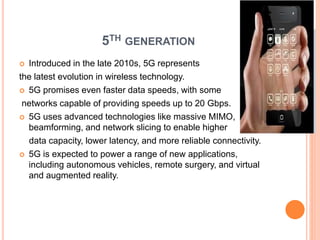
5TH GENERATION
 Introduced in the late 2010s, 5G represents
the latest evolution in wireless technology.
 5G promises even faster data speeds, with some
networks capable of providing speeds up to 20 Gbps.
 5G uses advanced technologies like massive MIMO,
beamforming, and network slicing to enable higher
data capacity, lower latency, and more reliable connectivity.
 5G is expected to power a range of new applications,
including autonomous vehicles, remote surgery, and virtual
and augmented reality.
Comparison of 1G to 5G Technology
.
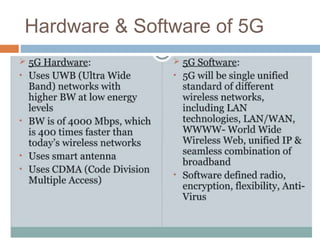
Hardware & Software of 5G
Features of 5G
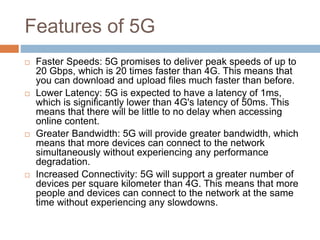
 Faster Speeds: 5G promises to deliver peak speeds of up to
20 Gbps, which is 20 times faster than 4G. This means that
you can download and upload files much faster than before.
 Lower Latency: 5G is expected to have a latency of 1ms,
which is significantly lower than 4G's latency of 50ms. This
means that there will be little to no delay when accessing
online content.
 Greater Bandwidth: 5G will provide greater bandwidth, which
means that more devices can connect to the network
simultaneously without experiencing any performance
degradation.
 Increased Connectivity: 5G will support a greater number of
devices per square kilometer than 4G. This means that more
people and devices can connect to the network at the same
time without experiencing any slowdowns.
Features of 5G(Cont….)
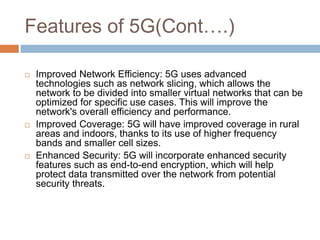
 Improved Network Efficiency: 5G uses advanced
technologies such as network slicing, which allows the
network to be divided into smaller virtual networks that can be
optimized for specific use cases. This will improve the
network's overall efficiency and performance.
 Improved Coverage: 5G will have improved coverage in rural
areas and indoors, thanks to its use of higher frequency
bands and smaller cell sizes.
 Enhanced Security: 5G will incorporate enhanced security
features such as end-to-end encryption, which will help
protect data transmitted over the network from potential
security threats.
Advantages of 5G
 Data BW of 1 Gbps or higher
 Globally accessible
 Dynamic information access
 Available at low cost
 High Speed and High capacity
 5G technology is providing large broadcasting
of data in Gigabit which supporting almost
65,000 connections.
Disadvantages
 Many of the old devices would not be
competent to 5G, hence, all of them need to
be replaced with new one — expensive deal.
 Developing infrastructure needs
high cost.
 Security and privacy issue
yet to be solved.
 Technology is still under process and
research on its viability is going on.
Applications
 It will make unified global standard for all.
 Network availability will be everywhere and will facilitate people to use their
computer and such kind of mobile devices anywhere anytime.
 Enhanced Mobile Broadband: 5G can be used to provide faster download
and upload speeds, allowing for high-quality video streaming, online
gaming, and other bandwidth-intensive applications on mobile devices.
 Internet of Things (IoT): 5G can enable the growth of IoT devices and
networks, supporting a large number of devices with low latency and high
reliability.
 Smart Cities: 5G can facilitate the development of smart cities by
supporting a range of applications such as smart traffic management,
public safety, and energy management.
 Autonomous Vehicles: 5G can support the development of autonomous
vehicles by providing low-latency communication between vehicles and
infrastructure.
 Virtual and Augmented Reality: 5G can support high-quality virtual and
augmented reality experiences, allowing for more immersive gaming,
training, and other applications.
Conclusion
 3G-Operator Centric,
4G-Service Centric Whereas
5G-User Centric
 We have proposed 5G wireless concept
designed as an open platform on different
layers
 The new coming 5G technology will be
available in the market at affordable rates, high
peak future & much reliability than preceding
technologies
5G  wireless technology ppt.pptx

5G wireless technology ppt.pptx

  • 1.
    VISVESVARAYA TECHNOLOGICAL UNIVERSITY,BELAGAVI BHEEMANNA KHANDRE INSTITUTE OF TECHNOLOGY, BHALKI DEPARTMENT OF ELECTRONICS AND COMMUNICATION A SEMINAR PRESENTATION ON 5G Wireless Technology PRESENTED BY : KARAN. (3RB19EC028) UNDER THE GUIDANCE Prof. Dhiraj Despande
  • 2.
    Contents  Introduction to5G Evolution from 1G to 5G Comparison of 1G to 5G Technologies Key Concepts Architecture Hardware & Software of 5G Features Advantages Applications Conclusion Reference
  • 3.
    Introduction  In 2015,the 3rd Generation Partnership Project (3GPP), a collaboration between telecommunications standards organizations, began working on the technical specifications for 5G.  Since then, 5G networks have been deployed in various parts of the world, with major mobile network operators in countries such as the United States, China, South Korea, and Japan investing heavily in the technology. In addition to providing faster mobile broadband services, 5G is also expected to enable new applications and use cases, such as autonomous vehicles, smart cities, and industrial automation, by providing high-speed, low-latency connectivity to a wide range of devices and sensors.  The development of 5G wireless technology began in the early 2010s, as a response to the growing demand for faster mobile networks and greater capacity to support the increasing number of connected devices. The International Telecommunication Union (ITU) initiated the process of defining the technical specifications for 5G in 2012, with the goal of achieving higher data rates, lower latency, and improved energy efficiency compared to existing wireless technologies.
  • 4.
    What is 5G? 5G is the fifth generation of wireless network technology, designed to provide faster data transfer rates, higher bandwidth, and lower latency than previous generations of mobile networks. 5G networks use advanced wireless technologies, including millimeter-wave frequencies, massive MIMO (Multiple Input Multiple Output), beamforming, and advanced signal processing algorithms, to deliver faster and more reliable connections. The increased speed and responsiveness of 5G networks will enable a range of new applications and services, including autonomous vehicles, remote surgery, and virtual reality experiences.
  • 5.
    Evolution from 1Gto 5G  1G  2G  3G  4G  5G
  • 6.
    1G  Developed in1970s & completed in early 1980s.  Based on analog system  Speed upto 2.4kbps.  AMPS(Advance MobilePhone System)was launched by the US & it was the 1G mobile system.  Allows user to make voice calls in 1 country
  • 7.
    2G  Introduced inthe 1980s. And completed in early 1990s.  2G networks were digital and provided improved voice quality and data transmission capabilities compared to 1G networks.  2G networks used digital signal processing and compression techniques to increase the efficiency of data transmission and allow for the introduction of basic data services, such as SMS messaging and basic mobile internet browsing.  2G networks were primarily used for voice and text messaging, and had limited data capabilities compared to later generations of mobile networks.
  • 8.
    3G  Introduced in1990s and complted in early 2000s, 3G marked a significant step forward in wireless technology.  3G introduced faster data speeds, video calling, and internet browsing capabilities.  The technology used packet-switching technology, which allowed for more efficient use of the network and enabled the development of mobile applications.
  • 9.
    4TH GENERATION  Introducedin the late 2000s & Developed in 2010s.  4G marked a major shift in wireless technology.  4G introduced even faster data speeds, with some networks capable of providing speeds up to 1 Gbps.  The technology used all-IP networks, which allowed for more efficient data transfer and enabled the development of advanced mobile applications like video streaming and mobile gaming.
  • 10.
    5TH GENERATION  Introducedin the late 2010s, 5G represents the latest evolution in wireless technology.  5G promises even faster data speeds, with some networks capable of providing speeds up to 20 Gbps.  5G uses advanced technologies like massive MIMO, beamforming, and network slicing to enable higher data capacity, lower latency, and more reliable connectivity.  5G is expected to power a range of new applications, including autonomous vehicles, remote surgery, and virtual and augmented reality.
  • 11.
    Comparison of 1Gto 5G Technology .
  • 12.
  • 13.
    Features of 5G Faster Speeds: 5G promises to deliver peak speeds of up to 20 Gbps, which is 20 times faster than 4G. This means that you can download and upload files much faster than before.  Lower Latency: 5G is expected to have a latency of 1ms, which is significantly lower than 4G's latency of 50ms. This means that there will be little to no delay when accessing online content.  Greater Bandwidth: 5G will provide greater bandwidth, which means that more devices can connect to the network simultaneously without experiencing any performance degradation.  Increased Connectivity: 5G will support a greater number of devices per square kilometer than 4G. This means that more people and devices can connect to the network at the same time without experiencing any slowdowns.
  • 14.
    Features of 5G(Cont….) Improved Network Efficiency: 5G uses advanced technologies such as network slicing, which allows the network to be divided into smaller virtual networks that can be optimized for specific use cases. This will improve the network's overall efficiency and performance.  Improved Coverage: 5G will have improved coverage in rural areas and indoors, thanks to its use of higher frequency bands and smaller cell sizes.  Enhanced Security: 5G will incorporate enhanced security features such as end-to-end encryption, which will help protect data transmitted over the network from potential security threats.
  • 15.
    Advantages of 5G Data BW of 1 Gbps or higher  Globally accessible  Dynamic information access  Available at low cost  High Speed and High capacity  5G technology is providing large broadcasting of data in Gigabit which supporting almost 65,000 connections.
  • 16.
    Disadvantages  Many ofthe old devices would not be competent to 5G, hence, all of them need to be replaced with new one — expensive deal.  Developing infrastructure needs high cost.  Security and privacy issue yet to be solved.  Technology is still under process and research on its viability is going on.
  • 17.
    Applications  It willmake unified global standard for all.  Network availability will be everywhere and will facilitate people to use their computer and such kind of mobile devices anywhere anytime.  Enhanced Mobile Broadband: 5G can be used to provide faster download and upload speeds, allowing for high-quality video streaming, online gaming, and other bandwidth-intensive applications on mobile devices.  Internet of Things (IoT): 5G can enable the growth of IoT devices and networks, supporting a large number of devices with low latency and high reliability.  Smart Cities: 5G can facilitate the development of smart cities by supporting a range of applications such as smart traffic management, public safety, and energy management.  Autonomous Vehicles: 5G can support the development of autonomous vehicles by providing low-latency communication between vehicles and infrastructure.  Virtual and Augmented Reality: 5G can support high-quality virtual and augmented reality experiences, allowing for more immersive gaming, training, and other applications.
  • 18.
    Conclusion  3G-Operator Centric, 4G-ServiceCentric Whereas 5G-User Centric  We have proposed 5G wireless concept designed as an open platform on different layers  The new coming 5G technology will be available in the market at affordable rates, high peak future & much reliability than preceding technologies