5G TECHNOLOGY
by
S.ANVESH
(14TP1A0442)
Department of Electronics & Communication Engineering
Siddhartha institute of engineering technology
Vinobhanagar, 501 506
INTRODUCTION
• 5G wireless means fifth generation wireless
technology and complete wireless
communication with almost no limitations.
• And this 5G can be called “Real Wireless
World”. And this has incredible transmission
speed.
5G OFFERS
• Worldwide cellular phones.
• Extraordinary data capabilities.
• High connectivity.
• More power & features in hand held phones.
• Large phone memory, more dialing speed, more
clarity in audio & video.
EVOLUTION FROM 1G to 5G
This 5G developed from 1G to 5G and as follows.
• 1G
• 2G
• 3G
• 4G
• 5G
1G
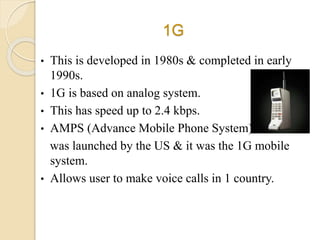
• This is developed in 1980s & completed in early
1990s.
• 1G is based on analog system.
• This has speed up to 2.4 kbps.
• AMPS (Advance Mobile Phone System)
was launched by the US & it was the 1G mobile
system.
• Allows user to make voice calls in 1 country.
2G
• Developed in late 1980s & completed in late
1990s.
• Based on digital system.
• Speed up to 64 kbps.
• Services such are digital voice & SMS with more
clarity.
• 2G are the handsets we are using today, with
2.5G having more capabilities.
3G
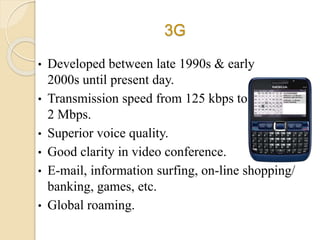
• Developed between late 1990s & early
2000s until present day.
• Transmission speed from 125 kbps to
2 Mbps.
• Superior voice quality.
• Good clarity in video conference.
• E-mail, information surfing, on-line shopping/
banking, games, etc.
• Global roaming.
4G
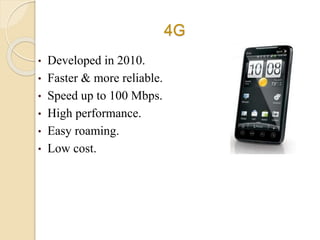
• Developed in 2010.
• Faster & more reliable.
• Speed up to 100 Mbps.
• High performance.
• Easy roaming.
• Low cost.
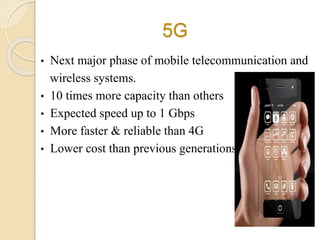
5G
• Next major phase of mobile telecommunication and
wireless systems.
• 10 times more capacity than others
• Expected speed up to 1 Gbps
• More faster & reliable than 4G
• Lower cost than previous generations
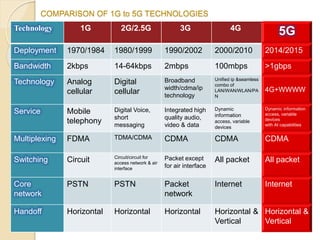
COMPARISON OF 1G to 5G TECHNOLOGIES
Technology 1G 2G/2.5G 3G 4G
5G
Deployment 1970/1984 1980/1999 1990/2002 2000/2010 2014/2015
Bandwidth 2kbps 14-64kbps 2mbps 100mbps >1gbps
Technology Analog
cellular
Digital
cellular
Broadband
width/cdma/ip
technology
Unified ip &seamless
combo of
LAN/WAN/WLAN/PA
N
4G+WWWW
Service Mobile
telephony
Digital Voice,
short
messaging
Integrated high
quality audio,
video & data
Dynamic
information
access, variable
devices
Dynamic information
access, variable
devices
with AI capabilities
Multiplexing FDMA TDMA/CDMA CDMA CDMA CDMA
Switching Circuit Circuit/circuit for
access network & air
interface
Packet except
for air interface
All packet All packet
Core
network
PSTN PSTN Packet
network
Internet Internet
Handoff Horizontal Horizontal Horizontal Horizontal &
Vertical
Horizontal &
Vertical
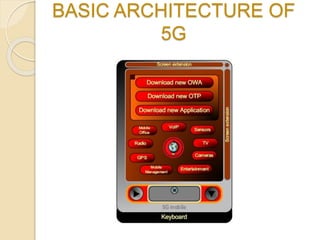
BASIC ARCHITECTURE OF
5G
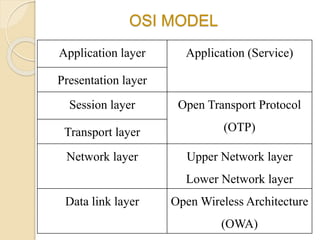
OSI MODEL
Application layer Application (Service)
Presentation layer
Session layer Open Transport Protocol
(OTP)Transport layer
Network layer Upper Network layer
Lower Network layer
Data link layer Open Wireless Architecture
(OWA)
OPEN WIRELESS
ARCHITECTURE
• OSI layer 1 & OSI layer 2 define the wireless
technology.
• For these two layers the 5G mobile network is
likely to be based on Open Wireless Architecture
(OWA).
• Physical layer + Data link layer = OWA
FEATURES OF 5G
• High resolution for crazy cell phone users.
• Less traffic.
• 25 Mbps connectivity speed.
• Enhanced & available connectivity just about the
world.
• Uploading & Downloading speed of 5G touching
the peak (up to 1 Gbps).
• Better & fast solution.
• More attractive & effective.
ADVANTAGES OF 5G
• Data BW of 1 Gbps or higher.
• Globally accessible.
• Dynamic information access.
• Available at low cost.
Applications of 5G
• Wearable devices with AI (Artificial Intelligence)
capabilities.
• Pervasive (Global) networks.
• Radio resource management.
• VoIP (Voice over IP) enabled devices.
CONCLUSION
• We have proposed 5G wireless concept designed
as an open platform on different layers.
• The new coming 5G technology will be available
in the market at affordable rates, high peak future
& much reliability than preceding technologies.
REFERENCES
• www.3g4g.co.uk/4g
• Wikipedia.org
• www.studymafia.org
Thank you

5g Ppt

  • 1.
    5G TECHNOLOGY by S.ANVESH (14TP1A0442) Department ofElectronics & Communication Engineering Siddhartha institute of engineering technology Vinobhanagar, 501 506
  • 2.
    INTRODUCTION • 5G wirelessmeans fifth generation wireless technology and complete wireless communication with almost no limitations. • And this 5G can be called “Real Wireless World”. And this has incredible transmission speed.
  • 3.
    5G OFFERS • Worldwidecellular phones. • Extraordinary data capabilities. • High connectivity. • More power & features in hand held phones. • Large phone memory, more dialing speed, more clarity in audio & video.
  • 4.
    EVOLUTION FROM 1Gto 5G This 5G developed from 1G to 5G and as follows. • 1G • 2G • 3G • 4G • 5G
  • 5.
    1G • This isdeveloped in 1980s & completed in early 1990s. • 1G is based on analog system. • This has speed up to 2.4 kbps. • AMPS (Advance Mobile Phone System) was launched by the US & it was the 1G mobile system. • Allows user to make voice calls in 1 country.
  • 6.
    2G • Developed inlate 1980s & completed in late 1990s. • Based on digital system. • Speed up to 64 kbps. • Services such are digital voice & SMS with more clarity. • 2G are the handsets we are using today, with 2.5G having more capabilities.
  • 7.
    3G • Developed betweenlate 1990s & early 2000s until present day. • Transmission speed from 125 kbps to 2 Mbps. • Superior voice quality. • Good clarity in video conference. • E-mail, information surfing, on-line shopping/ banking, games, etc. • Global roaming.
  • 8.
    4G • Developed in2010. • Faster & more reliable. • Speed up to 100 Mbps. • High performance. • Easy roaming. • Low cost.
  • 9.
    5G • Next majorphase of mobile telecommunication and wireless systems. • 10 times more capacity than others • Expected speed up to 1 Gbps • More faster & reliable than 4G • Lower cost than previous generations
  • 10.
    COMPARISON OF 1Gto 5G TECHNOLOGIES Technology 1G 2G/2.5G 3G 4G 5G Deployment 1970/1984 1980/1999 1990/2002 2000/2010 2014/2015 Bandwidth 2kbps 14-64kbps 2mbps 100mbps >1gbps Technology Analog cellular Digital cellular Broadband width/cdma/ip technology Unified ip &seamless combo of LAN/WAN/WLAN/PA N 4G+WWWW Service Mobile telephony Digital Voice, short messaging Integrated high quality audio, video & data Dynamic information access, variable devices Dynamic information access, variable devices with AI capabilities Multiplexing FDMA TDMA/CDMA CDMA CDMA CDMA Switching Circuit Circuit/circuit for access network & air interface Packet except for air interface All packet All packet Core network PSTN PSTN Packet network Internet Internet Handoff Horizontal Horizontal Horizontal Horizontal & Vertical Horizontal & Vertical
  • 11.
  • 12.
    OSI MODEL Application layerApplication (Service) Presentation layer Session layer Open Transport Protocol (OTP)Transport layer Network layer Upper Network layer Lower Network layer Data link layer Open Wireless Architecture (OWA)
  • 13.
    OPEN WIRELESS ARCHITECTURE • OSIlayer 1 & OSI layer 2 define the wireless technology. • For these two layers the 5G mobile network is likely to be based on Open Wireless Architecture (OWA). • Physical layer + Data link layer = OWA
  • 14.
    FEATURES OF 5G •High resolution for crazy cell phone users. • Less traffic. • 25 Mbps connectivity speed. • Enhanced & available connectivity just about the world. • Uploading & Downloading speed of 5G touching the peak (up to 1 Gbps). • Better & fast solution. • More attractive & effective.
  • 15.
    ADVANTAGES OF 5G •Data BW of 1 Gbps or higher. • Globally accessible. • Dynamic information access. • Available at low cost.
  • 16.
    Applications of 5G •Wearable devices with AI (Artificial Intelligence) capabilities. • Pervasive (Global) networks. • Radio resource management. • VoIP (Voice over IP) enabled devices.
  • 17.
    CONCLUSION • We haveproposed 5G wireless concept designed as an open platform on different layers. • The new coming 5G technology will be available in the market at affordable rates, high peak future & much reliability than preceding technologies.
  • 18.
  • 19.