Seminar on….

By:
Vishal rathee
00496407211
 Introduction to 5G
 Evolution from 1G to 5G
 Key concepts
 Architecture
 Hardware & Software of 5G
 Features
 Advantages
 Applications

 Conclusion
 What is 5G?
 What does it offer?
 5G Wireless: 5th generation wireless technology
 Complete wireless communication with almost no

limitations
 Can be called REAL wireless world
 Has incredible transmission speed
 Concept is only theory not real
 Worldwide cellular phones
 Extraordinary data capabilities
 High connectivity
 More power & features in hand held phones
 Large phone memory, more dialing speed, more

clarity in audio & video
 1G
 2G
 3G
 4G
 5G
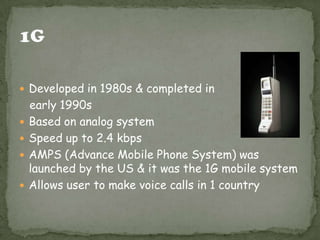
 Developed in 1980s & completed in






early 1990s
Based on analog system
Speed up to 2.4 kbps
AMPS (Advance Mobile Phone System) was
launched by the US & it was the 1G mobile system
Allows user to make voice calls in 1 country
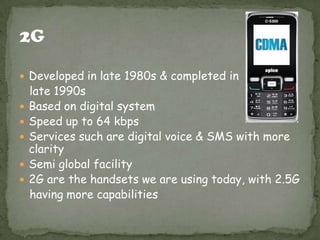
 Developed in late 1980s & completed in







late 1990s
Based on digital system
Speed up to 64 kbps
Services such are digital voice & SMS with more
clarity
Semi global facility
2G are the handsets we are using today, with 2.5G
having more capabilities
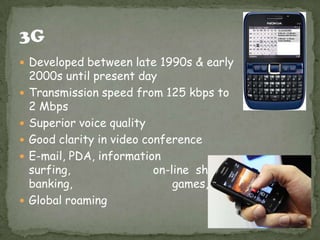
 Developed between late 1990s & early








2000s until present day
Transmission speed from 125 kbps to
2 Mbps
Superior voice quality
Good clarity in video conference
E-mail, PDA, information
surfing,
on-line shopping/
banking,
games, etc.
Global roaming
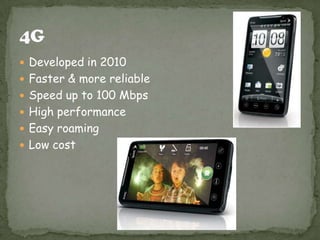
 Developed in 2010
 Faster & more reliable
 Speed up to 100 Mbps
 High performance
 Easy roaming
 Low cost
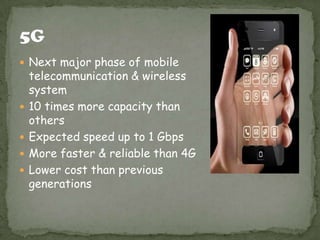
 Next major phase of mobile






telecommunication & wireless
system
10 times more capacity than
others
Expected speed up to 1 Gbps
More faster & reliable than 4G
Lower cost than previous
generations
 Real wireless world with no more limitations with









access & zone issues
Wearable devices
IPv6, where a visiting care of mobile IP address is
assigned according to location & connected
network
One unified global standard
Smart radio
The user can simultaneously be connected with
several wireless access technology
Multiple concurrent data transfer path
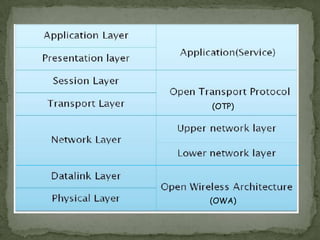
(OTP)

(OWA)
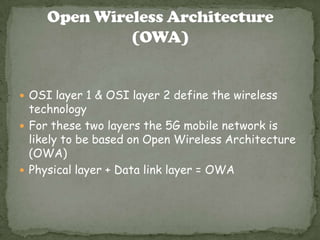
 OSI layer 1 & OSI layer 2 define the wireless

technology
 For these two layers the 5G mobile network is
likely to be based on Open Wireless Architecture
(OWA)
 Physical layer + Data link layer = OWA
 All mobile networks will use mobile IP
 Each mobile terminal will be FA (Foreign Agent)
 A mobile can be attached to several mobiles or

wireless networks at the same time
 The fixed IPv6 will be implemented in the mobile
phones
 Separation of network layer into two sub-layers:
(i) Lower network layer (for each interface)
(ii) Upper network layer (for the mobile terminal)
 Wireless network differs from wired network






regarding the transport layer
In all TCP versions the assumption is that lost
segments are due to network congestion
In wireless, the loss is due to higher bit error
ratio in the radio interface
5G mobile terminals have transport layer that is
possible to be downloaded & installed – Open
Transport Protocol (OTP)
Transport layer + Session layer = OTP
 Provides intelligent QoS (Quality of Service)








management over variety of networks
Provides possibility for service quality testing &
storage of measurement information in
information database in the mobile terminal
Select the best wireless connection for given
services
QoS parameters, such
as, delay, losses, BW, reliability, will be stored in
DB of 5G mobile
Presentation layer + Application layer =
Application
 5G Hardware:

 5G Software:

Band) networks with
higher BW at low energy
levels
• BW is of 4000 Mbps,
which is 400 times
faster than today’s
wireless networks
• Uses smart antenna
• Uses CDMA (Code
Division Multiple Access)

standard of different
wireless
networks, including LAN
technologies, LAN/WAN,
WWWW- World Wide
Wireless Web, unified IP
& seamless combination
of broadband
• Software defined
radio, encryption, flexibil
ity, Anti-Virus

• Uses UWB (Ultra Wide

• 5G will be single unified
 High resolution for crazy cell phone users
 Bi-directional large BW
 Less traffic
 25 Mbps connectivity speed
 Enhanced & available connectivity just about the

world
 Uploading & Downloading speed of 5G touching the
peak (up to 1 Gbps)
 Better & fast solution
 High quality service based on policy to avoid error
 Support virtual private networks
 More attractive & effective
 Provides subscriber supervision tools for fast

action
 Data BW of 1 Gbps or higher
 Globally accessible
 Dynamic information access
 Available at low cost
 Wearable devices with AI (Artificial Intelligence)







capabilities
Pervasive (Global) networks
Media independent handover
Radio resource management
VoIP (Voice over IP) enabled devices
With 6th sense technology


5G technology

  • 1.
  • 2.
     Introduction to5G  Evolution from 1G to 5G  Key concepts  Architecture  Hardware & Software of 5G  Features  Advantages  Applications  Conclusion
  • 3.
     What is5G?  What does it offer?
  • 4.
     5G Wireless:5th generation wireless technology  Complete wireless communication with almost no limitations  Can be called REAL wireless world  Has incredible transmission speed  Concept is only theory not real
  • 5.
     Worldwide cellularphones  Extraordinary data capabilities  High connectivity  More power & features in hand held phones  Large phone memory, more dialing speed, more clarity in audio & video
  • 6.
     1G  2G 3G  4G  5G
  • 7.
     Developed in1980s & completed in     early 1990s Based on analog system Speed up to 2.4 kbps AMPS (Advance Mobile Phone System) was launched by the US & it was the 1G mobile system Allows user to make voice calls in 1 country
  • 8.
     Developed inlate 1980s & completed in      late 1990s Based on digital system Speed up to 64 kbps Services such are digital voice & SMS with more clarity Semi global facility 2G are the handsets we are using today, with 2.5G having more capabilities
  • 9.
     Developed betweenlate 1990s & early      2000s until present day Transmission speed from 125 kbps to 2 Mbps Superior voice quality Good clarity in video conference E-mail, PDA, information surfing, on-line shopping/ banking, games, etc. Global roaming
  • 10.
     Developed in2010  Faster & more reliable  Speed up to 100 Mbps  High performance  Easy roaming  Low cost
  • 11.
     Next majorphase of mobile     telecommunication & wireless system 10 times more capacity than others Expected speed up to 1 Gbps More faster & reliable than 4G Lower cost than previous generations
  • 12.
     Real wirelessworld with no more limitations with       access & zone issues Wearable devices IPv6, where a visiting care of mobile IP address is assigned according to location & connected network One unified global standard Smart radio The user can simultaneously be connected with several wireless access technology Multiple concurrent data transfer path
  • 13.
  • 14.
     OSI layer1 & OSI layer 2 define the wireless technology  For these two layers the 5G mobile network is likely to be based on Open Wireless Architecture (OWA)  Physical layer + Data link layer = OWA
  • 15.
     All mobilenetworks will use mobile IP  Each mobile terminal will be FA (Foreign Agent)  A mobile can be attached to several mobiles or wireless networks at the same time  The fixed IPv6 will be implemented in the mobile phones  Separation of network layer into two sub-layers: (i) Lower network layer (for each interface) (ii) Upper network layer (for the mobile terminal)
  • 16.
     Wireless networkdiffers from wired network     regarding the transport layer In all TCP versions the assumption is that lost segments are due to network congestion In wireless, the loss is due to higher bit error ratio in the radio interface 5G mobile terminals have transport layer that is possible to be downloaded & installed – Open Transport Protocol (OTP) Transport layer + Session layer = OTP
  • 17.
     Provides intelligentQoS (Quality of Service)     management over variety of networks Provides possibility for service quality testing & storage of measurement information in information database in the mobile terminal Select the best wireless connection for given services QoS parameters, such as, delay, losses, BW, reliability, will be stored in DB of 5G mobile Presentation layer + Application layer = Application
  • 18.
     5G Hardware: 5G Software: Band) networks with higher BW at low energy levels • BW is of 4000 Mbps, which is 400 times faster than today’s wireless networks • Uses smart antenna • Uses CDMA (Code Division Multiple Access) standard of different wireless networks, including LAN technologies, LAN/WAN, WWWW- World Wide Wireless Web, unified IP & seamless combination of broadband • Software defined radio, encryption, flexibil ity, Anti-Virus • Uses UWB (Ultra Wide • 5G will be single unified
  • 19.
     High resolutionfor crazy cell phone users  Bi-directional large BW  Less traffic  25 Mbps connectivity speed  Enhanced & available connectivity just about the world  Uploading & Downloading speed of 5G touching the peak (up to 1 Gbps)  Better & fast solution
  • 20.
     High qualityservice based on policy to avoid error  Support virtual private networks  More attractive & effective  Provides subscriber supervision tools for fast action
  • 21.
     Data BWof 1 Gbps or higher  Globally accessible  Dynamic information access  Available at low cost
  • 22.
     Wearable deviceswith AI (Artificial Intelligence)      capabilities Pervasive (Global) networks Media independent handover Radio resource management VoIP (Voice over IP) enabled devices With 6th sense technology
  • 23.