TEKALIGN BEHAILU(MSc)
CHAPTER-2
FREE BODY
DIAGRAM
TRUSSES, FRAMES AND
MACHINES
TRUSS
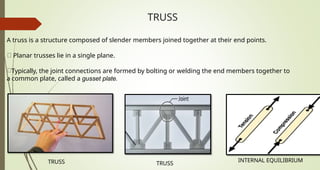
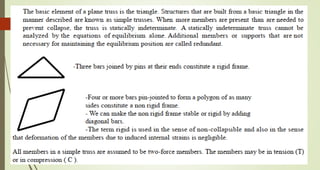
A truss is a structure composed of slender members joined together at their end points.
Planar trusses lie in a single plane.
Typically, the joint connections are formed by bolting or welding the end members together to
a common plate, called a gusset plate.
INTERNAL EQUILIBRIUM
TRUSS TRUSS
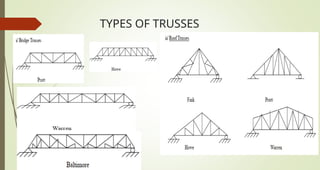
TYPES OF TRUSSES
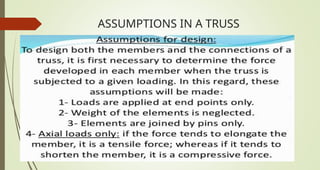
ASSUMPTIONS IN A TRUSS
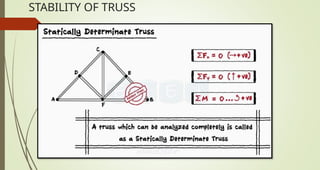
STABILITY OF TRUSS
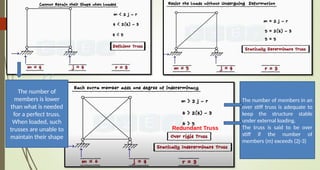
The number of
members is lower
than what is needed
for a perfect truss.
When loaded, such
trusses are unable to
maintain their shape
The number of members in an
over stiff truss is adequate to
keep the structure stable
under external loading.
The truss is said to be over
stiff if the number of
members (m) exceeds (2j-3)
Redundant Truss
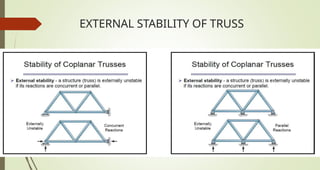
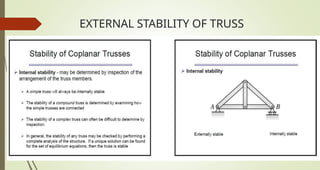
EXTERNAL STABILITY OF TRUSS
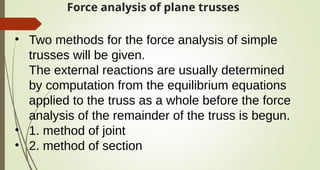
Force analysis of plane trusses
• Two methods for the force analysis of simple
trusses will be given.
The external reactions are usually determined
by computation from the equilibrium equations
applied to the truss as a whole before the force
analysis of the remainder of the truss is begun.
• 1. method of joint
• 2. method of section
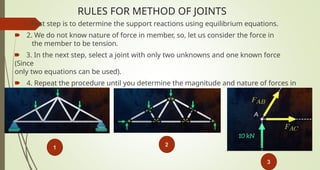
RULES FOR METHOD OF JOINTS
1. First step is to determine the support reactions using equilibrium equations.
🠶 2. We do not know nature of force in member, so, let us consider the force in
the member to be tension.
🠶 3. In the next step, select a joint with only two unknowns and one known force
(Since
only two equations can be used).
🠶 4. Repeat the procedure until you determine the magnitude and nature of forces in
all the members.
1 2
3
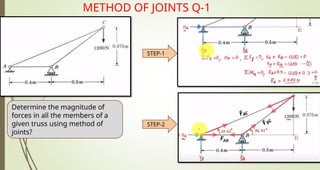
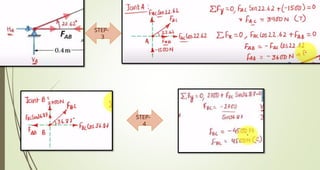
METHOD OF JOINTS Q-1
STEP-1
STEP-2
Determine the magnitude of
forces in all the members of a
given truss using method of
joints?
STEP-
3
STEP-
4
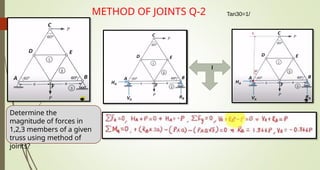
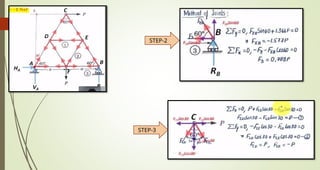
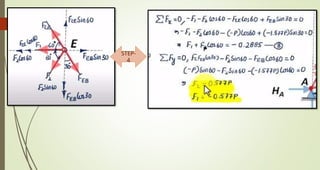
METHOD OF JOINTS Q-2
Determine the
magnitude of forces in
1,2,3 members of a given
truss using method of
joints?
I
Tan30=1/
STEP-2
STEP-3
STEP-
4
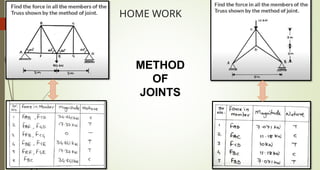
HOME WORK
METHOD
OF
JOINTS
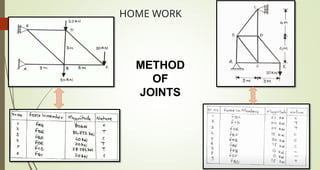
HOME WORK
METHOD
OF
JOINTS
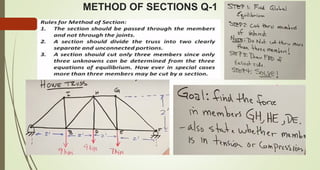
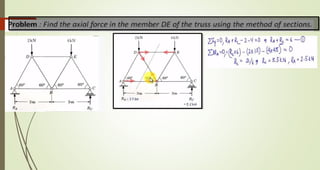
METHOD OF SECTIONS Q-1
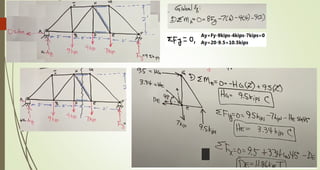
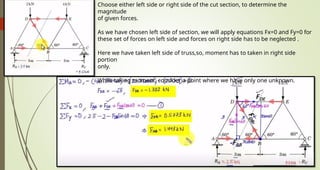
Choose either left side or right side of the cut section, to determine the
magnitude
of given forces.
As we have chosen left side of section, we will apply equations Fx=0 and Fy=0 for
these set of forces on left side and forces on right side has to be neglected .
Here we have taken left side of truss,so, moment has to taken in right side
portion
only.
While taking moment, consider a point where we have only one unknown.
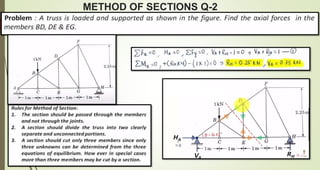
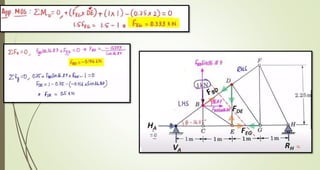
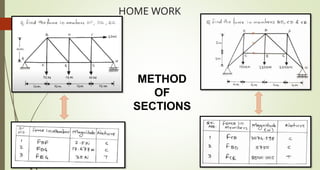
METHOD OF SECTIONS Q-2
HOME WORK
METHOD
OF
SECTIONS
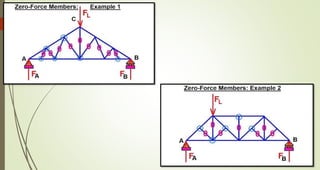
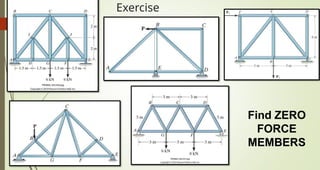
ZERO FORCE MEMBERS
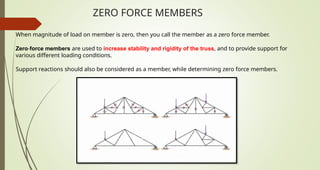
When magnitude of load on member is zero, then you call the member as a zero force member.
Zero-force members are used to increase stability and rigidity of the truss, and to provide support for
various different loading conditions.
Support reactions should also be considered as a member, while determining zero force members.
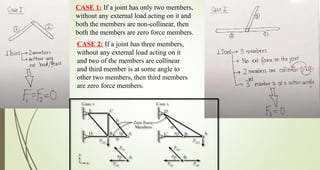
CASE 1: If a joint has only two members,
without any external load acting on it and
both the members are non-collinear, then
both the members are zero force members.
CASE 2: If a joint has three members,
without any external load acting on it
and two of the members are collinear
and third member is at some angle to
other two members, then third members
are zero force members.
Exercise
Find ZERO
FORCE
MEMBERS
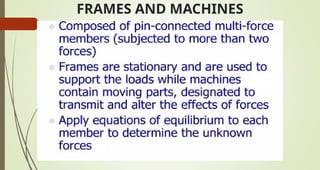
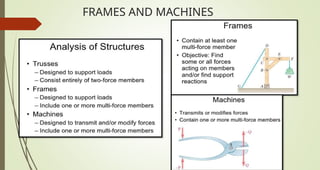
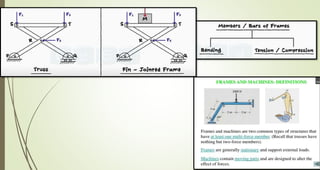
FRAMES AND MACHINES
FRAMES AND MACHINES
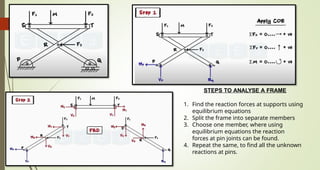
STEPS TO ANALYSE A FRAME
1. Find the reaction forces at supports using
equilibrium equations
2. Split the frame into separate members
3. Choose one member, where using
equilibrium equations the reaction
forces at pin joints can be found.
4. Repeat the same, to find all the unknown
reactions at pins.
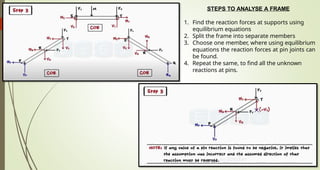
STEPS TO ANALYSE A FRAME
1. Find the reaction forces at supports using
equilibrium equations
2. Split the frame into separate members
3. Choose one member, where using equilibrium
equations the reaction forces at pin joints can
be found.
4. Repeat the same, to find all the unknown
reactions at pins.
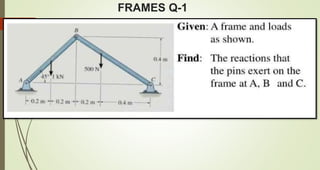
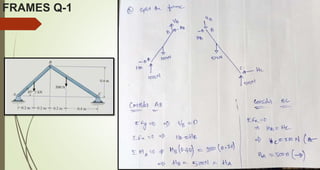
FRAMES Q-1
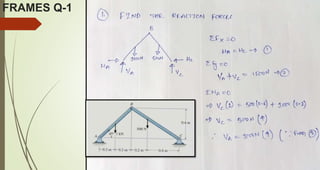
FRAMES Q-1
FRAMES Q-1
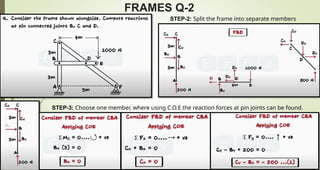
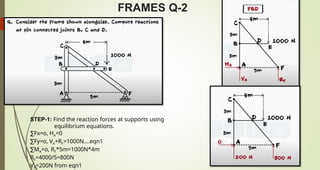
FRAMES Q-2
STEP-1: Find the reaction forces at supports using
equilibrium equations.
∑Fx=o, HA=0
∑Fy=o, VA+RF=1000N….eqn1
∑MA=o, RF*5m=1000N*4m
RF=4000/5=800N
VA=200N from eqn1
FRAMES Q-2
STEP-2: Split the frame into separate members
STEP-3: Choose one member, where using C.O.E the reaction forces at pin joints can be found.
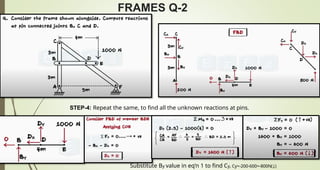
FRAMES Q-2
STEP-4: Repeat the same, to find all the unknown reactions at pins.
Substitute By value in eq’n 1 to find Cy, Cy=-200-600=-800N(↓)
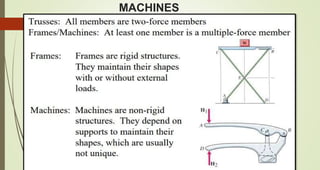
MACHINES
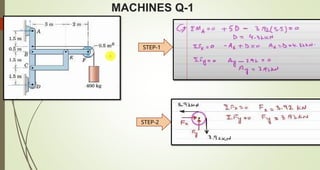
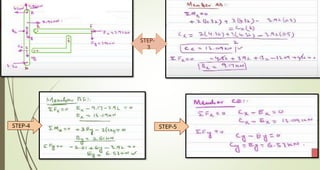
MACHINES Q-1
STEP-1
STEP-2
STEP-
3
STEP-4 STEP-5
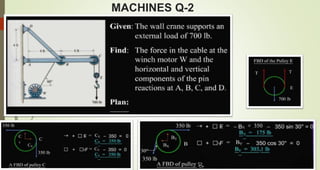
MACHINES Q-2
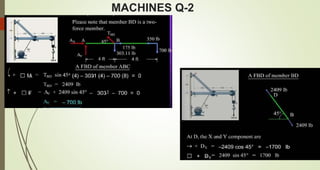
MACHINES Q-2
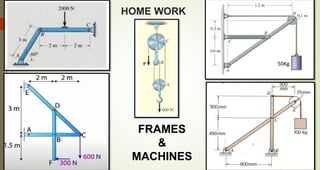
HOME WORK
FRAMES
&
MACHINES
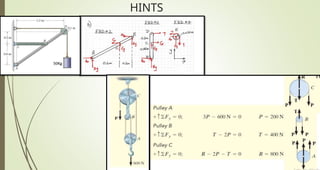
HINTS

chapter two truss and frame and machine.pptx

  • 1.
  • 2.
    TRUSS A truss isa structure composed of slender members joined together at their end points. Planar trusses lie in a single plane. Typically, the joint connections are formed by bolting or welding the end members together to a common plate, called a gusset plate. INTERNAL EQUILIBRIUM TRUSS TRUSS
  • 3.
  • 5.
  • 6.
  • 7.
    The number of membersis lower than what is needed for a perfect truss. When loaded, such trusses are unable to maintain their shape The number of members in an over stiff truss is adequate to keep the structure stable under external loading. The truss is said to be over stiff if the number of members (m) exceeds (2j-3) Redundant Truss
  • 8.
  • 9.
  • 11.
    Force analysis ofplane trusses • Two methods for the force analysis of simple trusses will be given. The external reactions are usually determined by computation from the equilibrium equations applied to the truss as a whole before the force analysis of the remainder of the truss is begun. • 1. method of joint • 2. method of section
  • 12.
    RULES FOR METHODOF JOINTS 1. First step is to determine the support reactions using equilibrium equations. 🠶 2. We do not know nature of force in member, so, let us consider the force in the member to be tension. 🠶 3. In the next step, select a joint with only two unknowns and one known force (Since only two equations can be used). 🠶 4. Repeat the procedure until you determine the magnitude and nature of forces in all the members. 1 2 3
  • 13.
    METHOD OF JOINTSQ-1 STEP-1 STEP-2 Determine the magnitude of forces in all the members of a given truss using method of joints?
  • 14.
  • 15.
    METHOD OF JOINTSQ-2 Determine the magnitude of forces in 1,2,3 members of a given truss using method of joints? I Tan30=1/
  • 16.
  • 17.
  • 18.
  • 19.
  • 20.
  • 23.
    Choose either leftside or right side of the cut section, to determine the magnitude of given forces. As we have chosen left side of section, we will apply equations Fx=0 and Fy=0 for these set of forces on left side and forces on right side has to be neglected . Here we have taken left side of truss,so, moment has to taken in right side portion only. While taking moment, consider a point where we have only one unknown.
  • 24.
  • 26.
  • 27.
    ZERO FORCE MEMBERS Whenmagnitude of load on member is zero, then you call the member as a zero force member. Zero-force members are used to increase stability and rigidity of the truss, and to provide support for various different loading conditions. Support reactions should also be considered as a member, while determining zero force members.
  • 28.
    CASE 1: Ifa joint has only two members, without any external load acting on it and both the members are non-collinear, then both the members are zero force members. CASE 2: If a joint has three members, without any external load acting on it and two of the members are collinear and third member is at some angle to other two members, then third members are zero force members.
  • 30.
  • 31.
  • 32.
  • 34.
    STEPS TO ANALYSEA FRAME 1. Find the reaction forces at supports using equilibrium equations 2. Split the frame into separate members 3. Choose one member, where using equilibrium equations the reaction forces at pin joints can be found. 4. Repeat the same, to find all the unknown reactions at pins.
  • 35.
    STEPS TO ANALYSEA FRAME 1. Find the reaction forces at supports using equilibrium equations 2. Split the frame into separate members 3. Choose one member, where using equilibrium equations the reaction forces at pin joints can be found. 4. Repeat the same, to find all the unknown reactions at pins.
  • 36.
  • 37.
  • 38.
  • 39.
    FRAMES Q-2 STEP-1: Findthe reaction forces at supports using equilibrium equations. ∑Fx=o, HA=0 ∑Fy=o, VA+RF=1000N….eqn1 ∑MA=o, RF*5m=1000N*4m RF=4000/5=800N VA=200N from eqn1
  • 40.
    FRAMES Q-2 STEP-2: Splitthe frame into separate members STEP-3: Choose one member, where using C.O.E the reaction forces at pin joints can be found.
  • 41.
    FRAMES Q-2 STEP-4: Repeatthe same, to find all the unknown reactions at pins. Substitute By value in eq’n 1 to find Cy, Cy=-200-600=-800N(↓)
  • 42.
  • 43.
  • 44.
  • 45.
  • 46.
  • 47.
  • 48.