TRUANCY
Dr Jo Martin Kuncheria
JR, Pediatrics
INTRODUCTION
• School aged child or adolescent frequently misses
school without an adequate excuse which is associated
with conduct and psychosocial problems.
• Truancy can be a precursor to delinquent behaviors and
low level crimes.
• It can also indicate family problems
• Significant short and long term effect on childrens
social, emotional and educational development
• Causes are multifactorial
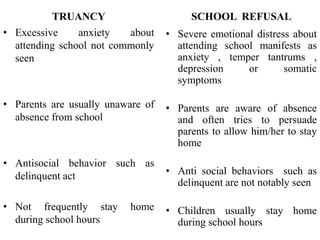
TRUANCY
• Excessive anxiety about
attending school not commonly
seen
• Parents are usually unaware of
absence from school
• Antisocial behavior such as
delinquent act
• Not frequently stay home
during school hours
SCHOOL REFUSAL
• Severe emotional distress about
attending school manifests as
anxiety , temper tantrums ,
depression or somatic
symptoms
• Parents are aware of absence
and often tries to persuade
parents to allow him/her to stay
home
• Anti social behaviors such as
delinquent are not notably seen
• Children usually stay home
during school hours
TRUANCY - ETIOLOGY
• A school is responsible for creating a safe
environment, tracking student attendance,
communicating with parents and ensuring that
all policies are clear , consistent and
communicated
Didaskaleinophobia Fear of Going to School
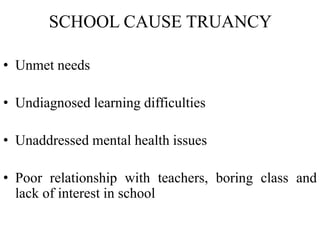
SCHOOL CAUSE TRUANCY
• Unmet needs
• Undiagnosed learning difficulties
• Unaddressed mental health issues
• Poor relationship with teachers, boring class and
lack of interest in school
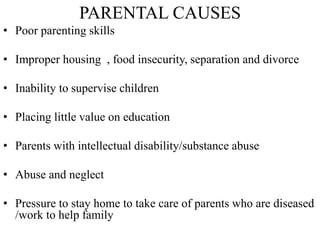
PARENTAL CAUSES
• Poor parenting skills
• Improper housing , food insecurity, separation and divorce
• Inability to supervise children
• Placing little value on education
• Parents with intellectual disability/substance abuse
• Abuse and neglect
• Pressure to stay home to take care of parents who are diseased
/work to help family
YOUTH RELATED CAUSES
• Peer pressure to skip school
• Bullying
• Mental health issues
• Boredom
• Lack of ambition
• Poor grades
• Being behind on school work
• Low self esteem
• Drugs and alcohol use
• Having no friends at school
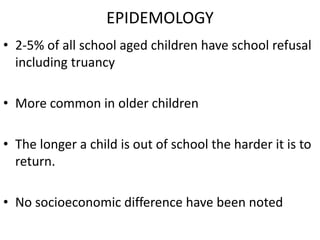
EPIDEMOLOGY
• 2-5% of all school aged children have school refusal
including truancy
• More common in older children
• The longer a child is out of school the harder it is to
return.
• No socioeconomic difference have been noted
EFFECTS OF TRUANCY
• Falling behind in school, Not graduating, Unemployment
• Socially isolated, running away out of frustration
• Engaging in delinquent behaviors, Mental health issues
• Substance abuse
• Unstable relationship
• Dropping out of school
• Violating law, Criminal behaviors
ASSESSMENT
• Complete physical and medical history
• Clinical interview with child and parents
• History of onset and development of symptoms
• Associated stressors
• School history
• Family psychiatric history
• Mental status examination for psychiatric problems
and substance abuse
• Collaboration with school staff
• Review of school records
• Psychological assessment tools
MANAGEMENT
• To facilitate the childs returning to normal functioning
• To make the child tolerate normal separation from caregivers
without distress or impairment of functioning
• To make the child attend school consistently without subjective
experience of distress
• Address comorbid psychiatric problems,family dysfunction and
other contributing problems
• Collaborative team approach include physician, child ,parents
,school staff and mental health professional
MANAGEMENT cont…..
• Cognitive behavior therapy
• Educational support therapy
• Pharmacotherapy
• Parent- teacher interventions
COGNITIVE BEHAVIOR THERAPY
• Therapist offers specific instructions for children to enable and
gradually increase their exposure to the school environment
• Children are encouraged to confront their fears and taught how
to modify negative thoughts
• Provides solution to current problems and provides tools to
change unhelpful thoughts and behaviors
• Desensitization , operant behavioral techniques (reinforcement
& punishment) are useful
• Modelling(observes the behavior of others and imitates), role
playing (visualize and practice different ways of handling a
situation), relaxation techniques and reward system are
frequently used
EDUCATIONAL SUPPORT THERAPY
• Children are encouraged to talk about their fears and
identify difference between fear, anxiety and phobias
• Children are given information to help them overcome
their fears about attending school
• They are given written assignments that are discussed
at follow up sessions
• Children keep a daily diary to describe their fears ,
thoughts, coping strategies and feelings
• Will not receive specific instructions on how to
confront fears /positive reinforcement as CBT
PHARMACOTHERAPHY
• SSRI – 1st line pharmacologic treatment for anxiety
disorders
• Fluvoxamine and sertaline are used frequently
• Sertaline started at initial dose 12.5 to 25 mg per day for
a minimum of 7 days and titrated upto 50mg per day in
increments of 12.5 mg (Child) or 25 mg (adolescent)
• If adequate clinical response not seen after 6 to 8 wks of
treatment increase dose of 12.5mg per day (Child) and
25mg per day(adolescent) to a maximum of 200 mg per
day.
PHARMACOTHERAPHY cont…
• Benzodiazepines used as short term basis with
severe school refusal
• Benzodiazepines added with SSRI to target acute
symptoms of anxiety. Discontinued once SSRI
produce beneficial effects . Benzodiazepines has risk
of addiction, sedation, Behavior disinhibition and
cognitive impairment
PARENT – TEACHER INTERVENTION
• Parent involvement and caregiver training are critical factors in
enhancing the effectiveness of behavior treatment
• It includes clinical sessions with parents and consultation with school
personnel
• Parents are given behavior management strategies
– Escorting the child to school
– Providing positive reinforcement for school attendance
– Decreasing positive reinforcement for staying home
• Helps parents to reduce their own anxiety and understand their role
in helping their children make effective changes
• School consultation for school staff to give positive reinforcement/
academic, social & emotional accommodations
PREVENTION
• Multifaceted approach that considers school, parents and
youth
• Best practice is to address the underlying psychological
symptoms and empowering parents, children and school
staff.
• Mentoring
• Law enforcement involvement
• Communication training
• Community involvement
ROLE OF SCHOOL
• Keep proper records
• Communicate problems to parents
• Change poor conditions in school
• Students should be matched with right teachers
• Students should get special attention when necessary
ROLE OF HOME
• Preventing truancy begins at home
• Open communication and problem solving
• Communication with school authority to solve the
problem
• Transferring classrooms / new school may help
• Rather than punishing ,find actionable solutions
• Youth should be referred for a mental health
evaluation
Thank you

Truancy jo.pptx

  • 1.
    TRUANCY Dr Jo MartinKuncheria JR, Pediatrics
  • 2.
    INTRODUCTION • School agedchild or adolescent frequently misses school without an adequate excuse which is associated with conduct and psychosocial problems. • Truancy can be a precursor to delinquent behaviors and low level crimes. • It can also indicate family problems • Significant short and long term effect on childrens social, emotional and educational development • Causes are multifactorial
  • 3.
    TRUANCY • Excessive anxietyabout attending school not commonly seen • Parents are usually unaware of absence from school • Antisocial behavior such as delinquent act • Not frequently stay home during school hours SCHOOL REFUSAL • Severe emotional distress about attending school manifests as anxiety , temper tantrums , depression or somatic symptoms • Parents are aware of absence and often tries to persuade parents to allow him/her to stay home • Anti social behaviors such as delinquent are not notably seen • Children usually stay home during school hours
  • 4.
    TRUANCY - ETIOLOGY •A school is responsible for creating a safe environment, tracking student attendance, communicating with parents and ensuring that all policies are clear , consistent and communicated Didaskaleinophobia Fear of Going to School
  • 5.
    SCHOOL CAUSE TRUANCY •Unmet needs • Undiagnosed learning difficulties • Unaddressed mental health issues • Poor relationship with teachers, boring class and lack of interest in school
  • 6.
    PARENTAL CAUSES • Poorparenting skills • Improper housing , food insecurity, separation and divorce • Inability to supervise children • Placing little value on education • Parents with intellectual disability/substance abuse • Abuse and neglect • Pressure to stay home to take care of parents who are diseased /work to help family
  • 7.
    YOUTH RELATED CAUSES •Peer pressure to skip school • Bullying • Mental health issues • Boredom • Lack of ambition • Poor grades • Being behind on school work • Low self esteem • Drugs and alcohol use • Having no friends at school
  • 8.
    EPIDEMOLOGY • 2-5% ofall school aged children have school refusal including truancy • More common in older children • The longer a child is out of school the harder it is to return. • No socioeconomic difference have been noted
  • 9.
    EFFECTS OF TRUANCY •Falling behind in school, Not graduating, Unemployment • Socially isolated, running away out of frustration • Engaging in delinquent behaviors, Mental health issues • Substance abuse • Unstable relationship • Dropping out of school • Violating law, Criminal behaviors
  • 10.
    ASSESSMENT • Complete physicaland medical history • Clinical interview with child and parents • History of onset and development of symptoms • Associated stressors • School history • Family psychiatric history • Mental status examination for psychiatric problems and substance abuse • Collaboration with school staff • Review of school records • Psychological assessment tools
  • 11.
    MANAGEMENT • To facilitatethe childs returning to normal functioning • To make the child tolerate normal separation from caregivers without distress or impairment of functioning • To make the child attend school consistently without subjective experience of distress • Address comorbid psychiatric problems,family dysfunction and other contributing problems • Collaborative team approach include physician, child ,parents ,school staff and mental health professional
  • 12.
    MANAGEMENT cont….. • Cognitivebehavior therapy • Educational support therapy • Pharmacotherapy • Parent- teacher interventions
  • 13.
    COGNITIVE BEHAVIOR THERAPY •Therapist offers specific instructions for children to enable and gradually increase their exposure to the school environment • Children are encouraged to confront their fears and taught how to modify negative thoughts • Provides solution to current problems and provides tools to change unhelpful thoughts and behaviors • Desensitization , operant behavioral techniques (reinforcement & punishment) are useful • Modelling(observes the behavior of others and imitates), role playing (visualize and practice different ways of handling a situation), relaxation techniques and reward system are frequently used
  • 14.
    EDUCATIONAL SUPPORT THERAPY •Children are encouraged to talk about their fears and identify difference between fear, anxiety and phobias • Children are given information to help them overcome their fears about attending school • They are given written assignments that are discussed at follow up sessions • Children keep a daily diary to describe their fears , thoughts, coping strategies and feelings • Will not receive specific instructions on how to confront fears /positive reinforcement as CBT
  • 15.
    PHARMACOTHERAPHY • SSRI –1st line pharmacologic treatment for anxiety disorders • Fluvoxamine and sertaline are used frequently • Sertaline started at initial dose 12.5 to 25 mg per day for a minimum of 7 days and titrated upto 50mg per day in increments of 12.5 mg (Child) or 25 mg (adolescent) • If adequate clinical response not seen after 6 to 8 wks of treatment increase dose of 12.5mg per day (Child) and 25mg per day(adolescent) to a maximum of 200 mg per day.
  • 16.
    PHARMACOTHERAPHY cont… • Benzodiazepinesused as short term basis with severe school refusal • Benzodiazepines added with SSRI to target acute symptoms of anxiety. Discontinued once SSRI produce beneficial effects . Benzodiazepines has risk of addiction, sedation, Behavior disinhibition and cognitive impairment
  • 17.
    PARENT – TEACHERINTERVENTION • Parent involvement and caregiver training are critical factors in enhancing the effectiveness of behavior treatment • It includes clinical sessions with parents and consultation with school personnel • Parents are given behavior management strategies – Escorting the child to school – Providing positive reinforcement for school attendance – Decreasing positive reinforcement for staying home • Helps parents to reduce their own anxiety and understand their role in helping their children make effective changes • School consultation for school staff to give positive reinforcement/ academic, social & emotional accommodations
  • 18.
    PREVENTION • Multifaceted approachthat considers school, parents and youth • Best practice is to address the underlying psychological symptoms and empowering parents, children and school staff. • Mentoring • Law enforcement involvement • Communication training • Community involvement
  • 19.
    ROLE OF SCHOOL •Keep proper records • Communicate problems to parents • Change poor conditions in school • Students should be matched with right teachers • Students should get special attention when necessary
  • 20.
    ROLE OF HOME •Preventing truancy begins at home • Open communication and problem solving • Communication with school authority to solve the problem • Transferring classrooms / new school may help • Rather than punishing ,find actionable solutions • Youth should be referred for a mental health evaluation
  • 21.