CBT for School
Refusal: A critique
Overview
• School refusal overview
• CBT for school refusal
• Decontextualisation of a complex problem
• Developmental considerations
• Empirical issues
• Professional and ethical issues
• Implications for practice
• Questions
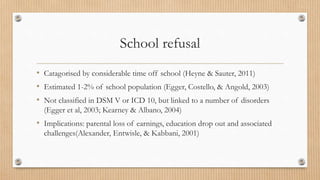
School refusal
• Catagorised by considerable time off school (Heyne & Sauter, 2011)
• Estimated 1-2% of school population (Egger, Costello, & Angold, 2003)
• Not classified in DSM V or ICD 10, but linked to a number of disorders
(Egger et al, 2003; Kearney & Albano, 2004)
• Implications: parental loss of earnings, education drop out and associated
challenges(Alexander, Entwisle, & Kabbani, 2001)
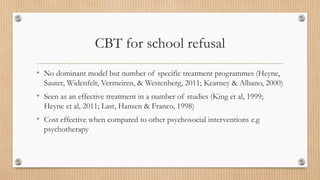
CBT for school refusal
• No dominant model but number of specific treatment programmes (Heyne,
Sauter, Widenfelt, Vermeiren, & Westenberg, 2011; Kearney & Albano, 2000)
• Seen as an effective treatment in a number of studies (King et al, 1999;
Heyne et al, 2011; Last, Hansen & Franco, 1998)
• Cost effective when compared to other psychosocial interventions e.g
psychotherapy
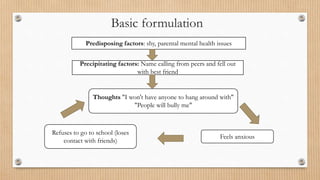
Basic formulation
Feels anxious
Refuses to go to school (loses
contact with friends)
Thoughts "I won't have anyone to hang around with"
"People will bully me"
Predisposing factors: shy, parental mental health issues
Precipitating factors: Name calling from peers and fell out
with best friend
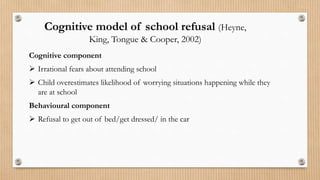
Cognitive component
 Irrational fears about attending school
 Child overestimates likelihood of worrying situations happening while they
are at school
Behavioural component
 Refusal to get out of bed/get dressed/ in the car
Cognitive model of school refusal (Heyne,
King, Tongue & Cooper, 2002)
Risk factors for school refusal (Kearney, 2008)
Family e.g family
conflicts
Child
e.g shyness
Peers e.g
bullying
School
e.g levels
of support
available
Community e.g poverty
Decontextualisation of a complex problem
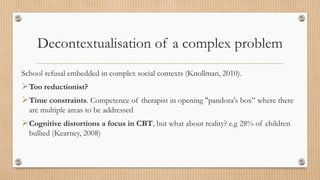
School refusal embedded in complex social contexts (Knollman, 2010).
Too reductionist?
Time constraints. Competence of therapist in opening "pandora's box” where there
are multiple areas to be addressed
Cognitive distortions a focus in CBT, but what about reality? e.g 28% of children
bullied (Kearney, 2008)
Developmental considerations
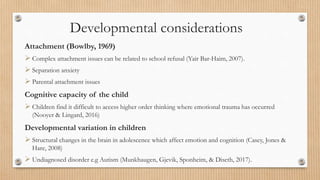
Attachment (Bowlby, 1969)
 Complex attachment issues can be related to school refusal (Yair Bar-Haim, 2007).
 Separation anxiety
 Parental attachment issues
Cognitive capacity of the child
 Children find it difficult to access higher order thinking where emotional trauma has occurred
(Nooyer & Lingard, 2016)
Developmental variation in children
 Structural changes in the brain in adolescence which affect emotion and cognition (Casey, Jones &
Hare, 2008)
 Undiagnosed disorder e.g Autism (Munkhaugen, Gjevik, Sponheim, & Diseth, 2017).
Empirical issues
Empirical validity issues
 A limited evidence base. Generalizability not strong (Maynard, 2015)
 Other psychosocial interventions have been shown to be as effective in outcome as CBT (Last,
Hansen & Franco, 1998).
 Is it the nature of intervention itself that instigates change?
Cultural considerations
 Based on a western model of compulsory school attendance.
 Not sensitive to different perspectives on the value of education e.g traveler communities
Professional and Ethical issues
What are the risks of emotional harm in implementation?
 Risk benefit payoff and intervention fatigue: Is there more importance on getting it right because of the
long term risk of school refusal?
 Opening up the child to trauma e.g bullying
 Focusses on the child's dysfunctional thinking and ignores the past. What are the implications for self-
esteem and future mental health?
 Return to school can increase anxiety (Maynard, 2015). Could this result in alternative coping strategies?
e.g. self harm
Implications for practice
Presents a dilemma for practitioners. CBT is cost effective in a resource
depleted environment
Suggestions for practice:
 CBT built into systemic intervention package, working collaboratively with other
professionals (social workers, schools)
 Strong consideration of ethical implications of intervention
 Assessment for developmental issues prior to treatment.
Conclusions
• School refusal can be complex problem and CBT, although cost effective, may be
too simplistic
• Therapist may need to consider a range of developmental and social issues
• More research is needed
• Development of CBT within a systemic model of working
Questions
References
Alexander, K. L., Entwisle, D. R., & Kabbani, N. S. (2001). The Dropout Process in Life Course Perspective: Early Risk Factors at Home
and School. Teachers College Record, 103(5), 760-822. doi:10.1111/0161-4681.00134
Bar-Haim, Y., Dan, O., Eshel, Y., & Sagi-Schwartz, A. (2007). Predicting childrens anxiety from early attachment relationships. Journal of
Anxiety Disorders, 21(8), 1061-1068. doi:10.1016/j.janxdis.2006.10.013
Bowlby, J. (1969). Attachment and loss. New York: Basic Books.
Brumariu, L. E., & Kerns, K. A. (2008). Mother–child attachment and social anxiety symptoms in middle childhood. Journal of Applied
Developmental Psychology, 29(5), 393-402.
Egger, H. L., Costello, E. J., & Angold, A. (2003). School refusal and psychiatric disorders: A community study. Journal of the American
Academy of Child & Adolescent Psychiatry, 42, 797–807.
Casey, B. J., Jones, R. M., & Hare, T. A. (2008). The Adolescent Brain. Annals of the New York Academy of Sciences, 1124, 111–126. Heyne,
D., & Rollings, S. (2002). School refusal. Malden, MA: Blackwell.
Heyne, D., Sauter, F. M., Widenfelt, B. M., Vermeiren, R., & Westenberg, P. M. (2011). School refusal and anxiety in adolescence: Non-
randomized trial of a developmentally sensitive cognitive behavioral therapy. Journal of Anxiety Disorders, 25(7), 870-878
Heyne, D., King, N. J., Tonge, B. J., & Cooper, H. (2001). School Refusal. Paediatric Drugs,3(10), 719-732.
Kearney, C. A., Albano, A. M. (2000). When children refuse school: A cognitive-behavioral therapy approach therapist’s guide. New York,
NY: Oxford University Press.
Kearney, C. A., & Albano, A. M. (2004). The Functional Profiles of School Refusal Behavior. Behavior Modification, 28(1), 147-161.
Kearney, C. (2008). School abstenteeism and school refusal behavior in youth: A contemporary review. Clinical psychology review, 28 (3),
pp.451-471.
King, N. J., Tonge, B. J., Turner, S., Heyne, D., Pritchard, M., Rollings, S., Young, D., Myerson, N. & Ollendick, T. H. (1999). Brief
cognitive-behavioural treatment for anxiety-disordered children exhibiting school refusal. Clinical Psychology & Psychotherapy, 6(1),
39-45.
Knollmann, M., Knoll, S., Reissner, V., Metzelaars, J., & Hebebrand, J. (2010). School Avoidance From the Point of View of Child and
Adolescent Psychiatry: Symptomatology, Development, Course, and Maynard
Treatment. Deutsches Arzteblatt International, 107(4), 43–49.
Last, C. G., Hansen, C., Franco, N. (1998). Cognitive-behavioral treatment of school phobia. Journal of the American Academy of Child &
Adolescent Psychiatry, 37, 404–411.
Maynard BR, Heyne D, Brendel KE, Bulanda JJ, Thompson A, Pigott TD (2015) Treatment for school refusal among children and
adolescents: a systematic review and meta-analysis. Res Social Work Prac. doi:10.1177/1049731515598619
Munkhaugen, E. K., Gjevik, E., Pripp, A. H., Sponheim, E., & Diseth, T. H. (2017). School refusal behaviour: Are children and
adolescents with autism spectrum disorder at a higher risk? Research in Autism Spectrum Disorders, 41-42, 31-38
Nooyer, K. M., & Lingard, M. W. (2016). Applying principles of the Neurosequential Model of Therapeutics across an adolescent day
program and inpatient unit. Australasian Psychiatry,25(2), 150-153

Cbt for school refusal: a critique

  • 1.
  • 2.
    Overview • School refusaloverview • CBT for school refusal • Decontextualisation of a complex problem • Developmental considerations • Empirical issues • Professional and ethical issues • Implications for practice • Questions
  • 3.
    School refusal • Catagorisedby considerable time off school (Heyne & Sauter, 2011) • Estimated 1-2% of school population (Egger, Costello, & Angold, 2003) • Not classified in DSM V or ICD 10, but linked to a number of disorders (Egger et al, 2003; Kearney & Albano, 2004) • Implications: parental loss of earnings, education drop out and associated challenges(Alexander, Entwisle, & Kabbani, 2001)
  • 4.
    CBT for schoolrefusal • No dominant model but number of specific treatment programmes (Heyne, Sauter, Widenfelt, Vermeiren, & Westenberg, 2011; Kearney & Albano, 2000) • Seen as an effective treatment in a number of studies (King et al, 1999; Heyne et al, 2011; Last, Hansen & Franco, 1998) • Cost effective when compared to other psychosocial interventions e.g psychotherapy
  • 5.
    Basic formulation Feels anxious Refusesto go to school (loses contact with friends) Thoughts "I won't have anyone to hang around with" "People will bully me" Predisposing factors: shy, parental mental health issues Precipitating factors: Name calling from peers and fell out with best friend
  • 6.
    Cognitive component  Irrationalfears about attending school  Child overestimates likelihood of worrying situations happening while they are at school Behavioural component  Refusal to get out of bed/get dressed/ in the car Cognitive model of school refusal (Heyne, King, Tongue & Cooper, 2002)
  • 7.
    Risk factors forschool refusal (Kearney, 2008) Family e.g family conflicts Child e.g shyness Peers e.g bullying School e.g levels of support available Community e.g poverty
  • 8.
    Decontextualisation of acomplex problem School refusal embedded in complex social contexts (Knollman, 2010). Too reductionist? Time constraints. Competence of therapist in opening "pandora's box” where there are multiple areas to be addressed Cognitive distortions a focus in CBT, but what about reality? e.g 28% of children bullied (Kearney, 2008)
  • 9.
    Developmental considerations Attachment (Bowlby,1969)  Complex attachment issues can be related to school refusal (Yair Bar-Haim, 2007).  Separation anxiety  Parental attachment issues Cognitive capacity of the child  Children find it difficult to access higher order thinking where emotional trauma has occurred (Nooyer & Lingard, 2016) Developmental variation in children  Structural changes in the brain in adolescence which affect emotion and cognition (Casey, Jones & Hare, 2008)  Undiagnosed disorder e.g Autism (Munkhaugen, Gjevik, Sponheim, & Diseth, 2017).
  • 10.
    Empirical issues Empirical validityissues  A limited evidence base. Generalizability not strong (Maynard, 2015)  Other psychosocial interventions have been shown to be as effective in outcome as CBT (Last, Hansen & Franco, 1998).  Is it the nature of intervention itself that instigates change? Cultural considerations  Based on a western model of compulsory school attendance.  Not sensitive to different perspectives on the value of education e.g traveler communities
  • 11.
    Professional and Ethicalissues What are the risks of emotional harm in implementation?  Risk benefit payoff and intervention fatigue: Is there more importance on getting it right because of the long term risk of school refusal?  Opening up the child to trauma e.g bullying  Focusses on the child's dysfunctional thinking and ignores the past. What are the implications for self- esteem and future mental health?  Return to school can increase anxiety (Maynard, 2015). Could this result in alternative coping strategies? e.g. self harm
  • 12.
    Implications for practice Presentsa dilemma for practitioners. CBT is cost effective in a resource depleted environment Suggestions for practice:  CBT built into systemic intervention package, working collaboratively with other professionals (social workers, schools)  Strong consideration of ethical implications of intervention  Assessment for developmental issues prior to treatment.
  • 13.
    Conclusions • School refusalcan be complex problem and CBT, although cost effective, may be too simplistic • Therapist may need to consider a range of developmental and social issues • More research is needed • Development of CBT within a systemic model of working Questions
  • 14.
    References Alexander, K. L.,Entwisle, D. R., & Kabbani, N. S. (2001). The Dropout Process in Life Course Perspective: Early Risk Factors at Home and School. Teachers College Record, 103(5), 760-822. doi:10.1111/0161-4681.00134 Bar-Haim, Y., Dan, O., Eshel, Y., & Sagi-Schwartz, A. (2007). Predicting childrens anxiety from early attachment relationships. Journal of Anxiety Disorders, 21(8), 1061-1068. doi:10.1016/j.janxdis.2006.10.013 Bowlby, J. (1969). Attachment and loss. New York: Basic Books. Brumariu, L. E., & Kerns, K. A. (2008). Mother–child attachment and social anxiety symptoms in middle childhood. Journal of Applied Developmental Psychology, 29(5), 393-402. Egger, H. L., Costello, E. J., & Angold, A. (2003). School refusal and psychiatric disorders: A community study. Journal of the American Academy of Child & Adolescent Psychiatry, 42, 797–807. Casey, B. J., Jones, R. M., & Hare, T. A. (2008). The Adolescent Brain. Annals of the New York Academy of Sciences, 1124, 111–126. Heyne, D., & Rollings, S. (2002). School refusal. Malden, MA: Blackwell. Heyne, D., Sauter, F. M., Widenfelt, B. M., Vermeiren, R., & Westenberg, P. M. (2011). School refusal and anxiety in adolescence: Non- randomized trial of a developmentally sensitive cognitive behavioral therapy. Journal of Anxiety Disorders, 25(7), 870-878 Heyne, D., King, N. J., Tonge, B. J., & Cooper, H. (2001). School Refusal. Paediatric Drugs,3(10), 719-732.
  • 15.
    Kearney, C. A.,Albano, A. M. (2000). When children refuse school: A cognitive-behavioral therapy approach therapist’s guide. New York, NY: Oxford University Press. Kearney, C. A., & Albano, A. M. (2004). The Functional Profiles of School Refusal Behavior. Behavior Modification, 28(1), 147-161. Kearney, C. (2008). School abstenteeism and school refusal behavior in youth: A contemporary review. Clinical psychology review, 28 (3), pp.451-471. King, N. J., Tonge, B. J., Turner, S., Heyne, D., Pritchard, M., Rollings, S., Young, D., Myerson, N. & Ollendick, T. H. (1999). Brief cognitive-behavioural treatment for anxiety-disordered children exhibiting school refusal. Clinical Psychology & Psychotherapy, 6(1), 39-45. Knollmann, M., Knoll, S., Reissner, V., Metzelaars, J., & Hebebrand, J. (2010). School Avoidance From the Point of View of Child and Adolescent Psychiatry: Symptomatology, Development, Course, and Maynard Treatment. Deutsches Arzteblatt International, 107(4), 43–49. Last, C. G., Hansen, C., Franco, N. (1998). Cognitive-behavioral treatment of school phobia. Journal of the American Academy of Child & Adolescent Psychiatry, 37, 404–411. Maynard BR, Heyne D, Brendel KE, Bulanda JJ, Thompson A, Pigott TD (2015) Treatment for school refusal among children and adolescents: a systematic review and meta-analysis. Res Social Work Prac. doi:10.1177/1049731515598619 Munkhaugen, E. K., Gjevik, E., Pripp, A. H., Sponheim, E., & Diseth, T. H. (2017). School refusal behaviour: Are children and adolescents with autism spectrum disorder at a higher risk? Research in Autism Spectrum Disorders, 41-42, 31-38 Nooyer, K. M., & Lingard, M. W. (2016). Applying principles of the Neurosequential Model of Therapeutics across an adolescent day program and inpatient unit. Australasian Psychiatry,25(2), 150-153

Editor's Notes

  • #6 Add in a mod
  • #9 From having worked in schools and seeing this first hand, my opinion is that... 
  • #12 1 – this is beneficial 2 – undermines and risks other professionals dropping responsbility – safeguarding implications