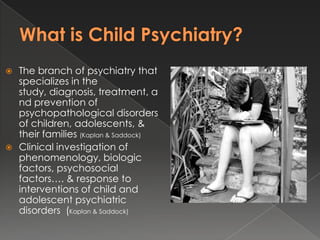
 The branch of psychiatry that
  specializes in the
  study, diagnosis, treatment, a
  nd prevention of
  psychopathological disorders
  of children, adolescents, &
  their families (Kaplan & Saddock)
 Clinical investigation of
  phenomenology, biologic
  factors, psychosocial
  factors…. & response to
  interventions of child and
  adolescent psychiatric
  disorders (Kaplan & Saddock)
   1883: Emil Kreapelin: Ignored
   1933: Moritz Tramer: Swiss
    psychiatrist
   1st Journal: Zeitschrift für
    Kinderpsychiatrie = Acta
    Paedopsychiatria
   1st academic child
    psychiatry department in the
    world was founded by Leo
    Kanner in Baltimore
   1953: AACP
   1959: Board certified
    speciality
 Where does the medical term “rounds”
  originate from?
 Who stated “Listen to your patient, he is
  telling you the diagnosis,“
 Who 1st developed the concept of
  Medical residency ?
 Hint: Rendu-Osler-Weber disease
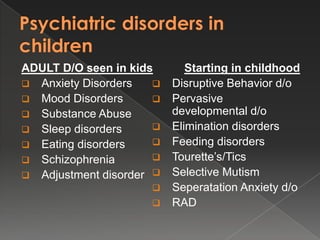
ADULT D/O seen in kids       Starting in childhood
 Anxiety Disorders      Disruptive Behavior d/o
 Mood Disorders         Pervasive
 Substance Abuse         developmental d/o
 Sleep disorders        Elimination disorders
 Eating disorders       Feeding disorders
 Schizophrenia          Tourette’s/Tics
 Adjustment disorder    Selective Mutism
                         Seperatation Anxiety d/o
                         RAD
 Panic disorder
 Specific & Social Phobias
 GAD
 PTSD/Acute Stress d/o
 Obsessive Compulsive Disorder
 What is the phobia of needles/injections
  called
 What is the fear of night/darkness
 What is Triskaidekaphobia
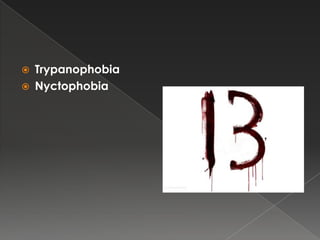
   Trypanophobia
   Nyctophobia
 Substance abuse
 Substance dependence
 Major depressive disorder
 Bipolar disorder
 Substance induced mood disorder
 Mood disorder NOS
Catatonic
Paranoid
Disorganized
Undifferentiated
Residual
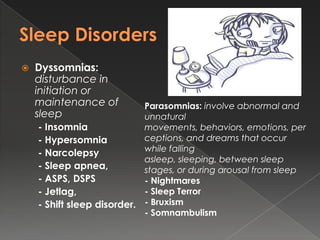
   Dyssomnias:
    disturbance in
    initiation or
    maintenance of          Parasomnias: involve abnormal and
    sleep                   unnatural
    - Insomnia              movements, behaviors, emotions, per
    - Hypersomnia           ceptions, and dreams that occur
    - Narcolepsy            while falling
                            asleep, sleeping, between sleep
    - Sleep apnea,          stages, or during arousal from sleep
    - ASPS, DSPS            - Nightmares
    - Jetlag,               - Sleep Terror
    - Shift sleep disorder. - Bruxism
                            - Somnambulism
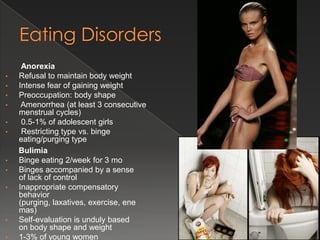
Anorexia
•   Refusal to maintain body weight
•   Intense fear of gaining weight
•   Preoccupation: body shape
•    Amenorrhea (at least 3 consecutive
    menstrual cycles)
•    0.5-1% of adolescent girls
•    Restricting type vs. binge
    eating/purging type
    Bulimia
•   Binge eating 2/week for 3 mo
•   Binges accompanied by a sense
    of lack of control
•   Inappropriate compensatory
    behavior
    (purging, laxatives, exercise, ene
    mas)
•   Self-evaluation is unduly based
    on body shape and weight
•   1-3% of young women
 ADHD
 Opositional defiant disorder
 Conduct disorder
  Mental Retardation
 Learning Disorders
 Pervasive developmental disorders
- Autism
- Aspergers Syndrome
- Retts Syndrome
- Childhood disintegrative disorder
- PDD NOS
 Stuttering
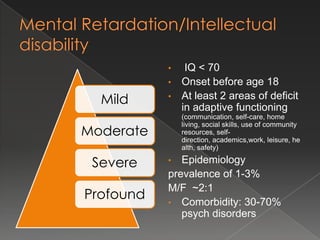
•  IQ < 70
           • Onset before age 18

  Mild     • At least 2 areas of deficit
             in adaptive functioning
               (communication, self-care, home

Moderate
               living, social skills, use of community
               resources, self-
               direction, academics,work, leisure, he
               alth, safety)

 Severe    •  Epidemiology
           prevalence of 1-3%
           M/F ~2:1
Profound   • Comorbidity: 30-70%
              psych disorders
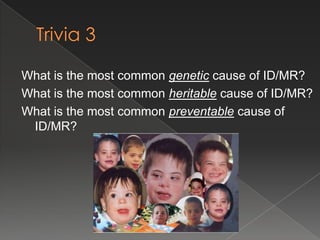
What is the most common genetic cause of ID/MR?
What is the most common heritable cause of ID/MR?
What is the most common preventable cause of
 ID/MR?
 Genetic: Down’s Syndrome
 Heritable: Fragile X
 Preventable: Fetal Alcohol Syndrome
 Eneuresis
-     voiding of urine in inappropriate places
-     > 2 times per week for 3 months
-     5 years of age or older
-     seen in 7% 5 year old boys & 3% 5 year old girls
-     can run in families
-     first line treatment: Reward/Behavioral
      therapy, Imipramine or ddAVP (vasopressin) are
      also used


 Encopresis
    -lack of bowel control & passage of feces in
        inappropriate places
    - > 1 time per month for 3 months
    - 4 years of age or older
    - seen in 1% of 5 year olds
    - higher in males
    - treat with supportive and behavioral therapy
   Markedly disturbed and developmentally
    inappropriate social relatedness in most
    contexts
   The disturbance is not accounted for solely
    by developmental delay and does not
    meet the criteria for pervasive
    developmental disorder
   Onset before five years of age
   A history of significant neglect
   An implicit lack of identifiable, preferred
    attachment figure.
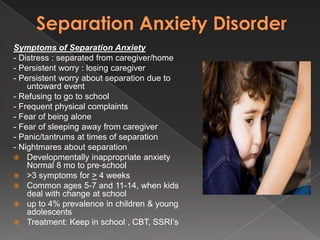
Symptoms of Separation Anxiety
- Distress : separated from caregiver/home
- Persistent worry : losing caregiver
- Persistent worry about separation due to
    untoward event
- Refusing to go to school
- Frequent physical complaints
- Fear of being alone
- Fear of sleeping away from caregiver
- Panic/tantrums at times of separation
- Nightmares about separation
 Developmentally inappropriate anxiety
    Normal 8 mo to pre-school
 >3 symptoms for > 4 weeks
 Common ages 5-7 and 11-14, when kids
    deal with change at school
 up to 4% prevalence in children & young
    adolescents
 Treatment: Keep in school , CBT, SSRI’s
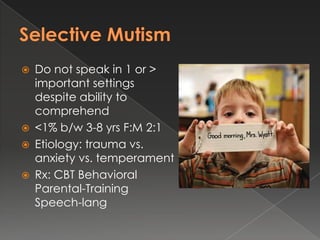
   Do not speak in 1 or >
    important settings
    despite ability to
    comprehend
   <1% b/w 3-8 yrs F:M 2:1
   Etiology: trauma vs.
    anxiety vs. temperament
   Rx: CBT Behavioral
    Parental-Training
    Speech-lang
A large, community-based study          Tourette’s: Motor and/or vocal tics
    suggested that over 19% of           -
    school-age children have tic            sudden, rapid, recurrent, nonrhyt
    disorders (Kurlan et.al.* )             hmic, stereotyped motor
                                            movement or vocalization-occur
Transient tic disorder consists of          at least 1 year with no tic free
    multiple motor and/or phonic            period for greater than 3 months
    tics with duration of at least 4     -onset before 18 yrs
    weeks, but less than 12             Epidemiology
    months.                              -0.04% M:F 3:1
Chronic tic disorder is either single   Associations: genetic
    or multiple motor or phonic             basis, ADHD, OCD, & PANDAS
    tics, but not both, which are
    present for more than a year.       Treatment
Tourete’s (see right side for             -behavioral therapy:CBIT
    description)                          -antipsychotics, alpha agonists:
Tic d/o NOS
                                        *Kurlan R, McDermott MP, Deeley C, et al. "Prevalence
                                             of tics in schoolchildren and association with
                                             placement in special education". Neurology Oct-
                                             2001
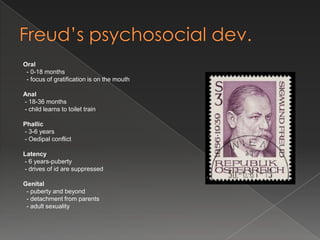
Oral
 - 0-18 months
 - focus of gratification is on the mouth

Anal
- 18-36 months
- child learns to toilet train

Phallic
- 3-6 years
- Oedipal conflict

Latency
- 6 years-puberty
- drives of id are suppressed

Genital
 - puberty and beyond
 - detachment from parents
 - adult sexuality
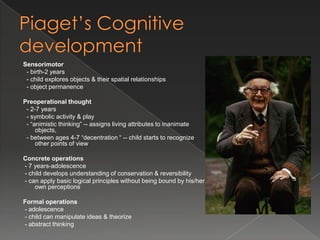
Sensorimotor
 - birth-2 years
 - child explores objects & their spatial relationships
 - object permanence

Preoperational thought
 - 2-7 years
 - symbolic activity & play
 - “animistic thinking” -- assigns living attributes to inanimate
     objects,
 - between ages 4-7 “decentration “ -- child starts to recognize
     other points of view

Concrete operations
- 7 years-adolescence
- child develops understanding of conservation & reversibility
- can apply basic logical principles without being bound by his/her
    own perceptions

Formal operations
- adolescence
- child can manipulate ideas & theorize
- abstract thinking
Trust/mistrust             Identity vs. role confusion
  - birth-18 months         - teens-20s
  Autonomy vs. shame        Intimacy vs. isolation
    and doubt               - 20s-40s
  -18 months-3 years       Generativity vs. stagnation
 Initiative vs. guilt        - 40-60
   - 3-5 years             Ego integrity vs. despair
Industry vs. inferiority    - 60-death
  - 6-teens

Introduction to Child Psychiatry

  • 2.
     The branchof psychiatry that specializes in the study, diagnosis, treatment, a nd prevention of psychopathological disorders of children, adolescents, & their families (Kaplan & Saddock)  Clinical investigation of phenomenology, biologic factors, psychosocial factors…. & response to interventions of child and adolescent psychiatric disorders (Kaplan & Saddock)
  • 3.
    1883: Emil Kreapelin: Ignored  1933: Moritz Tramer: Swiss psychiatrist  1st Journal: Zeitschrift für Kinderpsychiatrie = Acta Paedopsychiatria  1st academic child psychiatry department in the world was founded by Leo Kanner in Baltimore  1953: AACP  1959: Board certified speciality
  • 4.
     Where doesthe medical term “rounds” originate from?  Who stated “Listen to your patient, he is telling you the diagnosis,“  Who 1st developed the concept of Medical residency ?  Hint: Rendu-Osler-Weber disease
  • 6.
    ADULT D/O seenin kids Starting in childhood  Anxiety Disorders  Disruptive Behavior d/o  Mood Disorders  Pervasive  Substance Abuse developmental d/o  Sleep disorders  Elimination disorders  Eating disorders  Feeding disorders  Schizophrenia  Tourette’s/Tics  Adjustment disorder  Selective Mutism  Seperatation Anxiety d/o  RAD
  • 8.
     Panic disorder Specific & Social Phobias  GAD  PTSD/Acute Stress d/o  Obsessive Compulsive Disorder
  • 9.
     What isthe phobia of needles/injections called  What is the fear of night/darkness  What is Triskaidekaphobia
  • 10.
    Trypanophobia  Nyctophobia
  • 11.
     Substance abuse Substance dependence
  • 12.
     Major depressivedisorder  Bipolar disorder  Substance induced mood disorder  Mood disorder NOS
  • 13.
  • 14.
    Dyssomnias: disturbance in initiation or maintenance of Parasomnias: involve abnormal and sleep unnatural - Insomnia movements, behaviors, emotions, per - Hypersomnia ceptions, and dreams that occur - Narcolepsy while falling asleep, sleeping, between sleep - Sleep apnea, stages, or during arousal from sleep - ASPS, DSPS - Nightmares - Jetlag, - Sleep Terror - Shift sleep disorder. - Bruxism - Somnambulism
  • 15.
    Anorexia • Refusal to maintain body weight • Intense fear of gaining weight • Preoccupation: body shape • Amenorrhea (at least 3 consecutive menstrual cycles) • 0.5-1% of adolescent girls • Restricting type vs. binge eating/purging type Bulimia • Binge eating 2/week for 3 mo • Binges accompanied by a sense of lack of control • Inappropriate compensatory behavior (purging, laxatives, exercise, ene mas) • Self-evaluation is unduly based on body shape and weight • 1-3% of young women
  • 17.
     ADHD  Opositionaldefiant disorder  Conduct disorder
  • 18.
     MentalRetardation  Learning Disorders  Pervasive developmental disorders - Autism - Aspergers Syndrome - Retts Syndrome - Childhood disintegrative disorder - PDD NOS  Stuttering
  • 19.
    • IQ< 70 • Onset before age 18 Mild • At least 2 areas of deficit in adaptive functioning (communication, self-care, home Moderate living, social skills, use of community resources, self- direction, academics,work, leisure, he alth, safety) Severe • Epidemiology prevalence of 1-3% M/F ~2:1 Profound • Comorbidity: 30-70% psych disorders
  • 20.
    What is themost common genetic cause of ID/MR? What is the most common heritable cause of ID/MR? What is the most common preventable cause of ID/MR?
  • 21.
     Genetic: Down’sSyndrome  Heritable: Fragile X  Preventable: Fetal Alcohol Syndrome
  • 22.
     Eneuresis - voiding of urine in inappropriate places - > 2 times per week for 3 months - 5 years of age or older - seen in 7% 5 year old boys & 3% 5 year old girls - can run in families - first line treatment: Reward/Behavioral therapy, Imipramine or ddAVP (vasopressin) are also used  Encopresis -lack of bowel control & passage of feces in inappropriate places - > 1 time per month for 3 months - 4 years of age or older - seen in 1% of 5 year olds - higher in males - treat with supportive and behavioral therapy
  • 23.
    Markedly disturbed and developmentally inappropriate social relatedness in most contexts  The disturbance is not accounted for solely by developmental delay and does not meet the criteria for pervasive developmental disorder  Onset before five years of age  A history of significant neglect  An implicit lack of identifiable, preferred attachment figure.
  • 24.
    Symptoms of SeparationAnxiety - Distress : separated from caregiver/home - Persistent worry : losing caregiver - Persistent worry about separation due to untoward event - Refusing to go to school - Frequent physical complaints - Fear of being alone - Fear of sleeping away from caregiver - Panic/tantrums at times of separation - Nightmares about separation  Developmentally inappropriate anxiety Normal 8 mo to pre-school  >3 symptoms for > 4 weeks  Common ages 5-7 and 11-14, when kids deal with change at school  up to 4% prevalence in children & young adolescents  Treatment: Keep in school , CBT, SSRI’s
  • 25.
    Do not speak in 1 or > important settings despite ability to comprehend  <1% b/w 3-8 yrs F:M 2:1  Etiology: trauma vs. anxiety vs. temperament  Rx: CBT Behavioral Parental-Training Speech-lang
  • 26.
    A large, community-basedstudy Tourette’s: Motor and/or vocal tics suggested that over 19% of - school-age children have tic sudden, rapid, recurrent, nonrhyt disorders (Kurlan et.al.* ) hmic, stereotyped motor movement or vocalization-occur Transient tic disorder consists of at least 1 year with no tic free multiple motor and/or phonic period for greater than 3 months tics with duration of at least 4 -onset before 18 yrs weeks, but less than 12 Epidemiology months. -0.04% M:F 3:1 Chronic tic disorder is either single Associations: genetic or multiple motor or phonic basis, ADHD, OCD, & PANDAS tics, but not both, which are present for more than a year. Treatment Tourete’s (see right side for -behavioral therapy:CBIT description) -antipsychotics, alpha agonists: Tic d/o NOS *Kurlan R, McDermott MP, Deeley C, et al. "Prevalence of tics in schoolchildren and association with placement in special education". Neurology Oct- 2001
  • 27.
    Oral - 0-18months - focus of gratification is on the mouth Anal - 18-36 months - child learns to toilet train Phallic - 3-6 years - Oedipal conflict Latency - 6 years-puberty - drives of id are suppressed Genital - puberty and beyond - detachment from parents - adult sexuality
  • 28.
    Sensorimotor - birth-2years - child explores objects & their spatial relationships - object permanence Preoperational thought - 2-7 years - symbolic activity & play - “animistic thinking” -- assigns living attributes to inanimate objects, - between ages 4-7 “decentration “ -- child starts to recognize other points of view Concrete operations - 7 years-adolescence - child develops understanding of conservation & reversibility - can apply basic logical principles without being bound by his/her own perceptions Formal operations - adolescence - child can manipulate ideas & theorize - abstract thinking
  • 29.
    Trust/mistrust Identity vs. role confusion - birth-18 months - teens-20s Autonomy vs. shame Intimacy vs. isolation and doubt - 20s-40s -18 months-3 years Generativity vs. stagnation Initiative vs. guilt - 40-60 - 3-5 years Ego integrity vs. despair Industry vs. inferiority - 60-death - 6-teens