Presented By:
Kimberly Talines
Sam Sarmieto
Justine Talbo
Dale Kyle Sy
Leenie Mae Tan
Gerard Preciados


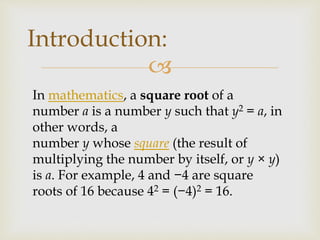
Introduction:
In mathematics, a square root of a
number a is a number y such that y2 = a, in
other words, a
number y whose square (the result of
multiplying the number by itself, or y × y)
is a. For example, 4 and −4 are square
roots of 16 because 42 = (−4)2 = 16.

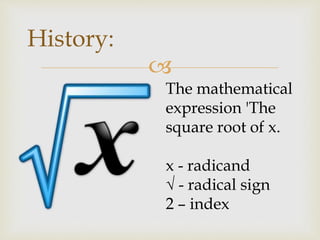
History:
The mathematical
expression 'The
square root of x.
x - radicand
√ - radical sign
2 – index

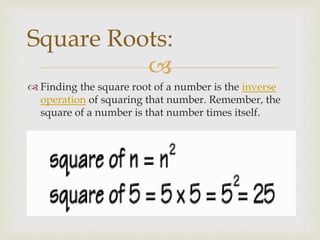
 Finding the square root of a number is the inverse
operation of squaring that number. Remember, the
square of a number is that number times itself.
Square Roots:

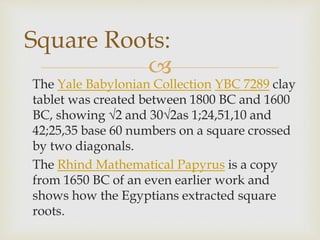
The Yale Babylonian Collection YBC 7289 clay
tablet was created between 1800 BC and 1600
BC, showing √2 and 30√2as 1;24,51,10 and
42;25,35 base 60 numbers on a square crossed
by two diagonals.
The Rhind Mathematical Papyrus is a copy
from 1650 BC of an even earlier work and
shows how the Egyptians extracted square
roots.
Square Roots:
In Ancient India, the knowledge of theoretical
and applied aspects of square and square root
was at least as old as theSulba Sutras, dated
around 800–500 BC (possibly much earlier).
A method for finding very good approximations
to the square roots of 2 and 3 are given in
the Baudhayana Sulba Sutra.[13] Aryabhata in
the Aryabhatiya(section 2.4), has given a method
for finding the square root of numbers having
many digits.
Square Roots:
In the Chinese mathematical work Writings on
Reckoning, written between 202 BC and 186 BC
during the early Han Dynasty, the square root
is approximated by using an "excess and
deficiency" method, which says to "...combine
the excess and deficiency as the divisor; (taking)
the deficiency numerator multiplied by the
excess denominator and the excess numerator
times the deficiency denominator, combine
them as the dividend."
Square Roots:

Mahāvīra, a 9th-century Indian
mathematician, was the first to state that
square roots of negative numbers do not
exist.
A symbol for square roots, written as an
elaborate R, was invented by
Regiomontanus (1436–1476). An R was also
used for Radix to indicate square roots in
Giralamo Cardano's Ars Magna.
Square Roots:

According to historian of mathematics D.E.
Smith, Aryabhata's method for finding the
square root was first introduced in Europe
by Cataneo in 1546.
The symbol '√' for the square root was first used
in print in 1525 in Christoph Rudolff's Coss,
which was also the first to use the then-new
signs '+' and '−'.
Square Roots:

Heron’s formula:
Geometric mean:
Cubic formula:
Finding the volume:
Quadratic formula:
Formulas involving radicals:

In geometry, Heron's formula (sometimes called Hero's
formula) is named after Hero of Alexandria[1] and states
that the area of a triangle whose sides have lengths a, b,
and c is,
where s is the semiperimeter of the triangle; that is,
Heron’s Formula:

In mathematics, the geometric mean is a type
of mean or average, which indicates the central
tendency or typical value of a set of numbers by
using the product of their values
Geometric Mean:

Cubic formula:

 The mathematics of pendulums are in general quite
complicated. Simplifying assumptions can be made,
which in the case of a simple pendulum allows the
equations of motion to be solved analytically for
small-angle oscillations.
Pendulum:

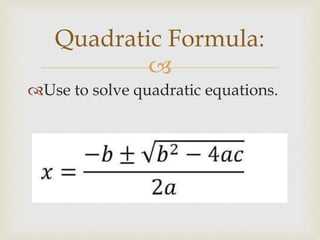
Use to solve quadratic equations.
Quadratic Formula:

RADICALS

  • 1.
    Presented By: Kimberly Talines SamSarmieto Justine Talbo Dale Kyle Sy Leenie Mae Tan Gerard Preciados
  • 2.
  • 3.
     Introduction: In mathematics, asquare root of a number a is a number y such that y2 = a, in other words, a number y whose square (the result of multiplying the number by itself, or y × y) is a. For example, 4 and −4 are square roots of 16 because 42 = (−4)2 = 16.
  • 4.
     History: The mathematical expression 'The squareroot of x. x - radicand √ - radical sign 2 – index
  • 5.
      Finding thesquare root of a number is the inverse operation of squaring that number. Remember, the square of a number is that number times itself. Square Roots:
  • 6.
     The Yale BabylonianCollection YBC 7289 clay tablet was created between 1800 BC and 1600 BC, showing √2 and 30√2as 1;24,51,10 and 42;25,35 base 60 numbers on a square crossed by two diagonals. The Rhind Mathematical Papyrus is a copy from 1650 BC of an even earlier work and shows how the Egyptians extracted square roots. Square Roots:
  • 7.
    In Ancient India,the knowledge of theoretical and applied aspects of square and square root was at least as old as theSulba Sutras, dated around 800–500 BC (possibly much earlier). A method for finding very good approximations to the square roots of 2 and 3 are given in the Baudhayana Sulba Sutra.[13] Aryabhata in the Aryabhatiya(section 2.4), has given a method for finding the square root of numbers having many digits. Square Roots:
  • 8.
    In the Chinesemathematical work Writings on Reckoning, written between 202 BC and 186 BC during the early Han Dynasty, the square root is approximated by using an "excess and deficiency" method, which says to "...combine the excess and deficiency as the divisor; (taking) the deficiency numerator multiplied by the excess denominator and the excess numerator times the deficiency denominator, combine them as the dividend." Square Roots:
  • 9.
     Mahāvīra, a 9th-centuryIndian mathematician, was the first to state that square roots of negative numbers do not exist. A symbol for square roots, written as an elaborate R, was invented by Regiomontanus (1436–1476). An R was also used for Radix to indicate square roots in Giralamo Cardano's Ars Magna. Square Roots:
  • 10.
     According to historianof mathematics D.E. Smith, Aryabhata's method for finding the square root was first introduced in Europe by Cataneo in 1546. The symbol '√' for the square root was first used in print in 1525 in Christoph Rudolff's Coss, which was also the first to use the then-new signs '+' and '−'. Square Roots:
  • 11.
     Heron’s formula: Geometric mean: Cubicformula: Finding the volume: Quadratic formula: Formulas involving radicals:
  • 12.
     In geometry, Heron'sformula (sometimes called Hero's formula) is named after Hero of Alexandria[1] and states that the area of a triangle whose sides have lengths a, b, and c is, where s is the semiperimeter of the triangle; that is, Heron’s Formula:
  • 13.
     In mathematics, thegeometric mean is a type of mean or average, which indicates the central tendency or typical value of a set of numbers by using the product of their values Geometric Mean:
  • 14.
  • 15.
      The mathematicsof pendulums are in general quite complicated. Simplifying assumptions can be made, which in the case of a simple pendulum allows the equations of motion to be solved analytically for small-angle oscillations. Pendulum:
  • 16.
     Use to solvequadratic equations. Quadratic Formula: