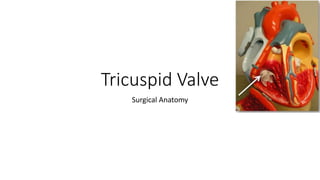
Tricuspid Valve 
Surgical Anatomy
Finger print 
• TV anatomy including the 
annulus, 3 leaflets (cusps), 
chordal apparatus, and papillary 
is unique for a particular person
Anatomy 
• The tricuspid valve (TV) has a 
saddle shape because of anterior 
and posterior high points and 
mid septal and lateral wall low 
points
Annnulus 
• Dynamic 
• Decreases both in circumference and area during ventricular 
contraction 
• on the clockface, the annulus contracts roughly from the 12:30 to the 
6 o'clock position
Valve leaflets/cusps 
• The valve is divided into what are called leaflets or cusps by 
"commissures 
• Three commissures 
• The anteroseptal separates the anterior and septal leaflets, the 
anteroposterior lies between the anterior and posterior leaflets, and 
the poster septal divides the posterior and septal leaflets 
• The free edge of the commissures forms a smooth arch although 
small projections, "miniscallops" or commissural cusps, may be 
present and are most frequently located between the anterior and 
posterior cusps
Chordae & Papillary muscles 
• The location of the anterior papillary muscle (APM) plays a key role 
• The angle (lateral tethering angle) between the plane of the TV 
leaflets and the chordae/APM at mid/end systole is approximately 
90º, allowing optimal coaptation between the valve leaflets
Tricuspid valve function 
• Coaptation of the TV leaflets is a dynamic, complex process involving the 
entire valve apparatus 
• Optimal Coaptation occurs when the annulus has an elliptical shape due to 
the limited mobility of the septal leaflet 
• Maintained by atrial, annular, and papillary muscle contraction, along with 
the ventricular septum bending toward the RV which decreases the 
annular diameter in the lateral direction 
• The TV is not designed to close a circular orifice 
• Circular geometry results in the septal leaflet being pulled away from the 
anterior/posterior leaflets resulting in valvar incompetence.
2D Echocardiographic of the tricuspid valve 
• Interrogated from all standard imaging planes (parasternal long axis, 
parasternal short axis, apical four chamber, subcostal) 
• Particular attention should be given to determining the annular 
diameter, leaflet mobility, anatomic leaflet abnormalities (leaflet 
tethering, prolapse, flail leaflet, chordal prolapse/rupture), valvar 
stenosis, degree of valvar insufficiency where the insufficiency jet/jets 
are coming through the valve, and the lateral tethering angle of the 
APM.
3DE 
• Parasternal long axis imaging plane with the sound beam directed toward 
the TV, (b) the parasternal short axis imaging plane at the level of the TV, 
(c) the apical four-chamber imaging plane, and (d) the subcostal sagittal 
imaging plane with the sound beam directed toward the TV. This is 
followed by 2D interrogation in the apical four-chamber imaging plane 
Bottom Panel] and 3D images are again obtained using Live 3D, 3D Zoom, 
or full volume acquisition. The 3D image is then cropped to just above the 
level of the TV annulus. The cropped image is then rotated (from the top of 
the image toward the bottom of the screen) along the X-axis until the TV is 
seen en face. The image is then rotated 180º along the Z-axis and the 
rotation is adjusted such that the plane of the septal leaflet lies along a line 
running from 9:00 o'clock to 6:00 o'clock when viewing the valve from the 
RA (surgeon's view).
• any of the imaging planes discussed above, the valve can be viewed 
from the right ventricular aspect by rotating the image 180º along the 
Y-axis; the plane of the septal leaflet is then oriented so that it lies 
along a line running from 3:00 o'clock to 6:00 o'clock. When using 
Live 3D acquisition, the valve will initially be seen on the half-edge 
and the interrogation beam will need to be steered using the 
Elevation Position and Lateral Position so that the entire valve can be 
seen en face.
Look into your own TV 
• 3 leaflets/cusps 
• Subdivided, accessory, and 
commissural cusps have been 
described and the number of cusps 
found in a normal "tricuspid" valve 
varies from 2 to 8 
• The anterior leaflet is generally the 
largest and the most mobile 
• The septal leaflet is generally the 
second largest and the least mobile 
• The posterior leaflet is typically 
triangular and is generally the 
smallest.
Papillary muscles and chordae tendineae 
• The number of papillary muscles varies considerably ranging from two to 
nine 
• The large anterior papillary muscle (APM) is attached to the RV anterior 
wall with chordae to the anterior/posterior cusps 
• The posterior papillary muscle consists of two or more parts attached to 
the inferior wall of the RV with chordae to the posterior/septal cusps 
• The septal papillary muscle, Lancisi's muscle, is a variable group of small 
papillary muscles attached to the ventricular septum with chordae to the 
anterior/septal cusps 
• Not all of the papillary muscles are always present, some are fused and the 
number of heads found on each muscle differs considerably.
Tricuspid valve function 
• Coaptation of the TV leaflets is a dynamic, complex process involving 
the entire valve apparatus 
• Optimal coaptation occurs when the annulus has an elliptical shape 
due to the limited mobility of the septal leaflet 
• This is maintained by atrial, annular, and papillary muscle 
contraction, along with the ventricular septum bending toward the 
RV which decreases the annular diameter in the lateral direction 
• The TV is not designed to close a circular orifice, circular geometry 
results in the septal leaflet being pulled away from the 
anterior/posterior leaflets resulting in valvar incompetence
3D ECHO 
• Look from RA/RV 
• Leaflet anatomy, 
• Identification of any clefts or indentations, and 
• The location of the coaptation defect
Surgical repair 
• Challenging 
• Unsatisfactory 
• Only after very careful planning
Thanks 
• Two Tricuspid valve anatomy is 
never same 
• The enormous variability in the 
anatomic description of the TV 
highlights the importance of a 
consistent and reproducible 
method of describing the valve 
• India’s First Mars Mission MOM 
Meets Mars on Sept. 23 or 24 of 
2014???

Tricuspid valve

  • 1.
  • 2.
    Finger print •TV anatomy including the annulus, 3 leaflets (cusps), chordal apparatus, and papillary is unique for a particular person
  • 3.
    Anatomy • Thetricuspid valve (TV) has a saddle shape because of anterior and posterior high points and mid septal and lateral wall low points
  • 4.
    Annnulus • Dynamic • Decreases both in circumference and area during ventricular contraction • on the clockface, the annulus contracts roughly from the 12:30 to the 6 o'clock position
  • 5.
    Valve leaflets/cusps •The valve is divided into what are called leaflets or cusps by "commissures • Three commissures • The anteroseptal separates the anterior and septal leaflets, the anteroposterior lies between the anterior and posterior leaflets, and the poster septal divides the posterior and septal leaflets • The free edge of the commissures forms a smooth arch although small projections, "miniscallops" or commissural cusps, may be present and are most frequently located between the anterior and posterior cusps
  • 6.
    Chordae & Papillarymuscles • The location of the anterior papillary muscle (APM) plays a key role • The angle (lateral tethering angle) between the plane of the TV leaflets and the chordae/APM at mid/end systole is approximately 90º, allowing optimal coaptation between the valve leaflets
  • 7.
    Tricuspid valve function • Coaptation of the TV leaflets is a dynamic, complex process involving the entire valve apparatus • Optimal Coaptation occurs when the annulus has an elliptical shape due to the limited mobility of the septal leaflet • Maintained by atrial, annular, and papillary muscle contraction, along with the ventricular septum bending toward the RV which decreases the annular diameter in the lateral direction • The TV is not designed to close a circular orifice • Circular geometry results in the septal leaflet being pulled away from the anterior/posterior leaflets resulting in valvar incompetence.
  • 8.
    2D Echocardiographic ofthe tricuspid valve • Interrogated from all standard imaging planes (parasternal long axis, parasternal short axis, apical four chamber, subcostal) • Particular attention should be given to determining the annular diameter, leaflet mobility, anatomic leaflet abnormalities (leaflet tethering, prolapse, flail leaflet, chordal prolapse/rupture), valvar stenosis, degree of valvar insufficiency where the insufficiency jet/jets are coming through the valve, and the lateral tethering angle of the APM.
  • 9.
    3DE • Parasternallong axis imaging plane with the sound beam directed toward the TV, (b) the parasternal short axis imaging plane at the level of the TV, (c) the apical four-chamber imaging plane, and (d) the subcostal sagittal imaging plane with the sound beam directed toward the TV. This is followed by 2D interrogation in the apical four-chamber imaging plane Bottom Panel] and 3D images are again obtained using Live 3D, 3D Zoom, or full volume acquisition. The 3D image is then cropped to just above the level of the TV annulus. The cropped image is then rotated (from the top of the image toward the bottom of the screen) along the X-axis until the TV is seen en face. The image is then rotated 180º along the Z-axis and the rotation is adjusted such that the plane of the septal leaflet lies along a line running from 9:00 o'clock to 6:00 o'clock when viewing the valve from the RA (surgeon's view).
  • 10.
    • any ofthe imaging planes discussed above, the valve can be viewed from the right ventricular aspect by rotating the image 180º along the Y-axis; the plane of the septal leaflet is then oriented so that it lies along a line running from 3:00 o'clock to 6:00 o'clock. When using Live 3D acquisition, the valve will initially be seen on the half-edge and the interrogation beam will need to be steered using the Elevation Position and Lateral Position so that the entire valve can be seen en face.
  • 11.
    Look into yourown TV • 3 leaflets/cusps • Subdivided, accessory, and commissural cusps have been described and the number of cusps found in a normal "tricuspid" valve varies from 2 to 8 • The anterior leaflet is generally the largest and the most mobile • The septal leaflet is generally the second largest and the least mobile • The posterior leaflet is typically triangular and is generally the smallest.
  • 12.
    Papillary muscles andchordae tendineae • The number of papillary muscles varies considerably ranging from two to nine • The large anterior papillary muscle (APM) is attached to the RV anterior wall with chordae to the anterior/posterior cusps • The posterior papillary muscle consists of two or more parts attached to the inferior wall of the RV with chordae to the posterior/septal cusps • The septal papillary muscle, Lancisi's muscle, is a variable group of small papillary muscles attached to the ventricular septum with chordae to the anterior/septal cusps • Not all of the papillary muscles are always present, some are fused and the number of heads found on each muscle differs considerably.
  • 13.
    Tricuspid valve function • Coaptation of the TV leaflets is a dynamic, complex process involving the entire valve apparatus • Optimal coaptation occurs when the annulus has an elliptical shape due to the limited mobility of the septal leaflet • This is maintained by atrial, annular, and papillary muscle contraction, along with the ventricular septum bending toward the RV which decreases the annular diameter in the lateral direction • The TV is not designed to close a circular orifice, circular geometry results in the septal leaflet being pulled away from the anterior/posterior leaflets resulting in valvar incompetence
  • 14.
    3D ECHO •Look from RA/RV • Leaflet anatomy, • Identification of any clefts or indentations, and • The location of the coaptation defect
  • 15.
    Surgical repair •Challenging • Unsatisfactory • Only after very careful planning
  • 16.
    Thanks • TwoTricuspid valve anatomy is never same • The enormous variability in the anatomic description of the TV highlights the importance of a consistent and reproducible method of describing the valve • India’s First Mars Mission MOM Meets Mars on Sept. 23 or 24 of 2014???