Z
Week7:
Trends in Database
Management
Subject Code: COMP131
By: Marlon Jamera
Email: mbjamera@ama.edu.ph
Z
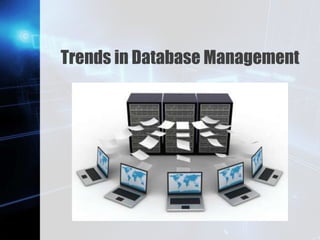
Trends in Database Management
Z
Review: Basic Concept
of Database
• A collection of raw facts and figures and
raw material that can be processed by any
computing machine.
a. Data
b. Information
c. Database
d. DBMS
Z
Review: Basic Concept
of Database
• Systematic and meaningful form of data;
knowledge acquired through study or
experience.
a. Data
b. Information
c. Database
d. DBMS
Z
Review: Basic Concept
of Database
• An organized collection of related
information so that it can easily be
accessed, managed and updated.
a. Data
b. Information
c. Database
d. DBMS
Z
Review: Basic Concept
of Database
• Describes structure of the database and
aim is to support the development of
information systems by providing the
definition and format of data.
a. Data Model
b. Representation Model
c. Hierarchical Database Model
d. Relational Database Model
Z
Review: Basic Concept
of Database
• Describes structure of the database and
aim is to support the development of
information systems by providing the
definition and format of data.
a. Data Model
b. Representation Model
c. Hierarchical Database Model
d. Relational Database Model
Z
Scope of the Lesson
• Trends in Database Management
• Operational Database
• Analytical Database
• Data Warehouse
• Distributed Database
Z
Learning Outcomes
By the end of the lesson, you will be
familiar with the current trends in the database.
• Define and explain perception of the
operational database.
• Identify and compare the dynamics of the
analytical database.
• Describe the features and the aim of the data
warehouse.
• Discuss thoroughly the distributed database.
Z
Operational Database
• Operational Database: used to manage
dynamic data in real time.
• Used to store, manage and track real time
business information.
• Stores information about the activities of an
organization.
• E.g. Customer relationship management or
financial operation.
Z
Operational Database
• Operational Database: Example
• A company might have an operational
database used to track stock quantities.
• As customers order product from an online
store, an operational database can be used to
keep track of how many items have been sold
and when the company will need to reorder
stocks.
Z
Operational Database
• Operational Database: Example
• For a bank, the operational database processes
checks and deposits, maintains balances and
creates the monthly statements.
• For a telephone company, the operational
database keeps track of the telephone calls
made and arranges the billing for them.
Z
Analytical Database
• Analytical Database: specifically designed to
support business intelligence (BI) and analytic
applications, typically as part of data
warehouse or data mart.
• It is a read – only system that stores historical
data on business metrics such as sales
performance and inventory levels.
Z
Types of Analytic Database
• Columnar Database: organize data by column
instead of rows – thus reducing the number of
data elements that typically have to be ready by
the database engine while processing queries.
• Data Warehouse Appliances: combine the
databases with hardware and BI tools in an
intelligent platform that’s turned for analytical
workloads and designed to be easy to install
and operate.
Z
Types of Analytic Database
• In Memory Databases: which load the source
data into system memory in a compressed, non-
relational format in an attempt to streamline the
work involved in processing queries.
• MMP Databases: Massively Parallel
Processing.
• This spread data across a cluster of servers,
enabling the systems to share the query
processing workloads.
Z
Types of Analytic Database
• OLAP Databases: Online Analytical
Processing.
• Which store multidimensional “cubes” of
aggregated data for analyzing information
based on multiple data attributes.
Z
Data Warehouse
• Data Warehouse: a system used for reporting
and data analysis.
• Central repositories of integrated data from
one or more disparate resources.
• It stores current and historical data and are
used for creating analytical reports for
knowledge workers through the enterprise.
Z
Data Warehouse
• Data Warehouse: Example
• Reports could range from annual and
quarterly comparisons and trends to detailed
daily sales analyses.
• Video Presentation
Z
Evolution in Organization Use
• Offline Operational Data Warehouse: Data
warehouse in this stage of evolution are
updated in a regular time cycle (usually daily,
weekly or monthly) from the operational
systems and the data is stored in an integrated
reporting – oriented data.
• Offline Data Warehouse: Data warehouse in
this stage are updated from data in the
operational systems on a regular basis.
Z
Evolution in Organization Use
• On Time Data Warehouse: represent the real
time data warehouses stage data in the
warehouse is updated for every transaction
performed on the source data.
• Integrated Data Warehouse: this data
warehouses assemble data from different areas
of business, so users can look up the
information they need across other systems.
Z
Distributed Database
• Distributed Database: is a database in which
portions of the database are stored on multiple
computers within a network.
• Users have access to the portion of the
database at their location so that they can
access the data relevant to their tasks without
interfering with the work of others.
• DDBMS: manages the database as if it were
all stored on the same computer.
Z
Distributed Database
•DDBMS: synchronizes all the data
periodically and in cases where multiple users
must access the same data, it ensures that
updates and deletes performed on the data in
one location will be automatically reflected in
the data stored elsewhere.
• E.g. Cloud Computing Services.
• Video Presentation
Z
Let’s call it a day,
Thank you!

Trends in Database Management

  • 1.
    Z Week7: Trends in Database Management SubjectCode: COMP131 By: Marlon Jamera Email: mbjamera@ama.edu.ph
  • 2.
  • 3.
    Z Review: Basic Concept ofDatabase • A collection of raw facts and figures and raw material that can be processed by any computing machine. a. Data b. Information c. Database d. DBMS
  • 4.
    Z Review: Basic Concept ofDatabase • Systematic and meaningful form of data; knowledge acquired through study or experience. a. Data b. Information c. Database d. DBMS
  • 5.
    Z Review: Basic Concept ofDatabase • An organized collection of related information so that it can easily be accessed, managed and updated. a. Data b. Information c. Database d. DBMS
  • 6.
    Z Review: Basic Concept ofDatabase • Describes structure of the database and aim is to support the development of information systems by providing the definition and format of data. a. Data Model b. Representation Model c. Hierarchical Database Model d. Relational Database Model
  • 7.
    Z Review: Basic Concept ofDatabase • Describes structure of the database and aim is to support the development of information systems by providing the definition and format of data. a. Data Model b. Representation Model c. Hierarchical Database Model d. Relational Database Model
  • 8.
    Z Scope of theLesson • Trends in Database Management • Operational Database • Analytical Database • Data Warehouse • Distributed Database
  • 9.
    Z Learning Outcomes By theend of the lesson, you will be familiar with the current trends in the database. • Define and explain perception of the operational database. • Identify and compare the dynamics of the analytical database. • Describe the features and the aim of the data warehouse. • Discuss thoroughly the distributed database.
  • 10.
    Z Operational Database • OperationalDatabase: used to manage dynamic data in real time. • Used to store, manage and track real time business information. • Stores information about the activities of an organization. • E.g. Customer relationship management or financial operation.
  • 11.
    Z Operational Database • OperationalDatabase: Example • A company might have an operational database used to track stock quantities. • As customers order product from an online store, an operational database can be used to keep track of how many items have been sold and when the company will need to reorder stocks.
  • 12.
    Z Operational Database • OperationalDatabase: Example • For a bank, the operational database processes checks and deposits, maintains balances and creates the monthly statements. • For a telephone company, the operational database keeps track of the telephone calls made and arranges the billing for them.
  • 13.
    Z Analytical Database • AnalyticalDatabase: specifically designed to support business intelligence (BI) and analytic applications, typically as part of data warehouse or data mart. • It is a read – only system that stores historical data on business metrics such as sales performance and inventory levels.
  • 14.
    Z Types of AnalyticDatabase • Columnar Database: organize data by column instead of rows – thus reducing the number of data elements that typically have to be ready by the database engine while processing queries. • Data Warehouse Appliances: combine the databases with hardware and BI tools in an intelligent platform that’s turned for analytical workloads and designed to be easy to install and operate.
  • 15.
    Z Types of AnalyticDatabase • In Memory Databases: which load the source data into system memory in a compressed, non- relational format in an attempt to streamline the work involved in processing queries. • MMP Databases: Massively Parallel Processing. • This spread data across a cluster of servers, enabling the systems to share the query processing workloads.
  • 16.
    Z Types of AnalyticDatabase • OLAP Databases: Online Analytical Processing. • Which store multidimensional “cubes” of aggregated data for analyzing information based on multiple data attributes.
  • 17.
    Z Data Warehouse • DataWarehouse: a system used for reporting and data analysis. • Central repositories of integrated data from one or more disparate resources. • It stores current and historical data and are used for creating analytical reports for knowledge workers through the enterprise.
  • 18.
    Z Data Warehouse • DataWarehouse: Example • Reports could range from annual and quarterly comparisons and trends to detailed daily sales analyses. • Video Presentation
  • 19.
    Z Evolution in OrganizationUse • Offline Operational Data Warehouse: Data warehouse in this stage of evolution are updated in a regular time cycle (usually daily, weekly or monthly) from the operational systems and the data is stored in an integrated reporting – oriented data. • Offline Data Warehouse: Data warehouse in this stage are updated from data in the operational systems on a regular basis.
  • 20.
    Z Evolution in OrganizationUse • On Time Data Warehouse: represent the real time data warehouses stage data in the warehouse is updated for every transaction performed on the source data. • Integrated Data Warehouse: this data warehouses assemble data from different areas of business, so users can look up the information they need across other systems.
  • 21.
    Z Distributed Database • DistributedDatabase: is a database in which portions of the database are stored on multiple computers within a network. • Users have access to the portion of the database at their location so that they can access the data relevant to their tasks without interfering with the work of others. • DDBMS: manages the database as if it were all stored on the same computer.
  • 22.
    Z Distributed Database •DDBMS: synchronizesall the data periodically and in cases where multiple users must access the same data, it ensures that updates and deletes performed on the data in one location will be automatically reflected in the data stored elsewhere. • E.g. Cloud Computing Services. • Video Presentation
  • 23.
    Z Let’s call ita day, Thank you!

Editor's Notes

  • #19 https://youtu.be/l74BAViTVns
  • #23 https://youtu.be/QJncFirhjPg
  • #24 https://youtu.be/FR4QIeZaPeM