WORKING WITH DATA
DATABASE
A database is a collection of information
that is organized so that it can easily be
accessed, managed, and updated. In one
view, databases can be classified according
to types of content: bibliographic, full-text,
numeric, and images.
DATABASE
In computing, databases are sometimes classified according to
their organizational approach. The most prevalent approach is
the relational database, a tabular database in which data is
defined so that it can be reorganized and accessed in a
number of different ways. A distributed database is one that
can be dispersed or replicated among different points in a
network. An object-oriented programming database is one
that is congruent with the data defined in object classes and
subclasses.
DATABASE
Traditional databases are organized by fields,
records, and files. A field is a single piece of
information; a record is one complete set of fields;
and a file is a collection of records. For example, a
telephone book is analogous to a file. It contains a
list of records, each of which consists of three
fields: name, address, and telephone number.
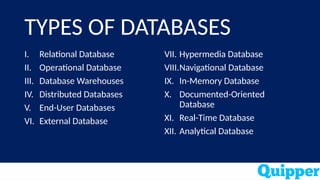
TYPES OF DATABASES
I. Relational Database
II. Operational Database
III. Database Warehouses
IV. Distributed Databases
V. End-User Databases
VI. External Database
VII. Hypermedia Database
VIII.Navigational Database
IX. In-Memory Database
X. Documented-Oriented
Database
XI. Real-Time Database
XII. Analytical Database
RELATIONAL DATABASE
This is the most common of all the different types of
databases. The data in a relational database is stored in
various data tables. Each table has a key field which is used to
connect it to other tables. Hence, all the tables are related to
each other through several key fields.
Examples of relational databases are Oracle, Sybase and
Microsoft SQL Server and they are often key parts of the
process of software development.
OPERATIONAL DATABASES
An organization generates a huge amount of data. Such as inventory
management, purchases, transactions and financials. All this data is
collected in a database which is often known by several names such as
operational/ production database, subject-area database (SADB) or
transaction databases. An operational database is usually important to
organization as they include the customer database, personal database
and inventory database, the details of how much of a product the
company has as well as information on the customers who buy them.
DATABASE WAREHOUSES
Organizations are required to keep all relevant data for several years.
This data is also an important source of information for analyzing and
comparing the current year data with that of the past years which also
makes it easy to determine key trends taking place. All these data from
previous years are stored in a database warehouse. Since the data
stored has gone through all kinds of screening, editing and integration
it does not need any further editing or alteration.
With this database ensure that the Software Requirements
Specification (SRS) is formally approved as part of the project quality
plan.
DISTIRBUTED DATABASE
Many organizations have several office locations,
manufacturing plants, regional offices, branch offices
and a head office at different geographic locations.
Each of these work groups may have their own
database which together will form the main database
of the company.
END-USER DATABASES
There is a variety of data available at the workstation of all the
end users of any organization. Each workstation is like a small
database in itself which includes data in spreadsheet,
presentations, word files, note pads and downloaded files. All
such small databases form a different type of database called
the end-user database.
EXTERNAL DATABASE
There is a lot of information available in outside world
which is required by an organization. They are
privately-owned data for which one can have
conditional and limited access for a fortune. This data is
meant for commercial usage. All such databases
outside the organization which are of use and limited
access are together called external database.
HYPERMEDIA DATABASE
Most websites have various interconnected multimedia pages
which might include text, video clips, audio clips, photographs
and graphics. These all need to be stored and “called” from
somewhere when the webpage is created. All of them
together form the hypermedia database.
If you are creating such a database from scratch, to be
generous when creating a project plan, detailed when defining
the Business Requirements Documentation (BRD) in your
project cost controls.
NAVIGATIONAL DATABASE
Navigational database has all the items which are
references from other objects. In this, one has to
navigate from one reference to another or one object
to another. It might be using modern systems like
XPath. One of its applications is the air flight
management systems.
IN-MEMORY DATABASE
Stores data in a computer’s main memory
instead of using a disk-based storage system.
It is faster and more reliable than that in a
disk. They find their application in
telecommunications network equipment.
DOCUMENTED-ORIENTED DATABASE
Type of database which is used in
applications which are document oriented.
The data is stored in the form of text records
instead of being stored in a data table as
usually happens.
REAL-TIME DATABASE
Handles data which constantly keep on changing. An example
of this is a stock market database where the value of shares
change every minute and need to be updated in the real-time
database. This type of database is also used in medical and
scientific analysis, banking, accounting, process control,
reservation systems etc. Essentially, anything which requires
access to fast moving and constantly changing information.
ANALYTICAL DATABASE
Is used to store information from different types of databases
such as selected operational databases and external
databases. Other names given to analytical databases are
information databases, management databases or multi-
dimensional databases. The data stored in an analytical
database is used by the management for analysis purposes,
hence the name. The data in an analytical database cannot be
changed or manipulated.

WORKING WITH DATA.pptx WORKING WITH DATA.pptx

  • 1.
  • 2.
    DATABASE A database isa collection of information that is organized so that it can easily be accessed, managed, and updated. In one view, databases can be classified according to types of content: bibliographic, full-text, numeric, and images.
  • 3.
    DATABASE In computing, databasesare sometimes classified according to their organizational approach. The most prevalent approach is the relational database, a tabular database in which data is defined so that it can be reorganized and accessed in a number of different ways. A distributed database is one that can be dispersed or replicated among different points in a network. An object-oriented programming database is one that is congruent with the data defined in object classes and subclasses.
  • 4.
    DATABASE Traditional databases areorganized by fields, records, and files. A field is a single piece of information; a record is one complete set of fields; and a file is a collection of records. For example, a telephone book is analogous to a file. It contains a list of records, each of which consists of three fields: name, address, and telephone number.
  • 5.
    TYPES OF DATABASES I.Relational Database II. Operational Database III. Database Warehouses IV. Distributed Databases V. End-User Databases VI. External Database VII. Hypermedia Database VIII.Navigational Database IX. In-Memory Database X. Documented-Oriented Database XI. Real-Time Database XII. Analytical Database
  • 6.
    RELATIONAL DATABASE This isthe most common of all the different types of databases. The data in a relational database is stored in various data tables. Each table has a key field which is used to connect it to other tables. Hence, all the tables are related to each other through several key fields. Examples of relational databases are Oracle, Sybase and Microsoft SQL Server and they are often key parts of the process of software development.
  • 7.
    OPERATIONAL DATABASES An organizationgenerates a huge amount of data. Such as inventory management, purchases, transactions and financials. All this data is collected in a database which is often known by several names such as operational/ production database, subject-area database (SADB) or transaction databases. An operational database is usually important to organization as they include the customer database, personal database and inventory database, the details of how much of a product the company has as well as information on the customers who buy them.
  • 8.
    DATABASE WAREHOUSES Organizations arerequired to keep all relevant data for several years. This data is also an important source of information for analyzing and comparing the current year data with that of the past years which also makes it easy to determine key trends taking place. All these data from previous years are stored in a database warehouse. Since the data stored has gone through all kinds of screening, editing and integration it does not need any further editing or alteration. With this database ensure that the Software Requirements Specification (SRS) is formally approved as part of the project quality plan.
  • 9.
    DISTIRBUTED DATABASE Many organizationshave several office locations, manufacturing plants, regional offices, branch offices and a head office at different geographic locations. Each of these work groups may have their own database which together will form the main database of the company.
  • 10.
    END-USER DATABASES There isa variety of data available at the workstation of all the end users of any organization. Each workstation is like a small database in itself which includes data in spreadsheet, presentations, word files, note pads and downloaded files. All such small databases form a different type of database called the end-user database.
  • 11.
    EXTERNAL DATABASE There isa lot of information available in outside world which is required by an organization. They are privately-owned data for which one can have conditional and limited access for a fortune. This data is meant for commercial usage. All such databases outside the organization which are of use and limited access are together called external database.
  • 12.
    HYPERMEDIA DATABASE Most websiteshave various interconnected multimedia pages which might include text, video clips, audio clips, photographs and graphics. These all need to be stored and “called” from somewhere when the webpage is created. All of them together form the hypermedia database. If you are creating such a database from scratch, to be generous when creating a project plan, detailed when defining the Business Requirements Documentation (BRD) in your project cost controls.
  • 13.
    NAVIGATIONAL DATABASE Navigational databasehas all the items which are references from other objects. In this, one has to navigate from one reference to another or one object to another. It might be using modern systems like XPath. One of its applications is the air flight management systems.
  • 14.
    IN-MEMORY DATABASE Stores datain a computer’s main memory instead of using a disk-based storage system. It is faster and more reliable than that in a disk. They find their application in telecommunications network equipment.
  • 15.
    DOCUMENTED-ORIENTED DATABASE Type ofdatabase which is used in applications which are document oriented. The data is stored in the form of text records instead of being stored in a data table as usually happens.
  • 16.
    REAL-TIME DATABASE Handles datawhich constantly keep on changing. An example of this is a stock market database where the value of shares change every minute and need to be updated in the real-time database. This type of database is also used in medical and scientific analysis, banking, accounting, process control, reservation systems etc. Essentially, anything which requires access to fast moving and constantly changing information.
  • 17.
    ANALYTICAL DATABASE Is usedto store information from different types of databases such as selected operational databases and external databases. Other names given to analytical databases are information databases, management databases or multi- dimensional databases. The data stored in an analytical database is used by the management for analysis purposes, hence the name. The data in an analytical database cannot be changed or manipulated.